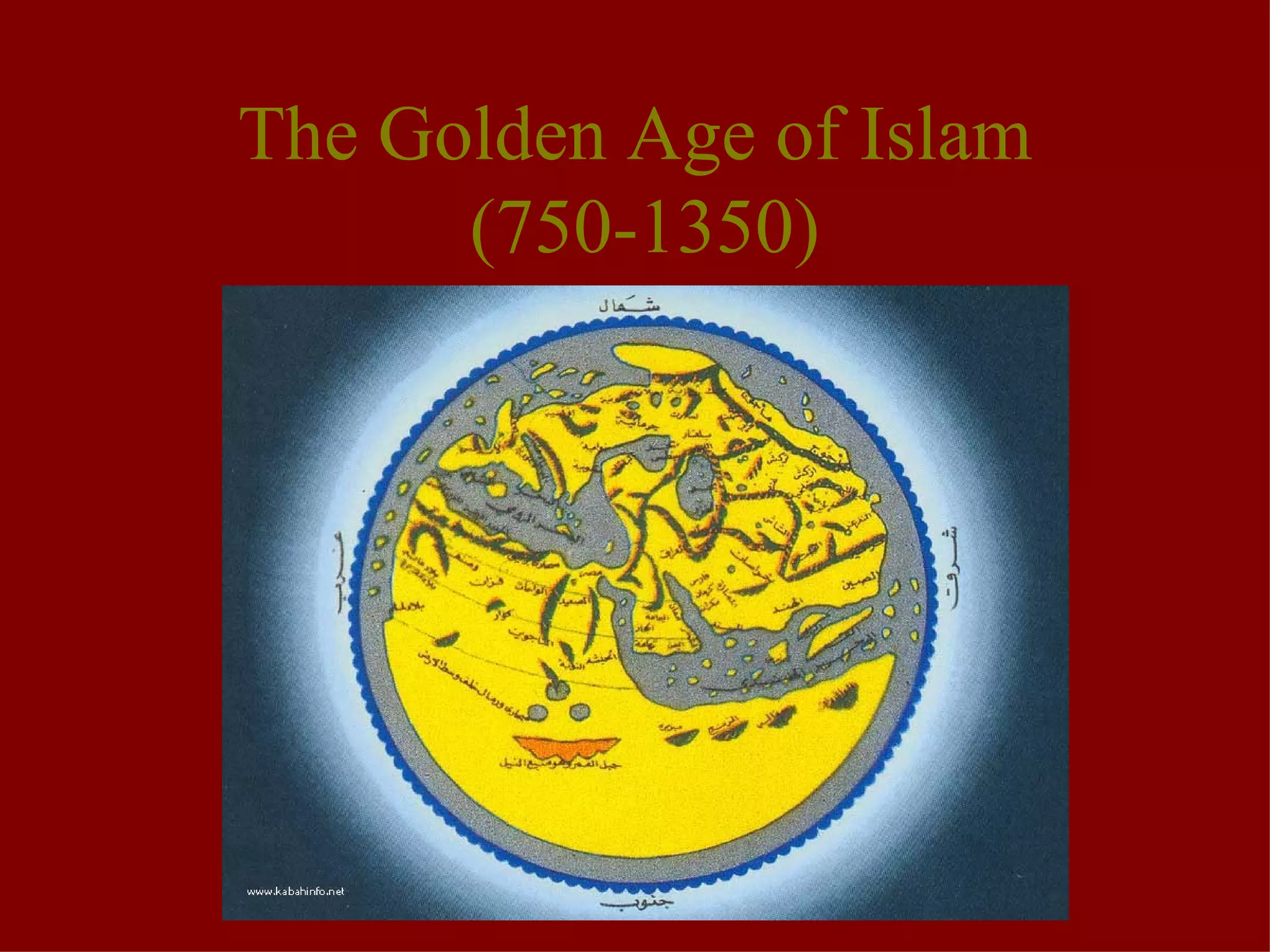
The Golden Age of Islam  (750-1350)
The Golden Age of Islam included advances in international trade manufacturing agriculture art architecture  literature mathematics astronomy medicine
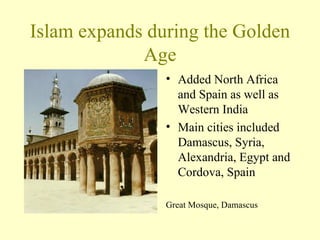
Islam expands during the Golden Age Added North Africa and Spain as well as Western India Main cities included Damascus, Syria, Alexandria, Egypt and Cordova, Spain Great Mosque, Damascus
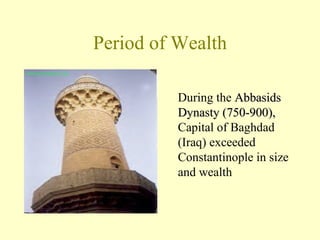
Period of Wealth During the  Abbasids Dynasty (750-900),  Capital of Baghdad (Iraq) exceeded Constantinople in size and wealth
Reasons for Islamic Success Islam unified the tribes of Arabia Religious zeal inspired Arab armies Allowed some religious freedom to Christians and Jews Honored merchants
More Reasons for Arab Success Byzantine and Persian Empires were weak Islam was attractive to the conquered easy to become Muslim preaches equality (people could move up in society)
Art The golden age of Islamic (and/or Muslim) art lasted from 750 to the 16th century, when ceramics, glass, metalwork, textiles, and woodwork flourished.  Lusterous glazing became the greatest Islamic contribution to ceramics.  Calligraphy, an essential aspect of written Arabic, developed in manuscripts and architectural decoration.
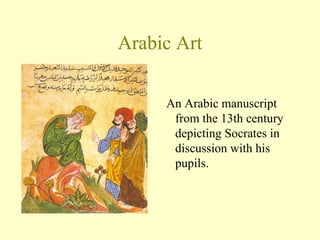
Arabic Art An Arabic manuscript from the 13th century depicting Socrates in discussion with his pupils.
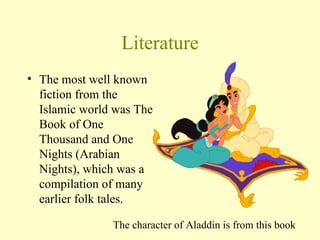
Literature The most well known fiction from the Islamic world was The Book of One Thousand and One Nights (Arabian Nights), which was a compilation of many earlier folk tales.  The character of Aladdin is from this book
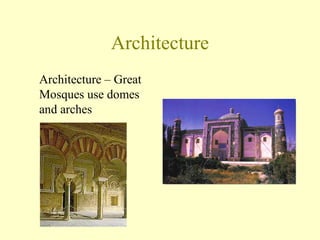
Architecture Architecture – Great Mosques use domes and arches
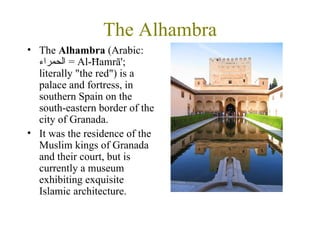
The Alhambra The  Alhambra  (Arabic:  الحمراء   = Al-Ħamrā'; literally "the red") is a palace and fortress, in southern Spain on the south-eastern border of the city of Granada.  It was the residence of the Muslim kings of Granada and their court, but is currently a museum exhibiting exquisite Islamic architecture.
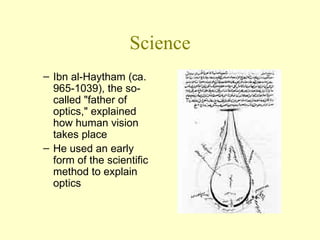
Science Ibn al-Haytham (ca. 965-1039), the so-called "father of optics," explained how human vision takes place  He used an early form of the scientific method to explain optics
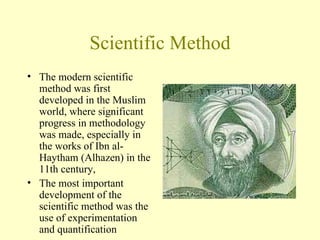
Scientific Method The modern scientific method was first developed in the Muslim world, where significant progress in methodology was made, especially in the works of Ibn al-Haytham (Alhazen) in the 11th century,  The most important development of the scientific method was the use of experimentation and quantification
Scientific Advances Many other advances were made by Muslim scientists in biology (botany, evolution, and zoology), mathematics (algebra, arithmetic, calculus, geometry, number theory, and trigonometry), chemistry, the earth sciences (anthropology, cartography, geography, and geology), physics (astrophysics, optics, mechanics, and motion), psychology (experimental psychology, psychiatry, psychophysics, and psychotherapy), and the social sciences (demography, economics, history and historiography, and sociology).
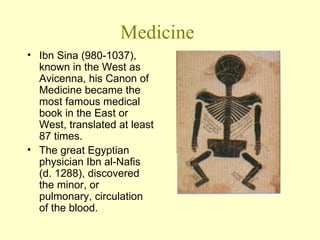
Medicine Ibn Sina (980-1037), known in the West as Avicenna, his Canon of Medicine became the most famous medical book in the East or West, translated at least 87 times. The great Egyptian physician Ibn al-Nafis (d. 1288), discovered the minor, or pulmonary, circulation of the blood.
Medicine The Arabs invented the hospital
Math Muhammad ibn Musa al-Khwarizmi (ca. 800-ca. 847) principally responsible for the diffusion of the Indian system of numeration (Arabic numerals) in the Islamic lands and the West.  Introduced algebra
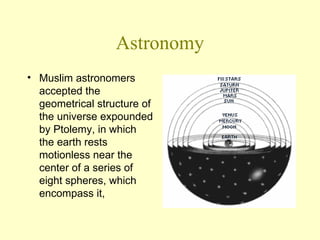
Astronomy Muslim astronomers accepted the geometrical structure of the universe expounded by Ptolemy, in which the earth rests motionless near the center of a series of eight spheres, which encompass it,

Islamgoldenages4

  • 1.
    The Golden Ageof Islam (750-1350)
  • 2.
    The Golden Ageof Islam included advances in international trade manufacturing agriculture art architecture literature mathematics astronomy medicine
  • 3.
    Islam expands duringthe Golden Age Added North Africa and Spain as well as Western India Main cities included Damascus, Syria, Alexandria, Egypt and Cordova, Spain Great Mosque, Damascus
  • 4.
    Period of WealthDuring the Abbasids Dynasty (750-900), Capital of Baghdad (Iraq) exceeded Constantinople in size and wealth
  • 5.
    Reasons for IslamicSuccess Islam unified the tribes of Arabia Religious zeal inspired Arab armies Allowed some religious freedom to Christians and Jews Honored merchants
  • 6.
    More Reasons forArab Success Byzantine and Persian Empires were weak Islam was attractive to the conquered easy to become Muslim preaches equality (people could move up in society)
  • 7.
    Art The goldenage of Islamic (and/or Muslim) art lasted from 750 to the 16th century, when ceramics, glass, metalwork, textiles, and woodwork flourished. Lusterous glazing became the greatest Islamic contribution to ceramics. Calligraphy, an essential aspect of written Arabic, developed in manuscripts and architectural decoration.
  • 8.
    Arabic Art AnArabic manuscript from the 13th century depicting Socrates in discussion with his pupils.
  • 9.
    Literature The mostwell known fiction from the Islamic world was The Book of One Thousand and One Nights (Arabian Nights), which was a compilation of many earlier folk tales. The character of Aladdin is from this book
  • 10.
    Architecture Architecture –Great Mosques use domes and arches
  • 11.
    The Alhambra The Alhambra (Arabic: الحمراء = Al-Ħamrā'; literally "the red") is a palace and fortress, in southern Spain on the south-eastern border of the city of Granada. It was the residence of the Muslim kings of Granada and their court, but is currently a museum exhibiting exquisite Islamic architecture.
  • 12.
    Science Ibn al-Haytham(ca. 965-1039), the so-called "father of optics," explained how human vision takes place He used an early form of the scientific method to explain optics
  • 13.
    Scientific Method Themodern scientific method was first developed in the Muslim world, where significant progress in methodology was made, especially in the works of Ibn al-Haytham (Alhazen) in the 11th century, The most important development of the scientific method was the use of experimentation and quantification
  • 14.
    Scientific Advances Manyother advances were made by Muslim scientists in biology (botany, evolution, and zoology), mathematics (algebra, arithmetic, calculus, geometry, number theory, and trigonometry), chemistry, the earth sciences (anthropology, cartography, geography, and geology), physics (astrophysics, optics, mechanics, and motion), psychology (experimental psychology, psychiatry, psychophysics, and psychotherapy), and the social sciences (demography, economics, history and historiography, and sociology).
  • 15.
    Medicine Ibn Sina(980-1037), known in the West as Avicenna, his Canon of Medicine became the most famous medical book in the East or West, translated at least 87 times. The great Egyptian physician Ibn al-Nafis (d. 1288), discovered the minor, or pulmonary, circulation of the blood.
  • 16.
    Medicine The Arabsinvented the hospital
  • 17.
    Math Muhammad ibnMusa al-Khwarizmi (ca. 800-ca. 847) principally responsible for the diffusion of the Indian system of numeration (Arabic numerals) in the Islamic lands and the West. Introduced algebra
  • 18.
    Astronomy Muslim astronomersaccepted the geometrical structure of the universe expounded by Ptolemy, in which the earth rests motionless near the center of a series of eight spheres, which encompass it,