Technical Seminar
on
“Cloud Computing Security Issues in Infrastructure
as a Service”
By
Vivek Kumar Maurya (1JB10IS115)
Under the Guidance of
Asst. Prof Kiran Kumar V, Designation, Dept of ISE
Department of Information Science and
Engineering
CONTENTS
Abstract
Introduction
Literature Survey
Results
Conclusion
References
Abstract
 This paper presents an elaborated study of IaaS
components security and determines its drawbacks and
its countermeasures.
Cloud Infrastructure as a Service (IaaS) helps agencies
realize cost savings and efficiencies while modernizing
and expanding their IT capabilities.
Cloud-based infrastructure is rapidly scalable, secure, and
accessible over the Internet — you only pay for what you
use.
 Infrastructure as a Service (IaaS) serves as the foundation
layer for the other delivery models, and a lack of security
in this layer will certainly affect the other delivery models.
Introduction
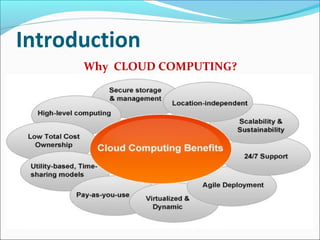
Why CLOUD COMPUTING?
“In simple words, the Cloud refers to the process
of sharing resources (such as hardware,
development platforms and/or software) over the
internet. It enables On-Demand network access.
These resources are accessed mostly on a pay-per-
use or subscription basis.”
 Cloud computing is a technology that uses the
internet and central remote servers to maintain data
and applications.
Cloud computing is much more efficient computing
by centralizing storage, memory, and processing .
Data isn’t “chained” to one place; rather, it can be
accessed anywhere, from any medium.
Processor speed becomes less important then
internet connection speed.
Low maintenance.
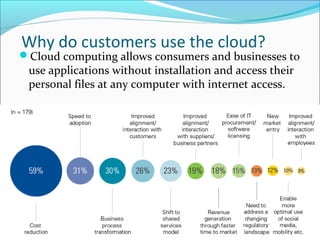
Why do customers use the cloud?
Cloud computing allows consumers and businesses to
use applications without installation and access their
personal files at any computer with internet access.
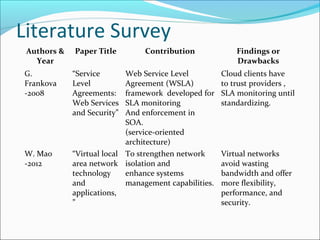
Literature Survey
Authors &
Year
Paper Title Contribution Findings or
Drawbacks
G.
Frankova
-2008
“Service
Level
Agreements:
Web Services
and Security”
Web Service Level
Agreement (WSLA)
framework developed for
SLA monitoring
And enforcement in
SOA.
(service-oriented
architecture)
Cloud clients have
to trust providers ,
SLA monitoring until
standardizing.
W. Mao
-2012
“Virtual local
area network
technology
and
applications,
”
To strengthen network
isolation and
enhance systems
management capabilities.
Virtual networks
avoid wasting
bandwidth and offer
more flexibility,
performance, and
security.
Cloud Delivery Models
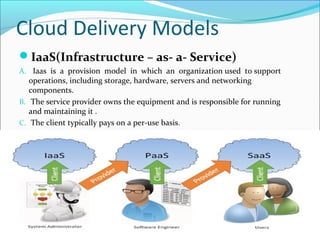
IaaS(Infrastructure – as- a- Service)
A. Iaas is a provision model in which an organization used to support
operations, including storage, hardware, servers and networking
components.
B. The service provider owns the equipment and is responsible for running
and maintaining it .
C. The client typically pays on a per-use basis.
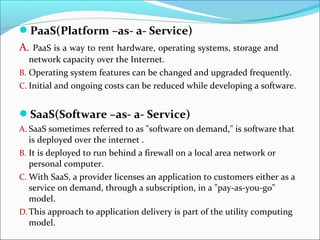
PaaS(Platform –as- a- Service)
A. PaaS is a way to rent hardware, operating systems, storage and
network capacity over the Internet.
B. Operating system features can be changed and upgraded frequently.
C. Initial and ongoing costs can be reduced while developing a software.
SaaS(Software –as- a- Service)
A. SaaS sometimes referred to as "software on demand," is software that
is deployed over the internet .
B. It is deployed to run behind a firewall on a local area network or
personal computer.
C. With SaaS, a provider licenses an application to customers either as a
service on demand, through a subscription, in a "pay-as-you-go"
model.
D.This approach to application delivery is part of the utility computing
model.
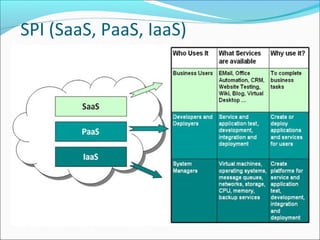
SPI (SaaS, PaaS, IaaS)
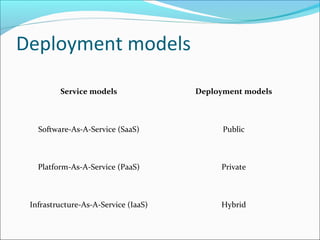
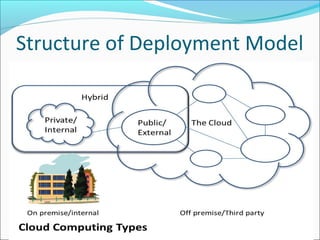
Deployment models
Service models Deployment models
Software-As-A-Service (SaaS) Public
Platform-As-A-Service (PaaS) Private
Infrastructure-As-A-Service (IaaS) Hybrid
Structure of Deployment Model
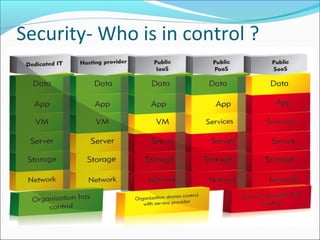
Security- Who is in control ?
Understanding Security of Cloud
Security in cloud computing is a major concern. Data in
cloud should be stored in encrypted form.
Since all the data is transferred using Internet, data
security is of major concern in cloud. Here are key
mechanisms for protecting data mechanisms listed below:
Integrity
Accountability
Privacy
Access Control
Authentication
Authorization
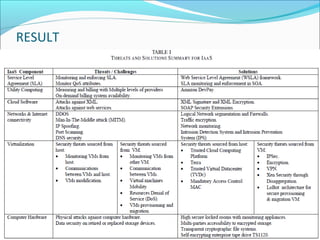
RESULT
Conclusion
Each component in Cloud infrastructure has its
drawbacks which might impact the whole Cloud’s
Computing security.
Cloud is a tradeoff between cost, security and privacy.
Change in trust boundaries leads to security and
privacy challenges.
References
1. Pankaj Arora and Rubal Chaudhry Wadhawan ,”Cloud Computing
Security Issues in Infrastructure as a Service ”, Volume 2, Issue 1, January
2012
2. G. Frankova, Service Level Agreements: Web Services and Security, ser.
Lecture Notes in Computer Science. Berlin, Heidelberg: Springer Berlin
Heidelberg, 2007, vol. 4607.
3. S. Garg and H. Saran, “Anti-DDoS Virtualized Operating System,” ARES,
p. 7, 2008.
4. V. Rajaravivarma, “Virtual local area network technology and
applications,” Proceedings The Twenty-Ninth Southeastern Symposium
on System Theory, pp. 49–52, 1997.
Cloud Computing Security Issues in Infrastructure as a Service”

Cloud Computing Security Issues in Infrastructure as a Service”

  • 1.
    Technical Seminar on “Cloud ComputingSecurity Issues in Infrastructure as a Service” By Vivek Kumar Maurya (1JB10IS115) Under the Guidance of Asst. Prof Kiran Kumar V, Designation, Dept of ISE Department of Information Science and Engineering
  • 2.
  • 3.
    Abstract  This paperpresents an elaborated study of IaaS components security and determines its drawbacks and its countermeasures. Cloud Infrastructure as a Service (IaaS) helps agencies realize cost savings and efficiencies while modernizing and expanding their IT capabilities. Cloud-based infrastructure is rapidly scalable, secure, and accessible over the Internet — you only pay for what you use.  Infrastructure as a Service (IaaS) serves as the foundation layer for the other delivery models, and a lack of security in this layer will certainly affect the other delivery models.
  • 4.
  • 5.
    “In simple words,the Cloud refers to the process of sharing resources (such as hardware, development platforms and/or software) over the internet. It enables On-Demand network access. These resources are accessed mostly on a pay-per- use or subscription basis.”  Cloud computing is a technology that uses the internet and central remote servers to maintain data and applications.
  • 6.
    Cloud computing ismuch more efficient computing by centralizing storage, memory, and processing . Data isn’t “chained” to one place; rather, it can be accessed anywhere, from any medium. Processor speed becomes less important then internet connection speed. Low maintenance.
  • 7.
    Why do customersuse the cloud? Cloud computing allows consumers and businesses to use applications without installation and access their personal files at any computer with internet access.
  • 8.
    Literature Survey Authors & Year PaperTitle Contribution Findings or Drawbacks G. Frankova -2008 “Service Level Agreements: Web Services and Security” Web Service Level Agreement (WSLA) framework developed for SLA monitoring And enforcement in SOA. (service-oriented architecture) Cloud clients have to trust providers , SLA monitoring until standardizing. W. Mao -2012 “Virtual local area network technology and applications, ” To strengthen network isolation and enhance systems management capabilities. Virtual networks avoid wasting bandwidth and offer more flexibility, performance, and security.
  • 9.
    Cloud Delivery Models IaaS(Infrastructure– as- a- Service) A. Iaas is a provision model in which an organization used to support operations, including storage, hardware, servers and networking components. B. The service provider owns the equipment and is responsible for running and maintaining it . C. The client typically pays on a per-use basis.
  • 10.
    PaaS(Platform –as- a-Service) A. PaaS is a way to rent hardware, operating systems, storage and network capacity over the Internet. B. Operating system features can be changed and upgraded frequently. C. Initial and ongoing costs can be reduced while developing a software. SaaS(Software –as- a- Service) A. SaaS sometimes referred to as "software on demand," is software that is deployed over the internet . B. It is deployed to run behind a firewall on a local area network or personal computer. C. With SaaS, a provider licenses an application to customers either as a service on demand, through a subscription, in a "pay-as-you-go" model. D.This approach to application delivery is part of the utility computing model.
  • 11.
  • 12.
    Deployment models Service modelsDeployment models Software-As-A-Service (SaaS) Public Platform-As-A-Service (PaaS) Private Infrastructure-As-A-Service (IaaS) Hybrid
  • 13.
  • 14.
    Security- Who isin control ?
  • 15.
    Understanding Security ofCloud Security in cloud computing is a major concern. Data in cloud should be stored in encrypted form. Since all the data is transferred using Internet, data security is of major concern in cloud. Here are key mechanisms for protecting data mechanisms listed below: Integrity Accountability Privacy Access Control Authentication Authorization
  • 16.
  • 17.
    Conclusion Each component inCloud infrastructure has its drawbacks which might impact the whole Cloud’s Computing security. Cloud is a tradeoff between cost, security and privacy. Change in trust boundaries leads to security and privacy challenges.
  • 18.
    References 1. Pankaj Aroraand Rubal Chaudhry Wadhawan ,”Cloud Computing Security Issues in Infrastructure as a Service ”, Volume 2, Issue 1, January 2012 2. G. Frankova, Service Level Agreements: Web Services and Security, ser. Lecture Notes in Computer Science. Berlin, Heidelberg: Springer Berlin Heidelberg, 2007, vol. 4607. 3. S. Garg and H. Saran, “Anti-DDoS Virtualized Operating System,” ARES, p. 7, 2008. 4. V. Rajaravivarma, “Virtual local area network technology and applications,” Proceedings The Twenty-Ninth Southeastern Symposium on System Theory, pp. 49–52, 1997.