Global Open Data
     A threat or a saviour for democracy?


                        Chris Taggart, OKCON 2011, Berlin
Me: Chris Taggart
                    @countculture
Me: Chris Taggart
                                       @countculture


Developer of OpenlyLocal, opening up local government
information since 2009. 150 councils, 10,000 councillors,
2 million payments, £12 billion – all open data
Me: Chris Taggart
                                       @countculture


Developer of OpenlyLocal, opening up local government
information since 2009. 150 councils, 10,000 councillors,
2 million payments, £12 billion – all open data
Developer of OpenCharities
Me: Chris Taggart
                                       @countculture


Developer of OpenlyLocal, opening up local government
information since 2009. 150 councils, 10,000 councillors,
2 million payments, £12 billion – all open data
Developer of OpenCharities
Member of UK Local Public Data Panel
Me: Chris Taggart
                                       @countculture


Developer of OpenlyLocal, opening up local government
information since 2009. 150 councils, 10,000 councillors,
2 million payments, £12 billion – all open data
Developer of OpenCharities
Member of UK Local Public Data Panel
Co-founder & CEO of OpenCorporates
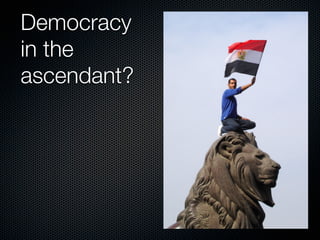
Democracy
in the
ascendant?
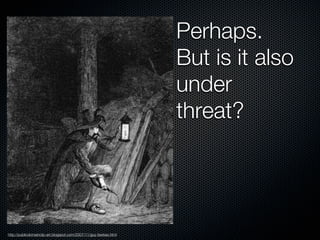
Perhaps.
                                                                   But is it also
                                                                   under
                                                                   threat?


http://publicdomainclip-art.blogspot.com/2007/11/guy-fawkes.html
3 big changes:
       (thanks to the internet & technology)
1
  Massive

  in friction
  reduction


http://www.flickr.com/photos/barelypodcasting/4899486065
Friction underpins society as
we know it
Friction underpins society as
we know it
 Many (most?) industries and business models are based
 on it, leading to intermediaries, such as from real-estate
 to electronics stores to the recorded music industry
Friction underpins society as
we know it
 Many (most?) industries and business models are based
                                   ED
                           EDIATsuch as from real-estate
 on it, leading SINTERM
             DI to intermediaries,
 to electronics stores to the recorded music industry
Friction underpins society as
we know it
 Many (most?) industries and business models are based
                                   ED
                           EDIATsuch as from real-estate
 on it, leading SINTERM
             DI to intermediaries,
 to electronics stores to the recorded music industry
 Privacy existed largely by dint of the difficulty of
 combining information, allowing us to live multiple
 separate lives, and the ability for our past to be
 forgotten
Friction underpins society as
we know it
 Many (most?) industries and business models are based
                                   ED
                           EDIATsuch as from real-estate
 on it, leading SINTERM
             DI to intermediaries,
 to electronics stores to the recorded music industry
 Privacy existed largely by dint of the difficulty of
 combining information,GLY SC us
                          allowing ARtoE multiple
                                       C live
           NCR    EASIN ability for our past to be
 separate Ilives, and the
 forgotten
Friction underpins society as
we know it
 Many (most?) industries and business models are based
                                   ED
                           EDIATsuch as from real-estate
 on it, leading SINTERM
             DI to intermediaries,
 to electronics stores to the recorded music industry
 Privacy existed largely by dint of the difficulty of
 combining information,GLY SC us
                          allowing ARtoE multiple
                                       C live
           NCR    EASIN ability for our past to be
 separate Ilives, and the
 forgotten
 Gives power to incumbents, but allows multiple
 competitors to exist, both in time and space (different
 countries have their own industries)
Friction underpins society as
we know it
 Many (most?) industries and business models are based
                                   ED
                           EDIATsuch as from real-estate
 on it, leading SINTERM
             DI to intermediaries,
 to electronics stores to the recorded music industry
 Privacy existed largely by dint of the difficulty of
 combining information,GLY SC us
                          allowing ARtoE multiple
                                       C live
           NCR    EASIN ability for our past to be
 separate Ilives, and the
 forgotten
 Gives power to incumbents, but allows multiple
 competitors to exist, both OPOLY PER       CTOR?
                                        SE(different
  ON       LOBAL   ) MON in time and space
     E (Ghave their own industries)
 countries
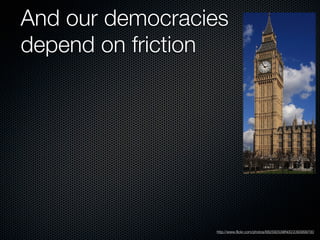
And our democracies
depend on friction


                 http://www.flickr.com/photos/68259253@N00/2393999700
And our democracies
depend on friction
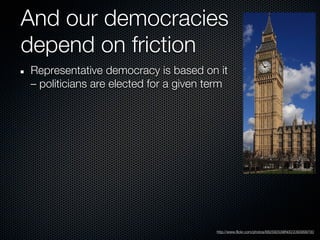
Representative democracy is based on it
– politicians are elected for a given term


                                       http://www.flickr.com/photos/68259253@N00/2393999700
And our democracies
depend on friction
Representative democracy is based on it
– politicians are elected for a given term
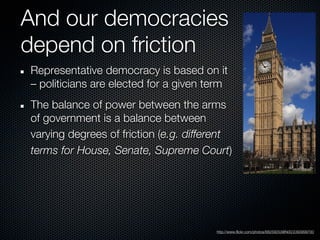
The balance of power between the arms
of government is a balance between
varying degrees of friction (e.g. different
terms for House, Senate, Supreme Court)


                                       http://www.flickr.com/photos/68259253@N00/2393999700
And our democracies
depend on friction
Representative democracy is based on it
– politicians are elected for a given term
The balance of power between the arms
of government is a balance between
varying degrees of friction (e.g. different
terms for House, Senate, Supreme Court)

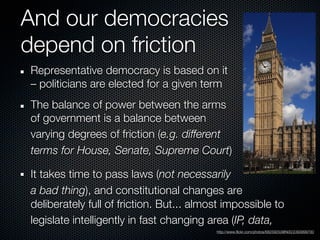
It takes time to pass laws (not necessarily
a bad thing), and constitutional changes are
deliberately full of friction. But... almost impossible to
legislate intelligently in fast changing area (IP, data,
                                          http://www.flickr.com/photos/68259253@N00/2393999700
The corporate world deals
with friction every day
The corporate world deals
with friction every day

Friction protects incumbents. Making it easier to switch
mobile phone providers == reducing friction for the
user
The corporate world deals
with friction every day

Friction protects incumbents. Making it easier to switch
mobile phone providers == reducing friction for the
user
Reducing friction allows you to deliver more for less,
reducing times, cost, increasing efficiency, with data
underlying all this
The corporate world deals
with friction every day

Friction protects incumbents. Making it easier to switch
mobile phone providers == reducing friction for the
user
Reducing friction allows you to deliver more for less,
reducing times, cost, increasing efficiency, with data
underlying all this
Government regulations, tax, social benefits are all
increases in friction that many companies will do their
best to overcome
But we know how the
internet deals with friction
But we know how the
internet deals with friction


 Friction == blockage (and the internet routes around
 blockages).
But we know how the
internet deals with friction


 Friction == blockage (and the internet routes around
 blockages).
 The corporate world in many ways prefigured the
 internet’s architecture – routing around blockages.
But we know how the
internet deals with friction


 Friction == blockage (and the internet routes around
 blockages).
 The corporate world in many ways prefigured the
 internet’s architecture – routing around blockages.
 And that’s true for the modern world too, as ideas,
 memes, money, all cross the world before the public
 realm has even noticed, still less had time to act.
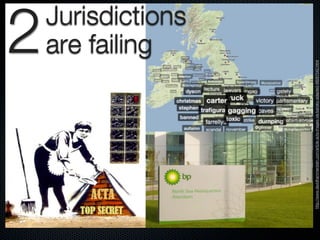
2     are failing
                                                                                       Jurisdictions


http://www.davidhammerstein.com/article-acta-images-via-bansky-adapted-48287542.html
Jurisdiction failure
              Note: failure, not elimination
Jurisdiction failure
                      Note: failure, not elimination


 Publish everywhere and nowhere?
Jurisdiction failure
                       Note: failure, not elimination


 Publish everywhere and nowhere?
 Is BP really a British company (more US than UK
 shareholders)?
Jurisdiction failure
                        Note: failure, not elimination


 Publish everywhere and nowhere?
 Is BP really a British company (more US than UK
 shareholders)?
 Who has jurisdiction over Twitter, Facebook, Baidu?
Jurisdiction failure
                        Note: failure, not elimination


 Publish everywhere and nowhere?
 Is BP really a British company (more US than UK
 shareholders)?
 Who has jurisdiction over Twitter, Facebook, Baidu?
 How can a company be audited (for tax) when key parts
 are hidden in tax havens, opaque corporate structures?
Jurisdiction failure
                         Note: failure, not elimination


 Publish everywhere and nowhere?
 Is BP really a British company (more US than UK
 shareholders)?
 Who has jurisdiction over Twitter, Facebook, Baidu?
 How can a company be audited (for tax) when key parts
 are hidden in tax havens, opaque corporate structures?
 Do we have selective jurisdiction applied in certain
 places & certain people (ACTA, rendition, tax)?
Jurisdiction failure
              Note: failure, not elimination
Jurisdiction failure
                         Note: failure, not elimination


 Corporate world long realised that jurisdictions are just a
 form of friction... and can be lubricated. Race to the
 bottom for regulation and taxes (been going on since at
 least the 19th century)
Jurisdiction failure
                         Note: failure, not elimination


 Corporate world long realised that jurisdictions are just a
 form of friction... and can be lubricated. Race to the
 bottom for regulation and taxes (been going on since at
 least the 19th century)
 What does a jurisdiction mean when we’re talking about
 open data – what is the the applicable law/jurisdiction
 for a piece of open data published by the US
 government about a UK company & referring to a
 German individual?
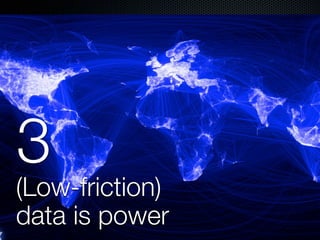
3
(Low-friction)
data is power
Ability to use data is critical
  3 main barriers: access, rights, understanding.
Ability to use data is critical
  3 main barriers: access, rights, understanding.


 Access: Can you get hold of the data... and if you’re an
 incumbent can you prevent others doing the same to
 gain a competitive advantage (commonly by having the
 data you are buying priced out of their reach)
Ability to use data is critical
  3 main barriers: access, rights, understanding.


 Access: Can you get hold of the data... and if you’re an
 incumbent can you prevent others doing the same to
 gain a competitive advantage (commonly by having the
 data you are buying priced out of their reach)
 Rights: Do you have the rights to use this data,
 combine it with other data, pass it on to others, work in
 a collaborative, distributed way?
Ability to use data is critical
  3 main barriers: access, rights, understanding.


 Access: Can you get hold of the data... and if you’re an
 incumbent can you prevent others doing the same to
 gain a competitive advantage (commonly by having the
 data you are buying priced out of their reach)
 Rights: Do you have the rights to use this data,
 combine it with other data, pass it on to others, work in
 a collaborative, distributed way?
 Understanding: Do you have the ability and processes
 to actually do something with the data
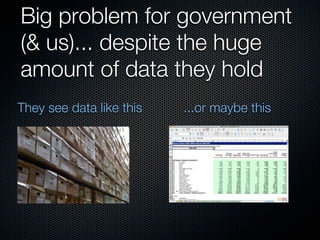
Big problem for government
(& us)... despite the huge
amount of data they hold
Big problem for government
(& us)... despite the huge
amount of data they hold
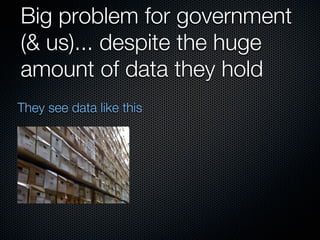
They see data like this
Big problem for government
(& us)... despite the huge
amount of data they hold
They see data like this   ...or maybe this
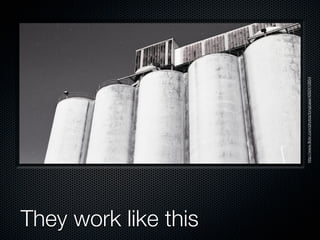
They work like this


                      http://www.flickr.com/photos/tonyjcase/4092410854
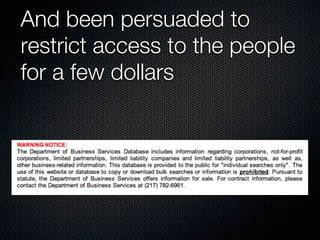
And been persuaded to
restrict access to the people
for a few dollars
Information is the currency
of democracy
                    Thomas Jefferson
A TA is the currency
Information
    D
of democracy
                   Thomas Jefferson
So, can open data help?


Gives the community a foothold, skin in the game
So, can open data help?


Gives the community a foothold, skin in the game
Allows government to make those walls that separate it
from the people permeable, the ‘open’ in ‘open data’
So, can open data help?


Gives the community a foothold, skin in the game
Allows government to make those walls that separate it
from the people permeable, the ‘open’ in ‘open data’
Allows retooling of government to take advantage of
data, removing silos, ending the culture of monolithic
projects, loosening hierarchies
So, can open data help?


Gives the community a foothold, skin in the game
Allows government to make those walls that separate it
from the people permeable, the ‘open’ in ‘open data’
Allows retooling of government to take advantage of
data, removing silos, ending the culture of monolithic
projects, loosening hierarchies
Allows the data to straddle to cross national
boundaries – essential with environmental, lobbying,
economic, development, corporate data
Yes, but it’s no silver bullet


                     http://www.flickr.com/photos/eschipul/4160817135/
Yes, but it’s no silver bullet
 With the wrong licence the community will be hobbled


                                   http://www.flickr.com/photos/eschipul/4160817135/
Yes, but it’s no silver bullet
 With the wrong licence the community will be hobbled
 They will be outgunned & outspent, so will need powerful
 network effects


                                   http://www.flickr.com/photos/eschipul/4160817135/
Yes, but it’s no silver bullet
 With the wrong licence the community will be hobbled
 They will be outgunned & outspent, so will need powerful
 network effects
 Having a government that understands data is not
 without its risk, unless there are democratic safeguards


                                     http://www.flickr.com/photos/eschipul/4160817135/
Yes, but it’s no silver bullet
 With the wrong licence the community will be hobbled
 They will be outgunned & outspent, so will need powerful
 network effects
 Having a government that understands data is not
 without its risk, unless there are democratic safeguards
 Where is the democratic
 oversight over the ‘community’,
 the digerati, non-profits, OKF?


                                     http://www.flickr.com/photos/eschipul/4160817135/
Yes, but it’s no silver bullet
 With the wrong licence the community will be hobbled
 They will be outgunned & outspent, so will need powerful
 network effects
 Having a government that understands data is not
 without its risk, unless there are democratic safeguards
 Where is the democratic
 oversight over the ‘community’,
 the digerati, non-profits, OKF?
 What about national cultural norms, especially privacy?
 Do they just strengthen proprietary databases?

                                     http://www.flickr.com/photos/eschipul/4160817135/
A concrete example:
                  company data
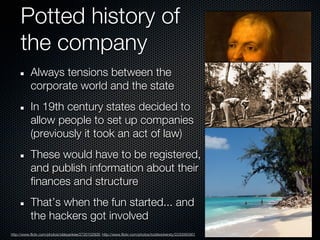
Potted history of
     the company


http://www.flickr.com/photos/oldeyankee/2720102926; http://www.flickr.com/photos/toddwickersty/2230065901
Potted history of
     the company
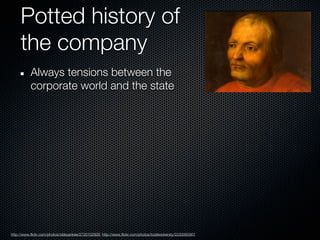
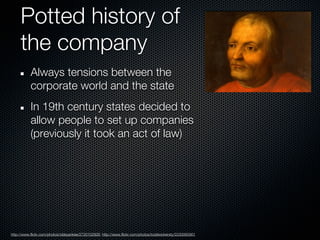
           Always tensions between the
           corporate world and the state


http://www.flickr.com/photos/oldeyankee/2720102926; http://www.flickr.com/photos/toddwickersty/2230065901
Potted history of
     the company
           Always tensions between the
           corporate world and the state


http://www.flickr.com/photos/oldeyankee/2720102926; http://www.flickr.com/photos/toddwickersty/2230065901
Potted history of
     the company
           Always tensions between the
           corporate world and the state
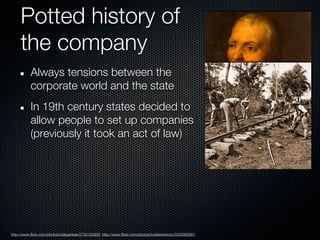
           In 19th century states decided to
           allow people to set up companies
           (previously it took an act of law)


http://www.flickr.com/photos/oldeyankee/2720102926; http://www.flickr.com/photos/toddwickersty/2230065901
Potted history of
     the company
           Always tensions between the
           corporate world and the state
           In 19th century states decided to
           allow people to set up companies
           (previously it took an act of law)


http://www.flickr.com/photos/oldeyankee/2720102926; http://www.flickr.com/photos/toddwickersty/2230065901
Potted history of
     the company
           Always tensions between the
           corporate world and the state
           In 19th century states decided to
           allow people to set up companies
           (previously it took an act of law)
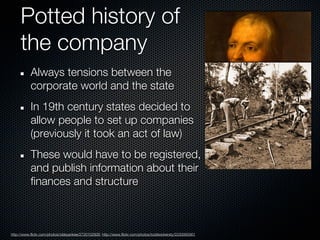
           These would have to be registered,
           and publish information about their
           finances and structure


http://www.flickr.com/photos/oldeyankee/2720102926; http://www.flickr.com/photos/toddwickersty/2230065901
Potted history of
     the company
           Always tensions between the
           corporate world and the state
           In 19th century states decided to
           allow people to set up companies
           (previously it took an act of law)
           These would have to be registered,
           and publish information about their
           finances and structure
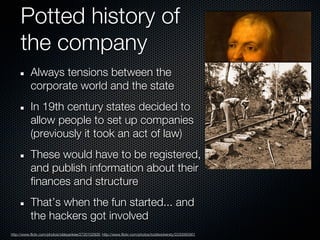
           That’s when the fun started... and
           the hackers got involved
http://www.flickr.com/photos/oldeyankee/2720102926; http://www.flickr.com/photos/toddwickersty/2230065901
Potted history of
     the company
           Always tensions between the
           corporate world and the state
           In 19th century states decided to
           allow people to set up companies
           (previously it took an act of law)
           These would have to be registered,
           and publish information about their
           finances and structure
           That’s when the fun started... and
           the hackers got involved
http://www.flickr.com/photos/oldeyankee/2720102926; http://www.flickr.com/photos/toddwickersty/2230065901
[digression]   Hackers?
[digression]   Hackers?
  Without doubt the world’s most successful, best
  rewarded, and skilled hackers in the world are
  corporate tax lawyers.
[digression]   Hackers?
  Without doubt the world’s most successful, best
  rewarded, and skilled hackers in the world are
  corporate tax lawyers.
  Make the rules work for them – within days of a new
  rules (tax code) being issued, they’ve figured out a way
  to game them to their (clients’) advantage.
[digression]   Hackers?
  Without doubt the world’s most successful, best
  rewarded, and skilled hackers in the world are
  corporate tax lawyers.
  Make the rules work for them – within days of a new
  rules (tax code) being issued, they’ve figured out a way
  to game them to their (clients’) advantage.
  Unlimited access to simple but powerful tools – cost
  not a problem.
[digression]   Hackers?
  Without doubt the world’s most successful, best
  rewarded, and skilled hackers in the world are
  corporate tax lawyers.
  Make the rules work for them – within days of a new
  rules (tax code) being issued, they’ve figured out a way
  to game them to their (clients’) advantage.
  Unlimited access to simple but powerful tools – cost
  not a problem.
  Agile, highly focused, amoral, able to understand and
  work multiple systems (jurisdictions) simultaneously
[digression]   Hackers?
  Without doubt the world’s most successful, best
  rewarded, and skilled hackers in the world are
  corporate tax lawyers.
  Make the rules work for them – within days of a new
  rules (tax code) being issued, they’ve figured out a way
  to game them to their (clients’) advantage.
  Unlimited access to simple but powerful tools – cost
  not a problem.
  Agile, highly focused, amoral, able to understand and
  work multiple systems (jurisdictions) simultaneously
  More or less untouchable by the law.
Always a slightly unequal
battle, but at least arguably
comparable when...
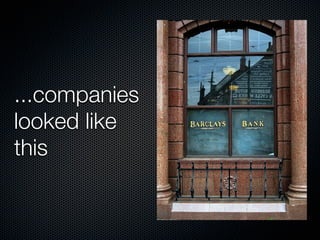
...companies
looked like
this
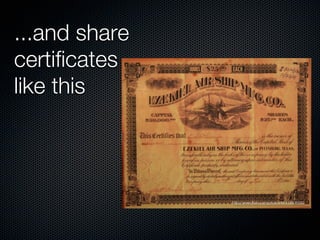
...and share
certificates
like this


               http://www.flickr.com/photos/kt/418938142
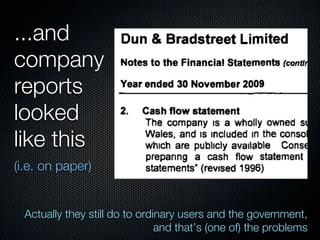
...and
company
reports
looked
like this
(i.e. on paper)


  Actually they still do to ordinary users and the government,
                                and that’s (one of) the problems
Massive asymmetry of
information.
Even bigger asymmetry of
friction (for governments,
community, SMEs,
innovators...)
Is this important?
What does government
collect about companies,
anyway?
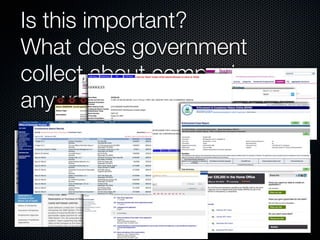
Is this important?
What does government
collect about companies,
anyway?
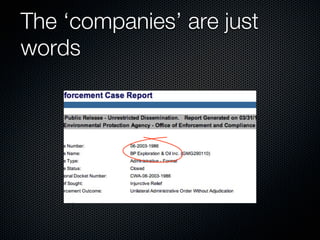
The ‘companies’ are just
words
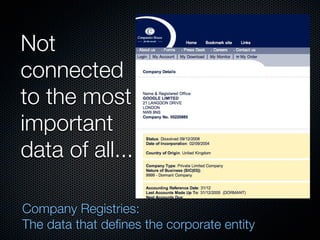
Not
connected
to the most
important
data of all...

Company Registries:
The data that defines the corporate entity
[Another
digression]   The DUNS number
[Another
digression]   The DUNS number
  Genius idea. Developed by Dun &
  Bradstreet in 1962
[Another
digression]   The DUNS number
  Genius idea. Developed by Dun &
  Bradstreet in 1962
  Create a monopoly ID system
[Another
digression]   The DUNS number
  Genius idea. Developed by Dun &
  Bradstreet in 1962
  Create a monopoly ID system
[Another
digression]   The DUNS number
  Genius idea. Developed by Dun &
  Bradstreet in 1962
  Create a monopoly ID system
  Get governments around the world
  to use it instead of the company
  IDs they created themselves...
[Another
digression]   The DUNS number
  Genius idea. Developed by Dun &
  Bradstreet in 1962
  Create a monopoly ID system
  Get governments around the world
  to use it instead of the company
  IDs they created themselves...
  Persuade them to integrate deeply
  into their systems, & thus do the
  selling for you
[Another
digression]   The DUNS number
  Genius idea. Developed by Dun &
  Bradstreet in 1962
  Create a monopoly ID system
  Get governments around the world
  to use it instead of the company
  IDs they created themselves...
  Persuade them to integrate deeply
  into their systems, & thus do the
  selling for you
[Another
digression]   The DUNS number
  Genius idea. Developed by Dun &
  Bradstreet in 1962
  Create a monopoly ID system
  Get governments around the world
  to use it instead of the company
  IDs they created themselves...
  Persuade them to integrate deeply
  into their systems, & thus do the
  selling for you
  Assert your IP so that they can’t
  use it freely (as in free speech)
If you don’t
think this
affects your
life, you’ve
slept through
the past few
years
                http://www.flickr.com/photos/aaronjacobs/64368770
[quick plug]   OpenCorporates
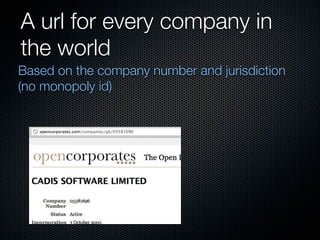
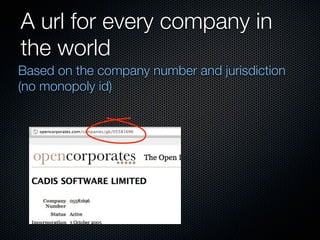
A url for every company in
the world
Based on the company number and jurisdiction
(no monopoly id)
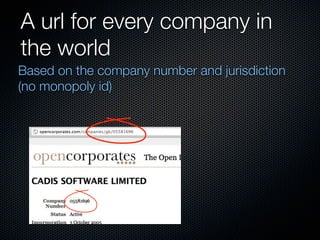
A url for every company in
the world
Based on the company number and jurisdiction
(no monopoly id)
A url for every company in
the world
Based on the company number and jurisdiction
(no monopoly id)
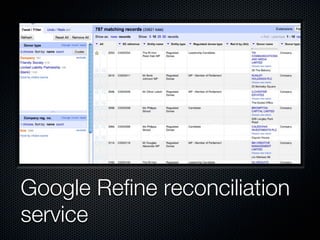
Google Refine reconciliation
service
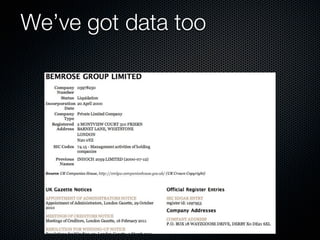
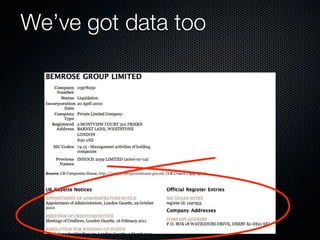
We’ve got data too
We’ve got data too
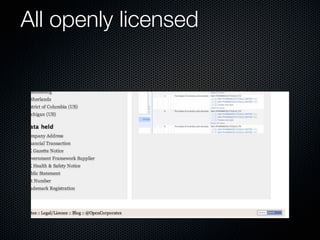
All openly licensed
All openly licensed
So what does this all mean?
 Hint: everything I needed to know about Open
               Data I learned from Open Source
It’s all about the licence
               Otherwise a two-stage world:
     the data-haves, and the data-have-nots
Even then, it’s going to be
tough for democracy
         And it possibly won’t look like the
                        one we have today
Open Global Data: A Threat Or Saviour For Democracy

Open Global Data: A Threat Or Saviour For Democracy

  • 1.
    Global Open Data A threat or a saviour for democracy? Chris Taggart, OKCON 2011, Berlin
  • 2.
    Me: Chris Taggart @countculture
  • 3.
    Me: Chris Taggart @countculture Developer of OpenlyLocal, opening up local government information since 2009. 150 councils, 10,000 councillors, 2 million payments, £12 billion – all open data
  • 4.
    Me: Chris Taggart @countculture Developer of OpenlyLocal, opening up local government information since 2009. 150 councils, 10,000 councillors, 2 million payments, £12 billion – all open data Developer of OpenCharities
  • 5.
    Me: Chris Taggart @countculture Developer of OpenlyLocal, opening up local government information since 2009. 150 councils, 10,000 councillors, 2 million payments, £12 billion – all open data Developer of OpenCharities Member of UK Local Public Data Panel
  • 6.
    Me: Chris Taggart @countculture Developer of OpenlyLocal, opening up local government information since 2009. 150 councils, 10,000 councillors, 2 million payments, £12 billion – all open data Developer of OpenCharities Member of UK Local Public Data Panel Co-founder & CEO of OpenCorporates
  • 7.
  • 8.
    Perhaps. But is it also under threat? http://publicdomainclip-art.blogspot.com/2007/11/guy-fawkes.html
  • 9.
    3 big changes: (thanks to the internet & technology)
  • 10.
    1 Massive in friction reduction http://www.flickr.com/photos/barelypodcasting/4899486065
  • 11.
  • 12.
    Friction underpins societyas we know it Many (most?) industries and business models are based on it, leading to intermediaries, such as from real-estate to electronics stores to the recorded music industry
  • 13.
    Friction underpins societyas we know it Many (most?) industries and business models are based ED EDIATsuch as from real-estate on it, leading SINTERM DI to intermediaries, to electronics stores to the recorded music industry
  • 14.
    Friction underpins societyas we know it Many (most?) industries and business models are based ED EDIATsuch as from real-estate on it, leading SINTERM DI to intermediaries, to electronics stores to the recorded music industry Privacy existed largely by dint of the difficulty of combining information, allowing us to live multiple separate lives, and the ability for our past to be forgotten
  • 15.
    Friction underpins societyas we know it Many (most?) industries and business models are based ED EDIATsuch as from real-estate on it, leading SINTERM DI to intermediaries, to electronics stores to the recorded music industry Privacy existed largely by dint of the difficulty of combining information,GLY SC us allowing ARtoE multiple C live NCR EASIN ability for our past to be separate Ilives, and the forgotten
  • 16.
    Friction underpins societyas we know it Many (most?) industries and business models are based ED EDIATsuch as from real-estate on it, leading SINTERM DI to intermediaries, to electronics stores to the recorded music industry Privacy existed largely by dint of the difficulty of combining information,GLY SC us allowing ARtoE multiple C live NCR EASIN ability for our past to be separate Ilives, and the forgotten Gives power to incumbents, but allows multiple competitors to exist, both in time and space (different countries have their own industries)
  • 17.
    Friction underpins societyas we know it Many (most?) industries and business models are based ED EDIATsuch as from real-estate on it, leading SINTERM DI to intermediaries, to electronics stores to the recorded music industry Privacy existed largely by dint of the difficulty of combining information,GLY SC us allowing ARtoE multiple C live NCR EASIN ability for our past to be separate Ilives, and the forgotten Gives power to incumbents, but allows multiple competitors to exist, both OPOLY PER CTOR? SE(different ON LOBAL ) MON in time and space E (Ghave their own industries) countries
  • 18.
    And our democracies dependon friction http://www.flickr.com/photos/68259253@N00/2393999700
  • 19.
    And our democracies dependon friction Representative democracy is based on it – politicians are elected for a given term http://www.flickr.com/photos/68259253@N00/2393999700
  • 20.
    And our democracies dependon friction Representative democracy is based on it – politicians are elected for a given term The balance of power between the arms of government is a balance between varying degrees of friction (e.g. different terms for House, Senate, Supreme Court) http://www.flickr.com/photos/68259253@N00/2393999700
  • 21.
    And our democracies dependon friction Representative democracy is based on it – politicians are elected for a given term The balance of power between the arms of government is a balance between varying degrees of friction (e.g. different terms for House, Senate, Supreme Court) It takes time to pass laws (not necessarily a bad thing), and constitutional changes are deliberately full of friction. But... almost impossible to legislate intelligently in fast changing area (IP, data, http://www.flickr.com/photos/68259253@N00/2393999700
  • 22.
    The corporate worlddeals with friction every day
  • 23.
    The corporate worlddeals with friction every day Friction protects incumbents. Making it easier to switch mobile phone providers == reducing friction for the user
  • 24.
    The corporate worlddeals with friction every day Friction protects incumbents. Making it easier to switch mobile phone providers == reducing friction for the user Reducing friction allows you to deliver more for less, reducing times, cost, increasing efficiency, with data underlying all this
  • 25.
    The corporate worlddeals with friction every day Friction protects incumbents. Making it easier to switch mobile phone providers == reducing friction for the user Reducing friction allows you to deliver more for less, reducing times, cost, increasing efficiency, with data underlying all this Government regulations, tax, social benefits are all increases in friction that many companies will do their best to overcome
  • 26.
    But we knowhow the internet deals with friction
  • 27.
    But we knowhow the internet deals with friction Friction == blockage (and the internet routes around blockages).
  • 28.
    But we knowhow the internet deals with friction Friction == blockage (and the internet routes around blockages). The corporate world in many ways prefigured the internet’s architecture – routing around blockages.
  • 29.
    But we knowhow the internet deals with friction Friction == blockage (and the internet routes around blockages). The corporate world in many ways prefigured the internet’s architecture – routing around blockages. And that’s true for the modern world too, as ideas, memes, money, all cross the world before the public realm has even noticed, still less had time to act.
  • 30.
    2 are failing Jurisdictions http://www.davidhammerstein.com/article-acta-images-via-bansky-adapted-48287542.html
  • 31.
    Jurisdiction failure Note: failure, not elimination
  • 32.
    Jurisdiction failure Note: failure, not elimination Publish everywhere and nowhere?
  • 33.
    Jurisdiction failure Note: failure, not elimination Publish everywhere and nowhere? Is BP really a British company (more US than UK shareholders)?
  • 34.
    Jurisdiction failure Note: failure, not elimination Publish everywhere and nowhere? Is BP really a British company (more US than UK shareholders)? Who has jurisdiction over Twitter, Facebook, Baidu?
  • 35.
    Jurisdiction failure Note: failure, not elimination Publish everywhere and nowhere? Is BP really a British company (more US than UK shareholders)? Who has jurisdiction over Twitter, Facebook, Baidu? How can a company be audited (for tax) when key parts are hidden in tax havens, opaque corporate structures?
  • 36.
    Jurisdiction failure Note: failure, not elimination Publish everywhere and nowhere? Is BP really a British company (more US than UK shareholders)? Who has jurisdiction over Twitter, Facebook, Baidu? How can a company be audited (for tax) when key parts are hidden in tax havens, opaque corporate structures? Do we have selective jurisdiction applied in certain places & certain people (ACTA, rendition, tax)?
  • 37.
    Jurisdiction failure Note: failure, not elimination
  • 38.
    Jurisdiction failure Note: failure, not elimination Corporate world long realised that jurisdictions are just a form of friction... and can be lubricated. Race to the bottom for regulation and taxes (been going on since at least the 19th century)
  • 39.
    Jurisdiction failure Note: failure, not elimination Corporate world long realised that jurisdictions are just a form of friction... and can be lubricated. Race to the bottom for regulation and taxes (been going on since at least the 19th century) What does a jurisdiction mean when we’re talking about open data – what is the the applicable law/jurisdiction for a piece of open data published by the US government about a UK company & referring to a German individual?
  • 40.
  • 41.
    Ability to usedata is critical 3 main barriers: access, rights, understanding.
  • 42.
    Ability to usedata is critical 3 main barriers: access, rights, understanding. Access: Can you get hold of the data... and if you’re an incumbent can you prevent others doing the same to gain a competitive advantage (commonly by having the data you are buying priced out of their reach)
  • 43.
    Ability to usedata is critical 3 main barriers: access, rights, understanding. Access: Can you get hold of the data... and if you’re an incumbent can you prevent others doing the same to gain a competitive advantage (commonly by having the data you are buying priced out of their reach) Rights: Do you have the rights to use this data, combine it with other data, pass it on to others, work in a collaborative, distributed way?
  • 44.
    Ability to usedata is critical 3 main barriers: access, rights, understanding. Access: Can you get hold of the data... and if you’re an incumbent can you prevent others doing the same to gain a competitive advantage (commonly by having the data you are buying priced out of their reach) Rights: Do you have the rights to use this data, combine it with other data, pass it on to others, work in a collaborative, distributed way? Understanding: Do you have the ability and processes to actually do something with the data
  • 45.
    Big problem forgovernment (& us)... despite the huge amount of data they hold
  • 46.
    Big problem forgovernment (& us)... despite the huge amount of data they hold They see data like this
  • 47.
    Big problem forgovernment (& us)... despite the huge amount of data they hold They see data like this ...or maybe this
  • 48.
    They work likethis http://www.flickr.com/photos/tonyjcase/4092410854
  • 49.
    And been persuadedto restrict access to the people for a few dollars
  • 50.
    Information is thecurrency of democracy Thomas Jefferson
  • 51.
    A TA isthe currency Information D of democracy Thomas Jefferson
  • 52.
    So, can opendata help?
  • 53.
    So, can opendata help? Gives the community a foothold, skin in the game
  • 54.
    So, can opendata help? Gives the community a foothold, skin in the game Allows government to make those walls that separate it from the people permeable, the ‘open’ in ‘open data’
  • 55.
    So, can opendata help? Gives the community a foothold, skin in the game Allows government to make those walls that separate it from the people permeable, the ‘open’ in ‘open data’ Allows retooling of government to take advantage of data, removing silos, ending the culture of monolithic projects, loosening hierarchies
  • 56.
    So, can opendata help? Gives the community a foothold, skin in the game Allows government to make those walls that separate it from the people permeable, the ‘open’ in ‘open data’ Allows retooling of government to take advantage of data, removing silos, ending the culture of monolithic projects, loosening hierarchies Allows the data to straddle to cross national boundaries – essential with environmental, lobbying, economic, development, corporate data
  • 57.
    Yes, but it’sno silver bullet http://www.flickr.com/photos/eschipul/4160817135/
  • 58.
    Yes, but it’sno silver bullet With the wrong licence the community will be hobbled http://www.flickr.com/photos/eschipul/4160817135/
  • 59.
    Yes, but it’sno silver bullet With the wrong licence the community will be hobbled They will be outgunned & outspent, so will need powerful network effects http://www.flickr.com/photos/eschipul/4160817135/
  • 60.
    Yes, but it’sno silver bullet With the wrong licence the community will be hobbled They will be outgunned & outspent, so will need powerful network effects Having a government that understands data is not without its risk, unless there are democratic safeguards http://www.flickr.com/photos/eschipul/4160817135/
  • 61.
    Yes, but it’sno silver bullet With the wrong licence the community will be hobbled They will be outgunned & outspent, so will need powerful network effects Having a government that understands data is not without its risk, unless there are democratic safeguards Where is the democratic oversight over the ‘community’, the digerati, non-profits, OKF? http://www.flickr.com/photos/eschipul/4160817135/
  • 62.
    Yes, but it’sno silver bullet With the wrong licence the community will be hobbled They will be outgunned & outspent, so will need powerful network effects Having a government that understands data is not without its risk, unless there are democratic safeguards Where is the democratic oversight over the ‘community’, the digerati, non-profits, OKF? What about national cultural norms, especially privacy? Do they just strengthen proprietary databases? http://www.flickr.com/photos/eschipul/4160817135/
  • 63.
  • 64.
    Potted history of the company http://www.flickr.com/photos/oldeyankee/2720102926; http://www.flickr.com/photos/toddwickersty/2230065901
  • 65.
    Potted history of the company Always tensions between the corporate world and the state http://www.flickr.com/photos/oldeyankee/2720102926; http://www.flickr.com/photos/toddwickersty/2230065901
  • 66.
    Potted history of the company Always tensions between the corporate world and the state http://www.flickr.com/photos/oldeyankee/2720102926; http://www.flickr.com/photos/toddwickersty/2230065901
  • 67.
    Potted history of the company Always tensions between the corporate world and the state In 19th century states decided to allow people to set up companies (previously it took an act of law) http://www.flickr.com/photos/oldeyankee/2720102926; http://www.flickr.com/photos/toddwickersty/2230065901
  • 68.
    Potted history of the company Always tensions between the corporate world and the state In 19th century states decided to allow people to set up companies (previously it took an act of law) http://www.flickr.com/photos/oldeyankee/2720102926; http://www.flickr.com/photos/toddwickersty/2230065901
  • 69.
    Potted history of the company Always tensions between the corporate world and the state In 19th century states decided to allow people to set up companies (previously it took an act of law) These would have to be registered, and publish information about their finances and structure http://www.flickr.com/photos/oldeyankee/2720102926; http://www.flickr.com/photos/toddwickersty/2230065901
  • 70.
    Potted history of the company Always tensions between the corporate world and the state In 19th century states decided to allow people to set up companies (previously it took an act of law) These would have to be registered, and publish information about their finances and structure That’s when the fun started... and the hackers got involved http://www.flickr.com/photos/oldeyankee/2720102926; http://www.flickr.com/photos/toddwickersty/2230065901
  • 71.
    Potted history of the company Always tensions between the corporate world and the state In 19th century states decided to allow people to set up companies (previously it took an act of law) These would have to be registered, and publish information about their finances and structure That’s when the fun started... and the hackers got involved http://www.flickr.com/photos/oldeyankee/2720102926; http://www.flickr.com/photos/toddwickersty/2230065901
  • 72.
    [digression] Hackers?
  • 73.
    [digression] Hackers? Without doubt the world’s most successful, best rewarded, and skilled hackers in the world are corporate tax lawyers.
  • 74.
    [digression] Hackers? Without doubt the world’s most successful, best rewarded, and skilled hackers in the world are corporate tax lawyers. Make the rules work for them – within days of a new rules (tax code) being issued, they’ve figured out a way to game them to their (clients’) advantage.
  • 75.
    [digression] Hackers? Without doubt the world’s most successful, best rewarded, and skilled hackers in the world are corporate tax lawyers. Make the rules work for them – within days of a new rules (tax code) being issued, they’ve figured out a way to game them to their (clients’) advantage. Unlimited access to simple but powerful tools – cost not a problem.
  • 76.
    [digression] Hackers? Without doubt the world’s most successful, best rewarded, and skilled hackers in the world are corporate tax lawyers. Make the rules work for them – within days of a new rules (tax code) being issued, they’ve figured out a way to game them to their (clients’) advantage. Unlimited access to simple but powerful tools – cost not a problem. Agile, highly focused, amoral, able to understand and work multiple systems (jurisdictions) simultaneously
  • 77.
    [digression] Hackers? Without doubt the world’s most successful, best rewarded, and skilled hackers in the world are corporate tax lawyers. Make the rules work for them – within days of a new rules (tax code) being issued, they’ve figured out a way to game them to their (clients’) advantage. Unlimited access to simple but powerful tools – cost not a problem. Agile, highly focused, amoral, able to understand and work multiple systems (jurisdictions) simultaneously More or less untouchable by the law.
  • 78.
    Always a slightlyunequal battle, but at least arguably comparable when...
  • 79.
  • 80.
    ...and share certificates like this http://www.flickr.com/photos/kt/418938142
  • 81.
    ...and company reports looked like this (i.e. onpaper) Actually they still do to ordinary users and the government, and that’s (one of) the problems
  • 82.
    Massive asymmetry of information. Evenbigger asymmetry of friction (for governments, community, SMEs, innovators...)
  • 83.
    Is this important? Whatdoes government collect about companies, anyway?
  • 84.
    Is this important? Whatdoes government collect about companies, anyway?
  • 85.
  • 86.
    Not connected to the most important dataof all... Company Registries: The data that defines the corporate entity
  • 87.
    [Another digression] The DUNS number
  • 88.
    [Another digression] The DUNS number Genius idea. Developed by Dun & Bradstreet in 1962
  • 89.
    [Another digression] The DUNS number Genius idea. Developed by Dun & Bradstreet in 1962 Create a monopoly ID system
  • 90.
    [Another digression] The DUNS number Genius idea. Developed by Dun & Bradstreet in 1962 Create a monopoly ID system
  • 91.
    [Another digression] The DUNS number Genius idea. Developed by Dun & Bradstreet in 1962 Create a monopoly ID system Get governments around the world to use it instead of the company IDs they created themselves...
  • 92.
    [Another digression] The DUNS number Genius idea. Developed by Dun & Bradstreet in 1962 Create a monopoly ID system Get governments around the world to use it instead of the company IDs they created themselves... Persuade them to integrate deeply into their systems, & thus do the selling for you
  • 93.
    [Another digression] The DUNS number Genius idea. Developed by Dun & Bradstreet in 1962 Create a monopoly ID system Get governments around the world to use it instead of the company IDs they created themselves... Persuade them to integrate deeply into their systems, & thus do the selling for you
  • 94.
    [Another digression] The DUNS number Genius idea. Developed by Dun & Bradstreet in 1962 Create a monopoly ID system Get governments around the world to use it instead of the company IDs they created themselves... Persuade them to integrate deeply into their systems, & thus do the selling for you Assert your IP so that they can’t use it freely (as in free speech)
  • 95.
    If you don’t thinkthis affects your life, you’ve slept through the past few years http://www.flickr.com/photos/aaronjacobs/64368770
  • 96.
    [quick plug] OpenCorporates
  • 97.
    A url forevery company in the world Based on the company number and jurisdiction (no monopoly id)
  • 98.
    A url forevery company in the world Based on the company number and jurisdiction (no monopoly id)
  • 99.
    A url forevery company in the world Based on the company number and jurisdiction (no monopoly id)
  • 100.
  • 101.
  • 102.
  • 103.
  • 104.
  • 105.
    So what doesthis all mean? Hint: everything I needed to know about Open Data I learned from Open Source
  • 106.
    It’s all aboutthe licence Otherwise a two-stage world: the data-haves, and the data-have-nots
  • 107.
    Even then, it’sgoing to be tough for democracy And it possibly won’t look like the one we have today

Editor's Notes