
Internet Innovation: Empowering Citizens in the Developing World   Ayelet Baron Director, Emerging Markets October 2009
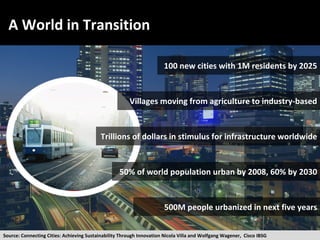
A World in Transition Source: Connecting Cities: Achieving Sustainability Through Innovation Nicola Villa and Wolfgang Wagener,  Cisco IBSG 50% of world population urban by 2008, 60% by 2030 500M people urbanized in next five years 100 new cities with 1M residents by 2025 Trillions of dollars in stimulus for infrastructure worldwide Villages moving from agriculture to industry-based
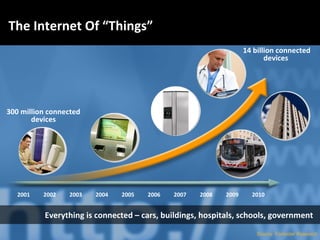
The Internet Of โ€œThingsโ€ Source: Forrester Research 2001 2006 2002 2003 2004 2005 2008 2009 2010 2007 300 million connected devices 14 billion connected devices  Everything is connected โ€“ cars, buildings, hospitals, schools, government
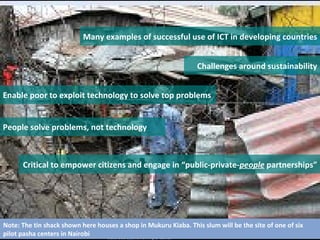
Many examples of successful use of ICT in developing countries Challenges around sustainability Enable poor to exploit technology to solve top problems People solve problems, not technology Critical to empower citizens and engage in โ€œpublic-private- people  partnershipsโ€ Note: The tin shack shown here houses a shop in Mukuru Kiaba. This slum will be the site of one of six pilot pasha centers in Nairobi
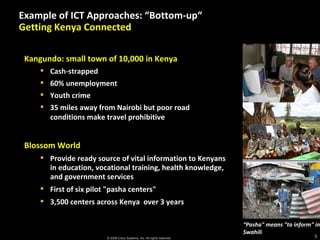
Example of ICT Approaches: โ€œBottom-up โ€œ  Getting Kenya Connected โ€œ Pasha" means "to inform" in Swahili Kangundo: small town of 10,000 in Kenya Cash-strapped 60% unemployment Youth crime 35 miles away from Nairobi but poor road conditions make travel prohibitive Blossom World Provide ready source of vital information to Kenyans in education, vocational training, health knowledge, and government services First of six pilot "pasha centers"  3,500 centers across Kenya  over 3 years
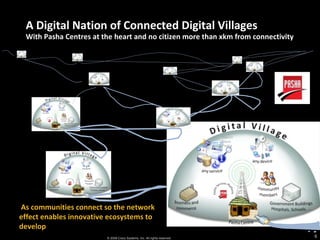
A Digital Nation of Connected Digital Villages With Pasha Centres at the heart and no citizen more than xkm from connectivity As communities connect so the network effect enables innovative ecosystems to develop Bashiri Gava Pasha
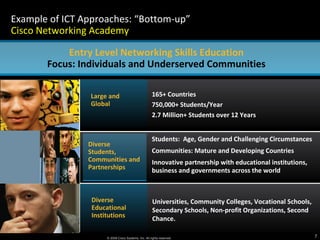
Large and Global Diverse  Students, Communities and Partnerships Students:  Age, Gender and Challenging Circumstances Communities: Mature and Developing Countries Innovative partnership with educational institutions, business and governments across the world 165+ Countries 750,000+ Students/Year 2.7 Million+ Students over 12 Years Diverse  Educational  Institutions Entry Level Networking Skills Education Focus: Individuals and Underserved Communities Universities, Community Colleges, Vocational Schools, Secondary Schools, Non-profit Organizations, Second Chance.  Example of ICT Approaches: โ€œBottom-upโ€  Cisco Networking Academy
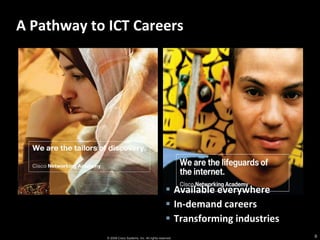
A Pathway to ICT Careers Available everywhere In-demand careers Transforming industries
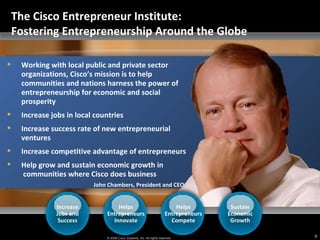
John Chambers, President and CEO Working with local public and private sector organizations, Ciscoโ€™s mission is to help communities and nations harness the power of entrepreneurship for economic and social prosperity  Increase jobs in local countries  Increase success rate of new entrepreneurial ventures Increase competitive advantage of entrepreneurs Help grow and sustain economic growth in   communities where Cisco does business Increase Jobs and Success Helps Entrepreneurs Innovate Helps Entrepreneurs Compete Sustain Economic Growth The Cisco Entrepreneur Institute:  Fostering Entrepreneurship Around the Globe
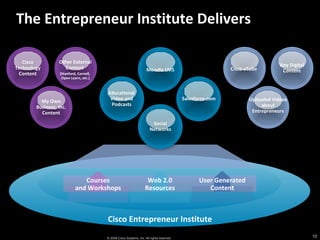
The Entrepreneur Institute Delivers Courses and Workshops Web 2.0 Resources User Generated Content Cisco Entrepreneur Institute Cisco Technology Content My Own Business, Inc. Content Other External Content  (Stanford, Cornell,  Open Learn, etc.) Educational Video and Podcasts Salesforce.com Any Digital Content Cisco eTube Uploaded Videos about Entrepreneurs Moodle LMS Social Networks
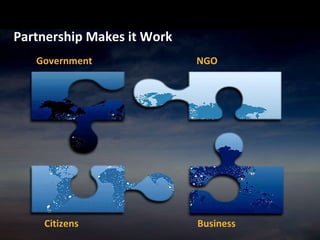
Partnership Makes it Work Government NGO Citizens Business
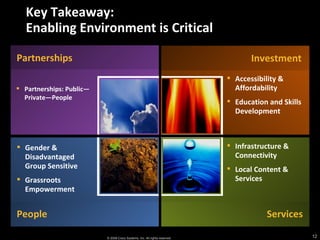
Key Takeaway:  Enabling Environment is Critical Product Partnerships: Publicโ€”Privateโ€”People People Gender & Disadvantaged Group Sensitive Grassroots Empowerment Investment Accessibility & Affordability Education and Skills Development Partnerships Services Infrastructure & Connectivity Local Content & Services
ย 

Internet Innovation: Empowering Citizens in the Developing World

  • 1.
    Internet Innovation: EmpoweringCitizens in the Developing World Ayelet Baron Director, Emerging Markets October 2009
  • 2.
    A World inTransition Source: Connecting Cities: Achieving Sustainability Through Innovation Nicola Villa and Wolfgang Wagener, Cisco IBSG 50% of world population urban by 2008, 60% by 2030 500M people urbanized in next five years 100 new cities with 1M residents by 2025 Trillions of dollars in stimulus for infrastructure worldwide Villages moving from agriculture to industry-based
  • 3.
    The Internet Ofโ€œThingsโ€ Source: Forrester Research 2001 2006 2002 2003 2004 2005 2008 2009 2010 2007 300 million connected devices 14 billion connected devices Everything is connected โ€“ cars, buildings, hospitals, schools, government
  • 4.
    Many examples ofsuccessful use of ICT in developing countries Challenges around sustainability Enable poor to exploit technology to solve top problems People solve problems, not technology Critical to empower citizens and engage in โ€œpublic-private- people partnershipsโ€ Note: The tin shack shown here houses a shop in Mukuru Kiaba. This slum will be the site of one of six pilot pasha centers in Nairobi
  • 5.
    Example of ICTApproaches: โ€œBottom-up โ€œ Getting Kenya Connected โ€œ Pasha" means "to inform" in Swahili Kangundo: small town of 10,000 in Kenya Cash-strapped 60% unemployment Youth crime 35 miles away from Nairobi but poor road conditions make travel prohibitive Blossom World Provide ready source of vital information to Kenyans in education, vocational training, health knowledge, and government services First of six pilot "pasha centers" 3,500 centers across Kenya over 3 years
  • 6.
    A Digital Nationof Connected Digital Villages With Pasha Centres at the heart and no citizen more than xkm from connectivity As communities connect so the network effect enables innovative ecosystems to develop Bashiri Gava Pasha
  • 7.
    Large and GlobalDiverse Students, Communities and Partnerships Students: Age, Gender and Challenging Circumstances Communities: Mature and Developing Countries Innovative partnership with educational institutions, business and governments across the world 165+ Countries 750,000+ Students/Year 2.7 Million+ Students over 12 Years Diverse Educational Institutions Entry Level Networking Skills Education Focus: Individuals and Underserved Communities Universities, Community Colleges, Vocational Schools, Secondary Schools, Non-profit Organizations, Second Chance. Example of ICT Approaches: โ€œBottom-upโ€ Cisco Networking Academy
  • 8.
    A Pathway toICT Careers Available everywhere In-demand careers Transforming industries
  • 9.
    John Chambers, Presidentand CEO Working with local public and private sector organizations, Ciscoโ€™s mission is to help communities and nations harness the power of entrepreneurship for economic and social prosperity Increase jobs in local countries Increase success rate of new entrepreneurial ventures Increase competitive advantage of entrepreneurs Help grow and sustain economic growth in communities where Cisco does business Increase Jobs and Success Helps Entrepreneurs Innovate Helps Entrepreneurs Compete Sustain Economic Growth The Cisco Entrepreneur Institute: Fostering Entrepreneurship Around the Globe
  • 10.
    The Entrepreneur InstituteDelivers Courses and Workshops Web 2.0 Resources User Generated Content Cisco Entrepreneur Institute Cisco Technology Content My Own Business, Inc. Content Other External Content (Stanford, Cornell, Open Learn, etc.) Educational Video and Podcasts Salesforce.com Any Digital Content Cisco eTube Uploaded Videos about Entrepreneurs Moodle LMS Social Networks
  • 11.
    Partnership Makes itWork Government NGO Citizens Business
  • 12.
    Key Takeaway: Enabling Environment is Critical Product Partnerships: Publicโ€”Privateโ€”People People Gender & Disadvantaged Group Sensitive Grassroots Empowerment Investment Accessibility & Affordability Education and Skills Development Partnerships Services Infrastructure & Connectivity Local Content & Services
  • 13.

Editor's Notes

  • #4ย Transition : Previous centuries saw industrial infrastructure such as rail, roads, and telephone lines paving the way for new cities and new connections. Whatโ€™s different today, whatโ€™s driving these changes? Much of it โ€ฆ being driven by the global network โ€ฆ everything is becoming connected In 2001โ€ฆ 300 million devices connectedโ€ฆ Primarily what youโ€™d expectโ€ฆ computers, cell phones, PDAs By 2010, in just two yearsโ€ฆ predicted that 14 billion things will be connected Not just talking cell phones anymoreโ€ฆ Cars, buildings, hospitals, security cameras โ€ฆeverything is connected The Internet has expanded into an โ€œInternet of Thingsโ€ beyond traditional computers and mobile devices.
  • #5ย In emerging countries, ICT has been hailed as โ€œgreat equalizerโ€ฆ a fundamental stepping stone in achieving a better quality of life โ€œ. T here are indeed many examples of successful use of ICT โ€“ frankly, a private sector company can โ€œmake virtually anything work onceโ€ by throwing enough resource on it. The core problem is finding approaches which are not only sustainable, but also scale up. No one has โ€œcracked the codeโ€ on mass adoption (other than mobile phone). Cisco realizes that to have an impact on poverty, corporations like ours need to think about impacting tens of millions of people, i.e., ways to create demand and viral approaches to the poor gaining ICT skills and the ability to use technology to solve their top problems (empowering people to solve their problems, not solving for them) This isnโ€™t about what we or public sector โ€œdoโ€ for citizens, but rather how we help them to help themselves in advancing economically and socially. Itโ€™s a given that no single sector can solve poverty (wicked) problems โ€“ takes a multi-stakeholder approach. We advocate that the community members/citizens themselves need to be in more of the driverโ€™s seat and empowered to make informed decisions to improve their lives.
  • #6ย Kangundo, a small town of 10,000 in Kenya, would at first glance seem an unlikely candidate for a serious Cisco business venture. It is a cash-strapped place with more than 60 percent unemployment and significant youth crime as a result. While the town is only about 35 miles away from Nairobi's greater opportunities, the poor condition of the roads makes frequent travel back and forth prohibitive. And yet here, in a modest building of less than 400 square feet known as the Blossom World cybercafรฉ, Cisco has helped launch what it hopes will be the start of big things in terms of getting all of Kenya more fully tapped into the digital age. Blossom World is the first of six pilot "pasha centres" that Wynn has been steering, along with IBSG teammate Peter Drury and Michele Castegnaro of Emerging Africa Business Development as part of a Digital Villages Project in Kenya. The word "pasha" means "to inform" in Swahili, and the goal of the centres, explains Wynn, is to provide a ready source of vital information to Kenyans in the areas of basic education, vocational training, health knowledge, and government services. Pasha Potential If the Digital Villages Project takes off according to plan, there will be approximately 3,500 pasha centres scattered across Kenya within the next three years, according to Wynn. Every Kenyan citizen will be within walking distance of the connectivity provided by a pasha centre.
  • #8ย Cisco Networking Academy is Ciscoโ€™s largest CSR program, with a expansive global presence. To give you perspective, the UN recognizes approximately 190 countries. Networking Academy has at least one academy in approximately 80% of the UN countries. Cisco has offices in fewer than 100 of these same countries. To put this more into perspective, Cisco has offices in only approximately 50% of the number of countries where Networking Academy is present. We educate over 750,000 unique students within a given year. This means we count the students only once within a given year, not by each time they take a class. To compare in the US, it means we are larger than the California University system in its entirety. Over the course of our 12 years we have taught over 2.7 Million students and are proud to say we have 400,000 CCNA 4 graduates. Networking Academy is incredibly diverse: Students are of all ages, with a strong female contingency and coming from very diverse backgrounds and circumstances Students range in age from 12 to over 60. There is a healthy mix of women and men, even though we want to increase the number of women. People range from those trying to work their way out of the slums in their region, to physically challenged students, to people in prison planning for their future outside Our communities are equally diverse, including both developing and mature countries, organizations providing a second chance, and a combination of schools ranging from public schools to advanced education institutions Upper Secondary schools represent approximately 15% 2-3 Year Institutions, such as community and vocational schools, 34% 4 Year Institutions/universities, 46% And the remaining schools for 5%
  • #9ย Exciting ICT career paths are open to students globally Information Technology is a solid and promising career path and IT industries are numerous and varied Air Traffic Controller of Finance the person managing the flow of critical data across the enterprise, or across the world Maitre dโ€™ of Entertainment the person in charge of โ€˜serving upโ€™ content of all kinds to different audiences, over the network We are challenging our student to consider their career goals in a new way. We consider them to be the Architects of the Networked Economy. They are building the platform for lifeโ€™s experiences , for us all.
  • #11ย Building on Ciscoโ€™s past success in education, the Cisco Entrepreneur Institute represents a new model for knowledge sharing Practical workshops include content from Partners, premier business schools, and Cisco technology content Web 2.0 technology is used extensively to enrich the participants experience, provide valuable content on demand, and to facilitate a community of business people and entrepreneurs and encourage the collaboration and exchange of ideas. Users also contribute to the Institute by sharing their own authored content, their successes and their challenges.
  • #12ย It is an ecosystem approach comprised of partners coming from educational institutions locally, national and local government, corporations, and NGOs. Cisco provides curriculum, instructor training, assessments, and equipment at cost, to name a few contributions. The ecosystem partners provide additional funding, building space, and people and other forms of support.