INTERNATIONAL RESEARCH JOURNAL OF ENGINEERING AND TECHNOLOGY (IRJET) E-ISSN: 2395-0056
VOLUME: 06 ISSUE: 03 | MAR 2019 WWW.IRJET.NET P-ISSN: 2395-0072
© 2019, IRJET | Impact Factor value: 7.211 | ISO 9001:2008 Certified Journal | Page 3233
Traffic Study on Mid-Block Section & Intersection
Lakhan Verma1, Prof. Shashikant Dhobale2
1M.E. Student, Department of Civil Engineering, JIT Borawan khargone, (M.P.), India
2Asst. Professor, Department of Civil Engineering, JIT Borawan khargone, (M.P.), India
----------------------------------------------------------------------***---------------------------------------------------------------------
Abstract - Traffic has mature in recently years with
urbanization. Within the recent situation traffic is that the
major consent for any developing nation. Vehicle crashes
square measure a serious concern in quickly growing urban
agglomerations. They even have attracted the eye of
researchers, academicians, andpolicy manufacturers. Increase
in these areas has been a lot of speedy in recently, thanks to
the saturation of population inside town space and also the
ensuant large-scale industrial development within the
peripheral areas. soit’snecessarytoprovideattentiontowards
transportation and study the necessity for higher geometric
style, capacity, signals, route marking, street lighting etc.
during this constant quantity study, level of service(LOS) of
various phase has been much disbursed in post office
chouraha, gaaytri mandir tiraha, shreekrishna talkies tiraha,
bistan road tiraha(near sabji mandi) and navgrah mandir
tiraha destination points facing heaviest traffic issues.
Expected resolution we tend to get from outcome is result in
potential improvement of traffic within the kind of either
growth of dimension of roads, construction of fly over or by-
pass, improvement of signal style. The study would be
primarily divided into 2 sections with initial sectionfocusinga
lot of on a mid-block section and also the later phase on
intersection mentioned higher than.
Key Words: Introduction, Aim and Objectives, Goals of
Study, Methodology, Experimental Work,LiteratureReview,
Expected Outcomes, References.
1. INTRODUCTION
Vehicular use has continually been the first suggests that of
human. And that’s why we have a tendencytothought-about
the conveyance area unit the essential parts of
transportation. In ancient ages there wasa largeconveyance
movement turn up and movement is that the mode of
transportation. Foreachtransportassociatedwithtravel and
journeys should begin and finish. The conveyance travel is
an efficient mode of transportation for brief visits and long
visits. Movement of conveyance could be a tonality of
transportation in cities additionally. so as to produce the
most effective style areas for human motion or circulation
like at move for movement Capitol Hill station and
movement the work facet and work the movement to tour
etc. for that conveyance motion is studied through empirical
observation all told aspects. It’s frenzied by 2 levels. At large
level one will analyse the essential flow parameters like
speed, density of conveyance motion and at microscopic
level one could track the ways followed by individual
conveyance whereas moving severally. From this it's clear
that the conveyance could produce own ways in their
journey trip. Coming back to the conveyance crosswalks
there have been many cross road like intersection area unit
designed for a road, offer paying work to help the
conveyance to maneuver from one facettotheoppositefacet
of road, and that plays a major role within the quality and
safety mode of signalized intersections. In another places
like wherever the busy traffic takes place, conveyance select
the middle blocks to cross the road. However there's no
safety as compared to signalized intersections. Even several
conveyance cross roads area unit going down in these
midblock sections. Depend upon the conveyance travel
motion demand road breadth is outlined. Some existing
manuals area unit printed regarding the road breadth,
however they are doing not offer clear specifications for the
desired road breadth, conveyance relating to completely
different demand volumes and properties. Conveyance flow
consists of 2 sorts, one-way and bifacial. In one-way flow,
conveyance motion is in one direction solely, whereas in
bifacial conveyance will travel from the each direction and
act with one another. Conveyance road safetyisoneinall the
most important aspects of transportation engineering in
urban areas. The extralegal crossing behaviour of the
conveyance could be a major truth within the road safety
issue. The thesis here is concentrated on developing
conveyance motion which might describe the conveyance
interaction at the cross sections. For that vehicle flow
interaction at many intersections was collected knowledge
from post office chouraha, gaaytri mandir tiraha,
shreekrishna talkies tiraha, bistan road tiraha(near sabji
mandi) and navgrah mandir tiraha. These experimental
studies are going to be mentioned.
1.1 AIM AND OBJECTIVES
To improvement of mid-block section and road intersection
at post office chouraha, gaaytri mandir tiraha, shreekrishna
talkies tiraha, bistan road tiraha(near sabji mandi) and
navgrah mandir tiraha to regulate the traffic volume and its
downside by traffic style. The objectives of the currentstudy
area unit as under:
1. to review the traffic volume of the mid-block section and
intersection.
2. to review the road condition.
3. to review the present emptying conditionofthe mid-block
section Road sites.
INTERNATIONAL RESEARCH JOURNAL OF ENGINEERING AND TECHNOLOGY (IRJET) E-ISSN: 2395-0056
VOLUME: 06 ISSUE: 03 | MAR 2019 WWW.IRJET.NET P-ISSN: 2395-0072
© 2019, IRJET | Impact Factor value: 7.211 | ISO 9001:2008 Certified Journal | Page 3234
4. to review the present condition of residencelivingcloseto
the location of study space WHO will have the matter with
the work.
5. To perform record search, website investigation and
knowledge assortment to spot existing utilities within the
space.
1.2 GOALS OF STUDY
1. Climate protection.
2. Healthy and safe communities.
3. Reduces intersection crash types.
4. Transportation system effectiveness.
5. Improved traffic flow by avoiding collisions and
obstruction congestion delays.
6. Facilitates complicated and risky traffic movements at 'X'
and 'T' intersections.
7. Attenuates or reduces disturbing noise generated by
vehicle horns and automatic warning devices.
2. METHODOLOGY
Data Collection
1. The Traffic Volume at post office chouraha mid-block
section, information are disbursed.
2. The Traffic Flow Survey at mid-block section FromTime8
AM To 11AM. Additionally evening 4 PM To 7 PM.
3. The Traffic at Junction principally In Early Morning and In
Afternoon. Most Traffic issues of Junction Is occurred By
Animals, Pedestrian, and significant Vehicle & Parking. to
resolve issues of Traffic the bridge or subway ought to be
provided.
Traffic investigation technique Two strategies are on the
market for conducting traffic volume counts:
(1) Manual count and
(2) Automatic count
Manual counts are generally accustomedgatherinformation
for determination of auto classification, turningmovements,
direction of travel, pedestrian movements, or vehicle
occupancy.
Automatic counts are generally accustomed gather
information for determination of auto hourly patterns, daily
or seasonal differences and growth trends, or annual traffic
estimates.
The choice of study technique ought to be determined
mistreatment the count amount. The count amount ought to
be representative of the time of day, day of month, and
month of year for the study space. for instance, counts at a
summer resort wouldn't be taken in January. The count
amount ought to avoid special event or compromising
atmospheric condition (Sharma 1994). Count periods could
vary from five minutes to one year.Typical countperiods are
quarter-hour or a pair of hours for peak periods, four hours
for morning and afternoon peaks, six hours for morning,
midday, and afternoon peaks, and twelve hours for daytime
periods (Robertson1994). for instance, if you were
conducting a 2-hour peak amount count, 8 to 15- minute
counts would be requiring.
Manual count method
Most applications of manual counts need little samples of
knowledge at any given location. Manual countsaretypically
used once the trouble and expense of machine-driven
instrumentation aren't even. Manual counts are necessary
once automatic instrumentation isn't on the market.Manual
counts are generally used for periods of but on a daily basis.
traditional intervals for a manual count are 5,10,orquarter-
hour. Traffic counts throughout a Monday morning time of
day and a weekday evening time of day could show
exceptionally high volumes and aren't usually employed in
analysis; thus, counts are sometimes conducted on a
Tuesday, Wednesday, or Thursday.
Manual Counts Recording Methods
Manual counts are recorded mistreatment one among 3
methods: tally sheets, mechanical counting boards, or
Electronic counting boards.
Automatic count method
This method is fully based on automatic system. In this
method the data will be recorded automatically by
videographic images and sensors on the zebra crossings
which records the no. of vehicles passes away.
Tally Sheets
Recording information into tally sheets is that the simplest
suggests that of conducting manual counts. the information
are often recorded with a tick mark on a pre-prepared field
type. A watch or timer is important tolivethe requiredcount
interval.
3. EXPERIMENTAL WORK
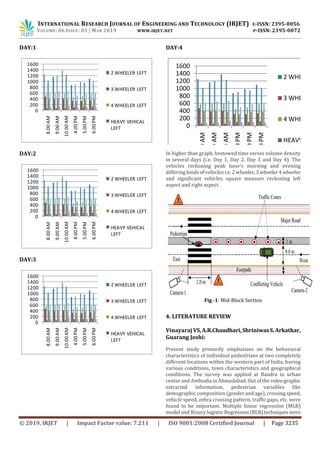
Vehicles Counting
The various knowledge collected within the sort of vehicles
reckoning is portrayed as per the subsequent Bar graphs,
Day 1 to Day 4 knowledge square measure portrayed as
follows:
INTERNATIONAL RESEARCH JOURNAL OF ENGINEERING AND TECHNOLOGY (IRJET) E-ISSN: 2395-0056
VOLUME: 06 ISSUE: 03 | MAR 2019 WWW.IRJET.NET P-ISSN: 2395-0072
© 2019, IRJET | Impact Factor value: 7.211 | ISO 9001:2008 Certified Journal | Page 3235
DAY:1
0
200
400
600
800
1000
1200
1400
1600
8.00AM
9.00AM
10.00AM
4.00PM
5.00PM
6.00PM
2 WHEELER LEFT
3 WHEELER LEFT
4 WHEELER LEFT
HEAVY VEHICAL
LEFT
DAY:2
0
200
400
600
800
1000
1200
1400
1600
8.00AM
9.00AM
10.00AM
4.00PM
5.00PM
6.00PM
2 WHEELER LEFT
3 WHEELER LEFT
4 WHEELER LEFT
HEAVY VEHICAL
LEFT
DAY:3
0
200
400
600
800
1000
1200
1400
1600
8.00AM
9.00AM
10.00AM
4.00PM
5.00PM
6.00PM
2 WHEELER LEFT
3 WHEELER LEFT
4 WHEELER LEFT
HEAVY VEHICAL
LEFT
DAY:4
0
200
400
600
800
1000
1200
1400
1600
8.00AM
9.00AM
10.00AM
4.00PM
5.00PM
6.00PM
2 WHEELER L
3 WHEELER L
4 WHEELER L
HEAVY VEHIC
LEFT
In higher than graph, bestowed time verses volume density
in several days (i.e. Day 1, Day 2, Day 3 and Day 4). The
vehicles reckoning peak hour’s morning and evening
differing kinds of vehicles i.e. 2 wheeler,3 wheeler4wheeler
and significant vehicles square measure reckoning left
aspect and right aspect.
Fig -1: Mid-Block Section
4. LITERATURE REVIEW
Vinayaraj VS,A.R.Chaudhari,ShriniwasS.Arkatkar,
Guarang Joshi:
Present study primarily emphasizes on the behavioral
characteristics of individual pedestrians at two completely
different locations within the western part of India, having
various conditions, town characteristics and geographical
conditions. The survey was applied at Bandra in urban
center and Anthodia in Ahmadabad. Out of the videographic
extracted information, pedestrian variables like
demographic composition (gender and age), crossingspeed,
vehicle speed, zebra crossing pattern, traffic gaps, etc. were
found to be important. Multiple linear regression (MLR)
model and Binary logistic Regression(BLR)techniqueswere
INTERNATIONAL RESEARCH JOURNAL OF ENGINEERING AND TECHNOLOGY (IRJET) E-ISSN: 2395-0056
VOLUME: 06 ISSUE: 03 | MAR 2019 WWW.IRJET.NET P-ISSN: 2395-0072
© 2019, IRJET | Impact Factor value: 7.211 | ISO 9001:2008 Certified Journal | Page 3236
utilized in order to analyses the impact of various
parameters on the traffic gap accepted by pedestrian and
therefore the call of pedestrian. Thereby,tocrosstheroador
not severally. it absolutely was found that the accepted gap
depends on the pedestrian rolling gap, pedestrian platoon
size, pedestrian speed vehicle space and incoming vehicle
speed. during thismodel,vehiclespeedandpedestrianspeed
were a lot of sensitive. Here, similar to increase in vehicle
speed, pedestrian speed gets reduced. Binary logistic
regression (BLR) technique disclosed that the choice of the
pedestrian whether or not to cross the road depends on the
gap size of car, space of car, vehicle speed, gender, cluster
size of pedestrian, crossing path amendment and crossing
speed amendment. moreover, as vehicle speed will increase
the chance to cross the road decreases(disutility).Thiscould
be the result of their age-related crossing capabilities
additionally as their higher safety consciousness.
Pedestrian’s individual characteristics were found to be
insignificant and solely gender was found to possess impact
of gap acceptance. this study additionally observes that the
pedestrians are acceptive transport gaps with regard to
vehicle speed.
Nate Vander Broke:
in summary, a midblock path provides pedestrians a safer
and a lot of visible thanks to cross a street than crossing at a
random and infrequently dangerous location. Midblock
crosswalks are most helpful in suburbs and areas wherever
it’s common to seek out long stretches while not
intersections. Midblock crosswalks ought to be settled
wherever there's significant traffic and major destinations,
like faculties, looking centres, or transit stops. whereas all
midblock crosswalks should be marked, they will even be
increased with medians, refuge islands, signals, signs,
lighting and curb extensions. Before considering a midblock
path, read the laws as expressed within the MUTCD to
envision if the midblock path is critical and what options,
like indication, ought to be used. and eventually, think about
old and disabled people within the style of the midblock
path. the utilization of passive sensors rather than push
buttons helps pedestrians who have trouble reaching or
pushing buttons, and an audible indicator helps the visually
impaired.
RaghuramKadali, TadiChiranjeevi, Rankireddy
Rajesh:
The transport flow characteristics were studiedatun-signal
sized mid-block zebra crossing and pedestrian unrestricted
crossing in Guntur, India. The transport speeds were
implicitly affected with zebra crossing in comparison to
while not zebra crossing location undermined traffic
conditions. The theoretical capability is considerably
reduced with pedestrian crossingsforautomobile.However,
increase in capability is ascertained with pedestrian
crossings just in case of two-wheeler. The underlying reality
is that the variation of the speed of the automobile and two-
wheeler. just in case of machine cart (three-wheeler)
additionally there's a big drop of speed price. From this
study, it over that the automobile and machine cart driver
yielding to pedestrians in terms of speed is a lot of in
comparison to the 2 wheeler drivers. the rise in reduction of
car speed considerably affects the period of transport
drivers and it any has influence on the fuel consumption.
However, the driving force yield behaviour is that the trade-
off between pedestrian safety and transport flow
characteristics. This study clearly indicates that the
importance of zebra crossing facilities and therefore the
barrier result on the transport flow characteristics. The
judgment of segregating pedestrians from trafficoughtto be
supported the amount of pedestrian accidents,outlawzebra
crossing and demand of pedestrian additionallyastransport
flow. However, this study has some limitations, during this
study the result of zebra crossing on the significant vehicle
isn't self-addressed thanks to less significant vehicle flow at
chosen location. This study result's restricted to single
location of 4-lane divide road characteristics. there's a
requirement to review the opposite path locations with
varied road pure mathematics and path varieties. it's
additionally necessary to handle the result of pedestrian
behavioral characteristics (change in pedestrian speed
additionally as crossing path) on transport characteristic
underneath mixed traffic condition. In spite of those
limitations, this study result has nice inferences for zebra
crossing facilities for urban designing policies and style
practices for dominant the zebra crossings additionally as
correct location for the pedestrian crossing underneath
mixed traffic conditions.
5. EXPECTED OUTCOMES
The following are the expected outcomes are as follows:
1. to produce crossover across approaching traffic finish of
the corner’s radius for folks will safely crossing the road
among 3 phases.
2. to produce signal with traffic police.
3. Traffic marking and islands ought to be provided as per
demand.
6. REFERENCES
[1] Ashalatha, R, and Chandra S, "Critical gap through
clearing behavior of drivers at un-signalized intersections."
KSCE Journal of Civil Engineering 15, no.8,1427-1434,2011
[2] Asaithambi et al “pedestrian road crossing behavior
under mixed traffic conditions: A comparative study of an
intersection before and after implementing control
measures” TIDE Journal of Civil Engineering 15,no.8,16-23,
2016.
[3] Bradu,D., Mundlak Y. Estimation in lognormal linear
models. Journal of the American Statistical Association 65,
pp. 198-21,1970
INTERNATIONAL RESEARCH JOURNAL OF ENGINEERING AND TECHNOLOGY (IRJET) E-ISSN: 2395-0056
VOLUME: 06 ISSUE: 03 | MAR 2019 WWW.IRJET.NET P-ISSN: 2395-0072
© 2019, IRJET | Impact Factor value: 7.211 | ISO 9001:2008 Certified Journal | Page 3237
[4] Brewer, Marcus, Kay Fitzpatrick, Jeffrey Whitacre, and
Dominique Lord. "Exploration of pedestrian gap-acceptance
behavior at selected locations." Transportation Research
Record: Journal of the Transportation ResearchBoard1982,
132-140, 2006
[5] Brilon, Werner, Ralph Koenig, and Rod J. Troutbeck.
"Useful estimation procedures for critical gaps."
Transportation Research Part A: Policy and Practice 33, no.
3, 1999
[6] Chandra, Satish, RajatRastogi, and Vivek R. Das.
"Descriptive and parametric analysis of pedestrian gap
acceptance in mixed traffic conditions." KSCE journal of civil
engineering 18, no. 1, 2014
[7] Cherry, C. and Moore, S.E. “Characterizing illegal
midblock pedestrian crossings in China. Jerusalem, Israel”:
International Conference on Safety and Mobility of
Vulnerable Road Users: Pedestrians, Motorcyclists, and
Bicyclists (2010).
[8] DiPietro, M., and King, L., Pedestrian gap-acceptance,
Highway Research Record 308, pp. 80–91, 1970
[9] Hamed, M. M. “Analysis of pedestrians‟ behaviour at
pedestrian crossings.” Safety Sci., 63–82, 2001
[10]Highway capacity manual, Washington, DC:
Transportation Research Board, 2010.

IRJET- Traffic Study on Mid-Block Section & Intersection

  • 1.
    INTERNATIONAL RESEARCH JOURNALOF ENGINEERING AND TECHNOLOGY (IRJET) E-ISSN: 2395-0056 VOLUME: 06 ISSUE: 03 | MAR 2019 WWW.IRJET.NET P-ISSN: 2395-0072 © 2019, IRJET | Impact Factor value: 7.211 | ISO 9001:2008 Certified Journal | Page 3233 Traffic Study on Mid-Block Section & Intersection Lakhan Verma1, Prof. Shashikant Dhobale2 1M.E. Student, Department of Civil Engineering, JIT Borawan khargone, (M.P.), India 2Asst. Professor, Department of Civil Engineering, JIT Borawan khargone, (M.P.), India ----------------------------------------------------------------------***--------------------------------------------------------------------- Abstract - Traffic has mature in recently years with urbanization. Within the recent situation traffic is that the major consent for any developing nation. Vehicle crashes square measure a serious concern in quickly growing urban agglomerations. They even have attracted the eye of researchers, academicians, andpolicy manufacturers. Increase in these areas has been a lot of speedy in recently, thanks to the saturation of population inside town space and also the ensuant large-scale industrial development within the peripheral areas. soit’snecessarytoprovideattentiontowards transportation and study the necessity for higher geometric style, capacity, signals, route marking, street lighting etc. during this constant quantity study, level of service(LOS) of various phase has been much disbursed in post office chouraha, gaaytri mandir tiraha, shreekrishna talkies tiraha, bistan road tiraha(near sabji mandi) and navgrah mandir tiraha destination points facing heaviest traffic issues. Expected resolution we tend to get from outcome is result in potential improvement of traffic within the kind of either growth of dimension of roads, construction of fly over or by- pass, improvement of signal style. The study would be primarily divided into 2 sections with initial sectionfocusinga lot of on a mid-block section and also the later phase on intersection mentioned higher than. Key Words: Introduction, Aim and Objectives, Goals of Study, Methodology, Experimental Work,LiteratureReview, Expected Outcomes, References. 1. INTRODUCTION Vehicular use has continually been the first suggests that of human. And that’s why we have a tendencytothought-about the conveyance area unit the essential parts of transportation. In ancient ages there wasa largeconveyance movement turn up and movement is that the mode of transportation. Foreachtransportassociatedwithtravel and journeys should begin and finish. The conveyance travel is an efficient mode of transportation for brief visits and long visits. Movement of conveyance could be a tonality of transportation in cities additionally. so as to produce the most effective style areas for human motion or circulation like at move for movement Capitol Hill station and movement the work facet and work the movement to tour etc. for that conveyance motion is studied through empirical observation all told aspects. It’s frenzied by 2 levels. At large level one will analyse the essential flow parameters like speed, density of conveyance motion and at microscopic level one could track the ways followed by individual conveyance whereas moving severally. From this it's clear that the conveyance could produce own ways in their journey trip. Coming back to the conveyance crosswalks there have been many cross road like intersection area unit designed for a road, offer paying work to help the conveyance to maneuver from one facettotheoppositefacet of road, and that plays a major role within the quality and safety mode of signalized intersections. In another places like wherever the busy traffic takes place, conveyance select the middle blocks to cross the road. However there's no safety as compared to signalized intersections. Even several conveyance cross roads area unit going down in these midblock sections. Depend upon the conveyance travel motion demand road breadth is outlined. Some existing manuals area unit printed regarding the road breadth, however they are doing not offer clear specifications for the desired road breadth, conveyance relating to completely different demand volumes and properties. Conveyance flow consists of 2 sorts, one-way and bifacial. In one-way flow, conveyance motion is in one direction solely, whereas in bifacial conveyance will travel from the each direction and act with one another. Conveyance road safetyisoneinall the most important aspects of transportation engineering in urban areas. The extralegal crossing behaviour of the conveyance could be a major truth within the road safety issue. The thesis here is concentrated on developing conveyance motion which might describe the conveyance interaction at the cross sections. For that vehicle flow interaction at many intersections was collected knowledge from post office chouraha, gaaytri mandir tiraha, shreekrishna talkies tiraha, bistan road tiraha(near sabji mandi) and navgrah mandir tiraha. These experimental studies are going to be mentioned. 1.1 AIM AND OBJECTIVES To improvement of mid-block section and road intersection at post office chouraha, gaaytri mandir tiraha, shreekrishna talkies tiraha, bistan road tiraha(near sabji mandi) and navgrah mandir tiraha to regulate the traffic volume and its downside by traffic style. The objectives of the currentstudy area unit as under: 1. to review the traffic volume of the mid-block section and intersection. 2. to review the road condition. 3. to review the present emptying conditionofthe mid-block section Road sites.
  • 2.
    INTERNATIONAL RESEARCH JOURNALOF ENGINEERING AND TECHNOLOGY (IRJET) E-ISSN: 2395-0056 VOLUME: 06 ISSUE: 03 | MAR 2019 WWW.IRJET.NET P-ISSN: 2395-0072 © 2019, IRJET | Impact Factor value: 7.211 | ISO 9001:2008 Certified Journal | Page 3234 4. to review the present condition of residencelivingcloseto the location of study space WHO will have the matter with the work. 5. To perform record search, website investigation and knowledge assortment to spot existing utilities within the space. 1.2 GOALS OF STUDY 1. Climate protection. 2. Healthy and safe communities. 3. Reduces intersection crash types. 4. Transportation system effectiveness. 5. Improved traffic flow by avoiding collisions and obstruction congestion delays. 6. Facilitates complicated and risky traffic movements at 'X' and 'T' intersections. 7. Attenuates or reduces disturbing noise generated by vehicle horns and automatic warning devices. 2. METHODOLOGY Data Collection 1. The Traffic Volume at post office chouraha mid-block section, information are disbursed. 2. The Traffic Flow Survey at mid-block section FromTime8 AM To 11AM. Additionally evening 4 PM To 7 PM. 3. The Traffic at Junction principally In Early Morning and In Afternoon. Most Traffic issues of Junction Is occurred By Animals, Pedestrian, and significant Vehicle & Parking. to resolve issues of Traffic the bridge or subway ought to be provided. Traffic investigation technique Two strategies are on the market for conducting traffic volume counts: (1) Manual count and (2) Automatic count Manual counts are generally accustomedgatherinformation for determination of auto classification, turningmovements, direction of travel, pedestrian movements, or vehicle occupancy. Automatic counts are generally accustomed gather information for determination of auto hourly patterns, daily or seasonal differences and growth trends, or annual traffic estimates. The choice of study technique ought to be determined mistreatment the count amount. The count amount ought to be representative of the time of day, day of month, and month of year for the study space. for instance, counts at a summer resort wouldn't be taken in January. The count amount ought to avoid special event or compromising atmospheric condition (Sharma 1994). Count periods could vary from five minutes to one year.Typical countperiods are quarter-hour or a pair of hours for peak periods, four hours for morning and afternoon peaks, six hours for morning, midday, and afternoon peaks, and twelve hours for daytime periods (Robertson1994). for instance, if you were conducting a 2-hour peak amount count, 8 to 15- minute counts would be requiring. Manual count method Most applications of manual counts need little samples of knowledge at any given location. Manual countsaretypically used once the trouble and expense of machine-driven instrumentation aren't even. Manual counts are necessary once automatic instrumentation isn't on the market.Manual counts are generally used for periods of but on a daily basis. traditional intervals for a manual count are 5,10,orquarter- hour. Traffic counts throughout a Monday morning time of day and a weekday evening time of day could show exceptionally high volumes and aren't usually employed in analysis; thus, counts are sometimes conducted on a Tuesday, Wednesday, or Thursday. Manual Counts Recording Methods Manual counts are recorded mistreatment one among 3 methods: tally sheets, mechanical counting boards, or Electronic counting boards. Automatic count method This method is fully based on automatic system. In this method the data will be recorded automatically by videographic images and sensors on the zebra crossings which records the no. of vehicles passes away. Tally Sheets Recording information into tally sheets is that the simplest suggests that of conducting manual counts. the information are often recorded with a tick mark on a pre-prepared field type. A watch or timer is important tolivethe requiredcount interval. 3. EXPERIMENTAL WORK Vehicles Counting The various knowledge collected within the sort of vehicles reckoning is portrayed as per the subsequent Bar graphs, Day 1 to Day 4 knowledge square measure portrayed as follows:
  • 3.
    INTERNATIONAL RESEARCH JOURNALOF ENGINEERING AND TECHNOLOGY (IRJET) E-ISSN: 2395-0056 VOLUME: 06 ISSUE: 03 | MAR 2019 WWW.IRJET.NET P-ISSN: 2395-0072 © 2019, IRJET | Impact Factor value: 7.211 | ISO 9001:2008 Certified Journal | Page 3235 DAY:1 0 200 400 600 800 1000 1200 1400 1600 8.00AM 9.00AM 10.00AM 4.00PM 5.00PM 6.00PM 2 WHEELER LEFT 3 WHEELER LEFT 4 WHEELER LEFT HEAVY VEHICAL LEFT DAY:2 0 200 400 600 800 1000 1200 1400 1600 8.00AM 9.00AM 10.00AM 4.00PM 5.00PM 6.00PM 2 WHEELER LEFT 3 WHEELER LEFT 4 WHEELER LEFT HEAVY VEHICAL LEFT DAY:3 0 200 400 600 800 1000 1200 1400 1600 8.00AM 9.00AM 10.00AM 4.00PM 5.00PM 6.00PM 2 WHEELER LEFT 3 WHEELER LEFT 4 WHEELER LEFT HEAVY VEHICAL LEFT DAY:4 0 200 400 600 800 1000 1200 1400 1600 8.00AM 9.00AM 10.00AM 4.00PM 5.00PM 6.00PM 2 WHEELER L 3 WHEELER L 4 WHEELER L HEAVY VEHIC LEFT In higher than graph, bestowed time verses volume density in several days (i.e. Day 1, Day 2, Day 3 and Day 4). The vehicles reckoning peak hour’s morning and evening differing kinds of vehicles i.e. 2 wheeler,3 wheeler4wheeler and significant vehicles square measure reckoning left aspect and right aspect. Fig -1: Mid-Block Section 4. LITERATURE REVIEW Vinayaraj VS,A.R.Chaudhari,ShriniwasS.Arkatkar, Guarang Joshi: Present study primarily emphasizes on the behavioral characteristics of individual pedestrians at two completely different locations within the western part of India, having various conditions, town characteristics and geographical conditions. The survey was applied at Bandra in urban center and Anthodia in Ahmadabad. Out of the videographic extracted information, pedestrian variables like demographic composition (gender and age), crossingspeed, vehicle speed, zebra crossing pattern, traffic gaps, etc. were found to be important. Multiple linear regression (MLR) model and Binary logistic Regression(BLR)techniqueswere
  • 4.
    INTERNATIONAL RESEARCH JOURNALOF ENGINEERING AND TECHNOLOGY (IRJET) E-ISSN: 2395-0056 VOLUME: 06 ISSUE: 03 | MAR 2019 WWW.IRJET.NET P-ISSN: 2395-0072 © 2019, IRJET | Impact Factor value: 7.211 | ISO 9001:2008 Certified Journal | Page 3236 utilized in order to analyses the impact of various parameters on the traffic gap accepted by pedestrian and therefore the call of pedestrian. Thereby,tocrosstheroador not severally. it absolutely was found that the accepted gap depends on the pedestrian rolling gap, pedestrian platoon size, pedestrian speed vehicle space and incoming vehicle speed. during thismodel,vehiclespeedandpedestrianspeed were a lot of sensitive. Here, similar to increase in vehicle speed, pedestrian speed gets reduced. Binary logistic regression (BLR) technique disclosed that the choice of the pedestrian whether or not to cross the road depends on the gap size of car, space of car, vehicle speed, gender, cluster size of pedestrian, crossing path amendment and crossing speed amendment. moreover, as vehicle speed will increase the chance to cross the road decreases(disutility).Thiscould be the result of their age-related crossing capabilities additionally as their higher safety consciousness. Pedestrian’s individual characteristics were found to be insignificant and solely gender was found to possess impact of gap acceptance. this study additionally observes that the pedestrians are acceptive transport gaps with regard to vehicle speed. Nate Vander Broke: in summary, a midblock path provides pedestrians a safer and a lot of visible thanks to cross a street than crossing at a random and infrequently dangerous location. Midblock crosswalks are most helpful in suburbs and areas wherever it’s common to seek out long stretches while not intersections. Midblock crosswalks ought to be settled wherever there's significant traffic and major destinations, like faculties, looking centres, or transit stops. whereas all midblock crosswalks should be marked, they will even be increased with medians, refuge islands, signals, signs, lighting and curb extensions. Before considering a midblock path, read the laws as expressed within the MUTCD to envision if the midblock path is critical and what options, like indication, ought to be used. and eventually, think about old and disabled people within the style of the midblock path. the utilization of passive sensors rather than push buttons helps pedestrians who have trouble reaching or pushing buttons, and an audible indicator helps the visually impaired. RaghuramKadali, TadiChiranjeevi, Rankireddy Rajesh: The transport flow characteristics were studiedatun-signal sized mid-block zebra crossing and pedestrian unrestricted crossing in Guntur, India. The transport speeds were implicitly affected with zebra crossing in comparison to while not zebra crossing location undermined traffic conditions. The theoretical capability is considerably reduced with pedestrian crossingsforautomobile.However, increase in capability is ascertained with pedestrian crossings just in case of two-wheeler. The underlying reality is that the variation of the speed of the automobile and two- wheeler. just in case of machine cart (three-wheeler) additionally there's a big drop of speed price. From this study, it over that the automobile and machine cart driver yielding to pedestrians in terms of speed is a lot of in comparison to the 2 wheeler drivers. the rise in reduction of car speed considerably affects the period of transport drivers and it any has influence on the fuel consumption. However, the driving force yield behaviour is that the trade- off between pedestrian safety and transport flow characteristics. This study clearly indicates that the importance of zebra crossing facilities and therefore the barrier result on the transport flow characteristics. The judgment of segregating pedestrians from trafficoughtto be supported the amount of pedestrian accidents,outlawzebra crossing and demand of pedestrian additionallyastransport flow. However, this study has some limitations, during this study the result of zebra crossing on the significant vehicle isn't self-addressed thanks to less significant vehicle flow at chosen location. This study result's restricted to single location of 4-lane divide road characteristics. there's a requirement to review the opposite path locations with varied road pure mathematics and path varieties. it's additionally necessary to handle the result of pedestrian behavioral characteristics (change in pedestrian speed additionally as crossing path) on transport characteristic underneath mixed traffic condition. In spite of those limitations, this study result has nice inferences for zebra crossing facilities for urban designing policies and style practices for dominant the zebra crossings additionally as correct location for the pedestrian crossing underneath mixed traffic conditions. 5. EXPECTED OUTCOMES The following are the expected outcomes are as follows: 1. to produce crossover across approaching traffic finish of the corner’s radius for folks will safely crossing the road among 3 phases. 2. to produce signal with traffic police. 3. Traffic marking and islands ought to be provided as per demand. 6. REFERENCES [1] Ashalatha, R, and Chandra S, "Critical gap through clearing behavior of drivers at un-signalized intersections." KSCE Journal of Civil Engineering 15, no.8,1427-1434,2011 [2] Asaithambi et al “pedestrian road crossing behavior under mixed traffic conditions: A comparative study of an intersection before and after implementing control measures” TIDE Journal of Civil Engineering 15,no.8,16-23, 2016. [3] Bradu,D., Mundlak Y. Estimation in lognormal linear models. Journal of the American Statistical Association 65, pp. 198-21,1970
  • 5.
    INTERNATIONAL RESEARCH JOURNALOF ENGINEERING AND TECHNOLOGY (IRJET) E-ISSN: 2395-0056 VOLUME: 06 ISSUE: 03 | MAR 2019 WWW.IRJET.NET P-ISSN: 2395-0072 © 2019, IRJET | Impact Factor value: 7.211 | ISO 9001:2008 Certified Journal | Page 3237 [4] Brewer, Marcus, Kay Fitzpatrick, Jeffrey Whitacre, and Dominique Lord. "Exploration of pedestrian gap-acceptance behavior at selected locations." Transportation Research Record: Journal of the Transportation ResearchBoard1982, 132-140, 2006 [5] Brilon, Werner, Ralph Koenig, and Rod J. Troutbeck. "Useful estimation procedures for critical gaps." Transportation Research Part A: Policy and Practice 33, no. 3, 1999 [6] Chandra, Satish, RajatRastogi, and Vivek R. Das. "Descriptive and parametric analysis of pedestrian gap acceptance in mixed traffic conditions." KSCE journal of civil engineering 18, no. 1, 2014 [7] Cherry, C. and Moore, S.E. “Characterizing illegal midblock pedestrian crossings in China. Jerusalem, Israel”: International Conference on Safety and Mobility of Vulnerable Road Users: Pedestrians, Motorcyclists, and Bicyclists (2010). [8] DiPietro, M., and King, L., Pedestrian gap-acceptance, Highway Research Record 308, pp. 80–91, 1970 [9] Hamed, M. M. “Analysis of pedestrians‟ behaviour at pedestrian crossings.” Safety Sci., 63–82, 2001 [10]Highway capacity manual, Washington, DC: Transportation Research Board, 2010.