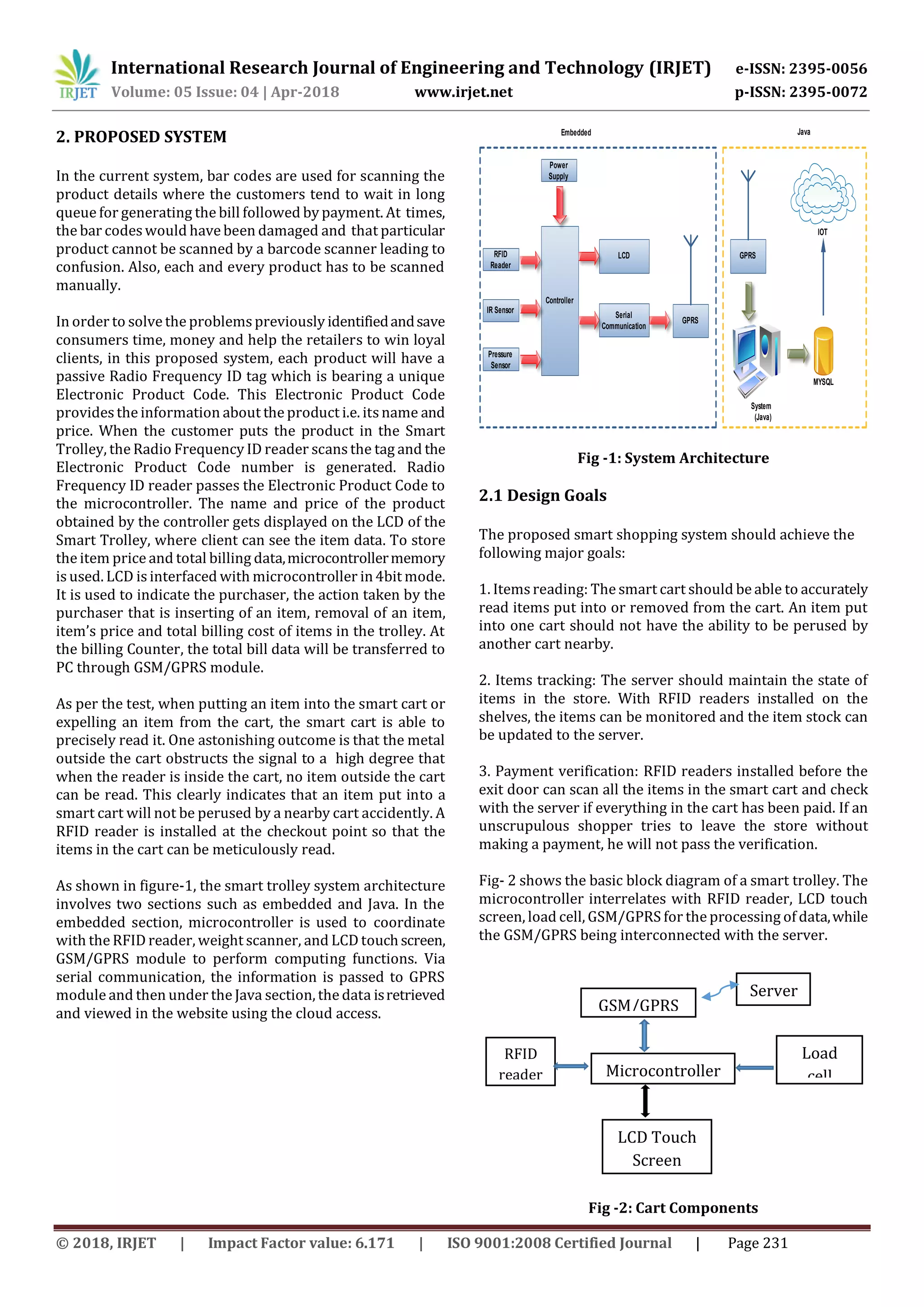
International Research Journal of Engineering and Technology (IRJET) e-ISSN: 2395-0056
Volume: 05 Issue: 04 | Apr-2018 www.irjet.net p-ISSN: 2395-0072
© 2018, IRJET | Impact Factor value: 6.171 | ISO 9001:2008 Certified Journal | Page 230
Smart Trolley System for Automated Billing using RFID and IoT
Pritha N1 , Sahana S1* , Selvin Stephy N1* , Shiny Rose S1* , Unnamalai S1*
1Assistant Professor, Department of Electronics & Communication Engineering, Panimalar Engineering College,
Chennai -600123, Tamil Nadu, India.
1*UG Students, Department of Electronics & Communication Engineering, Panimalar Engineering College,
Chennai -600123, Tamil Nadu, India.
---------------------------------------------------------------------***---------------------------------------------------------------------
Abstract - An automated smart shopping system is formed
by introducing the concept of IoT to connect all items in the
grocery shop. In this system, an inexpensive RFID tag is
embedded within each product. When the product is placed
into a smart cart, the product detail is automatically read by
the cart equipped with an RFID reader. Hence, billing is made
from the shopping cart itself preventing customers from
waiting in a long queue at checkout. Also, expiry date of the
product is displayed and the damaged products can be
identified with respect to its weight. Thus, expired and
damaged products will not be considered for bill calculation.
In addition to that, smart shelving is added to this system by
introducing RFID readers that can monitor stock, perhaps
updating a central server. Thus, inventory management
becomes easier. Finally, the checkout points can validate the
purchase made by a client. A prototype of a smart shopping
system is also presented in this paper.
Key Words: RFID tag, IoT, smart shopping, smart cart,
grocery shop.
1.INTRODUCTION
In the world of Internet of Things (IoT), interactions among
physical objects have become a reality. Day to day items
would now be able to be outfitted with computing power
and communication functionalities, permitting objects
everywhere to be associated with one another. This has
brought a new revolution in industrial, financial and
environmental systems and triggered great challenges in
data management, wireless communications and real-time
decision making [1]. Also, numeroussecurity andprotection
issues have risen and lightweight cryptographic techniques
are in high demand to fit in with IoT applications. There has
been a lot of IoT experimentation on various applications
such as smart homes, e-health frameworks, wearable
gadgets, and so on [2]-[4]. This paper centersaroundasmart
shopping framework based on Radio Frequency
Identification (RFID) technology [5]. All things available to
be purchased are joined with a RFID tag, so they can be
tracked by any gadget outfitted with a RFID reader in the
store. This brings the accompanying advantages:
1) Items put into a smart shopping cart (with RFID perusing
capacity) can be read by default and the billing information
is generated. Subsequently, clients do not have to hold up in
long lines at checkout.
2) Smart racks that are likewise outfitted with RFID readers
can screen every single loaded item and send item status
updates to the server. At the point when items wind up sold
out, the server can tell representatives to restock.
The utilization of ultra high frequency (UHF) RFID
technology [6] is proposed in the smart shopping
framework, as UHF passive tags have a more drawn out
range from 1 to 12 meters. Past research on the design of
smart shopping frameworks principally centered around
utilizing low/high frequency RFID [7]– [14], which have
insufficient ranges and leave clientstophysicallycheckitems
with a RFID scanner. In this proposed framework, each
smart cart is furnished with an UHF RFID reader, a
microcontroller, a LCD touch screen, a GSM/GPRS module,
and a load cell. The smart cart is able to automatically read
the items put into a cart via the RFID reader. A micro
controller is installed on the cart for data processing and a
LCD touch screen is equipped as user interface. In order for
the smart cart to communicate with the server, we have
chosen GSM/GPRS technology. We also have a load cell
(weight scanner) installed on the smart cart for weighing
items. The weight scanner also helps do a securitycheck.For
example, if a malicioususer peelsoff one item’s RFIDtagand
puts it into the cart, an extra unaccounted weight will be
added. When shopping has been done by a customer, the
payment can be made at the checkout point using the billing
data generated on the smart cart. An RFID reader is kept
before the exit door in order to check if all the items in the
cart have been paid for. Security and privacy issues related
to smart shopping system are considered. Wireless
communicationsamong the server, smartcartsanditemsare
vulnerable to various attacks. If there is no proper security
method, an adversary can easily intrude with the
communication process. Privacy issues also exist ie., the
competitor of a store might get easy access to the circulation
of commodities for financial strategy and customer
preferences can be inferred by easily collecting the product
information in shoppers’ shopping carts.
The paper is organized as follows. Section 2 describes the
proposed system. Section 3 summarizestheprocessingsteps
in grocery store. The variousoutputs obtained areexplained
under section 4. We conclude this paperwithfutureresearch
discussion in section 5.
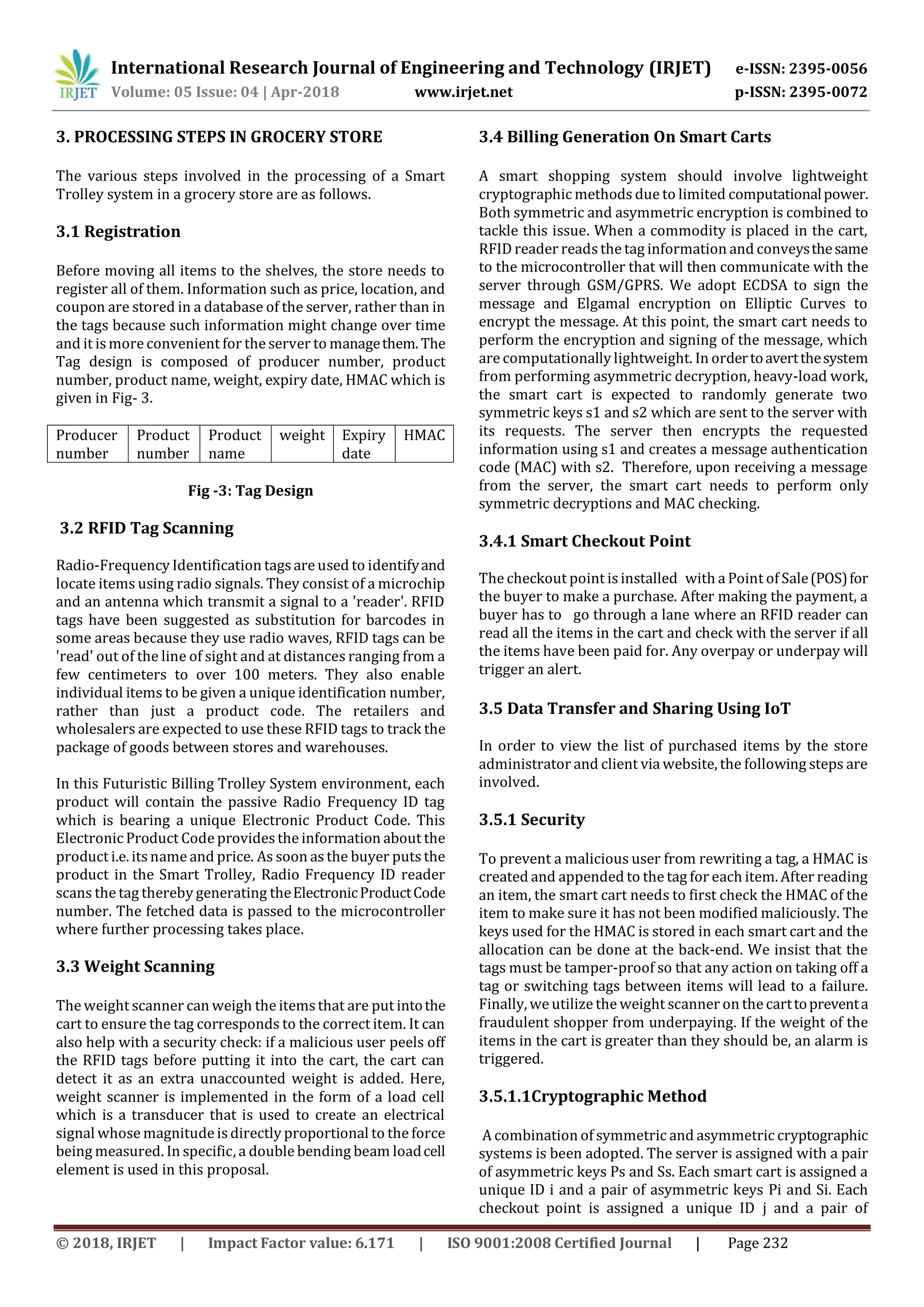
International Research Journal of Engineering and Technology (IRJET) e-ISSN: 2395-0056
Volume: 05 Issue: 04 | Apr-2018 www.irjet.net p-ISSN: 2395-0072
© 2018, IRJET | Impact Factor value: 6.171 | ISO 9001:2008 Certified Journal | Page 231
2. PROPOSED SYSTEM
In the current system, bar codes are used for scanning the
product details where the customers tend to wait in long
queue for generating the bill followed by payment. At times,
the bar codes would have been damaged and that particular
product cannot be scanned by a barcode scanner leading to
confusion. Also, each and every product has to be scanned
manually.
In order to solve the problemspreviously identifiedandsave
consumers time, money and help the retailers to win loyal
clients, in this proposed system, each product will have a
passive Radio Frequency ID tag which is bearing a unique
Electronic Product Code. This Electronic Product Code
provides the information about the product i.e. itsname and
price. When the customer puts the product in the Smart
Trolley, the Radio Frequency ID reader scans the tag and the
Electronic Product Code number is generated. Radio
Frequency ID reader passes the Electronic Product Code to
the microcontroller. The name and price of the product
obtained by the controller gets displayed on the LCD of the
Smart Trolley, where client can see the item data. To store
the item price and total billing data,microcontrollermemory
is used. LCD is interfaced with microcontroller in4bit mode.
It is used to indicate the purchaser, the action taken by the
purchaser that is inserting of an item, removal of an item,
item’s price and total billing cost of items in the trolley. At
the billing Counter, the total bill data will be transferred to
PC through GSM/GPRS module.
As per the test, when putting an item into the smart cart or
expelling an item from the cart, the smart cart is able to
precisely read it. One astonishing outcome is that the metal
outside the cart obstructs the signal to a high degree that
when the reader is inside the cart, no item outside the cart
can be read. This clearly indicates that an item put into a
smart cart will not be perused by a nearby cart accidently. A
RFID reader is installed at the checkout point so that the
items in the cart can be meticulously read.
As shown in figure-1, the smart trolley system architecture
involves two sections such as embedded and Java. In the
embedded section, microcontroller is used to coordinate
with the RFID reader, weight scanner, and LCD touch screen,
GSM/GPRS module to perform computing functions. Via
serial communication, the information is passed to GPRS
module and then under the Java section, the data isretrieved
and viewed in the website using the cloud access.
RFID
Reader
Controller
Power
Supply
Serial
Communication
GPRS
GPRS
System
(Java)
MYSQL
IOT
Embedded Java
IR Sensor
Pressure
Sensor
LCD
Fig -1: System Architecture
2.1 Design Goals
The proposed smart shopping system should achieve the
following major goals:
1. Itemsreading: The smart cart should be able to accurately
read items put into or removed from the cart. An item put
into one cart should not have the ability to be perused by
another cart nearby.
2. Items tracking: The server should maintain the state of
items in the store. With RFID readers installed on the
shelves, the items can be monitored and the item stock can
be updated to the server.
3. Payment verification: RFID readers installed before the
exit door can scan all the items in the smart cart and check
with the server if everything in the cart has been paid. If an
unscrupulous shopper tries to leave the store without
making a payment, he will not pass the verification.
Fig- 2 shows the basic block diagram of a smart trolley. The
microcontroller interrelates with RFID reader, LCD touch
screen, load cell, GSM/GPRS for the processing of data,while
the GSM/GPRS being interconnected with the server.
Fig -2: Cart Components
GSM/GPRS
RFID
reader Microcontroller
Load
cell
(Weight
Scanner)
LCD Touch
Screen
Server
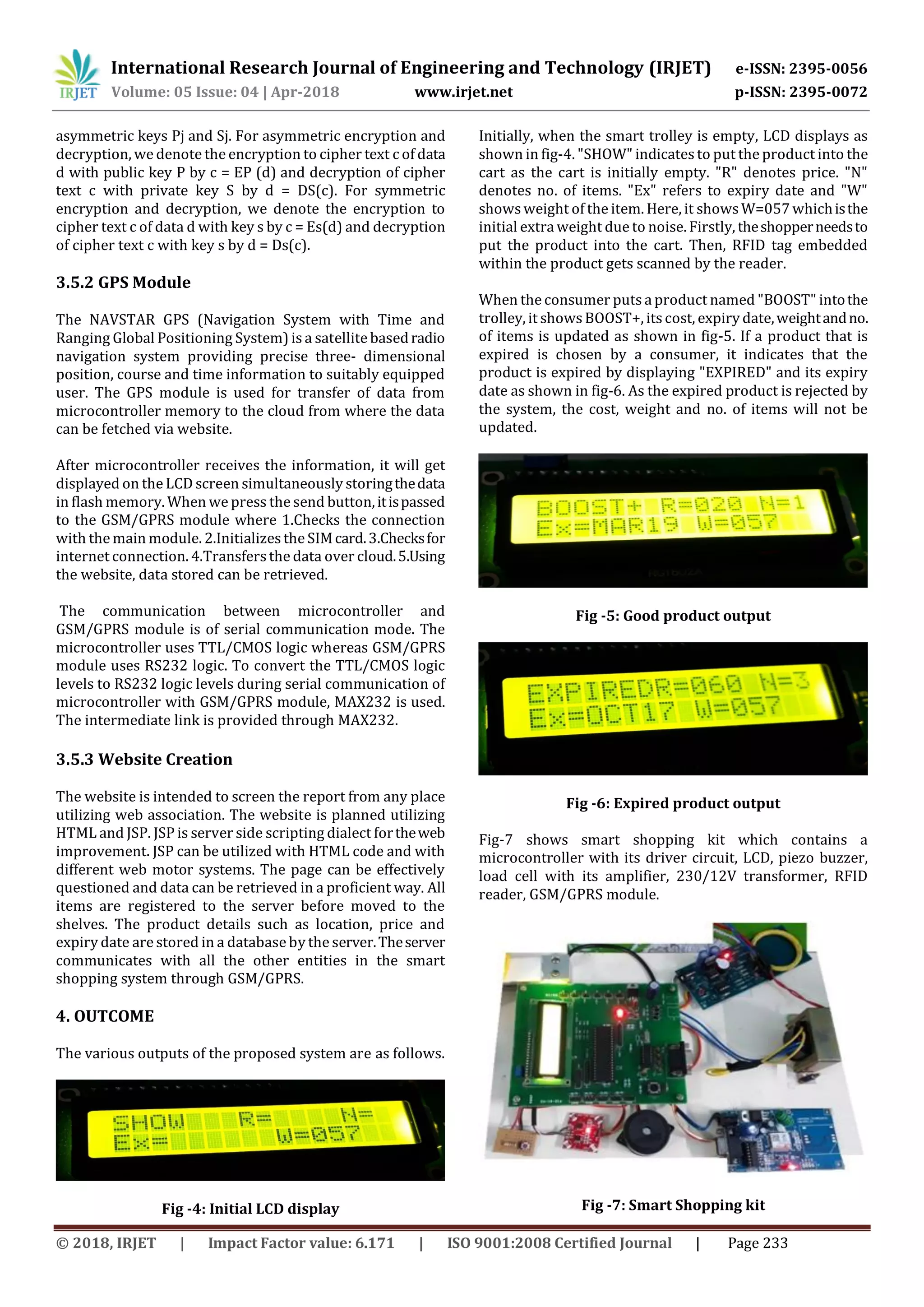
International Research Journal of Engineering and Technology (IRJET) e-ISSN: 2395-0056
Volume: 05 Issue: 04 | Apr-2018 www.irjet.net p-ISSN: 2395-0072
© 2018, IRJET | Impact Factor value: 6.171 | ISO 9001:2008 Certified Journal | Page 232
3. PROCESSING STEPS IN GROCERY STORE
The various steps involved in the processing of a Smart
Trolley system in a grocery store are as follows.
3.1 Registration
Before moving all items to the shelves, the store needs to
register all of them. Information such as price, location, and
coupon are stored in a database of the server, rather than in
the tags because such information might change over time
and it is more convenient for the server to managethem.The
Tag design is composed of producer number, product
number, product name, weight, expiry date, HMAC which is
given in Fig- 3.
Producer
number
Product
number
Product
name
weight Expiry
date
HMAC
Fig -3: Tag Design
3.2 RFID Tag Scanning
Radio-Frequency Identification tagsare used to identifyand
locate items using radio signals. They consist of a microchip
and an antenna which transmit a signal to a 'reader'. RFID
tags have been suggested as substitution for barcodes in
some areas because they use radio waves, RFID tags can be
'read' out of the line of sight and at distances ranging from a
few centimeters to over 100 meters. They also enable
individual items to be given a unique identification number,
rather than just a product code. The retailers and
wholesalers are expected to use these RFID tags to track the
package of goods between stores and warehouses.
In this Futuristic Billing Trolley System environment, each
product will contain the passive Radio Frequency ID tag
which is bearing a unique Electronic Product Code. This
Electronic Product Code providesthe information about the
product i.e. its name and price. As soon asthe buyer puts the
product in the Smart Trolley, Radio Frequency ID reader
scans the tag thereby generating theElectronicProductCode
number. The fetched data is passed to the microcontroller
where further processing takes place.
3.3 Weight Scanning
The weight scanner can weigh the itemsthat are put intothe
cart to ensure the tag corresponds to the correct item. It can
also help with a security check: if a malicious user peels off
the RFID tags before putting it into the cart, the cart can
detect it as an extra unaccounted weight is added. Here,
weight scanner is implemented in the form of a load cell
which is a transducer that is used to create an electrical
signal whose magnitude is directly proportional to the force
being measured. In specific, a double bending beam loadcell
element is used in this proposal.
3.4 Billing Generation On Smart Carts
A smart shopping system should involve lightweight
cryptographic methods due to limited computationalpower.
Both symmetric and asymmetric encryption is combined to
tackle this issue. When a commodity is placed in the cart,
RFID reader readsthe tag information and conveysthesame
to the microcontroller that will then communicate with the
server through GSM/GPRS. We adopt ECDSA to sign the
message and Elgamal encryption on Elliptic Curves to
encrypt the message. At this point, the smart cart needs to
perform the encryption and signing of the message, which
are computationally lightweight. In ordertoavertthesystem
from performing asymmetric decryption, heavy-load work,
the smart cart is expected to randomly generate two
symmetric keys s1 and s2 which are sent to the server with
its requests. The server then encrypts the requested
information using s1 and creates a message authentication
code (MAC) with s2. Therefore, upon receiving a message
from the server, the smart cart needs to perform only
symmetric decryptions and MAC checking.
3.4.1 Smart Checkout Point
The checkout point is installed with a Point of Sale(POS)for
the buyer to make a purchase. After making the payment, a
buyer has to go through a lane where an RFID reader can
read all the items in the cart and check with the server if all
the items have been paid for. Any overpay or underpay will
trigger an alert.
3.5 Data Transfer and Sharing Using IoT
In order to view the list of purchased items by the store
administrator and client via website, the following steps are
involved.
3.5.1 Security
To prevent a malicious user from rewriting a tag, a HMAC is
created and appended to the tag for each item. After reading
an item, the smart cart needs to first check the HMAC of the
item to make sure it has not been modified maliciously. The
keys used for the HMAC is stored in each smart cart and the
allocation can be done at the back-end. We insist that the
tags must be tamper-proof so that any action on taking off a
tag or switching tags between items will lead to a failure.
Finally, we utilize the weight scanner on the carttopreventa
fraudulent shopper from underpaying. If the weight of the
items in the cart is greater than they should be, an alarm is
triggered.
3.5.1.1Cryptographic Method
A combination of symmetric and asymmetric cryptographic
systems is been adopted. The server is assigned with a pair
of asymmetric keys Ps and Ss. Each smart cart is assigned a
unique ID i and a pair of asymmetric keys Pi and Si. Each
checkout point is assigned a unique ID j and a pair of
International Research Journal of Engineering and Technology (IRJET) e-ISSN: 2395-0056
Volume: 05 Issue: 04 | Apr-2018 www.irjet.net p-ISSN: 2395-0072
© 2018, IRJET | Impact Factor value: 6.171 | ISO 9001:2008 Certified Journal | Page 233
asymmetric keys Pj and Sj. For asymmetric encryption and
decryption, we denote the encryption to cipher text c of data
d with public key P by c = EP (d) and decryption of cipher
text c with private key S by d = DS(c). For symmetric
encryption and decryption, we denote the encryption to
cipher text c of data d with key s by c = Es(d) and decryption
of cipher text c with key s by d = Ds(c).
3.5.2 GPS Module
The NAVSTAR GPS (Navigation System with Time and
Ranging Global Positioning System) is a satellite basedradio
navigation system providing precise three- dimensional
position, course and time information to suitably equipped
user. The GPS module is used for transfer of data from
microcontroller memory to the cloud from where the data
can be fetched via website.
After microcontroller receives the information, it will get
displayed on the LCD screen simultaneously storingthedata
in flash memory. When we press the send button,itispassed
to the GSM/GPRS module where 1.Checks the connection
with the main module. 2.Initializesthe SIMcard.3.Checksfor
internet connection. 4.Transfersthe data over cloud.5.Using
the website, data stored can be retrieved.
The communication between microcontroller and
GSM/GPRS module is of serial communication mode. The
microcontroller uses TTL/CMOS logic whereas GSM/GPRS
module uses RS232 logic. To convert the TTL/CMOS logic
levels to RS232 logic levels during serial communication of
microcontroller with GSM/GPRS module, MAX232 is used.
The intermediate link is provided through MAX232.
3.5.3 Website Creation
The website is intended to screen the report from any place
utilizing web association. The website is planned utilizing
HTML and JSP. JSP is server side scripting dialect fortheweb
improvement. JSP can be utilized with HTML code and with
different web motor systems. The page can be effectively
questioned and data can be retrieved in a proficient way. All
items are registered to the server before moved to the
shelves. The product details such as location, price and
expiry date are stored in a database by the server.Theserver
communicates with all the other entities in the smart
shopping system through GSM/GPRS.
4. OUTCOME
The various outputs of the proposed system are as follows.
Fig -4: Initial LCD display
Initially, when the smart trolley is empty, LCD displays as
shown in fig-4. "SHOW" indicatesto put the product into the
cart as the cart is initially empty. "R" denotes price. "N"
denotes no. of items. "Ex" refers to expiry date and "W"
showsweight of the item. Here, it showsW=057whichisthe
initial extra weight due to noise. Firstly, theshopperneedsto
put the product into the cart. Then, RFID tag embedded
within the product gets scanned by the reader.
When the consumer puts a product named "BOOST" intothe
trolley, it showsBOOST+, itscost, expiry date,weightandno.
of items is updated as shown in fig-5. If a product that is
expired is chosen by a consumer, it indicates that the
product is expired by displaying "EXPIRED" and its expiry
date as shown in fig-6. As the expired product is rejected by
the system, the cost, weight and no. of items will not be
updated.
Fig -5: Good product output
Fig -6: Expired product output
Fig-7 shows smart shopping kit which contains a
microcontroller with its driver circuit, LCD, piezo buzzer,
load cell with its amplifier, 230/12V transformer, RFID
reader, GSM/GPRS module.
Fig -7: Smart Shopping kit
International Research Journal of Engineering and Technology (IRJET) e-ISSN: 2395-0056
Volume: 05 Issue: 04 | Apr-2018 www.irjet.net p-ISSN: 2395-0072
© 2018, IRJET | Impact Factor value: 6.171 | ISO 9001:2008 Certified Journal | Page 234
Finally, as soon as the purchase is over, the customer is
supposed to press the send button and thus the bill of the
purchased items is transferred via GSM/GPRS and stored in
the database. Then, the same can be retrieved using a
website as given in fig-8 and 9. The user hasto enter into the
shop's website and login. Thus, the bill of the items
purchased gets displayed. Online payment can also be done
by giving the account details. In case of payment by cash, the
purchaser has to go through a lane and pay the bill in the
billing section of the shop.
Fig -8: Website result
Fig -9: List of products purchased
5. CONCLUSION
In this proposed paper, a secure smart shopping system
utilizing RFID technology is employedinenhancingshopping
experiences and security issues. The smart shelves are able
to monitor the items on the shelves by reading the RFID
signals from the tags. The smart carts are able to read and
retrieve information of the itemsinside the carts and finally,
the checkout points can validate the purchase made by a
customer.
REFERENCES
[1] F. Xia, L. T. Yang, L. Wang, and A. Vinel, “Internet of
things,” International Journal of Communication Systems,
vol. 25, no. 9, p. 1101, 2012.
[2] P. Castillejo, J.-F. Martinez, J. Rodriguez-Molina, and A.
Cuerva, “Integration of wearable devicesinawirelesssensor
network for an e-health application,” IEEE Wireless
Communications, vol. 20, no. 4, pp. 38–49, 2013.
[3] N. Mitton, S. Papavassiliou, A. Puliafito, and K. S. Trivedi,
“Combining cloud and sensorsin a smart city environment,”
EURASIP journal on Wireless Communications and
Networking, vol. 2012, no. 1, p. 1, 2012.
[4] T. Song, R. Li, X. Xing, J. Yu, and X. Cheng, “A privacy
preserving communication protocol for iot applications in
smart homes,” in to appear in International Conference on
Identification, Information and Knowledge in the Internetof
Things (IIKI) 2016, 2016.
[5] S. Shepard, RFID: radio frequency identification.McGraw
Hill Professional, 2005.
[6] D. M. Dobkin, The rf in RFID: uhf RFID in practice.
Newnes, 2012.
[7] D. Klabjan and J. Pei, “In-store one-to-one marketing,”
Journal of Retailing and Consumer Services, vol. 18,no.1,pp.
64–73, 2011.
[8] T. Shanmugapriyan, “Smart cart to recognize objects
based on user intention,” International Journal of Advanced
Research in Computer and Communication Engineering,vol.
2, no. 5, 2013.
[9] R. Kumar, K. Gopalakrishna, and K. Ramesha, “Intelligent
shopping cart,” International Journal of Engineering Science
and Innovative Technology, vol. 2, no. 4, pp. 499–507, 2013.
[10] S. Gupta, A. Kaur, A. Garg, A. Verma, A. Bansal, and A.
Singh, “Arduino based smart cart,” International Journal of
Advanced Research in Computer Engineering & Technology,
vol. 2, no. 12, 2013.
[11] Z. Ali and R. Sonkusare, “Rfid based smart shoppingand
billing,” International Journal of Advanced Research in
Computer and Communication Engineering,vol.2,no.12,pp.
4696–4699, 2013.
[12] P. Chandrasekar and T. Sangeetha, “Smartshoppingcart
with automatic billing system through rfid and zigbee,” in
Information Communication and Embedded Systems
(ICICES), 2014 International Conference on.
IEEE, 2014, pp. 1–4.
[13] M. R. Sawant, K. Krishnan, S. Bhokre, and P. Bhosale,
“The rfid based smart shopping cart,” International Journal
of Engineering Research and General Science, vol. 3, no. 2,
pp. 275–280, 2015.
[14] A. Yewatkar, F. Inamdar, R. Singh, A. Bandal et al.,
“Smart cart with automatic billing, product information,
product recommendation using rfid & zigbee with anti-
theft,” Procedia Computer Science, vol. 79, pp. 793–800,
2016.

IRJET- Smart Trolley System for Automated Billing using RFID and IoT

  • 1.
    International Research Journalof Engineering and Technology (IRJET) e-ISSN: 2395-0056 Volume: 05 Issue: 04 | Apr-2018 www.irjet.net p-ISSN: 2395-0072 © 2018, IRJET | Impact Factor value: 6.171 | ISO 9001:2008 Certified Journal | Page 230 Smart Trolley System for Automated Billing using RFID and IoT Pritha N1 , Sahana S1* , Selvin Stephy N1* , Shiny Rose S1* , Unnamalai S1* 1Assistant Professor, Department of Electronics & Communication Engineering, Panimalar Engineering College, Chennai -600123, Tamil Nadu, India. 1*UG Students, Department of Electronics & Communication Engineering, Panimalar Engineering College, Chennai -600123, Tamil Nadu, India. ---------------------------------------------------------------------***--------------------------------------------------------------------- Abstract - An automated smart shopping system is formed by introducing the concept of IoT to connect all items in the grocery shop. In this system, an inexpensive RFID tag is embedded within each product. When the product is placed into a smart cart, the product detail is automatically read by the cart equipped with an RFID reader. Hence, billing is made from the shopping cart itself preventing customers from waiting in a long queue at checkout. Also, expiry date of the product is displayed and the damaged products can be identified with respect to its weight. Thus, expired and damaged products will not be considered for bill calculation. In addition to that, smart shelving is added to this system by introducing RFID readers that can monitor stock, perhaps updating a central server. Thus, inventory management becomes easier. Finally, the checkout points can validate the purchase made by a client. A prototype of a smart shopping system is also presented in this paper. Key Words: RFID tag, IoT, smart shopping, smart cart, grocery shop. 1.INTRODUCTION In the world of Internet of Things (IoT), interactions among physical objects have become a reality. Day to day items would now be able to be outfitted with computing power and communication functionalities, permitting objects everywhere to be associated with one another. This has brought a new revolution in industrial, financial and environmental systems and triggered great challenges in data management, wireless communications and real-time decision making [1]. Also, numeroussecurity andprotection issues have risen and lightweight cryptographic techniques are in high demand to fit in with IoT applications. There has been a lot of IoT experimentation on various applications such as smart homes, e-health frameworks, wearable gadgets, and so on [2]-[4]. This paper centersaroundasmart shopping framework based on Radio Frequency Identification (RFID) technology [5]. All things available to be purchased are joined with a RFID tag, so they can be tracked by any gadget outfitted with a RFID reader in the store. This brings the accompanying advantages: 1) Items put into a smart shopping cart (with RFID perusing capacity) can be read by default and the billing information is generated. Subsequently, clients do not have to hold up in long lines at checkout. 2) Smart racks that are likewise outfitted with RFID readers can screen every single loaded item and send item status updates to the server. At the point when items wind up sold out, the server can tell representatives to restock. The utilization of ultra high frequency (UHF) RFID technology [6] is proposed in the smart shopping framework, as UHF passive tags have a more drawn out range from 1 to 12 meters. Past research on the design of smart shopping frameworks principally centered around utilizing low/high frequency RFID [7]– [14], which have insufficient ranges and leave clientstophysicallycheckitems with a RFID scanner. In this proposed framework, each smart cart is furnished with an UHF RFID reader, a microcontroller, a LCD touch screen, a GSM/GPRS module, and a load cell. The smart cart is able to automatically read the items put into a cart via the RFID reader. A micro controller is installed on the cart for data processing and a LCD touch screen is equipped as user interface. In order for the smart cart to communicate with the server, we have chosen GSM/GPRS technology. We also have a load cell (weight scanner) installed on the smart cart for weighing items. The weight scanner also helps do a securitycheck.For example, if a malicioususer peelsoff one item’s RFIDtagand puts it into the cart, an extra unaccounted weight will be added. When shopping has been done by a customer, the payment can be made at the checkout point using the billing data generated on the smart cart. An RFID reader is kept before the exit door in order to check if all the items in the cart have been paid for. Security and privacy issues related to smart shopping system are considered. Wireless communicationsamong the server, smartcartsanditemsare vulnerable to various attacks. If there is no proper security method, an adversary can easily intrude with the communication process. Privacy issues also exist ie., the competitor of a store might get easy access to the circulation of commodities for financial strategy and customer preferences can be inferred by easily collecting the product information in shoppers’ shopping carts. The paper is organized as follows. Section 2 describes the proposed system. Section 3 summarizestheprocessingsteps in grocery store. The variousoutputs obtained areexplained under section 4. We conclude this paperwithfutureresearch discussion in section 5.
  • 2.
    International Research Journalof Engineering and Technology (IRJET) e-ISSN: 2395-0056 Volume: 05 Issue: 04 | Apr-2018 www.irjet.net p-ISSN: 2395-0072 © 2018, IRJET | Impact Factor value: 6.171 | ISO 9001:2008 Certified Journal | Page 231 2. PROPOSED SYSTEM In the current system, bar codes are used for scanning the product details where the customers tend to wait in long queue for generating the bill followed by payment. At times, the bar codes would have been damaged and that particular product cannot be scanned by a barcode scanner leading to confusion. Also, each and every product has to be scanned manually. In order to solve the problemspreviously identifiedandsave consumers time, money and help the retailers to win loyal clients, in this proposed system, each product will have a passive Radio Frequency ID tag which is bearing a unique Electronic Product Code. This Electronic Product Code provides the information about the product i.e. itsname and price. When the customer puts the product in the Smart Trolley, the Radio Frequency ID reader scans the tag and the Electronic Product Code number is generated. Radio Frequency ID reader passes the Electronic Product Code to the microcontroller. The name and price of the product obtained by the controller gets displayed on the LCD of the Smart Trolley, where client can see the item data. To store the item price and total billing data,microcontrollermemory is used. LCD is interfaced with microcontroller in4bit mode. It is used to indicate the purchaser, the action taken by the purchaser that is inserting of an item, removal of an item, item’s price and total billing cost of items in the trolley. At the billing Counter, the total bill data will be transferred to PC through GSM/GPRS module. As per the test, when putting an item into the smart cart or expelling an item from the cart, the smart cart is able to precisely read it. One astonishing outcome is that the metal outside the cart obstructs the signal to a high degree that when the reader is inside the cart, no item outside the cart can be read. This clearly indicates that an item put into a smart cart will not be perused by a nearby cart accidently. A RFID reader is installed at the checkout point so that the items in the cart can be meticulously read. As shown in figure-1, the smart trolley system architecture involves two sections such as embedded and Java. In the embedded section, microcontroller is used to coordinate with the RFID reader, weight scanner, and LCD touch screen, GSM/GPRS module to perform computing functions. Via serial communication, the information is passed to GPRS module and then under the Java section, the data isretrieved and viewed in the website using the cloud access. RFID Reader Controller Power Supply Serial Communication GPRS GPRS System (Java) MYSQL IOT Embedded Java IR Sensor Pressure Sensor LCD Fig -1: System Architecture 2.1 Design Goals The proposed smart shopping system should achieve the following major goals: 1. Itemsreading: The smart cart should be able to accurately read items put into or removed from the cart. An item put into one cart should not have the ability to be perused by another cart nearby. 2. Items tracking: The server should maintain the state of items in the store. With RFID readers installed on the shelves, the items can be monitored and the item stock can be updated to the server. 3. Payment verification: RFID readers installed before the exit door can scan all the items in the smart cart and check with the server if everything in the cart has been paid. If an unscrupulous shopper tries to leave the store without making a payment, he will not pass the verification. Fig- 2 shows the basic block diagram of a smart trolley. The microcontroller interrelates with RFID reader, LCD touch screen, load cell, GSM/GPRS for the processing of data,while the GSM/GPRS being interconnected with the server. Fig -2: Cart Components GSM/GPRS RFID reader Microcontroller Load cell (Weight Scanner) LCD Touch Screen Server
  • 3.
    International Research Journalof Engineering and Technology (IRJET) e-ISSN: 2395-0056 Volume: 05 Issue: 04 | Apr-2018 www.irjet.net p-ISSN: 2395-0072 © 2018, IRJET | Impact Factor value: 6.171 | ISO 9001:2008 Certified Journal | Page 232 3. PROCESSING STEPS IN GROCERY STORE The various steps involved in the processing of a Smart Trolley system in a grocery store are as follows. 3.1 Registration Before moving all items to the shelves, the store needs to register all of them. Information such as price, location, and coupon are stored in a database of the server, rather than in the tags because such information might change over time and it is more convenient for the server to managethem.The Tag design is composed of producer number, product number, product name, weight, expiry date, HMAC which is given in Fig- 3. Producer number Product number Product name weight Expiry date HMAC Fig -3: Tag Design 3.2 RFID Tag Scanning Radio-Frequency Identification tagsare used to identifyand locate items using radio signals. They consist of a microchip and an antenna which transmit a signal to a 'reader'. RFID tags have been suggested as substitution for barcodes in some areas because they use radio waves, RFID tags can be 'read' out of the line of sight and at distances ranging from a few centimeters to over 100 meters. They also enable individual items to be given a unique identification number, rather than just a product code. The retailers and wholesalers are expected to use these RFID tags to track the package of goods between stores and warehouses. In this Futuristic Billing Trolley System environment, each product will contain the passive Radio Frequency ID tag which is bearing a unique Electronic Product Code. This Electronic Product Code providesthe information about the product i.e. its name and price. As soon asthe buyer puts the product in the Smart Trolley, Radio Frequency ID reader scans the tag thereby generating theElectronicProductCode number. The fetched data is passed to the microcontroller where further processing takes place. 3.3 Weight Scanning The weight scanner can weigh the itemsthat are put intothe cart to ensure the tag corresponds to the correct item. It can also help with a security check: if a malicious user peels off the RFID tags before putting it into the cart, the cart can detect it as an extra unaccounted weight is added. Here, weight scanner is implemented in the form of a load cell which is a transducer that is used to create an electrical signal whose magnitude is directly proportional to the force being measured. In specific, a double bending beam loadcell element is used in this proposal. 3.4 Billing Generation On Smart Carts A smart shopping system should involve lightweight cryptographic methods due to limited computationalpower. Both symmetric and asymmetric encryption is combined to tackle this issue. When a commodity is placed in the cart, RFID reader readsthe tag information and conveysthesame to the microcontroller that will then communicate with the server through GSM/GPRS. We adopt ECDSA to sign the message and Elgamal encryption on Elliptic Curves to encrypt the message. At this point, the smart cart needs to perform the encryption and signing of the message, which are computationally lightweight. In ordertoavertthesystem from performing asymmetric decryption, heavy-load work, the smart cart is expected to randomly generate two symmetric keys s1 and s2 which are sent to the server with its requests. The server then encrypts the requested information using s1 and creates a message authentication code (MAC) with s2. Therefore, upon receiving a message from the server, the smart cart needs to perform only symmetric decryptions and MAC checking. 3.4.1 Smart Checkout Point The checkout point is installed with a Point of Sale(POS)for the buyer to make a purchase. After making the payment, a buyer has to go through a lane where an RFID reader can read all the items in the cart and check with the server if all the items have been paid for. Any overpay or underpay will trigger an alert. 3.5 Data Transfer and Sharing Using IoT In order to view the list of purchased items by the store administrator and client via website, the following steps are involved. 3.5.1 Security To prevent a malicious user from rewriting a tag, a HMAC is created and appended to the tag for each item. After reading an item, the smart cart needs to first check the HMAC of the item to make sure it has not been modified maliciously. The keys used for the HMAC is stored in each smart cart and the allocation can be done at the back-end. We insist that the tags must be tamper-proof so that any action on taking off a tag or switching tags between items will lead to a failure. Finally, we utilize the weight scanner on the carttopreventa fraudulent shopper from underpaying. If the weight of the items in the cart is greater than they should be, an alarm is triggered. 3.5.1.1Cryptographic Method A combination of symmetric and asymmetric cryptographic systems is been adopted. The server is assigned with a pair of asymmetric keys Ps and Ss. Each smart cart is assigned a unique ID i and a pair of asymmetric keys Pi and Si. Each checkout point is assigned a unique ID j and a pair of
  • 4.
    International Research Journalof Engineering and Technology (IRJET) e-ISSN: 2395-0056 Volume: 05 Issue: 04 | Apr-2018 www.irjet.net p-ISSN: 2395-0072 © 2018, IRJET | Impact Factor value: 6.171 | ISO 9001:2008 Certified Journal | Page 233 asymmetric keys Pj and Sj. For asymmetric encryption and decryption, we denote the encryption to cipher text c of data d with public key P by c = EP (d) and decryption of cipher text c with private key S by d = DS(c). For symmetric encryption and decryption, we denote the encryption to cipher text c of data d with key s by c = Es(d) and decryption of cipher text c with key s by d = Ds(c). 3.5.2 GPS Module The NAVSTAR GPS (Navigation System with Time and Ranging Global Positioning System) is a satellite basedradio navigation system providing precise three- dimensional position, course and time information to suitably equipped user. The GPS module is used for transfer of data from microcontroller memory to the cloud from where the data can be fetched via website. After microcontroller receives the information, it will get displayed on the LCD screen simultaneously storingthedata in flash memory. When we press the send button,itispassed to the GSM/GPRS module where 1.Checks the connection with the main module. 2.Initializesthe SIMcard.3.Checksfor internet connection. 4.Transfersthe data over cloud.5.Using the website, data stored can be retrieved. The communication between microcontroller and GSM/GPRS module is of serial communication mode. The microcontroller uses TTL/CMOS logic whereas GSM/GPRS module uses RS232 logic. To convert the TTL/CMOS logic levels to RS232 logic levels during serial communication of microcontroller with GSM/GPRS module, MAX232 is used. The intermediate link is provided through MAX232. 3.5.3 Website Creation The website is intended to screen the report from any place utilizing web association. The website is planned utilizing HTML and JSP. JSP is server side scripting dialect fortheweb improvement. JSP can be utilized with HTML code and with different web motor systems. The page can be effectively questioned and data can be retrieved in a proficient way. All items are registered to the server before moved to the shelves. The product details such as location, price and expiry date are stored in a database by the server.Theserver communicates with all the other entities in the smart shopping system through GSM/GPRS. 4. OUTCOME The various outputs of the proposed system are as follows. Fig -4: Initial LCD display Initially, when the smart trolley is empty, LCD displays as shown in fig-4. "SHOW" indicatesto put the product into the cart as the cart is initially empty. "R" denotes price. "N" denotes no. of items. "Ex" refers to expiry date and "W" showsweight of the item. Here, it showsW=057whichisthe initial extra weight due to noise. Firstly, theshopperneedsto put the product into the cart. Then, RFID tag embedded within the product gets scanned by the reader. When the consumer puts a product named "BOOST" intothe trolley, it showsBOOST+, itscost, expiry date,weightandno. of items is updated as shown in fig-5. If a product that is expired is chosen by a consumer, it indicates that the product is expired by displaying "EXPIRED" and its expiry date as shown in fig-6. As the expired product is rejected by the system, the cost, weight and no. of items will not be updated. Fig -5: Good product output Fig -6: Expired product output Fig-7 shows smart shopping kit which contains a microcontroller with its driver circuit, LCD, piezo buzzer, load cell with its amplifier, 230/12V transformer, RFID reader, GSM/GPRS module. Fig -7: Smart Shopping kit
  • 5.
    International Research Journalof Engineering and Technology (IRJET) e-ISSN: 2395-0056 Volume: 05 Issue: 04 | Apr-2018 www.irjet.net p-ISSN: 2395-0072 © 2018, IRJET | Impact Factor value: 6.171 | ISO 9001:2008 Certified Journal | Page 234 Finally, as soon as the purchase is over, the customer is supposed to press the send button and thus the bill of the purchased items is transferred via GSM/GPRS and stored in the database. Then, the same can be retrieved using a website as given in fig-8 and 9. The user hasto enter into the shop's website and login. Thus, the bill of the items purchased gets displayed. Online payment can also be done by giving the account details. In case of payment by cash, the purchaser has to go through a lane and pay the bill in the billing section of the shop. Fig -8: Website result Fig -9: List of products purchased 5. CONCLUSION In this proposed paper, a secure smart shopping system utilizing RFID technology is employedinenhancingshopping experiences and security issues. The smart shelves are able to monitor the items on the shelves by reading the RFID signals from the tags. The smart carts are able to read and retrieve information of the itemsinside the carts and finally, the checkout points can validate the purchase made by a customer. REFERENCES [1] F. Xia, L. T. Yang, L. Wang, and A. Vinel, “Internet of things,” International Journal of Communication Systems, vol. 25, no. 9, p. 1101, 2012. [2] P. Castillejo, J.-F. Martinez, J. Rodriguez-Molina, and A. Cuerva, “Integration of wearable devicesinawirelesssensor network for an e-health application,” IEEE Wireless Communications, vol. 20, no. 4, pp. 38–49, 2013. [3] N. Mitton, S. Papavassiliou, A. Puliafito, and K. S. Trivedi, “Combining cloud and sensorsin a smart city environment,” EURASIP journal on Wireless Communications and Networking, vol. 2012, no. 1, p. 1, 2012. [4] T. Song, R. Li, X. Xing, J. Yu, and X. Cheng, “A privacy preserving communication protocol for iot applications in smart homes,” in to appear in International Conference on Identification, Information and Knowledge in the Internetof Things (IIKI) 2016, 2016. [5] S. Shepard, RFID: radio frequency identification.McGraw Hill Professional, 2005. [6] D. M. Dobkin, The rf in RFID: uhf RFID in practice. Newnes, 2012. [7] D. Klabjan and J. Pei, “In-store one-to-one marketing,” Journal of Retailing and Consumer Services, vol. 18,no.1,pp. 64–73, 2011. [8] T. Shanmugapriyan, “Smart cart to recognize objects based on user intention,” International Journal of Advanced Research in Computer and Communication Engineering,vol. 2, no. 5, 2013. [9] R. Kumar, K. Gopalakrishna, and K. Ramesha, “Intelligent shopping cart,” International Journal of Engineering Science and Innovative Technology, vol. 2, no. 4, pp. 499–507, 2013. [10] S. Gupta, A. Kaur, A. Garg, A. Verma, A. Bansal, and A. Singh, “Arduino based smart cart,” International Journal of Advanced Research in Computer Engineering & Technology, vol. 2, no. 12, 2013. [11] Z. Ali and R. Sonkusare, “Rfid based smart shoppingand billing,” International Journal of Advanced Research in Computer and Communication Engineering,vol.2,no.12,pp. 4696–4699, 2013. [12] P. Chandrasekar and T. Sangeetha, “Smartshoppingcart with automatic billing system through rfid and zigbee,” in Information Communication and Embedded Systems (ICICES), 2014 International Conference on. IEEE, 2014, pp. 1–4. [13] M. R. Sawant, K. Krishnan, S. Bhokre, and P. Bhosale, “The rfid based smart shopping cart,” International Journal of Engineering Research and General Science, vol. 3, no. 2, pp. 275–280, 2015. [14] A. Yewatkar, F. Inamdar, R. Singh, A. Bandal et al., “Smart cart with automatic billing, product information, product recommendation using rfid & zigbee with anti- theft,” Procedia Computer Science, vol. 79, pp. 793–800, 2016.