International Research Journal of Engineering and Technology (IRJET) e-ISSN: 2395-0056
Volume: 06 Issue: 03 | Mar 2019 www.irjet.net p-ISSN: 2395-0072
© 2019, IRJET | Impact Factor value: 7.211 | ISO 9001:2008 Certified Journal | Page 3480
Real-time Eye Tracking for Password Authentication
Mr. Kaustubh S. Sawant1, Mr. Pange P.D2
1Student, E&TC Dept. of AMGOI Engineering, Maharashtra, India
2Professor, E&TC Dept. of AMGOI Engineering, Maharashtra, India
---------------------------------------------------------------------***----------------------------------------------------------------------
Abstract - Real-time eye and iris tracking is important for
hands-off gaze-based password entry, instrument control by
paraplegic patients, Internet user studies, aswellashomeland
security applications. Personal identification numbers are
widely used for user authentication and security. Password
authentication using PINs requires users to physically input
the PIN, which could be vulnerable to password cracking via
shoulder surfing or thermal tracking. PIN authenticationwith
hands-off gaze-based PIN entry techniques, on theotherhand,
leaves no physical footprints behindandthereforeofferamore
secure password entry option. Gaze-based authentication
refers to finding the eye location across sequential image
frames, and tracking eye center over time. The purpose of this
work is to enter and identify gaze-based PINs using a smart
camera through real-time eye detection and tracking. NI
Vision Builder and LabVIEW are used for eye tracking and for
recording eye center location on board the camera real-time.
The smart camera allows on-board data processing and
collection. This project presents a real-time application for
gaze-based PIN entry, and eye detection and tracking for PIN
identification using a smart camera.
Keywords —: Smart Camera, Personal Identification
Number Entry, Eye Detection and Tracking, Gaze-based
PIN Identification.
1. INTRODUCTION
The use of personal identification numbers (PINs) is a
common user authentication method for many applications,
such as money management in automatic teller machines
(ATMs), approving electronic transactions, unlocking
personal devices, and opening doors. Flawless identity
authentication remains a challenge even when PIN
authentication is used, such as in financial systems and gate
access control. According to European ATM Security, fraud
attacks on ATMs increased by 26% in2016comparedtothat
of 2015. The fact that an authorizedusermust enterthecode
in open or public places make PIN entry vulnerable to
password attacks, such as shoulder surfing as well as
thermal tracking.
The purpose of this work is to enter and identify gaze-
based PINs using a smart camera through real-time eye
detection and tracking. The experimental evaluation of the
algorithm is also described for eye detection and tracking
under different conditions including different angles of the
face, head motion, and eye occlusions to determine the
usability of the system for real-time applications. NI Vision
Builder and LabVIEW are used for eye tracking and for
recording eye center location on boardthecamera real-time.
The smart camera allows on-board data processing and
collection. Non-contact PIN based authentication adds a
layer of security to physical PIN entries and are expected to
reduce the vulnerability of the authentication process [1].
2. REAL-TIME EYE DETECTION SYSTEM
2.1. Smart Camera
The main component of the eye tracking system is a NI 1762
smart camera with a Computer 12 mm lens and the Gigabit
Ethernet interface as described in previous publications [1],
[2]. The system has previouslybeenusedfor eyedetection to
capture eye patterns of readersofvarious readingskill levels
[3], where the users were asked to read texts while their eye
location was saved on board the smart camera across image
frames. In this particular application, the viewer gazesatthe
digits of a digital key pad (Fig. 1). The camera is locatedright
above the keypad screen with camera lens directly viewing
the user’s eye. LabVIEW 8.5f.1 and VisionBuilderAI3.6have
been used to implement the eye detection algorithm on the
smart camera.
Fig-1. Digital keypad for eye gazing and tracking
The smart camera contains a dual processor which
permits the camera to work well with applications such as
pattern matching, optical character recognition and data
matrix code in real time. The camera is equipped witha 1/3-
inch Sony ICX 424 AL solid-state image sensor. The whole
setup produces high resolution gray-scale images which are
necessary for the implementation of the real-time eye
tracking algorithm. When the smart camera is connected
through FTP or Ethernet hard drive, the data can then be
transferred to other devices. The eye detection algorithm
processes about seven frames per second.Thecamera frame
rate specification is not very stringent for this application,
since the user pauses over each digit for several seconds.
Typical 33 fps or slower cameras could also be used for gaze
International Research Journal of Engineering and Technology (IRJET) e-ISSN: 2395-0056
Volume: 06 Issue: 03 | Mar 2019 www.irjet.net p-ISSN: 2395-0072
© 2019, IRJET | Impact Factor value: 7.211 | ISO 9001:2008 Certified Journal | Page 3481
based password identification. The advantage of the smart
camera system is on-board data capture, processing and
storage.
2.2. Real-time Eye Tracking Algorithm
The camera is programmed to track the eye motion
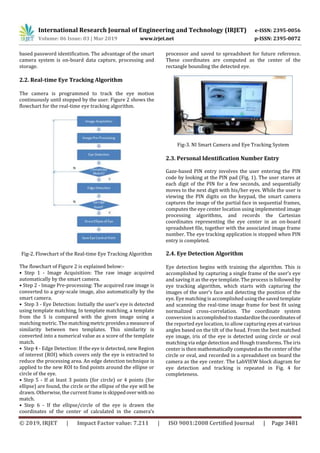
continuously until stopped by the user. Figure 2 shows the
flowchart for the real-time eye tracking algorithm.
Fig-2. Flowchart of the Real-time Eye Tracking Algorithm
The flowchart of Figure 2 is explained below:-
• Step 1 - Image Acquisition: The raw image acquired
automatically by the smart camera.
• Step 2 - Image Pre-processing: The acquired raw image is
converted to a gray-scale image, also automatically by the
smart camera.
• Step 3 - Eye Detection: Initially the user’s eye is detected
using template matching, In template matching, a template
from the S is compared with the given image using a
matching metric. The matchingmetric providesa measureof
similarity between two templates. This similarity is
converted into a numerical value as a score of the template
match.
• Step 4 - Edge Detection: If the eye is detected, new Region
of interest (ROI) which covers only the eye is extracted to
reduce the processing area. An edge detection technique is
applied to the new ROI to find points around the ellipse or
circle of the eye.
• Step 5 - If at least 3 points (for circle) or 4 points (for
ellipse) are found, the circle or the ellipse of the eye will be
drawn. Otherwise, the current frame is skippedoverwith no
match.
• Step 6 - If the ellipse/circle of the eye is drawn the
coordinates of the center of calculated in the camera’s
processor and saved to spreadsheet for future reference.
These coordinates are computed as the center of the
rectangle bounding the detected eye.
Fig-3. NI Smart Camera and Eye Tracking System
2.3. Personal Identification Number Entry
Gaze-based PIN entry involves the user entering the PIN
code by looking at the PIN pad (Fig. 1). The user stares at
each digit of the PIN for a few seconds, and sequentially
moves to the next digit with his/her eyes. While the user is
viewing the PIN digits on the keypad, the smart camera
captures the image of the partial face in sequential frames,
computes the eye center location using implemented image
processing algorithms, and records the Cartesian
coordinates representing the eye center in an on-board
spreadsheet file, together with the associated image frame
number. The eye tracking application is stopped when PIN
entry is completed.
2.4. Eye Detection Algorithm
Eye detection begins with training the algorithm. This is
accomplished by capturing a single frame of the user’s eye
and saving it as the eye template. The process is followed by
eye tracking algorithm, which starts with capturing the
images of the user’s face and detecting the position of the
eye. Eye matching is accomplished using the saved template
and scanning the real-time image frame for best fit using
normalized cross-correlation. The coordinate system
conversion is accomplishedtostandardizethecoordinatesof
the reported eye location, to allow capturing eyes at various
angles based on the tilt of the head. From the best matched
eye image, iris of the eye is detected using circle or oval
matching via edge detection and Hough transforms. The iris
center is then mathematically computed as the center of the
circle or oval, and recorded in a spreadsheet on board the
camera as the eye center. The LabVIEW block diagram for
eye detection and tracking is repeated in Fig. 4 for
completeness.
International Research Journal of Engineering and Technology (IRJET) e-ISSN: 2395-0056
Volume: 06 Issue: 03 | Mar 2019 www.irjet.net p-ISSN: 2395-0072
© 2019, IRJET | Impact Factor value: 7.211 | ISO 9001:2008 Certified Journal | Page 3482
Fig-4. LabVIEW block diagram for eye detection and
tracking
2.5. Gaze-based PIN Identification
For PIN identification,theeyecentercoordinates(horizontal
and vertical) in the spreadsheet is first plotted on a 2D
spreadsheet. Then the data points are grouped using
clustering. This process determines the gazed digits, but not
the order in which they were gazed. To determine the order
of the entered digits, a 3D connected graph is plotted to
demonstrate the order of gazed digits.
3. CONCLUSION
In this paper, we discussed possible way of password
authentication by using real-time eye tracking. A smart-
camera based eye-tracking system has been incorporated
into a new application for gaze-based PIN identification.
REFERENCES
[1] M. Mehrubeoglu, H. T. Bui and L. McLauchlan, “Real-time
iris tracking with a smart camera,” Proc. SPIE 7871, 787104,
2011.
[2] M. Mehrubeoglu, L. M. Pham, H. T. Le, M. Ramchander,
and D. Ryu, “Real-time eye tracking using a smart camera,”
Proc. 2011 IEEE Applied Imagery Pattern Recognition
Workshop (AIPR ‘11), pp. 1-7, 2011.
[3] M. Mehrubeoglu, E. Ortlieb, L. McLauchlan, L. M. Pham,
“Capturing reading patterns through a real-time smart
camera iris tracking system,” Proc. SPIE, vol. 8437, id.
843705, 2012.
[4] R. Revathy and R. Bama, “Advanced Safe PIN-Entry
Against Human Shoulder-Surfing,”IOSR Journal ofComputer
Engineering, vol 17, issue 4, ver. II, pp. 9-15, July-Aug. 2015.
[5] J. Weaver, K. Mock and B. Hoanca,“Gaze-BasedPassword
Authentication through Automatic Clustering of Gaze
Points,” Proc. 2011 IEEE Conf. on Systems, Man and
Cybernetics, Oct.2011.
[6] “ATM Fraud, ATM Black Box Attacks Spread Across
Europe”, European ATM Security Team (E.A.S.T.), online,
posted 11 April 2017.
[7] Smart Cameras for Embedded Machine Vision, (product
information) National Instruments.

IRJET- Real-time Eye Tracking for Password Authentication

  • 1.
    International Research Journalof Engineering and Technology (IRJET) e-ISSN: 2395-0056 Volume: 06 Issue: 03 | Mar 2019 www.irjet.net p-ISSN: 2395-0072 © 2019, IRJET | Impact Factor value: 7.211 | ISO 9001:2008 Certified Journal | Page 3480 Real-time Eye Tracking for Password Authentication Mr. Kaustubh S. Sawant1, Mr. Pange P.D2 1Student, E&TC Dept. of AMGOI Engineering, Maharashtra, India 2Professor, E&TC Dept. of AMGOI Engineering, Maharashtra, India ---------------------------------------------------------------------***---------------------------------------------------------------------- Abstract - Real-time eye and iris tracking is important for hands-off gaze-based password entry, instrument control by paraplegic patients, Internet user studies, aswellashomeland security applications. Personal identification numbers are widely used for user authentication and security. Password authentication using PINs requires users to physically input the PIN, which could be vulnerable to password cracking via shoulder surfing or thermal tracking. PIN authenticationwith hands-off gaze-based PIN entry techniques, on theotherhand, leaves no physical footprints behindandthereforeofferamore secure password entry option. Gaze-based authentication refers to finding the eye location across sequential image frames, and tracking eye center over time. The purpose of this work is to enter and identify gaze-based PINs using a smart camera through real-time eye detection and tracking. NI Vision Builder and LabVIEW are used for eye tracking and for recording eye center location on board the camera real-time. The smart camera allows on-board data processing and collection. This project presents a real-time application for gaze-based PIN entry, and eye detection and tracking for PIN identification using a smart camera. Keywords —: Smart Camera, Personal Identification Number Entry, Eye Detection and Tracking, Gaze-based PIN Identification. 1. INTRODUCTION The use of personal identification numbers (PINs) is a common user authentication method for many applications, such as money management in automatic teller machines (ATMs), approving electronic transactions, unlocking personal devices, and opening doors. Flawless identity authentication remains a challenge even when PIN authentication is used, such as in financial systems and gate access control. According to European ATM Security, fraud attacks on ATMs increased by 26% in2016comparedtothat of 2015. The fact that an authorizedusermust enterthecode in open or public places make PIN entry vulnerable to password attacks, such as shoulder surfing as well as thermal tracking. The purpose of this work is to enter and identify gaze- based PINs using a smart camera through real-time eye detection and tracking. The experimental evaluation of the algorithm is also described for eye detection and tracking under different conditions including different angles of the face, head motion, and eye occlusions to determine the usability of the system for real-time applications. NI Vision Builder and LabVIEW are used for eye tracking and for recording eye center location on boardthecamera real-time. The smart camera allows on-board data processing and collection. Non-contact PIN based authentication adds a layer of security to physical PIN entries and are expected to reduce the vulnerability of the authentication process [1]. 2. REAL-TIME EYE DETECTION SYSTEM 2.1. Smart Camera The main component of the eye tracking system is a NI 1762 smart camera with a Computer 12 mm lens and the Gigabit Ethernet interface as described in previous publications [1], [2]. The system has previouslybeenusedfor eyedetection to capture eye patterns of readersofvarious readingskill levels [3], where the users were asked to read texts while their eye location was saved on board the smart camera across image frames. In this particular application, the viewer gazesatthe digits of a digital key pad (Fig. 1). The camera is locatedright above the keypad screen with camera lens directly viewing the user’s eye. LabVIEW 8.5f.1 and VisionBuilderAI3.6have been used to implement the eye detection algorithm on the smart camera. Fig-1. Digital keypad for eye gazing and tracking The smart camera contains a dual processor which permits the camera to work well with applications such as pattern matching, optical character recognition and data matrix code in real time. The camera is equipped witha 1/3- inch Sony ICX 424 AL solid-state image sensor. The whole setup produces high resolution gray-scale images which are necessary for the implementation of the real-time eye tracking algorithm. When the smart camera is connected through FTP or Ethernet hard drive, the data can then be transferred to other devices. The eye detection algorithm processes about seven frames per second.Thecamera frame rate specification is not very stringent for this application, since the user pauses over each digit for several seconds. Typical 33 fps or slower cameras could also be used for gaze
  • 2.
    International Research Journalof Engineering and Technology (IRJET) e-ISSN: 2395-0056 Volume: 06 Issue: 03 | Mar 2019 www.irjet.net p-ISSN: 2395-0072 © 2019, IRJET | Impact Factor value: 7.211 | ISO 9001:2008 Certified Journal | Page 3481 based password identification. The advantage of the smart camera system is on-board data capture, processing and storage. 2.2. Real-time Eye Tracking Algorithm The camera is programmed to track the eye motion continuously until stopped by the user. Figure 2 shows the flowchart for the real-time eye tracking algorithm. Fig-2. Flowchart of the Real-time Eye Tracking Algorithm The flowchart of Figure 2 is explained below:- • Step 1 - Image Acquisition: The raw image acquired automatically by the smart camera. • Step 2 - Image Pre-processing: The acquired raw image is converted to a gray-scale image, also automatically by the smart camera. • Step 3 - Eye Detection: Initially the user’s eye is detected using template matching, In template matching, a template from the S is compared with the given image using a matching metric. The matchingmetric providesa measureof similarity between two templates. This similarity is converted into a numerical value as a score of the template match. • Step 4 - Edge Detection: If the eye is detected, new Region of interest (ROI) which covers only the eye is extracted to reduce the processing area. An edge detection technique is applied to the new ROI to find points around the ellipse or circle of the eye. • Step 5 - If at least 3 points (for circle) or 4 points (for ellipse) are found, the circle or the ellipse of the eye will be drawn. Otherwise, the current frame is skippedoverwith no match. • Step 6 - If the ellipse/circle of the eye is drawn the coordinates of the center of calculated in the camera’s processor and saved to spreadsheet for future reference. These coordinates are computed as the center of the rectangle bounding the detected eye. Fig-3. NI Smart Camera and Eye Tracking System 2.3. Personal Identification Number Entry Gaze-based PIN entry involves the user entering the PIN code by looking at the PIN pad (Fig. 1). The user stares at each digit of the PIN for a few seconds, and sequentially moves to the next digit with his/her eyes. While the user is viewing the PIN digits on the keypad, the smart camera captures the image of the partial face in sequential frames, computes the eye center location using implemented image processing algorithms, and records the Cartesian coordinates representing the eye center in an on-board spreadsheet file, together with the associated image frame number. The eye tracking application is stopped when PIN entry is completed. 2.4. Eye Detection Algorithm Eye detection begins with training the algorithm. This is accomplished by capturing a single frame of the user’s eye and saving it as the eye template. The process is followed by eye tracking algorithm, which starts with capturing the images of the user’s face and detecting the position of the eye. Eye matching is accomplished using the saved template and scanning the real-time image frame for best fit using normalized cross-correlation. The coordinate system conversion is accomplishedtostandardizethecoordinatesof the reported eye location, to allow capturing eyes at various angles based on the tilt of the head. From the best matched eye image, iris of the eye is detected using circle or oval matching via edge detection and Hough transforms. The iris center is then mathematically computed as the center of the circle or oval, and recorded in a spreadsheet on board the camera as the eye center. The LabVIEW block diagram for eye detection and tracking is repeated in Fig. 4 for completeness.
  • 3.
    International Research Journalof Engineering and Technology (IRJET) e-ISSN: 2395-0056 Volume: 06 Issue: 03 | Mar 2019 www.irjet.net p-ISSN: 2395-0072 © 2019, IRJET | Impact Factor value: 7.211 | ISO 9001:2008 Certified Journal | Page 3482 Fig-4. LabVIEW block diagram for eye detection and tracking 2.5. Gaze-based PIN Identification For PIN identification,theeyecentercoordinates(horizontal and vertical) in the spreadsheet is first plotted on a 2D spreadsheet. Then the data points are grouped using clustering. This process determines the gazed digits, but not the order in which they were gazed. To determine the order of the entered digits, a 3D connected graph is plotted to demonstrate the order of gazed digits. 3. CONCLUSION In this paper, we discussed possible way of password authentication by using real-time eye tracking. A smart- camera based eye-tracking system has been incorporated into a new application for gaze-based PIN identification. REFERENCES [1] M. Mehrubeoglu, H. T. Bui and L. McLauchlan, “Real-time iris tracking with a smart camera,” Proc. SPIE 7871, 787104, 2011. [2] M. Mehrubeoglu, L. M. Pham, H. T. Le, M. Ramchander, and D. Ryu, “Real-time eye tracking using a smart camera,” Proc. 2011 IEEE Applied Imagery Pattern Recognition Workshop (AIPR ‘11), pp. 1-7, 2011. [3] M. Mehrubeoglu, E. Ortlieb, L. McLauchlan, L. M. Pham, “Capturing reading patterns through a real-time smart camera iris tracking system,” Proc. SPIE, vol. 8437, id. 843705, 2012. [4] R. Revathy and R. Bama, “Advanced Safe PIN-Entry Against Human Shoulder-Surfing,”IOSR Journal ofComputer Engineering, vol 17, issue 4, ver. II, pp. 9-15, July-Aug. 2015. [5] J. Weaver, K. Mock and B. Hoanca,“Gaze-BasedPassword Authentication through Automatic Clustering of Gaze Points,” Proc. 2011 IEEE Conf. on Systems, Man and Cybernetics, Oct.2011. [6] “ATM Fraud, ATM Black Box Attacks Spread Across Europe”, European ATM Security Team (E.A.S.T.), online, posted 11 April 2017. [7] Smart Cameras for Embedded Machine Vision, (product information) National Instruments.