International Research Journal of Engineering and Technology (IRJET) e-ISSN: 2395-0056
Volume: 07 Issue: 02 | Feb 2020 www.irjet.net p-ISSN: 2395-0072
© 2020, IRJET | Impact Factor value: 7.34 | ISO 9001:2008 Certified Journal | Page 668
Analysis of Predicting Diseases for Smart Croping
Dicksha Sharma1, Dr K. Channaiah2
1M.Tech. Student, Department of Computer Science Engineering, RAMA University, Kanpur.
2Professor, Department of Computer Science Engineering, RAMA University, Kanpur.
--------------------------------------------------------------------***----------------------------------------------------------------
Abstract-In this work, we clarify a structure for the early discovery of infections in crops from visual side effects. The
explanations for this incorporates climate conditions, obligation, family issues and regular change in Indian government
standards. In some cases, ranchers don't know about the crop which suits their dirt quality, soil supplements, and soil
synthesis. The work proposes to assist ranchers with checking the dirt quality relying upon the investigation done dependent
on the information mining approach. In this way, the framework centres around checking the dirt quality to foresee the
harvest reasonable for development as indicated by their dirt sort and augment the yield by suggesting suitable compost.
Keywords—Smart Farming, Detection, Crop Infection, IoT Architecture System
1. INTRODUCTION
Farming is a significant wellspring of each nation. The generation of horticulture will assume a significant job in the
advancement of the nation. The nation's GDP will get improves by farming generation. Horticulture commitment in India is
about an all-out GDP of 16% and complete fares of 10%. Spine of the Indian economy depends upon the agribusiness
generation. At the point when contrast and the development of different segments, the general portion of Agriculture on
the GDP of the nation has diminished. The general financial situation of India will depend on the agribusiness framework.
These days farming turns out to be most significant because of the expanding populace on the planet. As indicated by the
report by the United Nations of Food and Agriculture Organization the populace will get duplicates in 2050. Countries like
India and China they need to build their horticulture generation because the birth paces of this nation are expanding quick.
The expanded generation of farming will bolster the colossal financial lift to the country. In farming, crop is the significant
nourishment harvest devoured by a larger part of the individuals on the planet, especially in India 70% of the individuals
accepting the rice as their significant nourishment. Our spotlight is going excessively dependent on the crop generation
agribusiness framework. Over the Globe, India positions the second-biggest maker of crop after china. The ranchers face
parcel of issues in the harvests because of the infections. Serious issues in the farming incorporate water issue, climatic
change, bugs and illnesses in the plants [2]. Because of nuisances and infections along the harvest misfortunes up to 37%
consistently. The proposition is going to manage the infections alone. The infections brought about by crop are growths,
microbes, infections, nematode and it happens anyplace crop is developed. Some of the national and worldwide
significance, others happen in neighbourhoods. This proposition manages just infections of national significance which
may cause significant yield misfortunes. The harvest illness location should be possible with the IoT based easy to
understand framework. The Internet of Things (IoT) is going to change the agribusiness business and interfaces the
ranchers to fight with the difficulties they face. Presently the IoT System will address these issues and expanding the
amount of the harvest generation.
2. AUDIT OF LITERATURE
Crop illnesses can influence in various pieces of the plants. The principle tainted pieces of the plant incorporate leaf cutting
edge, panicle and neck hub [3] [4] [5]. From the writing, sicknesses are separated from different applications including
neural systems, fluffy rationale, remote detecting, and SVM. For the most part, suggested procedures are pictured
preparing for crop infections distinguishing proof framework [6]. From the reference of the writing survey, our spotlight
has been made on the IoT based framework utilizing picture preparing for sickness ID. A large measure of data regarding
the matter can be found in the paper [1] Jayme Garcia and Arnal Barbedo (2013).
3. DESIGN OF THE SYSTEM
The real-time images of various crop blast diseases are acquired using a web camera. The interfacing of a camera with
raspberry pi is very easy. The Raspberry pi board is used to process the images of the crops from camera output.
Raspberry pi is perfect for any automation. Then various image-processing methods are applied to the acquired images to
getting useful features that are important for the next analysis process. The image comparison by optimization techniques
using open CV. The architecture of the system shown in the Figure-1. The block diagram is shown in the Figure-2.
International Research Journal of Engineering and Technology (IRJET) e-ISSN: 2395-0056
Volume: 07 Issue: 02 | Feb 2020 www.irjet.net p-ISSN: 2395-0072
© 2020, IRJET | Impact Factor value: 7.34 | ISO 9001:2008 Certified Journal | Page 669
Figure-1. Architecture of the system.
Figure-2. Block diagram of IOT Agriculture
4. PROPOSED TECHNIQUES
The proposition manages IoT based framework utilizing Image preparing methods. First, the pictures are procured
utilizing Web camera and procedure by raspberry pi. When the equipment arrangement finishes the assignment, the
product part will be finished by the picture preparing strategies [3]. The picture gained from the camera and the database
will be pre-handled. Next to the change of RGB to dim scale picture, as dark scale picture gives ideal exactness to surrender
recognition, at that point picture resizing, trailed by picture improvement and edge discovery. At that point, numerous
examination strategy is done to arrange the pictures as per the specific issue within reach. In the last contrasted picture,
sickness will be sent with the Cloud utilizing streamlining procedures. Effectively earlier work exists in the continuous yet
not in the implanted situation. Our proposed work is to advance the calculation to send information to the cloud. Cloud
investigation will be finished by python contents [8] [9].
5. INVESTIGATION AND METHODS
First, we do the fundamental pictures preparing task which incorporates, convert the RGB picture to grayscale, and apply
edge location (Sobel) to recognize sick forms. By coordinating this with a current database, the application gives quick
outcomes on conceivably ailing yields. The looked at pictures will dissect the information, procedure and transmitted to a
brought together cloud server, aside from the confined handling. The cloud stores a movement of pictures both spatially
and transiently variation for further handling. Cloud structure can likewise be used for ailment forecast by distinguishing
conditions preceding the beginning of the yield infection.
International Research Journal of Engineering and Technology (IRJET) e-ISSN: 2395-0056
Volume: 07 Issue: 02 | Feb 2020 www.irjet.net p-ISSN: 2395-0072
© 2020, IRJET | Impact Factor value: 7.34 | ISO 9001:2008 Certified Journal | Page 670
A. INFECTION ARRENGEMENT
The infections can be named a few sorts. A few maladies are impact, bacterial sheath scourge, sheath decay and so on for
exploratory reason we have taken the examples of impact sicknesses influenced rice crops from the database and picture
catch crop. Aggregate of 2 examples taken for thought work which incorporates database picture and procured picture. It
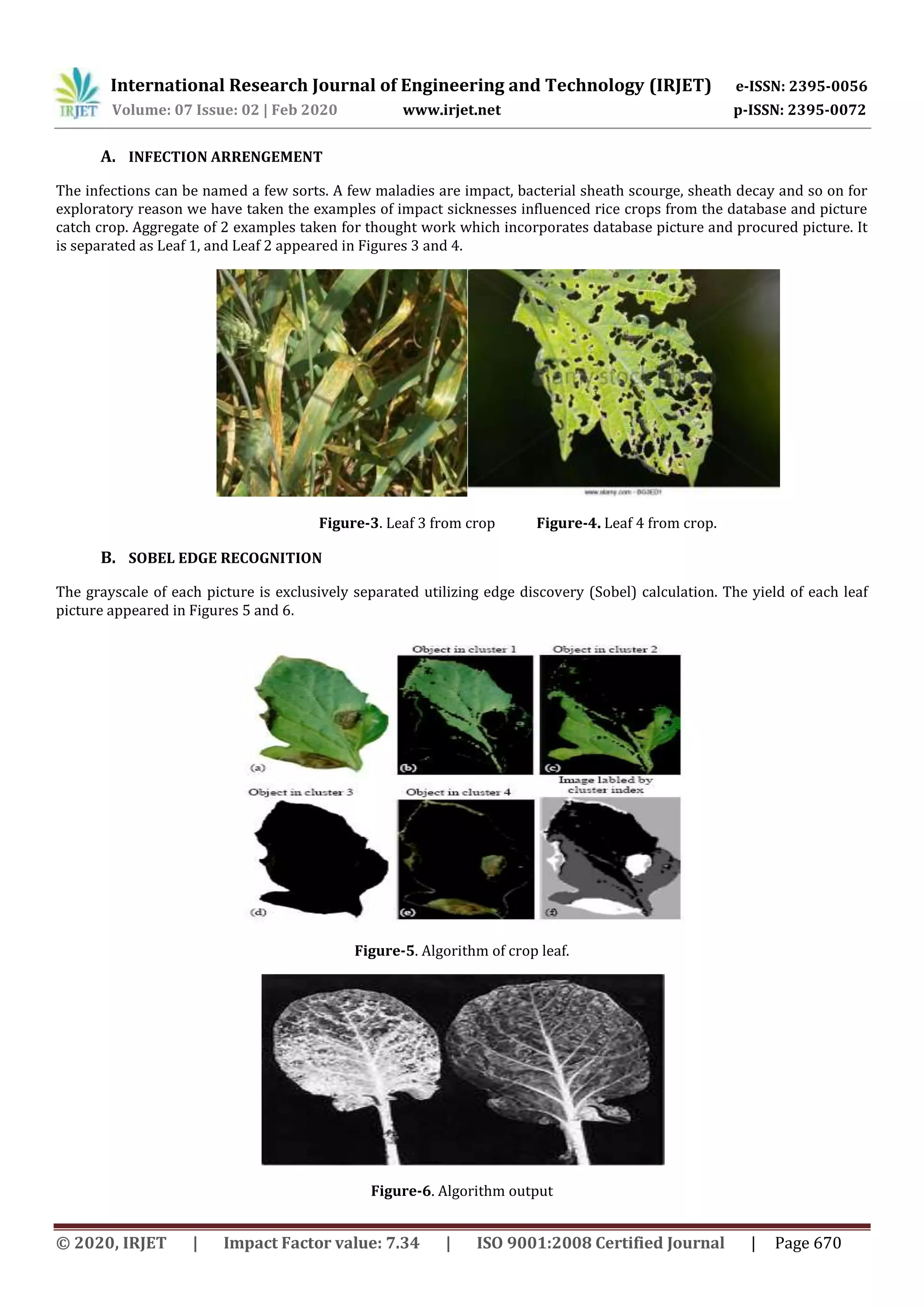
is separated as Leaf 1, and Leaf 2 appeared in Figures 3 and 4.
Figure-3. Leaf 3 from crop Figure-4. Leaf 4 from crop.
B. SOBEL EDGE RECOGNITION
The grayscale of each picture is exclusively separated utilizing edge discovery (Sobel) calculation. The yield of each leaf
picture appeared in Figures 5 and 6.
Figure-5. Algorithm of crop leaf.
Figure-6. Algorithm output
International Research Journal of Engineering and Technology (IRJET) e-ISSN: 2395-0056
Volume: 07 Issue: 02 | Feb 2020 www.irjet.net p-ISSN: 2395-0072
© 2020, IRJET | Impact Factor value: 7.34 | ISO 9001:2008 Certified Journal | Page 671
6. RESULTS AND DISCUSSIONS
We have actualized the structure on an IoT Reference Architecture for nearby on-field infection recognition and cloud
investigation for illness expectation. In this work, we centres around crop impact which is liable for over 37% of crop
misfortune in the Indian subcontinent. The cloud administration is going to execute on Microsoft Azure with the end goal
of illness expectation. Our proposed system can recognize the infection. The cloud expectation system, however, executed,
has not been assessed.
7. CONCLUSION
The fundamental issues are examined about the yield sicknesses for the identification framework. Nearly the work has
been begun to actualize continuously and showed signs of improvement results. The examination is significant in wording
to build the generation of farming framework in India. It is noticed that the advancement of the framework will cause the
ranchers to spare their harvest misfortune from the maladies. At the long last reason, that framework will recognize the
ailments in the previous time and arrange the above maladies and offer data to the ranchers to spare their harvests.
8. FUTURE WORK
The work has been accomplished for crop alone; in the future, the work will be actualized in all yields by a similar
procedure and most likely it will get the great outcomes. While considering different harvests check the side effects of the
infections alone.
9. REFRENCES
[1] Arnal Barbedo, Jayme Garcia. 2013.
[2] Jagadeesh D. Pujari, Rajesh Yakkundimath, Abdulmunaf S. Byadgi. 2015.
[3] S. Mutalib, M. H. Abdullah, S. Abdul-Rahman and Z. A. Aziz. 2016.
[4] D. A. Devi and K. Muthukannan. 2014.
[5] G. Anthonys and N. Wickramarachchi. 2009.
[6] A. A. Joshi and B. D. Jadhav. 2016.
[7] A. Khattab, A. Abdelgawad and K. Yelmarthi. 2016.
[8] A. Tuli, N. Hasteer, M. Sharma and A. Bansal. 2014.
[9] K. A. Patil and N. R. Kale. 2016.
[10] M. Lee, J. Hwang and H. Yoe. 2013.

IRJET- Analysis of Predicting Diseases for Smart Croping

  • 1.
    International Research Journalof Engineering and Technology (IRJET) e-ISSN: 2395-0056 Volume: 07 Issue: 02 | Feb 2020 www.irjet.net p-ISSN: 2395-0072 © 2020, IRJET | Impact Factor value: 7.34 | ISO 9001:2008 Certified Journal | Page 668 Analysis of Predicting Diseases for Smart Croping Dicksha Sharma1, Dr K. Channaiah2 1M.Tech. Student, Department of Computer Science Engineering, RAMA University, Kanpur. 2Professor, Department of Computer Science Engineering, RAMA University, Kanpur. --------------------------------------------------------------------***---------------------------------------------------------------- Abstract-In this work, we clarify a structure for the early discovery of infections in crops from visual side effects. The explanations for this incorporates climate conditions, obligation, family issues and regular change in Indian government standards. In some cases, ranchers don't know about the crop which suits their dirt quality, soil supplements, and soil synthesis. The work proposes to assist ranchers with checking the dirt quality relying upon the investigation done dependent on the information mining approach. In this way, the framework centres around checking the dirt quality to foresee the harvest reasonable for development as indicated by their dirt sort and augment the yield by suggesting suitable compost. Keywords—Smart Farming, Detection, Crop Infection, IoT Architecture System 1. INTRODUCTION Farming is a significant wellspring of each nation. The generation of horticulture will assume a significant job in the advancement of the nation. The nation's GDP will get improves by farming generation. Horticulture commitment in India is about an all-out GDP of 16% and complete fares of 10%. Spine of the Indian economy depends upon the agribusiness generation. At the point when contrast and the development of different segments, the general portion of Agriculture on the GDP of the nation has diminished. The general financial situation of India will depend on the agribusiness framework. These days farming turns out to be most significant because of the expanding populace on the planet. As indicated by the report by the United Nations of Food and Agriculture Organization the populace will get duplicates in 2050. Countries like India and China they need to build their horticulture generation because the birth paces of this nation are expanding quick. The expanded generation of farming will bolster the colossal financial lift to the country. In farming, crop is the significant nourishment harvest devoured by a larger part of the individuals on the planet, especially in India 70% of the individuals accepting the rice as their significant nourishment. Our spotlight is going excessively dependent on the crop generation agribusiness framework. Over the Globe, India positions the second-biggest maker of crop after china. The ranchers face parcel of issues in the harvests because of the infections. Serious issues in the farming incorporate water issue, climatic change, bugs and illnesses in the plants [2]. Because of nuisances and infections along the harvest misfortunes up to 37% consistently. The proposition is going to manage the infections alone. The infections brought about by crop are growths, microbes, infections, nematode and it happens anyplace crop is developed. Some of the national and worldwide significance, others happen in neighbourhoods. This proposition manages just infections of national significance which may cause significant yield misfortunes. The harvest illness location should be possible with the IoT based easy to understand framework. The Internet of Things (IoT) is going to change the agribusiness business and interfaces the ranchers to fight with the difficulties they face. Presently the IoT System will address these issues and expanding the amount of the harvest generation. 2. AUDIT OF LITERATURE Crop illnesses can influence in various pieces of the plants. The principle tainted pieces of the plant incorporate leaf cutting edge, panicle and neck hub [3] [4] [5]. From the writing, sicknesses are separated from different applications including neural systems, fluffy rationale, remote detecting, and SVM. For the most part, suggested procedures are pictured preparing for crop infections distinguishing proof framework [6]. From the reference of the writing survey, our spotlight has been made on the IoT based framework utilizing picture preparing for sickness ID. A large measure of data regarding the matter can be found in the paper [1] Jayme Garcia and Arnal Barbedo (2013). 3. DESIGN OF THE SYSTEM The real-time images of various crop blast diseases are acquired using a web camera. The interfacing of a camera with raspberry pi is very easy. The Raspberry pi board is used to process the images of the crops from camera output. Raspberry pi is perfect for any automation. Then various image-processing methods are applied to the acquired images to getting useful features that are important for the next analysis process. The image comparison by optimization techniques using open CV. The architecture of the system shown in the Figure-1. The block diagram is shown in the Figure-2.
  • 2.
    International Research Journalof Engineering and Technology (IRJET) e-ISSN: 2395-0056 Volume: 07 Issue: 02 | Feb 2020 www.irjet.net p-ISSN: 2395-0072 © 2020, IRJET | Impact Factor value: 7.34 | ISO 9001:2008 Certified Journal | Page 669 Figure-1. Architecture of the system. Figure-2. Block diagram of IOT Agriculture 4. PROPOSED TECHNIQUES The proposition manages IoT based framework utilizing Image preparing methods. First, the pictures are procured utilizing Web camera and procedure by raspberry pi. When the equipment arrangement finishes the assignment, the product part will be finished by the picture preparing strategies [3]. The picture gained from the camera and the database will be pre-handled. Next to the change of RGB to dim scale picture, as dark scale picture gives ideal exactness to surrender recognition, at that point picture resizing, trailed by picture improvement and edge discovery. At that point, numerous examination strategy is done to arrange the pictures as per the specific issue within reach. In the last contrasted picture, sickness will be sent with the Cloud utilizing streamlining procedures. Effectively earlier work exists in the continuous yet not in the implanted situation. Our proposed work is to advance the calculation to send information to the cloud. Cloud investigation will be finished by python contents [8] [9]. 5. INVESTIGATION AND METHODS First, we do the fundamental pictures preparing task which incorporates, convert the RGB picture to grayscale, and apply edge location (Sobel) to recognize sick forms. By coordinating this with a current database, the application gives quick outcomes on conceivably ailing yields. The looked at pictures will dissect the information, procedure and transmitted to a brought together cloud server, aside from the confined handling. The cloud stores a movement of pictures both spatially and transiently variation for further handling. Cloud structure can likewise be used for ailment forecast by distinguishing conditions preceding the beginning of the yield infection.
  • 3.
    International Research Journalof Engineering and Technology (IRJET) e-ISSN: 2395-0056 Volume: 07 Issue: 02 | Feb 2020 www.irjet.net p-ISSN: 2395-0072 © 2020, IRJET | Impact Factor value: 7.34 | ISO 9001:2008 Certified Journal | Page 670 A. INFECTION ARRENGEMENT The infections can be named a few sorts. A few maladies are impact, bacterial sheath scourge, sheath decay and so on for exploratory reason we have taken the examples of impact sicknesses influenced rice crops from the database and picture catch crop. Aggregate of 2 examples taken for thought work which incorporates database picture and procured picture. It is separated as Leaf 1, and Leaf 2 appeared in Figures 3 and 4. Figure-3. Leaf 3 from crop Figure-4. Leaf 4 from crop. B. SOBEL EDGE RECOGNITION The grayscale of each picture is exclusively separated utilizing edge discovery (Sobel) calculation. The yield of each leaf picture appeared in Figures 5 and 6. Figure-5. Algorithm of crop leaf. Figure-6. Algorithm output
  • 4.
    International Research Journalof Engineering and Technology (IRJET) e-ISSN: 2395-0056 Volume: 07 Issue: 02 | Feb 2020 www.irjet.net p-ISSN: 2395-0072 © 2020, IRJET | Impact Factor value: 7.34 | ISO 9001:2008 Certified Journal | Page 671 6. RESULTS AND DISCUSSIONS We have actualized the structure on an IoT Reference Architecture for nearby on-field infection recognition and cloud investigation for illness expectation. In this work, we centres around crop impact which is liable for over 37% of crop misfortune in the Indian subcontinent. The cloud administration is going to execute on Microsoft Azure with the end goal of illness expectation. Our proposed system can recognize the infection. The cloud expectation system, however, executed, has not been assessed. 7. CONCLUSION The fundamental issues are examined about the yield sicknesses for the identification framework. Nearly the work has been begun to actualize continuously and showed signs of improvement results. The examination is significant in wording to build the generation of farming framework in India. It is noticed that the advancement of the framework will cause the ranchers to spare their harvest misfortune from the maladies. At the long last reason, that framework will recognize the ailments in the previous time and arrange the above maladies and offer data to the ranchers to spare their harvests. 8. FUTURE WORK The work has been accomplished for crop alone; in the future, the work will be actualized in all yields by a similar procedure and most likely it will get the great outcomes. While considering different harvests check the side effects of the infections alone. 9. REFRENCES [1] Arnal Barbedo, Jayme Garcia. 2013. [2] Jagadeesh D. Pujari, Rajesh Yakkundimath, Abdulmunaf S. Byadgi. 2015. [3] S. Mutalib, M. H. Abdullah, S. Abdul-Rahman and Z. A. Aziz. 2016. [4] D. A. Devi and K. Muthukannan. 2014. [5] G. Anthonys and N. Wickramarachchi. 2009. [6] A. A. Joshi and B. D. Jadhav. 2016. [7] A. Khattab, A. Abdelgawad and K. Yelmarthi. 2016. [8] A. Tuli, N. Hasteer, M. Sharma and A. Bansal. 2014. [9] K. A. Patil and N. R. Kale. 2016. [10] M. Lee, J. Hwang and H. Yoe. 2013.