International Research Journal of Engineering and Technology (IRJET) e-ISSN: 2395-0056
Volume: 07 Issue: 03 | Mar 2020 www.irjet.net p-ISSN: 2395-0072
© 2020, IRJET | Impact Factor value: 7.34 | ISO 9001:2008 Certified Journal | Page 2454
SMART HOME WITH POWER CONSUMED STATISTICS USING ANDROID
APPLICATION
Aishwarya Rai1, Kinjal Bhagat2, Kiran Mane3, Prof. Swati Sharma4
1,2,3 Students of Department of Information Technology, Vidyalankar Institute of Technology, Mumbai,
Maharashtra
4 Prof. of Department of Information Technology, Vidyalankar Institute of Technology, Mumbai, Maharashtra
---------------------------------------------------------------------***---------------------------------------------------------------------
Abstract - In our day-to-day life, today we need each and
everything smart, i.e. smart phones, smart watches, etc. Inthis
paper we propose Smart Home where home appliances like
lights, fans or blinds can be easily operated throughourSmart
Home android application. This androidapplicationalsokeeps
track of the power consumed by appliances and sets a
limitation for daily power usage. Hence, when power
consumed exceeds the limitation, an alert notification would
be sent for the same. The aim of this paper is to carry
out a low-cost, reliable and scalable Smart Home System that
can be used to remotely operate household appliances
and check daily power consumption.
Key Words: Smart Home,androidapplication,lightintensity
control, speed control of fan, automated blinds, power
consumption, Arduino nano.
1. INTRODUCTION
Automation of home refers to automation of various
household activities or housework. Automation of home
may include controlling light intensity, controlling speed of
fan, automating blinds depending upon light intensity,
automated door lock, and various other systems to provide
comfort, ease of work and security. A smart home (SH) is an
Internet of Things (IoT) application that allows users to
control and monitor home appliances in real time over the
Internet [3, 4]. A widespread oftechnologycontrollinghome
appliances has started by using mobile devices with short-
range communication interfaces, such as Bluetooth and
ZigBee [5], and by Wi-Fi networks. Home automationfor the
elderly and disabled can provide increased quality of life for
persons who might otherwise require caregivers or
institutional care [1].
“Ease use of appliances” is the main motive of the system
[2]. Looking at this we have controlled fan and light
appliances through an application, whereas the
curtain(blind) appliance is automated. Theseappliances can
be monitored and controlled through a user-friendly
interface. All appliances are connected to the Arduino board
which is the main controllerboard.Thissystemalsocontains
a module of daily monitoring power consumption by the
appliances and sending an alert if it exceeds the limitation.
By using the Internet of Things (IOT), the development of
home automation is going to become simpler and hence
developing an android application will help connect objects
to provide proper communication, synchronization, and
inter-connection between various devices or physical
appliances.
2. BACKGROUND OVERVIEW
A. Approach
The concept of the word “smart” is beingusedinvarious
fields such as smartphones, smart TVs and smart
learning, including smart homes. The idea of Smart
home service has been activated since the mid-2000s.
“Ease use of appliances”' is the main motive of the
system. The application is used by the user while
operating the appliances which can be easily helpful in
ensuring privacy and security thereby having a login
authentication in the app. The background of this
project is as follows:
•It gives a graph of daily power consumption.
•If the limit exceeds then it will alert the notification.
•It can be helpful for handicapped as well as elderly and
everyone to use the appliances easily using a simple
Android application.
B. Drawback of Existing System
The existing system has the drawback about the
application. In the previous model the appliances were
only connected with the Android application, they were
not representing the power usage graph.
Also, there was only an ON/OFF button in the
application for the appliances used. The proposed
system emphasizes more on the power usage graphand
there is speed control buttons as well.
C. Proposed System
The proposed system revolves around the android
application by which it controls all the appliances of
home. It has different sensors which operates some of
the appliances as well. The power usage by all the
devices has been shown in the form of graph which is
daily consumption of power. The easy usage of home
appliances is undertaken in the proposed system with a
simple login authentication which maintains securityas
well.
International Research Journal of Engineering and Technology (IRJET) e-ISSN: 2395-0056
Volume: 07 Issue: 03 | Mar 2020 www.irjet.net p-ISSN: 2395-0072
© 2020, IRJET | Impact Factor value: 7.34 | ISO 9001:2008 Certified Journal | Page 2455
3. Proposed System
A. System Overview:
The whole proposed system revolves around the
automated control of home appliances and tracking the
power consumed byeachappliancefollowedbycreating
a statistical graph on daily basis for the same.ItisanIOT
and Android based project which offers people to
control home environment in efficient and comfortable
manner. This Smart Home system consists of hardware
and software part with XAMPP server as an interface.
Hardware: Arduino Nano, ESP01, L298 motor driver,
LDR module, 10RPM gear motor, etc.
Block diagram:
Software: Arduino, Xampp, Android studio
B. Design
The Smart home application consists of different
functions and modules which are:
a. Login: The system needs to be logged in using
username and password considering safety
measures for children.
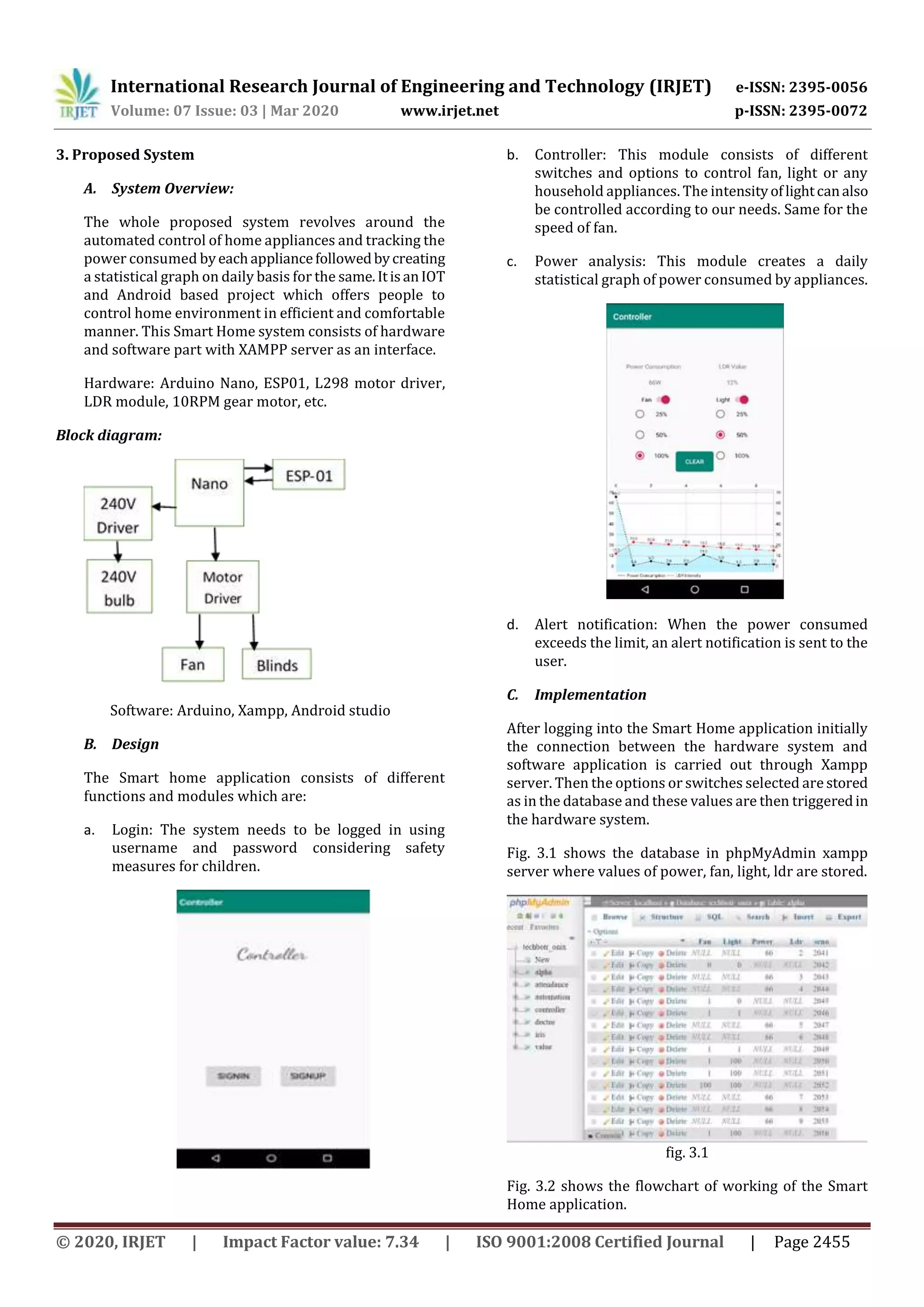
b. Controller: This module consists of different
switches and options to control fan, light or any
household appliances. The intensityoflightcanalso
be controlled according to our needs. Same for the
speed of fan.
c. Power analysis: This module creates a daily
statistical graph of power consumed by appliances.
d. Alert notification: When the power consumed
exceeds the limit, an alert notification is sent to the
user.
C. Implementation
After logging into the Smart Home application initially
the connection between the hardware system and
software application is carried out through Xampp
server. Then the options or switches selected are stored
as in the database and these values are then triggeredin
the hardware system.
Fig. 3.1 shows the database in phpMyAdmin xampp
server where values of power, fan, light, ldr are stored.
fig. 3.1
Fig. 3.2 shows the flowchart of working of the Smart
Home application.
International Research Journal of Engineering and Technology (IRJET) e-ISSN: 2395-0056
Volume: 07 Issue: 03 | Mar 2020 www.irjet.net p-ISSN: 2395-0072
© 2020, IRJET | Impact Factor value: 7.34 | ISO 9001:2008 Certified Journal | Page 2456
fig. 3.2
4. CONCLUSION AND FUTURE WORK
The idea of Smart Home is not new, but rather this project
concentrates on focusing on the daily power usage of the
appliances. The "Ease of application" is successfully
implemented in this project by operatingall theSmartHome
appliances using an Android app which can be easily
installed in mobile phones. The power usage gives thegraph
about the current and voltage supplied to the system which
can prevent the system from Short circuit and power failure
problems if it exceeds the limit. This project is also useful for
handicapped and elderly people who cannot move every
time to operate the devices. Thesecurityandprivacyare also
determined in this project.
The future work regarding this project would be able to use
this on a large scale in any organizationlikeschools,colleges,
etc. They can also implement the power saving module
giving alert notification on the mobile phone as well.
5. REFERENCES
[1] J. Vasseur, A. Dunkels, Interconnecting Smart Objects
with IP. Elsevier Inc. 2010, ch. 23.
[2] Prof.H.B.Shinde, Abhay Chaudhari,Prafull Chaure,Mayur
Chandgude, Pratik Waghmare, “Smart Home Automation
System using Android Application.” International Research
Journal of Engineering and Technology (IRJET), Volume: 04
Issue: 04 | Apr -2017
[3] W. A. Jabbar, M. H. Alsibai, N. S. S. Amran, and S. K.
Mahayadin, “Design and Implementation of IoT-Based
Automation System for Smart Home,” in the 2018
International Symposium on Networks, Computers and
Communications (ISNCC), 2018, pp. 1-6: IEEE.
[4] H. Ning, F. Shi, T. Zhu, Q. Li, and L. Chen, “novel ontology
consistent with acknowledged standards in smart homes,”
Computer Networks, vol. 148, pp. 101-107, 2019.
[5] S. G. Varghese, C. P. Kurian, V. George, A. John, V. Nayak,
and A. Upadhyay, “Comparative study of zigBee topologies
for IoT-based lighting automation,” IET Wireless Sensor
Systems, 2019.
[6] Soumya S, Malini Chavali, Shuchi Gupta, Niharika Rao,
“Internet of Things based Home Automation System,” IEEE
International Conference On Recent Trends In Electronics
Information Communication Technology, May 20-21, 2016.
[7] Kodali, Ravi Kishore, Vishal Jain, Suvadeep Bose, and
Lakshmi Boppana. “IoT based smart security and home
automation system.” In Computing, Communication and
Automation (ICCCA), 2016 International Conference on, pp.
1286-1289. IEEE, 2016.
[8] Kamal, Md Sarwar, Sazia Parvin, Kashif Saleem, Hussam
Al-Hamadi, and Amjad Gawanmeh. “Efficient low-cost
supervisory system for Internet of Things enabled smart
home.” In Communications Workshops (ICC Workshops),
2017 IEEE International Conference on, pp. 864-869. IEEE,
2017.

IRJET - Smart Home with Power Consumed Statistics using Android Application

  • 1.
    International Research Journalof Engineering and Technology (IRJET) e-ISSN: 2395-0056 Volume: 07 Issue: 03 | Mar 2020 www.irjet.net p-ISSN: 2395-0072 © 2020, IRJET | Impact Factor value: 7.34 | ISO 9001:2008 Certified Journal | Page 2454 SMART HOME WITH POWER CONSUMED STATISTICS USING ANDROID APPLICATION Aishwarya Rai1, Kinjal Bhagat2, Kiran Mane3, Prof. Swati Sharma4 1,2,3 Students of Department of Information Technology, Vidyalankar Institute of Technology, Mumbai, Maharashtra 4 Prof. of Department of Information Technology, Vidyalankar Institute of Technology, Mumbai, Maharashtra ---------------------------------------------------------------------***--------------------------------------------------------------------- Abstract - In our day-to-day life, today we need each and everything smart, i.e. smart phones, smart watches, etc. Inthis paper we propose Smart Home where home appliances like lights, fans or blinds can be easily operated throughourSmart Home android application. This androidapplicationalsokeeps track of the power consumed by appliances and sets a limitation for daily power usage. Hence, when power consumed exceeds the limitation, an alert notification would be sent for the same. The aim of this paper is to carry out a low-cost, reliable and scalable Smart Home System that can be used to remotely operate household appliances and check daily power consumption. Key Words: Smart Home,androidapplication,lightintensity control, speed control of fan, automated blinds, power consumption, Arduino nano. 1. INTRODUCTION Automation of home refers to automation of various household activities or housework. Automation of home may include controlling light intensity, controlling speed of fan, automating blinds depending upon light intensity, automated door lock, and various other systems to provide comfort, ease of work and security. A smart home (SH) is an Internet of Things (IoT) application that allows users to control and monitor home appliances in real time over the Internet [3, 4]. A widespread oftechnologycontrollinghome appliances has started by using mobile devices with short- range communication interfaces, such as Bluetooth and ZigBee [5], and by Wi-Fi networks. Home automationfor the elderly and disabled can provide increased quality of life for persons who might otherwise require caregivers or institutional care [1]. “Ease use of appliances” is the main motive of the system [2]. Looking at this we have controlled fan and light appliances through an application, whereas the curtain(blind) appliance is automated. Theseappliances can be monitored and controlled through a user-friendly interface. All appliances are connected to the Arduino board which is the main controllerboard.Thissystemalsocontains a module of daily monitoring power consumption by the appliances and sending an alert if it exceeds the limitation. By using the Internet of Things (IOT), the development of home automation is going to become simpler and hence developing an android application will help connect objects to provide proper communication, synchronization, and inter-connection between various devices or physical appliances. 2. BACKGROUND OVERVIEW A. Approach The concept of the word “smart” is beingusedinvarious fields such as smartphones, smart TVs and smart learning, including smart homes. The idea of Smart home service has been activated since the mid-2000s. “Ease use of appliances”' is the main motive of the system. The application is used by the user while operating the appliances which can be easily helpful in ensuring privacy and security thereby having a login authentication in the app. The background of this project is as follows: •It gives a graph of daily power consumption. •If the limit exceeds then it will alert the notification. •It can be helpful for handicapped as well as elderly and everyone to use the appliances easily using a simple Android application. B. Drawback of Existing System The existing system has the drawback about the application. In the previous model the appliances were only connected with the Android application, they were not representing the power usage graph. Also, there was only an ON/OFF button in the application for the appliances used. The proposed system emphasizes more on the power usage graphand there is speed control buttons as well. C. Proposed System The proposed system revolves around the android application by which it controls all the appliances of home. It has different sensors which operates some of the appliances as well. The power usage by all the devices has been shown in the form of graph which is daily consumption of power. The easy usage of home appliances is undertaken in the proposed system with a simple login authentication which maintains securityas well.
  • 2.
    International Research Journalof Engineering and Technology (IRJET) e-ISSN: 2395-0056 Volume: 07 Issue: 03 | Mar 2020 www.irjet.net p-ISSN: 2395-0072 © 2020, IRJET | Impact Factor value: 7.34 | ISO 9001:2008 Certified Journal | Page 2455 3. Proposed System A. System Overview: The whole proposed system revolves around the automated control of home appliances and tracking the power consumed byeachappliancefollowedbycreating a statistical graph on daily basis for the same.ItisanIOT and Android based project which offers people to control home environment in efficient and comfortable manner. This Smart Home system consists of hardware and software part with XAMPP server as an interface. Hardware: Arduino Nano, ESP01, L298 motor driver, LDR module, 10RPM gear motor, etc. Block diagram: Software: Arduino, Xampp, Android studio B. Design The Smart home application consists of different functions and modules which are: a. Login: The system needs to be logged in using username and password considering safety measures for children. b. Controller: This module consists of different switches and options to control fan, light or any household appliances. The intensityoflightcanalso be controlled according to our needs. Same for the speed of fan. c. Power analysis: This module creates a daily statistical graph of power consumed by appliances. d. Alert notification: When the power consumed exceeds the limit, an alert notification is sent to the user. C. Implementation After logging into the Smart Home application initially the connection between the hardware system and software application is carried out through Xampp server. Then the options or switches selected are stored as in the database and these values are then triggeredin the hardware system. Fig. 3.1 shows the database in phpMyAdmin xampp server where values of power, fan, light, ldr are stored. fig. 3.1 Fig. 3.2 shows the flowchart of working of the Smart Home application.
  • 3.
    International Research Journalof Engineering and Technology (IRJET) e-ISSN: 2395-0056 Volume: 07 Issue: 03 | Mar 2020 www.irjet.net p-ISSN: 2395-0072 © 2020, IRJET | Impact Factor value: 7.34 | ISO 9001:2008 Certified Journal | Page 2456 fig. 3.2 4. CONCLUSION AND FUTURE WORK The idea of Smart Home is not new, but rather this project concentrates on focusing on the daily power usage of the appliances. The "Ease of application" is successfully implemented in this project by operatingall theSmartHome appliances using an Android app which can be easily installed in mobile phones. The power usage gives thegraph about the current and voltage supplied to the system which can prevent the system from Short circuit and power failure problems if it exceeds the limit. This project is also useful for handicapped and elderly people who cannot move every time to operate the devices. Thesecurityandprivacyare also determined in this project. The future work regarding this project would be able to use this on a large scale in any organizationlikeschools,colleges, etc. They can also implement the power saving module giving alert notification on the mobile phone as well. 5. REFERENCES [1] J. Vasseur, A. Dunkels, Interconnecting Smart Objects with IP. Elsevier Inc. 2010, ch. 23. [2] Prof.H.B.Shinde, Abhay Chaudhari,Prafull Chaure,Mayur Chandgude, Pratik Waghmare, “Smart Home Automation System using Android Application.” International Research Journal of Engineering and Technology (IRJET), Volume: 04 Issue: 04 | Apr -2017 [3] W. A. Jabbar, M. H. Alsibai, N. S. S. Amran, and S. K. Mahayadin, “Design and Implementation of IoT-Based Automation System for Smart Home,” in the 2018 International Symposium on Networks, Computers and Communications (ISNCC), 2018, pp. 1-6: IEEE. [4] H. Ning, F. Shi, T. Zhu, Q. Li, and L. Chen, “novel ontology consistent with acknowledged standards in smart homes,” Computer Networks, vol. 148, pp. 101-107, 2019. [5] S. G. Varghese, C. P. Kurian, V. George, A. John, V. Nayak, and A. Upadhyay, “Comparative study of zigBee topologies for IoT-based lighting automation,” IET Wireless Sensor Systems, 2019. [6] Soumya S, Malini Chavali, Shuchi Gupta, Niharika Rao, “Internet of Things based Home Automation System,” IEEE International Conference On Recent Trends In Electronics Information Communication Technology, May 20-21, 2016. [7] Kodali, Ravi Kishore, Vishal Jain, Suvadeep Bose, and Lakshmi Boppana. “IoT based smart security and home automation system.” In Computing, Communication and Automation (ICCCA), 2016 International Conference on, pp. 1286-1289. IEEE, 2016. [8] Kamal, Md Sarwar, Sazia Parvin, Kashif Saleem, Hussam Al-Hamadi, and Amjad Gawanmeh. “Efficient low-cost supervisory system for Internet of Things enabled smart home.” In Communications Workshops (ICC Workshops), 2017 IEEE International Conference on, pp. 864-869. IEEE, 2017.