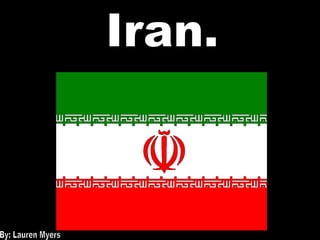
Iran. By: Lauren Myers
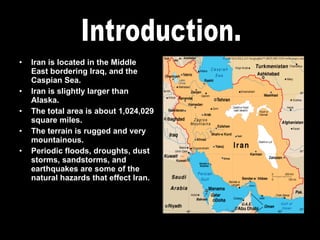
Iran is located in the Middle East bordering Iraq, and the Caspian Sea. Iran is slightly larger than Alaska. The total area is about 1,024,029 square miles. The terrain is rugged and very mountainous. Periodic floods, droughts, dust storms, sandstorms, and earthquakes are some of the natural hazards that effect Iran. Introduction.
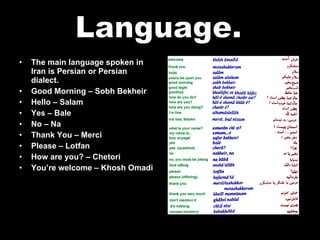
The main language spoken in Iran is Persian or Persian dialect. Good Morning – Sobh Bekheir Hello – Salam Yes – Bale  No – Na Thank You – Merci Please – Lotfan How are you? – Chetori You’re welcome – Khosh Omadi Language.
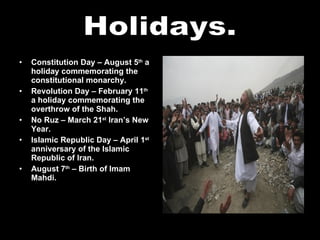
Constitution Day – August 5 th  a holiday commemorating the constitutional monarchy. Revolution Day – February 11 th  a holiday commemorating the overthrow of the Shah. No Ruz – March 21 st  Iran’s New Year. Islamic Republic Day – April 1 st  anniversary of the Islamic Republic of Iran. August 7 th  – Birth of Imam Mahdi.  Holidays.
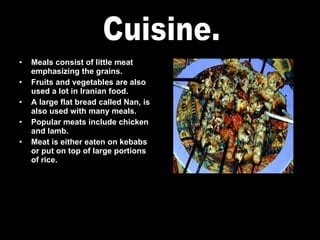
Meals consist of little meat emphasizing the grains. Fruits and vegetables are also used a lot in Iranian food. A large flat bread called Nan, is also used with many meals. Popular meats include chicken and lamb. Meat is either eaten on kebabs or put on top of large portions of rice. Cuisine.
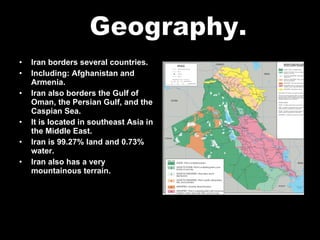
Iran borders several countries. Including: Afghanistan and Armenia. Iran also borders the Gulf of Oman, the Persian Gulf, and the Caspian Sea. It is located in southeast Asia in the Middle East. Iran is 99.27% land and 0.73% water. Iran also has a very mountainous terrain. Geography.
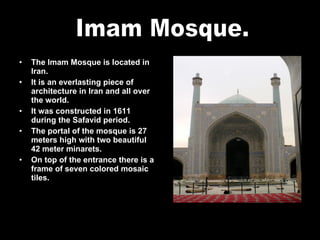
The Imam Mosque is located in Iran. It is an everlasting piece of architecture in Iran and all over the world. It was constructed in 1611 during the Safavid period. The portal of the mosque is 27 meters high with two beautiful 42 meter minarets. On top of the entrance there is a frame of seven colored mosaic tiles. Imam Mosque.
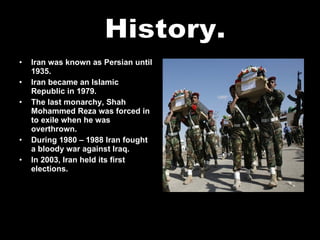
Iran was known as Persian until 1935. Iran became an Islamic Republic in 1979. The last monarchy, Shah Mohammed Reza was forced in to exile when he was overthrown. During 1980 – 1988 Iran fought a bloody war against Iraq. In 2003, Iran held its first elections.  History.
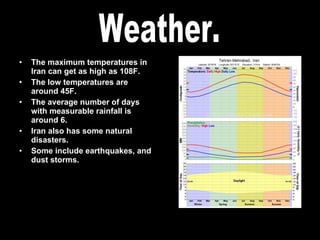
The maximum temperatures in Iran can get as high as 108F. The low temperatures are around 45F. The average number of days with measurable rainfall is around 6. Iran also has some natural disasters. Some include earthquakes, and dust storms. Weather.
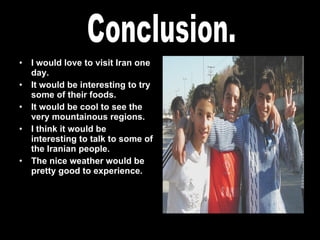
I would love to visit Iran one day. It would be interesting to try some of their foods. It would be cool to see the very mountainous regions. I think it would be interesting to talk to some of the Iranian people. The nice weather would be pretty good to experience. Conclusion.

Iran Powerpoint Presentation

  • 1.
  • 2.
    Iran is locatedin the Middle East bordering Iraq, and the Caspian Sea. Iran is slightly larger than Alaska. The total area is about 1,024,029 square miles. The terrain is rugged and very mountainous. Periodic floods, droughts, dust storms, sandstorms, and earthquakes are some of the natural hazards that effect Iran. Introduction.
  • 3.
    The main languagespoken in Iran is Persian or Persian dialect. Good Morning – Sobh Bekheir Hello – Salam Yes – Bale No – Na Thank You – Merci Please – Lotfan How are you? – Chetori You’re welcome – Khosh Omadi Language.
  • 4.
    Constitution Day –August 5 th a holiday commemorating the constitutional monarchy. Revolution Day – February 11 th a holiday commemorating the overthrow of the Shah. No Ruz – March 21 st Iran’s New Year. Islamic Republic Day – April 1 st anniversary of the Islamic Republic of Iran. August 7 th – Birth of Imam Mahdi. Holidays.
  • 5.
    Meals consist oflittle meat emphasizing the grains. Fruits and vegetables are also used a lot in Iranian food. A large flat bread called Nan, is also used with many meals. Popular meats include chicken and lamb. Meat is either eaten on kebabs or put on top of large portions of rice. Cuisine.
  • 6.
    Iran borders severalcountries. Including: Afghanistan and Armenia. Iran also borders the Gulf of Oman, the Persian Gulf, and the Caspian Sea. It is located in southeast Asia in the Middle East. Iran is 99.27% land and 0.73% water. Iran also has a very mountainous terrain. Geography.
  • 7.
    The Imam Mosqueis located in Iran. It is an everlasting piece of architecture in Iran and all over the world. It was constructed in 1611 during the Safavid period. The portal of the mosque is 27 meters high with two beautiful 42 meter minarets. On top of the entrance there is a frame of seven colored mosaic tiles. Imam Mosque.
  • 8.
    Iran was knownas Persian until 1935. Iran became an Islamic Republic in 1979. The last monarchy, Shah Mohammed Reza was forced in to exile when he was overthrown. During 1980 – 1988 Iran fought a bloody war against Iraq. In 2003, Iran held its first elections. History.
  • 9.
    The maximum temperaturesin Iran can get as high as 108F. The low temperatures are around 45F. The average number of days with measurable rainfall is around 6. Iran also has some natural disasters. Some include earthquakes, and dust storms. Weather.
  • 10.
    I would loveto visit Iran one day. It would be interesting to try some of their foods. It would be cool to see the very mountainous regions. I think it would be interesting to talk to some of the Iranian people. The nice weather would be pretty good to experience. Conclusion.