IRAQ Burhan Mahmoud 8D Humanities
Introduction The Republic of Iraq is a country in the Middle East spreading out on most of the northwest part of the Zagros mountains to the east of the Syrian Desert and the north of the Arabian Desert. It shares borders with Kuwait and Saudi Arabia to the south, Jordan to the west, Syria to the northwest, Turkey to the north, and Iran to the east. It has a very narrow section of coastline at Umm Qasr on the Persian Gulf. There are two major flowing rivers: the Tigris and the Euphrates. These provide Iraq with the water needed to grow their crops which contrasts with the desert landscape that covers most of the Middle East.  The capital city, Baghdad, is in the center-east.  Iraq's rich history dates back to ancient Mesopotamia.  The region between the Tigris and Euphrates rivers is  identified as the Fertile and the birthplace of writing.
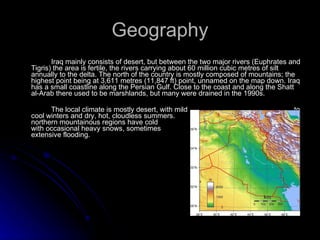
Geography Iraq mainly consists of desert, but between the two major rivers (Euphrates and Tigris) the area is fertile, the rivers carrying about 60 million cubic metres of silt annually to the delta. The north of the country is mostly composed of mountains; the highest point being at 3,611 metres (11,847 ft) point, unnamed on the map down. Iraq has a small coastline along the Persian Gulf. Close to the coast and along the Shatt al-Arab there used to be marshlands, but many were drained in the 1990s. The local climate is mostly desert, with mild  to cool winters and dry, hot, cloudless summers.  The northern mountainous regions have cold  winters with occasional heavy snows, sometimes  causing extensive flooding.
Government and Politics Iraq has a parliamentary democracy which has been made by Americans, this means that everyone can vote including women. The dictatorship of Saddam Hussein collapsed on April 9, 2003, after U.S. and British forces invaded the country. Sovereignty was returned to Iraq on June 28, 2004.
Economy Iraq's economy is dominated by the oil sector, which has traditionally provided about 95% of foreign exchange earnings. In the 1980s financial problems caused by massive money spent in the eight-year war with Iran and damage to oil export facilities by Iran led the government to implement austerity measures, borrow heavily, and later reschedule foreign debt payments. Iraq suffered economic losses from the war of at least US$100 billion. After hostilities ended in 1988, oil exports gradually increased with the construction of new pipelines and restoration of damaged facilities. A combination of low oil prices, repayment of war debts and the costs of reconstruction resulted in a serious financial crisis which was the main short term motivation for the invasion of Kuwait.
Social Iraq is divided into three religious groups which consist of Sunni, Shia and Kurds. These divisions lead to violence from one group to the other which can mean lots of dead civilians. It has a population of 27,499,638 which descended after every single attack either by a suicide bombing or by assassinations.
Bibliography http://www.zindamagazine.com/html/archives/2004/12.24.04/pix/Iraq_map.png http://upload.wikimedia.org/wikipedia/commons/f/f2/Iraq_Topography.png http://www.zindamagazine.com/html/archives/2004/12.24.04/pix/Iraq_map.png http://upload.wikimedia.org/wikipedia/commons/f/f2/Iraq_Topography.png http://www.appliedlanguage.com/flags_of_the_world/large_flag_of_iraq.gif http://upload.wikimedia.org/wikipedia/commons/6/61/IraqNumberedRegions.png http://en.wikipedia.org/wiki/Iraq http://newsimg.bbc.co.uk/media/images/40922000/gif/_40922084_iraq_provinces2_map416.gif

Iraq

  • 1.
    IRAQ Burhan Mahmoud8D Humanities
  • 2.
    Introduction The Republicof Iraq is a country in the Middle East spreading out on most of the northwest part of the Zagros mountains to the east of the Syrian Desert and the north of the Arabian Desert. It shares borders with Kuwait and Saudi Arabia to the south, Jordan to the west, Syria to the northwest, Turkey to the north, and Iran to the east. It has a very narrow section of coastline at Umm Qasr on the Persian Gulf. There are two major flowing rivers: the Tigris and the Euphrates. These provide Iraq with the water needed to grow their crops which contrasts with the desert landscape that covers most of the Middle East. The capital city, Baghdad, is in the center-east. Iraq's rich history dates back to ancient Mesopotamia. The region between the Tigris and Euphrates rivers is identified as the Fertile and the birthplace of writing.
  • 3.
    Geography Iraq mainlyconsists of desert, but between the two major rivers (Euphrates and Tigris) the area is fertile, the rivers carrying about 60 million cubic metres of silt annually to the delta. The north of the country is mostly composed of mountains; the highest point being at 3,611 metres (11,847 ft) point, unnamed on the map down. Iraq has a small coastline along the Persian Gulf. Close to the coast and along the Shatt al-Arab there used to be marshlands, but many were drained in the 1990s. The local climate is mostly desert, with mild to cool winters and dry, hot, cloudless summers. The northern mountainous regions have cold winters with occasional heavy snows, sometimes causing extensive flooding.
  • 4.
    Government and PoliticsIraq has a parliamentary democracy which has been made by Americans, this means that everyone can vote including women. The dictatorship of Saddam Hussein collapsed on April 9, 2003, after U.S. and British forces invaded the country. Sovereignty was returned to Iraq on June 28, 2004.
  • 5.
    Economy Iraq's economyis dominated by the oil sector, which has traditionally provided about 95% of foreign exchange earnings. In the 1980s financial problems caused by massive money spent in the eight-year war with Iran and damage to oil export facilities by Iran led the government to implement austerity measures, borrow heavily, and later reschedule foreign debt payments. Iraq suffered economic losses from the war of at least US$100 billion. After hostilities ended in 1988, oil exports gradually increased with the construction of new pipelines and restoration of damaged facilities. A combination of low oil prices, repayment of war debts and the costs of reconstruction resulted in a serious financial crisis which was the main short term motivation for the invasion of Kuwait.
  • 6.
    Social Iraq isdivided into three religious groups which consist of Sunni, Shia and Kurds. These divisions lead to violence from one group to the other which can mean lots of dead civilians. It has a population of 27,499,638 which descended after every single attack either by a suicide bombing or by assassinations.
  • 7.
    Bibliography http://www.zindamagazine.com/html/archives/2004/12.24.04/pix/Iraq_map.png http://upload.wikimedia.org/wikipedia/commons/f/f2/Iraq_Topography.pnghttp://www.zindamagazine.com/html/archives/2004/12.24.04/pix/Iraq_map.png http://upload.wikimedia.org/wikipedia/commons/f/f2/Iraq_Topography.png http://www.appliedlanguage.com/flags_of_the_world/large_flag_of_iraq.gif http://upload.wikimedia.org/wikipedia/commons/6/61/IraqNumberedRegions.png http://en.wikipedia.org/wiki/Iraq http://newsimg.bbc.co.uk/media/images/40922000/gif/_40922084_iraq_provinces2_map416.gif