MIDDLE EAST
PRESENTED
BY
RAAVI TRINATH
INTRODUCTION
 The term ‘Middle East’ may have originated in the 1850s in the British India Office.
 The Middle East is a region that roughly encompasses a majority of Western Asia and Egypt.
 It is the birthplace and spiritual center of many religions and earliest civilizations.
 Christianity, Islam, Judaism, Manichaeism, Yezidi, Druze, Yarsan and Mandeanism, Mithraism, Zoroastri
anism, Manicheanism, and the Bahá'í Faith.
 Mesopotamia (Sumer, Akkad, Assyria and Babylonia) and ancient Egypt were originated in this region.
 The region is well known for its oil reserves.
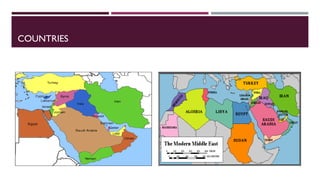
COUNTRIES
DEMOGRAPHICS
ETHNIC GROUPS
 The Middle East is today home to numerous long established ethnic groups.
 Including; Arabs, Turks, Persians, Jews, Kurds, Somalis, Assyrians (Chaldo-Assyrians), Arameans-
Syriacs, Egyptian Copts, Armenians, Azeris, Maltese, Circassians, Greeks, Turcomans, Shabaks, Yazidis,
Mandeans, Georgians, Roma, Gagauz, Mhallami and Samaritans.
RELIGIONS
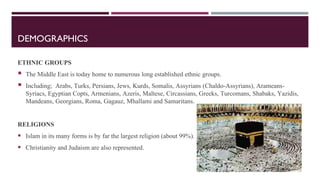
 Islam in its many forms is by far the largest religion (about 99%).
 Christianity and Judaism are also represented.
DEMOGRAPHICS
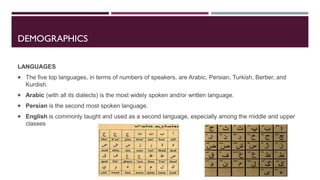
LANGUAGES
 The five top languages, in terms of numbers of speakers, are Arabic, Persian, Turkish, Berber, and
Kurdish.
 Arabic (with all its dialects) is the most widely spoken and/or written language.
 Persian is the second most spoken language.
 English is commonly taught and used as a second language, especially among the middle and upper
classes
CLIMATE
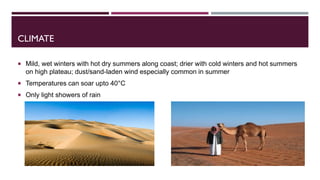
 Mild, wet winters with hot dry summers along coast; drier with cold winters and hot summers
on high plateau; dust/sand-laden wind especially common in summer
 Temperatures can soar upto 40°C
 Only light showers of rain
CUISINE
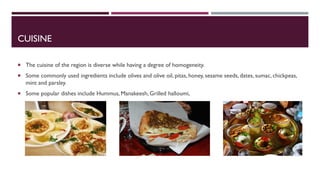
 The cuisine of the region is diverse while having a degree of homogeneity.
 Some commonly used ingredients include olives and olive oil, pitas, honey, sesame seeds, dates, sumac, chickpeas,
mint and parsley.
 Some popular dishes include Hummus, Manakeesh, Grilled halloumi,
CLOTHING
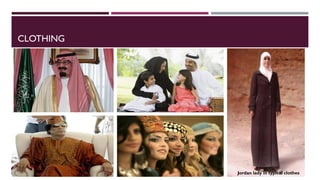
Jordan lady in typical clothes
FAMILY ROLE AND NAMES
FAMILY ROLE
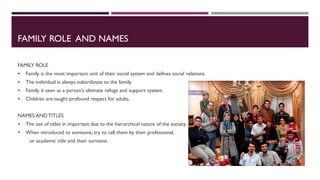
 Family is the most important unit of their social system and defines social relations.
 The individual is always subordinate to the family.
 Family is seen as a person’s ultimate refuge and support system.
 Children are taught profound respect for adults.
NAMES AND TITLES
 The use of titles in important due to the hierarchical nature of the society.
 When introduced to someone, try to call them by their professional,
or academic title and their surname.
HISTORIC PLACES TOVISIT
 Petra, Jordan
 Giza Plateau, Cairo, Egypt
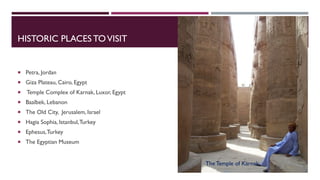
 Temple Complex of Karnak, Luxor, Egypt
 Baalbek, Lebanon
 The Old City, Jerusalem, Israel
 Hagia Sophia, Istanbul,Turkey
 Ephesus,Turkey
 The Egyptian Museum
TheTemple of Karnak
ECONOMY
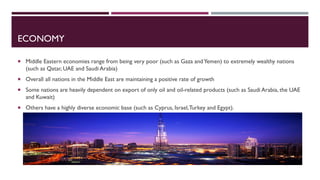
 Middle Eastern economies range from being very poor (such as Gaza andYemen) to extremely wealthy nations
(such as Qatar, UAE and Saudi Arabia)
 Overall all nations in the Middle East are maintaining a positive rate of growth
 Some nations are heavily dependent on export of only oil and oil-related products (such as Saudi Arabia, the UAE
and Kuwait)
 Others have a highly diverse economic base (such as Cyprus, Israel,Turkey and Egypt).
‫شكرا‬

Middle East PPT

  • 1.
  • 2.
    INTRODUCTION  The term‘Middle East’ may have originated in the 1850s in the British India Office.  The Middle East is a region that roughly encompasses a majority of Western Asia and Egypt.  It is the birthplace and spiritual center of many religions and earliest civilizations.  Christianity, Islam, Judaism, Manichaeism, Yezidi, Druze, Yarsan and Mandeanism, Mithraism, Zoroastri anism, Manicheanism, and the Bahá'í Faith.  Mesopotamia (Sumer, Akkad, Assyria and Babylonia) and ancient Egypt were originated in this region.  The region is well known for its oil reserves.
  • 3.
  • 4.
    DEMOGRAPHICS ETHNIC GROUPS  TheMiddle East is today home to numerous long established ethnic groups.  Including; Arabs, Turks, Persians, Jews, Kurds, Somalis, Assyrians (Chaldo-Assyrians), Arameans- Syriacs, Egyptian Copts, Armenians, Azeris, Maltese, Circassians, Greeks, Turcomans, Shabaks, Yazidis, Mandeans, Georgians, Roma, Gagauz, Mhallami and Samaritans. RELIGIONS  Islam in its many forms is by far the largest religion (about 99%).  Christianity and Judaism are also represented.
  • 5.
    DEMOGRAPHICS LANGUAGES  The fivetop languages, in terms of numbers of speakers, are Arabic, Persian, Turkish, Berber, and Kurdish.  Arabic (with all its dialects) is the most widely spoken and/or written language.  Persian is the second most spoken language.  English is commonly taught and used as a second language, especially among the middle and upper classes
  • 6.
    CLIMATE  Mild, wetwinters with hot dry summers along coast; drier with cold winters and hot summers on high plateau; dust/sand-laden wind especially common in summer  Temperatures can soar upto 40°C  Only light showers of rain
  • 7.
    CUISINE  The cuisineof the region is diverse while having a degree of homogeneity.  Some commonly used ingredients include olives and olive oil, pitas, honey, sesame seeds, dates, sumac, chickpeas, mint and parsley.  Some popular dishes include Hummus, Manakeesh, Grilled halloumi,
  • 8.
    CLOTHING Jordan lady intypical clothes
  • 9.
    FAMILY ROLE ANDNAMES FAMILY ROLE  Family is the most important unit of their social system and defines social relations.  The individual is always subordinate to the family.  Family is seen as a person’s ultimate refuge and support system.  Children are taught profound respect for adults. NAMES AND TITLES  The use of titles in important due to the hierarchical nature of the society.  When introduced to someone, try to call them by their professional, or academic title and their surname.
  • 10.
    HISTORIC PLACES TOVISIT Petra, Jordan  Giza Plateau, Cairo, Egypt  Temple Complex of Karnak, Luxor, Egypt  Baalbek, Lebanon  The Old City, Jerusalem, Israel  Hagia Sophia, Istanbul,Turkey  Ephesus,Turkey  The Egyptian Museum TheTemple of Karnak
  • 11.
    ECONOMY  Middle Easterneconomies range from being very poor (such as Gaza andYemen) to extremely wealthy nations (such as Qatar, UAE and Saudi Arabia)  Overall all nations in the Middle East are maintaining a positive rate of growth  Some nations are heavily dependent on export of only oil and oil-related products (such as Saudi Arabia, the UAE and Kuwait)  Others have a highly diverse economic base (such as Cyprus, Israel,Turkey and Egypt).
  • 12.