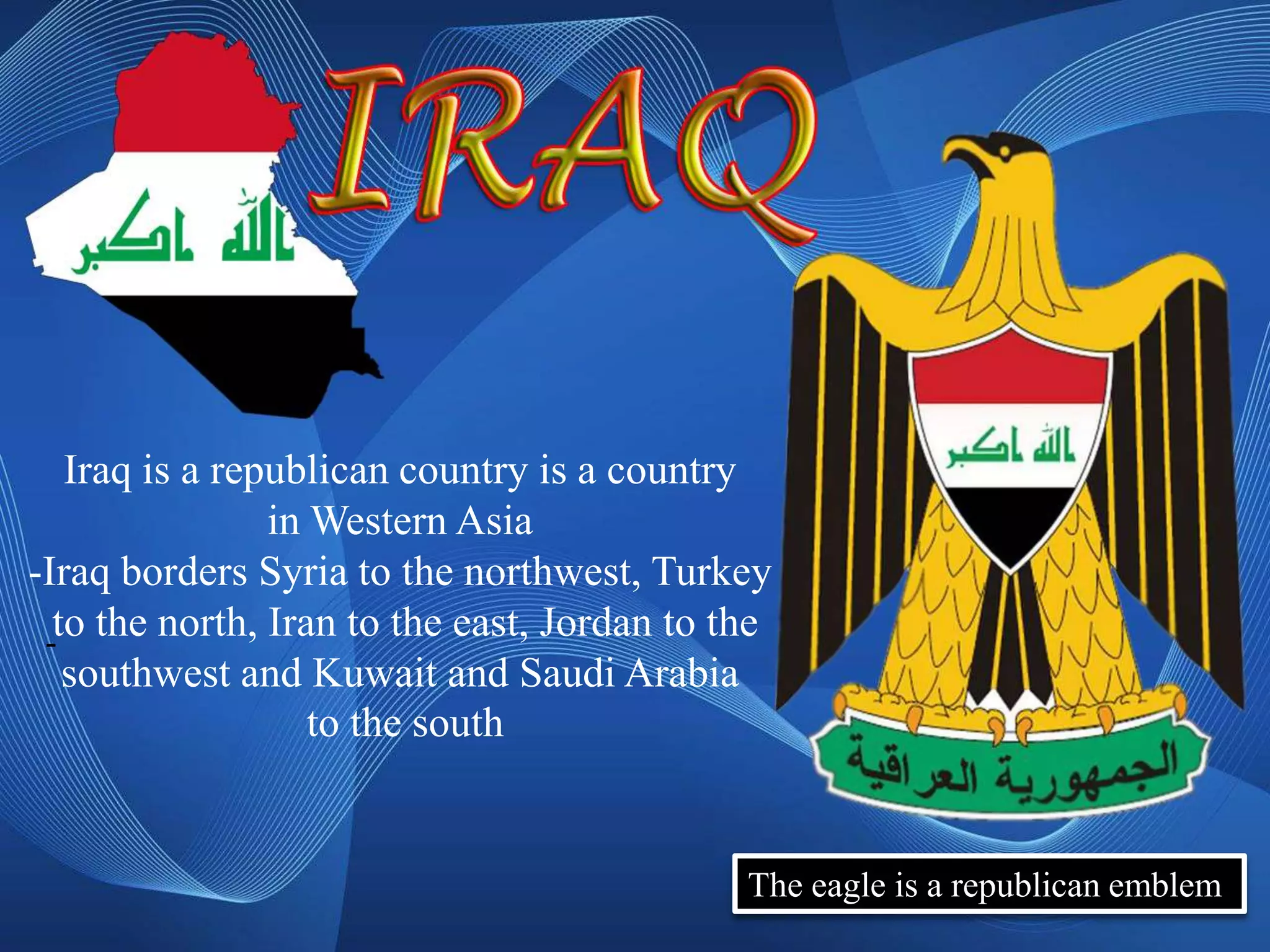
Iraq is a republican country is a country
                in Western Asia
-Iraq borders Syria to the northwest, Turkey
 -to the north, Iran to the east, Jordan to the
   southwest and Kuwait and Saudi Arabia
                   to the south


                                             The eagle is a republican emblem
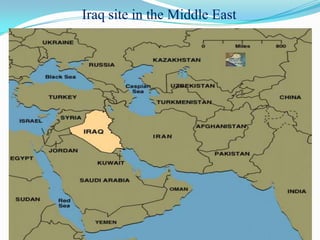
Iraq site in the Middle East
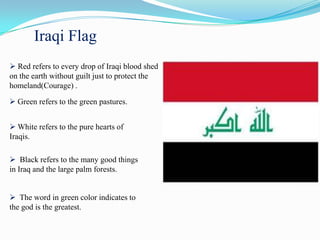
Iraqi Flag
 Red refers to every drop of Iraqi blood shed
on the earth without guilt just to protect the
homeland(Courage) .

 Green refers to the green pastures.


 White refers to the pure hearts of
Iraqis.

 Black refers to the many good things
in Iraq and the large palm forests.


 The word in green color indicates to
the god is the greatest.
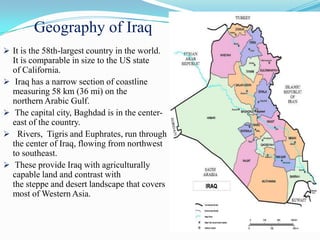
Geography of Iraq
 It is the 58th-largest country in the world.
    It is comparable in size to the US state
    of California.
    Iraq has a narrow section of coastline
    measuring 58 km (36 mi) on the
    northern Arabic Gulf.
    The capital city, Baghdad is in the center-
    east of the country.
     Rivers, Tigris and Euphrates, run through
    the center of Iraq, flowing from northwest
    to southeast.
    These provide Iraq with agriculturally
    capable land and contrast with
    the steppe and desert landscape that covers
    most of Western Asia.
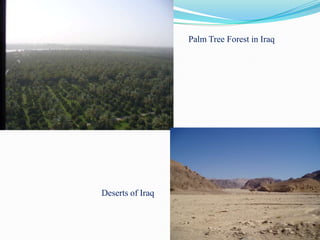
Palm Tree Forest in Iraq


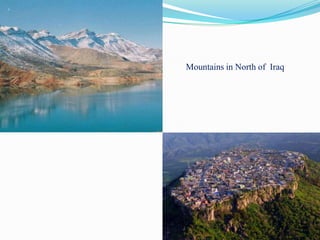
Deserts of Iraq
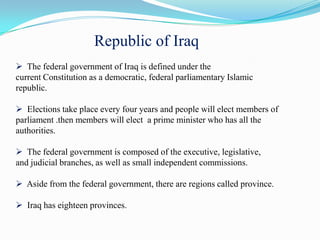
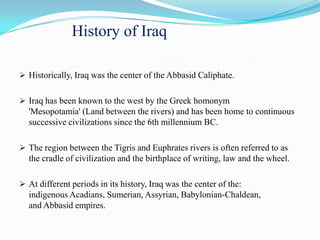
Mountains in North of Iraq
Republic of Iraq
 The federal government of Iraq is defined under the
current Constitution as a democratic, federal parliamentary Islamic
republic.

 Elections take place every four years and people will elect members of
parliament .then members will elect a prime minister who has all the
authorities.

 The federal government is composed of the executive, legislative,
and judicial branches, as well as small independent commissions.

 Aside from the federal government, there are regions called province.

 Iraq has eighteen provinces.
History of Iraq

 Historically, Iraq was the center of the Abbasid Caliphate.


 Iraq has been known to the west by the Greek homonym
  'Mesopotamia' (Land between the rivers) and has been home to continuous
  successive civilizations since the 6th millennium BC.

 The region between the Tigris and Euphrates rivers is often referred to as
  the cradle of civilization and the birthplace of writing, law and the wheel.

 At different periods in its history, Iraq was the center of the:
  indigenous Acadians, Sumerian, Assyrian, Babylonian-Chaldean,
  and Abbasid empires.
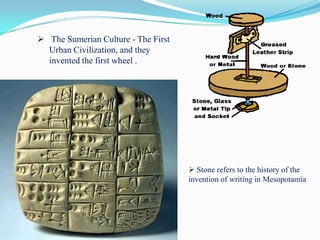
 The Sumerian Culture - The First
  Urban Civilization, and they
  invented the first wheel .


                                      Stone refers to the history of the
                                     invention of writing in Mesopotamia
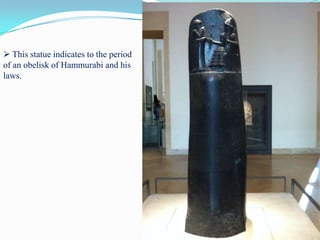
 This statue indicates to the period
of an obelisk of Hammurabi and his
laws.
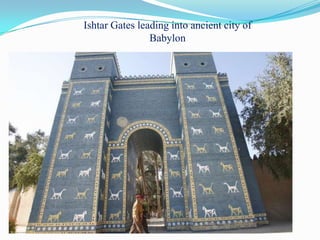
Babylon: was an Akkadian city-state (founded in 1894 BC by an Amorite dynasty) of
ancient Mesopotamia, the remains of which are found in present-day Al Hillah, Babylon
Province, Iraq, about 85 kilometers (55 mi) south of Baghdad.


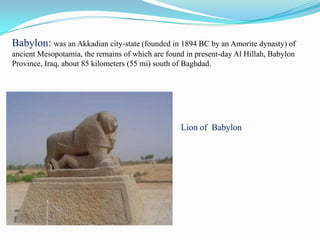
                                                  Lion of Babylon
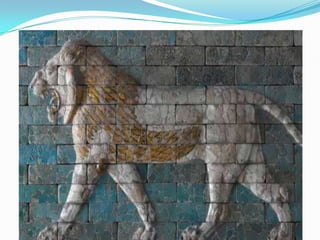
Ishtar Gates leading into ancient city of
                Babylon
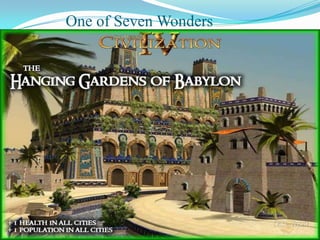
One of Seven Wonders
Abbasid Empire

 The Abbasid Caliphate built the city of Baghdad in the 8th century as their
capital, and it became the leading metropolis of the Arab and Muslim world for
five centuries.
 Baghdad was the largest multicultural city of the Middle Ages, peaking at a
population of more than a million, and was the centre of learning during
the Islamic Golden Age.

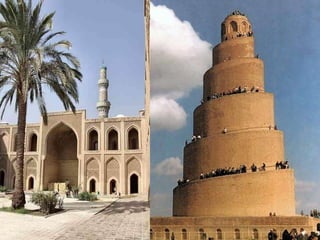
Minaret Malwiya and Mustansiriya school are one of the landmarks of the
Abbasid Empire as in the pictures below :
Religions
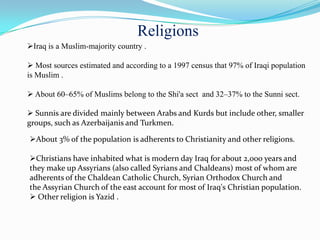
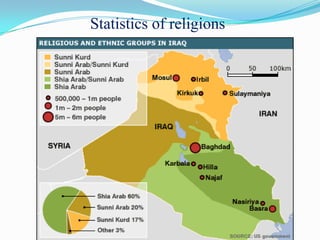
Iraq is a Muslim-majority country .

 Most sources estimated and according to a 1997 census that 97% of Iraqi population
is Muslim .

 About 60–65% of Muslims belong to the Shi'a sect and 32–37% to the Sunni sect.

 Sunnis are divided mainly between Arabs and Kurds but include other, smaller
groups, such as Azerbaijanis and Turkmen.

About 3% of the population is adherents to Christianity and other religions.

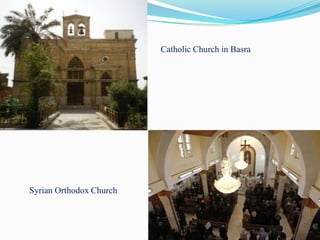
Christians have inhabited what is modern day Iraq for about 2,000 years and
they make up Assyrians (also called Syrians and Chaldeans) most of whom are
adherents of the Chaldean Catholic Church, Syrian Orthodox Church and
the Assyrian Church of the east account for most of Iraq's Christian population.
 Other religion is Yazid .
Statistics of religions
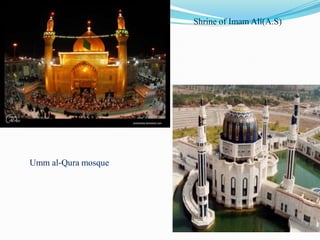
Shrine of Imam Ali(A.S)


Umm al-Qura mosque
Catholic Church in Basra


Syrian Orthodox Church
Iraqi‟s food
 Iraqi food is so strongly influenced by its neighboring countries, Turkey and
Iran, it is one of the few nations of the Middle East to lack a unique cuisine. Like
the Turks, Iraqis like to stuff vegetables and eat a lot of lamb, rice, and yogurt.
Like Iranians, they enjoy cooking fruits with beef and poultry.

There are three main foods and very popular in Iraq such as
Biryani , Dolma and Kebabs.

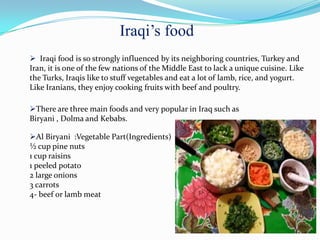
Al Biryani :Vegetable Part(Ingredients)
½ cup pine nuts
1 cup raisins
1 peeled potato
2 large onions
3 carrots
4- beef or lamb meat
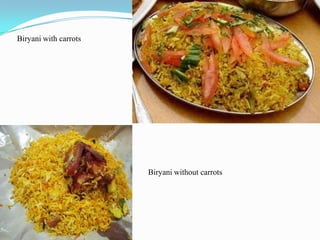
Biryani with carrots


                       Biryani without carrots
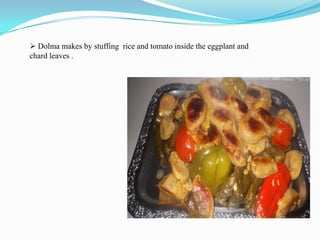
 Dolma makes by stuffing rice and tomato inside the eggplant and
chard leaves .
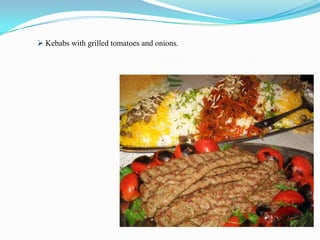
 Kebabs with grilled tomatoes and onions.
Entertainment /Recreation
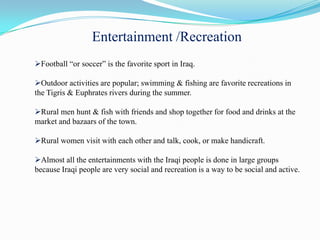
Football “or soccer” is the favorite sport in Iraq.

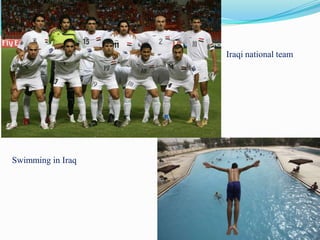
Outdoor activities are popular; swimming & fishing are favorite recreations in
the Tigris & Euphrates rivers during the summer.

Rural men hunt & fish with friends and shop together for food and drinks at the
market and bazaars of the town.

Rural women visit with each other and talk, cook, or make handicraft.

Almost all the entertainments with the Iraqi people is done in large groups
because Iraqi people are very social and recreation is a way to be social and active.
Iraqi national team


Swimming in Iraq
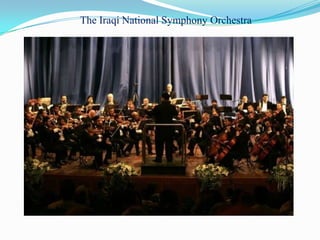
The Iraqi National Symphony Orchestra
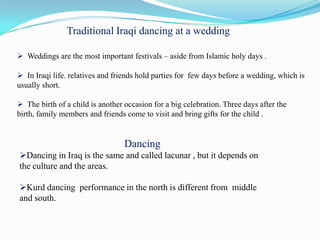
Traditional Iraqi dancing at a wedding

 Weddings are the most important festivals – aside from Islamic holy days .

 In Iraqi life. relatives and friends hold parties for few days before a wedding, which is
usually short.

 The birth of a child is another occasion for a big celebration. Three days after the
birth, family members and friends come to visit and bring gifts for the child .


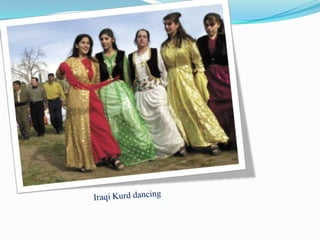
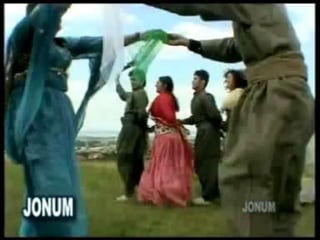
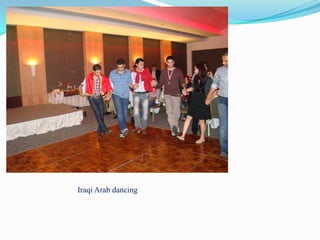
                                  Dancing
Dancing in Iraq is the same and called lacunar , but it depends on
the culture and the areas.

Kurd dancing performance in the north is different from middle
and south.
Iraqi Arab dancing
I „m strongly recommended for you to see (the Virtual
Museum Of Iraq) . To see more information about the
first civilization in the world.

Iraq civilization modren

  • 1.
    Iraq is arepublican country is a country in Western Asia -Iraq borders Syria to the northwest, Turkey -to the north, Iran to the east, Jordan to the southwest and Kuwait and Saudi Arabia to the south The eagle is a republican emblem
  • 2.
    Iraq site inthe Middle East
  • 3.
    Iraqi Flag  Redrefers to every drop of Iraqi blood shed on the earth without guilt just to protect the homeland(Courage) .  Green refers to the green pastures.  White refers to the pure hearts of Iraqis.  Black refers to the many good things in Iraq and the large palm forests.  The word in green color indicates to the god is the greatest.
  • 4.
    Geography of Iraq It is the 58th-largest country in the world. It is comparable in size to the US state of California.  Iraq has a narrow section of coastline measuring 58 km (36 mi) on the northern Arabic Gulf.  The capital city, Baghdad is in the center- east of the country.  Rivers, Tigris and Euphrates, run through the center of Iraq, flowing from northwest to southeast.  These provide Iraq with agriculturally capable land and contrast with the steppe and desert landscape that covers most of Western Asia.
  • 5.
    Palm Tree Forestin Iraq Deserts of Iraq
  • 6.
  • 7.
    Republic of Iraq The federal government of Iraq is defined under the current Constitution as a democratic, federal parliamentary Islamic republic.  Elections take place every four years and people will elect members of parliament .then members will elect a prime minister who has all the authorities.  The federal government is composed of the executive, legislative, and judicial branches, as well as small independent commissions.  Aside from the federal government, there are regions called province.  Iraq has eighteen provinces.
  • 8.
    History of Iraq Historically, Iraq was the center of the Abbasid Caliphate.  Iraq has been known to the west by the Greek homonym 'Mesopotamia' (Land between the rivers) and has been home to continuous successive civilizations since the 6th millennium BC.  The region between the Tigris and Euphrates rivers is often referred to as the cradle of civilization and the birthplace of writing, law and the wheel.  At different periods in its history, Iraq was the center of the: indigenous Acadians, Sumerian, Assyrian, Babylonian-Chaldean, and Abbasid empires.
  • 9.
     The SumerianCulture - The First Urban Civilization, and they invented the first wheel .  Stone refers to the history of the invention of writing in Mesopotamia
  • 10.
     This statueindicates to the period of an obelisk of Hammurabi and his laws.
  • 11.
    Babylon: was anAkkadian city-state (founded in 1894 BC by an Amorite dynasty) of ancient Mesopotamia, the remains of which are found in present-day Al Hillah, Babylon Province, Iraq, about 85 kilometers (55 mi) south of Baghdad. Lion of Babylon
  • 13.
    Ishtar Gates leadinginto ancient city of Babylon
  • 14.
    One of SevenWonders
  • 15.
    Abbasid Empire  TheAbbasid Caliphate built the city of Baghdad in the 8th century as their capital, and it became the leading metropolis of the Arab and Muslim world for five centuries.  Baghdad was the largest multicultural city of the Middle Ages, peaking at a population of more than a million, and was the centre of learning during the Islamic Golden Age. Minaret Malwiya and Mustansiriya school are one of the landmarks of the Abbasid Empire as in the pictures below :
  • 17.
    Religions Iraq is aMuslim-majority country .  Most sources estimated and according to a 1997 census that 97% of Iraqi population is Muslim .  About 60–65% of Muslims belong to the Shi'a sect and 32–37% to the Sunni sect.  Sunnis are divided mainly between Arabs and Kurds but include other, smaller groups, such as Azerbaijanis and Turkmen. About 3% of the population is adherents to Christianity and other religions. Christians have inhabited what is modern day Iraq for about 2,000 years and they make up Assyrians (also called Syrians and Chaldeans) most of whom are adherents of the Chaldean Catholic Church, Syrian Orthodox Church and the Assyrian Church of the east account for most of Iraq's Christian population.  Other religion is Yazid .
  • 18.
  • 19.
    Shrine of ImamAli(A.S) Umm al-Qura mosque
  • 20.
    Catholic Church inBasra Syrian Orthodox Church
  • 21.
    Iraqi‟s food  Iraqifood is so strongly influenced by its neighboring countries, Turkey and Iran, it is one of the few nations of the Middle East to lack a unique cuisine. Like the Turks, Iraqis like to stuff vegetables and eat a lot of lamb, rice, and yogurt. Like Iranians, they enjoy cooking fruits with beef and poultry. There are three main foods and very popular in Iraq such as Biryani , Dolma and Kebabs. Al Biryani :Vegetable Part(Ingredients) ½ cup pine nuts 1 cup raisins 1 peeled potato 2 large onions 3 carrots 4- beef or lamb meat
  • 22.
    Biryani with carrots Biryani without carrots
  • 23.
     Dolma makesby stuffing rice and tomato inside the eggplant and chard leaves .
  • 24.
     Kebabs withgrilled tomatoes and onions.
  • 25.
    Entertainment /Recreation Football “orsoccer” is the favorite sport in Iraq. Outdoor activities are popular; swimming & fishing are favorite recreations in the Tigris & Euphrates rivers during the summer. Rural men hunt & fish with friends and shop together for food and drinks at the market and bazaars of the town. Rural women visit with each other and talk, cook, or make handicraft. Almost all the entertainments with the Iraqi people is done in large groups because Iraqi people are very social and recreation is a way to be social and active.
  • 26.
  • 27.
    The Iraqi NationalSymphony Orchestra
  • 28.
    Traditional Iraqi dancingat a wedding  Weddings are the most important festivals – aside from Islamic holy days .  In Iraqi life. relatives and friends hold parties for few days before a wedding, which is usually short.  The birth of a child is another occasion for a big celebration. Three days after the birth, family members and friends come to visit and bring gifts for the child . Dancing Dancing in Iraq is the same and called lacunar , but it depends on the culture and the areas. Kurd dancing performance in the north is different from middle and south.
  • 31.
  • 33.
    I „m stronglyrecommended for you to see (the Virtual Museum Of Iraq) . To see more information about the first civilization in the world.