Prepared By : SYEDa RIDA FATIMA RIZVI
Submitted To : Dr . Anila & Ma’am Maryam
Bsc.(hons) 3rd year
African Culture
Introduction To African Culture :
 Africa is the world's second-largest and
second-most-populous continent with
approximately 58 countries.
 African culture is incredibly interesting
because it is so diverse. Every African
country is a mix of tribes each with their
own unique language and culture
 This rich and diverse culture varies from
country to country.
 Africa has 3000 distinct ethnic groups,
2000 languages.
Languages Spoken in African
Countries:
 Africa is a continent with a very high
linguistic diversity, there are an
estimated 1500-2000 African languages.
Of these languages four main groupings
can be distinguished:
Afro-Asiatic:
 200 million speakers
 Spoken in northern Africa, Somalia,
Ethiopia, Eritrea, and the area around
Lake Chad in central Africa.
 Subgroups of Afro-Asiatic are Chadic,
Berber, Semitic, Cushitic, and Egyptian
Niger-Saharian: (Niger-Congo)
 300 million speakers
 The family has seven main subgroups,
six of which cover West Africa and the
Central African Republic.
 The subgroups of the Niger-Congo
family are Benue-Congo (including
Bantu), West Atlantic, Mande, Voltaic,
Kwa, Adamawa East, and Kordofanian
 Bantu is spoken in most of the southern
half of Africa.
Nilo-Saharan Family:
 11 million speakers
 The Nilo-Saharan language family
covers much of the eastern Sahara, the
upper Nile Valley, areas around Lake
Victoria in east central Africa, and the
Democratic Republic of the Congo.
 Nilo-Saharan divides into six subgroups:
Nilotic (or Chari-Nile), Songhai, Saharan,
Maban, Koman, and Fur.
Khoisan Family:
 About 78,000 people speak these
languages.
 The Khoisan language family has about
12 languages in its two subgroups:
South African Khoisan and East African
Khoisan.
 Languages of South African Khoisan,
which include Nama and Naron, are
spoken in and around the Kalahari
Desert of northern South Africa,
southwestern Botswana, and Namibia.
 The Austronesian language in
Madagascar.
 Indo-European language on the
Southern tip of the continent
Religion in Africa:
Christianity:
The majority of African population
is christian.
Christianity slowly spread over to
Sudan, Egypt, Ethiopia and
Eritrea.
Today, Africa has more than 350
million followers of Christianity.
Islam:
 Islam is the dominant religion in North
Africa and the Horn of Africa, and it is
also the predominant and historical
religion of the West African interior and
the far west coast of the continent as
well as the coast of East Africa
Hindusim:
 There are sizable of Hindu populations
in South Africa and the East African
coastal nations.
Judaism:
 Judaism has an ancient and rich
history on the African continent.
 Today, there are Jewish
communities in many countries;
including the Beta Israel of Ethiopia,
the Abayudaya of Uganda, the
House of Israel in Ghana, the Igbo
Jews of Nigeria and the Lemba of
Southern Africa.
Traditional religion:
 Traditional religious customs are
sometimes shared by many African
societies.
 Many African Christians and Muslims
maintain some aspects of their
traditional religions.
Religion in Mozambique:
 Religious communities are dispersed
throughout the country.
 According to the 1997 census,
a. Roman Catholic 23.8%
b. Muslims 17.8%,
c. Protestant 17.5%
d. 17.8% of the people have other
beliefs,
e. and 23.1% have no religious beliefs.
Food in Africa
The food of Africa
is a combination of
local fruit, grains,
vegetables, milk and
meat products, their
own traditions and
Arab, European and
Asian influences.
Food in the North Africa;
The Arabs
introduced spices
such as saffron,
nutmeg,
cinnamon, ginger
and cloves.
Sweet pastries
and other baked
foods were
brought by the
Ottoman Turks.
Olives are an
important local
harvest in North
Africa and olive oil
is frequently used
Food in the South and East
Africa:
Dairy products
 Ground maize or
corn
 Stiff porridge.
 Arabic influences
can be seen in East
African cuisine
 Spiced vegetable
curries, lentil soups,
chapattis and pickles.
Oranges, lemons
and limes are used in
cooking, while other
fruits such as
mangoes, papayas
and pineapples are
eaten for dessert.
 Domestic pig.
Food in the West Africa:
Fufu this is made
from root
vegetables such as
yams, cocoyams, or
cassava.
 Rice dishes
 Along coastlines,
rivers and lakes,
fish are an
important source of
protein.
 Cattle, goats and
sheep are raised
(varying by region),
Food in Central Africa:
Plantains
 Cassavas continue
to form the basis of
many meals.
 Starchy staples
are often served
with meat, bean or
vegetable stews.
 Families use 'bush
meat' from wild
animals such as
monkey, antelope
and wild pigs.
 Bambara is a
Traditional African Customs:
“Each group of people have customs that
are
unique to them”.
 One traditional custom in African culture
is that of lobola,
Wedding:
 The wedding is held at night
 A man can have as many wives as he
can afford and the wives share the
responsibilities of the daily chores, such
as preparing meals washing clothes etc
Houses in Africa:
 Traditional houses differ in different
regions in Africa because of the
available materials and climate.
 Most commonly houses are made of
clay and thatch.
 These houses most commonly have
cylinder or quadrangular shapes and
they are small in size
 In some more modern rammed houses
there is used concrete, cement or
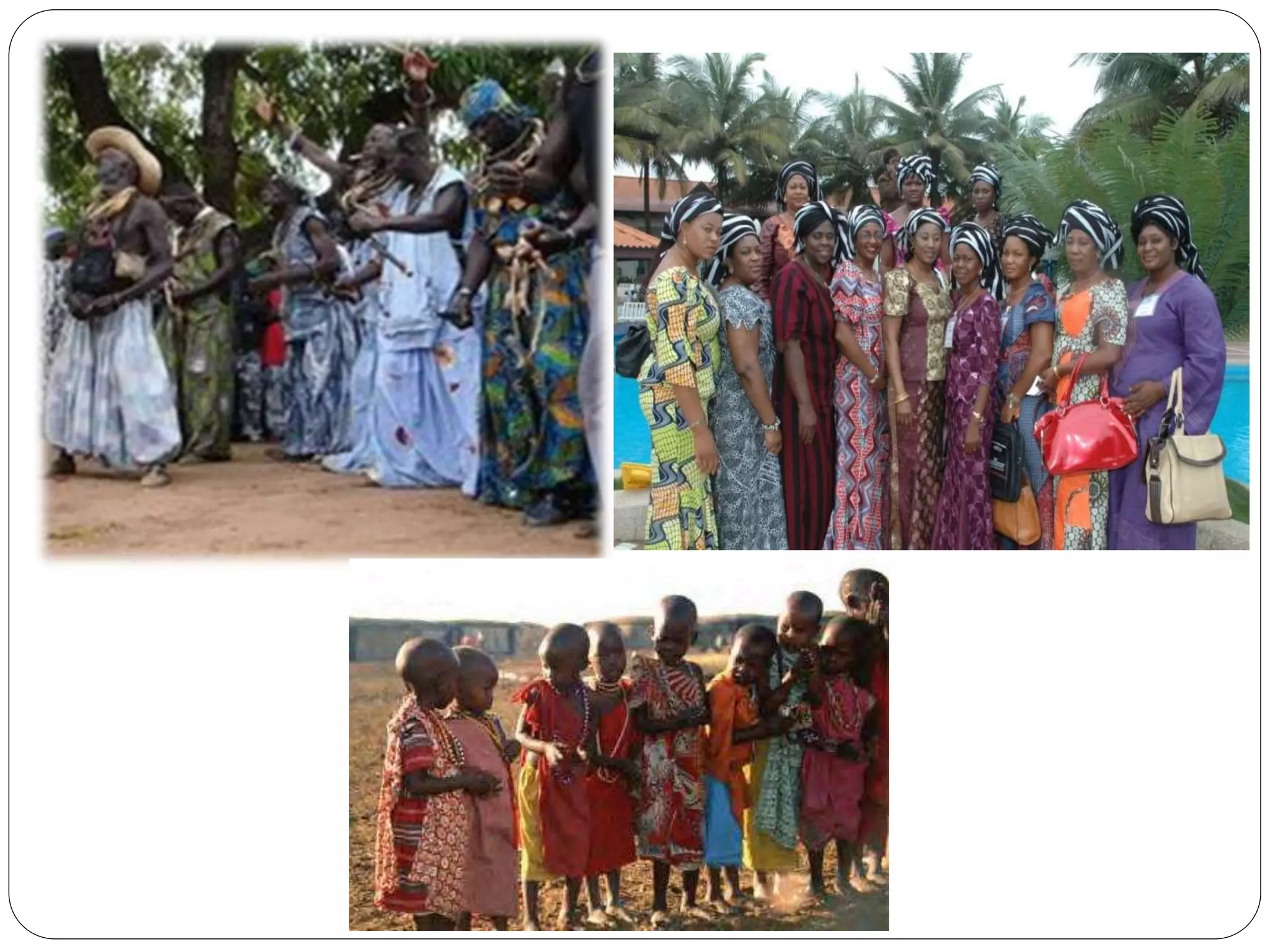
African Clothing:
 African clothing has changed over time,
Originally, Europeans and Arabs
influenced African clothing, especially in
the northern regions
 The influence of the Arabian culture
continues to be seen in the designs,
embroideries, and long robes worn by
some Africans in their daily lives.
 Most modern Africans wear Western-
styled pants, shirts, dresses and shoes.
 Others continue to combine the old with
the new, wearing traditional clothing,
along with Western styles.
African's top 10 festivals:
 So here’s the list of Africa’s top 10 festivals.
1. Lake of Stars, Malawi
2. Cape Town International Jazz Festival, South
Africa
3. Mawazine, Morocco
4. Felabration, Nigeria
5. Chale Wote Street Art Festival, Ghana
6. Harare International Festival of the Arts (HIFA),
Zimbabwe
7. Timkat, Ethiopia
8. Festima: The International Festival of Masks
and the Arts, Burkina Faso
9. Gnaoua World Music Festival, Morocco
Sports of Africa:
Football is the most popular
sport throughout Africa.
Africa has its own Olympic
Games. The All Africa Games
were first held in Madagascar in
1960, organised by French-
speaking countries.
Cricket is another sport played in
Africa, particularly in South
Sports of Africa:
Circket Football

African culture

  • 1.
    Prepared By :SYEDa RIDA FATIMA RIZVI Submitted To : Dr . Anila & Ma’am Maryam Bsc.(hons) 3rd year African Culture
  • 2.
  • 3.
     Africa isthe world's second-largest and second-most-populous continent with approximately 58 countries.  African culture is incredibly interesting because it is so diverse. Every African country is a mix of tribes each with their own unique language and culture  This rich and diverse culture varies from country to country.  Africa has 3000 distinct ethnic groups, 2000 languages.
  • 4.
    Languages Spoken inAfrican Countries:
  • 5.
     Africa isa continent with a very high linguistic diversity, there are an estimated 1500-2000 African languages. Of these languages four main groupings can be distinguished: Afro-Asiatic:  200 million speakers  Spoken in northern Africa, Somalia, Ethiopia, Eritrea, and the area around Lake Chad in central Africa.  Subgroups of Afro-Asiatic are Chadic, Berber, Semitic, Cushitic, and Egyptian
  • 6.
    Niger-Saharian: (Niger-Congo)  300million speakers  The family has seven main subgroups, six of which cover West Africa and the Central African Republic.  The subgroups of the Niger-Congo family are Benue-Congo (including Bantu), West Atlantic, Mande, Voltaic, Kwa, Adamawa East, and Kordofanian  Bantu is spoken in most of the southern half of Africa.
  • 7.
    Nilo-Saharan Family:  11million speakers  The Nilo-Saharan language family covers much of the eastern Sahara, the upper Nile Valley, areas around Lake Victoria in east central Africa, and the Democratic Republic of the Congo.  Nilo-Saharan divides into six subgroups: Nilotic (or Chari-Nile), Songhai, Saharan, Maban, Koman, and Fur.
  • 8.
    Khoisan Family:  About78,000 people speak these languages.  The Khoisan language family has about 12 languages in its two subgroups: South African Khoisan and East African Khoisan.  Languages of South African Khoisan, which include Nama and Naron, are spoken in and around the Kalahari Desert of northern South Africa, southwestern Botswana, and Namibia.
  • 9.
     The Austronesianlanguage in Madagascar.  Indo-European language on the Southern tip of the continent
  • 11.
  • 12.
    Christianity: The majority ofAfrican population is christian. Christianity slowly spread over to Sudan, Egypt, Ethiopia and Eritrea. Today, Africa has more than 350 million followers of Christianity.
  • 13.
    Islam:  Islam isthe dominant religion in North Africa and the Horn of Africa, and it is also the predominant and historical religion of the West African interior and the far west coast of the continent as well as the coast of East Africa Hindusim:  There are sizable of Hindu populations in South Africa and the East African coastal nations.
  • 14.
    Judaism:  Judaism hasan ancient and rich history on the African continent.  Today, there are Jewish communities in many countries; including the Beta Israel of Ethiopia, the Abayudaya of Uganda, the House of Israel in Ghana, the Igbo Jews of Nigeria and the Lemba of Southern Africa.
  • 15.
    Traditional religion:  Traditionalreligious customs are sometimes shared by many African societies.  Many African Christians and Muslims maintain some aspects of their traditional religions.
  • 17.
    Religion in Mozambique: Religious communities are dispersed throughout the country.  According to the 1997 census, a. Roman Catholic 23.8% b. Muslims 17.8%, c. Protestant 17.5% d. 17.8% of the people have other beliefs, e. and 23.1% have no religious beliefs.
  • 18.
  • 19.
    The food ofAfrica is a combination of local fruit, grains, vegetables, milk and meat products, their own traditions and Arab, European and Asian influences.
  • 20.
    Food in theNorth Africa; The Arabs introduced spices such as saffron, nutmeg, cinnamon, ginger and cloves. Sweet pastries and other baked foods were brought by the Ottoman Turks. Olives are an important local harvest in North Africa and olive oil is frequently used
  • 21.
    Food in theSouth and East Africa: Dairy products  Ground maize or corn  Stiff porridge.  Arabic influences can be seen in East African cuisine  Spiced vegetable curries, lentil soups, chapattis and pickles. Oranges, lemons and limes are used in cooking, while other fruits such as mangoes, papayas and pineapples are eaten for dessert.  Domestic pig.
  • 22.
    Food in theWest Africa: Fufu this is made from root vegetables such as yams, cocoyams, or cassava.  Rice dishes  Along coastlines, rivers and lakes, fish are an important source of protein.  Cattle, goats and sheep are raised (varying by region),
  • 23.
    Food in CentralAfrica: Plantains  Cassavas continue to form the basis of many meals.  Starchy staples are often served with meat, bean or vegetable stews.  Families use 'bush meat' from wild animals such as monkey, antelope and wild pigs.  Bambara is a
  • 24.
  • 25.
    “Each group ofpeople have customs that are unique to them”.  One traditional custom in African culture is that of lobola, Wedding:  The wedding is held at night  A man can have as many wives as he can afford and the wives share the responsibilities of the daily chores, such as preparing meals washing clothes etc
  • 26.
  • 27.
     Traditional housesdiffer in different regions in Africa because of the available materials and climate.  Most commonly houses are made of clay and thatch.  These houses most commonly have cylinder or quadrangular shapes and they are small in size  In some more modern rammed houses there is used concrete, cement or
  • 29.
  • 30.
     African clothinghas changed over time, Originally, Europeans and Arabs influenced African clothing, especially in the northern regions  The influence of the Arabian culture continues to be seen in the designs, embroideries, and long robes worn by some Africans in their daily lives.  Most modern Africans wear Western- styled pants, shirts, dresses and shoes.  Others continue to combine the old with the new, wearing traditional clothing, along with Western styles.
  • 32.
    African's top 10festivals:
  • 33.
     So here’sthe list of Africa’s top 10 festivals. 1. Lake of Stars, Malawi 2. Cape Town International Jazz Festival, South Africa 3. Mawazine, Morocco 4. Felabration, Nigeria 5. Chale Wote Street Art Festival, Ghana 6. Harare International Festival of the Arts (HIFA), Zimbabwe 7. Timkat, Ethiopia 8. Festima: The International Festival of Masks and the Arts, Burkina Faso 9. Gnaoua World Music Festival, Morocco
  • 35.
  • 36.
    Football is themost popular sport throughout Africa. Africa has its own Olympic Games. The All Africa Games were first held in Madagascar in 1960, organised by French- speaking countries. Cricket is another sport played in Africa, particularly in South
  • 37.