Search Engine Technology
           (1)

   Prof. Dragomir R. Radev
   radev@cs.columbia.edu
SET FALL 2009

…
2.Introduction
…
…
…
…
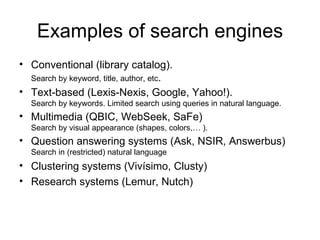
Examples of search engines
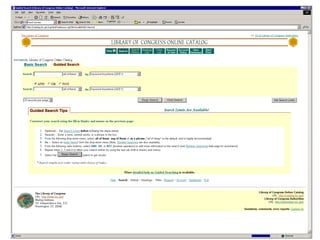
• Conventional (library catalog).
  Search by keyword, title, author, etc.
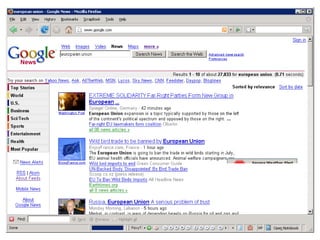
• Text-based (Lexis-Nexis, Google, Yahoo!).
  Search by keywords. Limited search using queries in natural language.
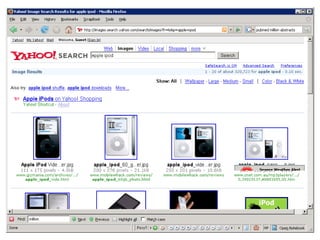
• Multimedia (QBIC, WebSeek, SaFe)
  Search by visual appearance (shapes, colors,… ).
• Question answering systems (Ask, NSIR, Answerbus)
  Search in (restricted) natural language
• Clustering systems (Vivísimo, Clusty)
• Research systems (Lemur, Nutch)
What does it take to build a search
             engine?
•   Decide what to index
•   Collect it
•   Index it (efficiently)
•   Keep the index up to date
•   Provide user-friendly query facilities
What else?
• Understand the structure of the web for
  efficient crawling
• Understand user information needs
• Preprocess text and other unstructured
  data
• Cluster data
• Classify data
• Evaluate performance
Goals of the course
•   Understand how search engines work
•   Understand the limits of existing search technology
•   Learn to appreciate the sheer size of the Web
•   Learn to wrote code for text indexing and retrieval
•   Learn about the state of the art in IR research
•   Learn to analyze textual and semi-structured data sets
•   Learn to appreciate the diversity of texts on the Web
•   Learn to evaluate information retrieval
•   Learn about standardized document collections
•   Learn about text similarity measures
•   Learn about semantic dimensionality reduction
•   Learn about the idiosyncracies of hyperlinked document collections
•   Learn about web crawling
•   Learn to use existing software
•   Understand the dynamics of the Web by building appropriate mathematical models
•   Build working systems that assist users in finding useful information on the Web
Course logistics
• Thursdays 6:10-8:00
• Office hours: TBA
• URL: http://www.cs.columbia.edu/~cs6998

• Instructor: Dragomir Radev
• Email: radev@cs.columbia.edu
• TA:
  – Yves Petinot (ypetinot@cs.columbia.edu)
  – Kaushal Lahankar (knl2102@columbia.edu)
Course outline
• Classic document retrieval: storing,
  indexing, retrieval.
• Web retrieval: crawling, query processing.
• Text and web mining: classification,
  clustering.
• Network analysis: random graph models,
  centrality, diameter and clustering
  coefficient.
Syllabus
•   Introduction.
•   Queries and Documents. Models of Information retrieval. The
    Boolean model. The Vector model.
•   Document preprocessing. Tokenization. Stemming. The Porter
    algorithm. Storing, indexing and searching text. Inverted indexes.
•   Word distributions. The Zipf distribution. The Benford distribution.
    Heap's law. TF*IDF. Vector space similarity and ranking.
•   Retrieval evaluation. Precision and Recall. F-measure. Reference
    collections. The TREC conferences.
•   Automated indexing/labeling. Compression and coding. Optimal
    codes.
•   String matching. Approximate matching.
•   Query expansion. Relevance feedback.
•   Text classification. Naive Bayes. Feature selection. Decision
    trees.
Syllabus
•   Linear classifiers. k-nearest neighbors. Perceptron. Kernel
    methods. Maximum-margin classifiers. Support vector machines.
    Semi-supervised learning.
•   Lexical semantics and Wordnet.
•   Latent semantic indexing. Singular value decomposition.
•   Vector space clustering. k-means clustering. EM clustering.
•   Random graph models. Properties of random graphs: clustering
    coefficient, betweenness, diameter, giant connected component,
    degree distribution.
•   Social network analysis. Small worlds and scale-free networks.
    Power law distributions. Centrality.
•   Graph-based methods. Harmonic functions. Random walks.
•   PageRank. Hubs and authorities. Bipartite graphs. HITS.
•   Models of the Web.
Syllabus
•   Crawling the web. Webometrics. Measuring the size of the web. The Bow-tie-
    method.
•   Hypertext retrieval. Web-based IR. Document closures. Focused crawling.
•   Question answering
•   Burstiness. Self-triggerability
•   Information extraction
•   Adversarial IR. Human behavior on the web.
•   Text summarization

POSSIBLE TOPICS

•   Discovering communities, spectral clustering
•   Semi-supervised retrieval
•   Natural language processing. XML retrieval. Text tiling. Human behavior on the
    web.
Readings
• required: Information Retrieval by Manning,
  Schuetze, and Raghavan (
  http://www-csli.stanford.edu/~schuetze/information-re
  ), freely available, hard copy for sale
• optional: Modeling the Internet and the Web:
  Probabilistic Methods and Algorithms by Pierre
  Baldi, Paolo Frasconi, Padhraic Smyth, Wiley,
  2003, ISBN: 0-470-84906-1 (
  http://ibook.ics.uci.edu).
• papers from SIGIR, WWW and journals (to be
  announced in class).
Prerequisites
• Linear algebra: vectors and matrices.
• Calculus: Finding extrema of functions.
• Probabilities: random variables, discrete and
  continuous distributions, Bayes theorem.
• Programming: experience with at least one web-
  aware programming language such as Perl
  (highly recommended) or Java in a UNIX
  environment.
• Required CS account
Course requirements
• Three assignments (30%)
  – Some of them will be in Perl. The rest can be done in
    any appropriate language. All will involve some data
    analysis and evaluation
• Final project (30%)
  – Research paper or software system.
• Class participation (10%)
• Final exam (30%)
Final project format
• Research paper - using the SIGIR format.
  Students will be in charge of problem
  formulation, literature survey, hypothesis
  formulation, experimental design,
  implementation, and possibly submission to a
  conference like SIGIR or WWW.
• Software system - develop a working system or
  API. Students will be responsible for identifying a
  niche problem, implementing it and deploying it,
  either on the Web or as an open-source
  downloadable tool. The system can be either
  stand alone or an extension to an existing one.
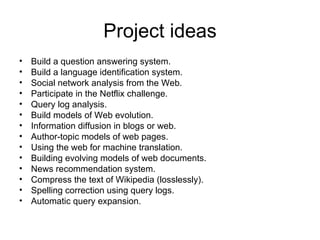
Project ideas
•   Build a question answering system.
•   Build a language identification system.
•   Social network analysis from the Web.
•   Participate in the Netflix challenge.
•   Query log analysis.
•   Build models of Web evolution.
•   Information diffusion in blogs or web.
•   Author-topic models of web pages.
•   Using the web for machine translation.
•   Building evolving models of web documents.
•   News recommendation system.
•   Compress the text of Wikipedia (losslessly).
•   Spelling correction using query logs.
•   Automatic query expansion.
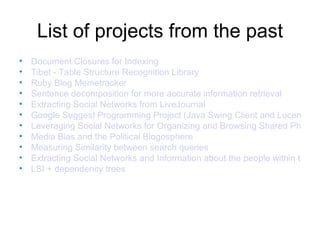
List of projects from the past
•   Document Closures for Indexing
•   Tibet - Table Structure Recognition Library
•   Ruby Blog Memetracker
•   Sentence decomposition for more accurate information retrieval
•   Extracting Social Networks from LiveJournal
•   Google Suggest Programming Project (Java Swing Client and Lucene Bac
•   Leveraging Social Networks for Organizing and Browsing Shared Photogr
•   Media Bias and the Political Blogosphere
•   Measuring Similarity between search queries
•   Extracting Social Networks and Information about the people within them
•   LSI + dependency trees
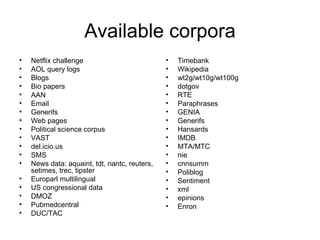
Available corpora
•   Netflix challenge                          •   Timebank
•   AOL query logs                             •   Wikipedia
•   Blogs                                      •   wt2g/wt10g/wt100g
•   Bio papers                                 •   dotgov
•   AAN                                        •   RTE
•   Email                                      •   Paraphrases
•   Generifs                                   •   GENIA
•   Web pages                                  •   Generifs
•   Political science corpus                   •   Hansards
•   VAST                                       •   IMDB
•   del.icio.us                                •   MTA/MTC
•   SMS                                        •   nie
•   News data: aquaint, tdt, nantc, reuters,   •   cnnsumm
    setimes, trec, tipster                     •   Poliblog
•   Europarl multilingual                      •   Sentiment
•   US congressional data                      •   xml
•   DMOZ                                       •   epinions
•   Pubmedcentral                              •   Enron
•   DUC/TAC
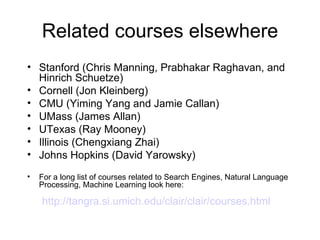
Related courses elsewhere
• Stanford (Chris Manning, Prabhakar Raghavan, and
  Hinrich Schuetze)
• Cornell (Jon Kleinberg)
• CMU (Yiming Yang and Jamie Callan)
• UMass (James Allan)
• UTexas (Ray Mooney)
• Illinois (Chengxiang Zhai)
• Johns Hopkins (David Yarowsky)
•   For a long list of courses related to Search Engines, Natural Language
    Processing, Machine Learning look here:

    http://tangra.si.umich.edu/clair/clair/courses.html
SET FALL 2009

…
2. Models of Information retrieval
   The Vector model
   The Boolean model
…
…
The web is really large
• 100 B pages
• Dynamically generated content
• New pages get added all the time
• Technorati has 50M+ blogs
• The size of the blogosphere doubles every
  6 months
• Yahoo deals with 12TB of data per day
  (according to Ron Brachman)
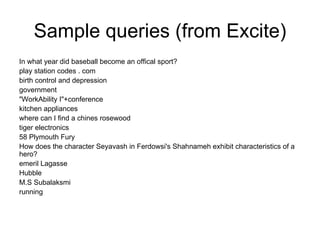
Sample queries (from Excite)
In what year did baseball become an offical sport?
play station codes . com
birth control and depression
government
"WorkAbility I"+conference
kitchen appliances
where can I find a chines rosewood
tiger electronics
58 Plymouth Fury
How does the character Seyavash in Ferdowsi's Shahnameh exhibit characteristics of a
hero?
emeril Lagasse
Hubble
M.S Subalaksmi
running
Fun things to do with search
             engines
• Googlewhack
• Reduce document set size to 1
• Find query that will bring given URL in the
  top 10
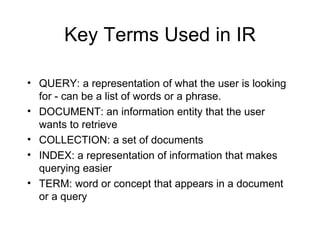
Key Terms Used in IR

• QUERY: a representation of what the user is looking
  for - can be a list of words or a phrase.
• DOCUMENT: an information entity that the user
  wants to retrieve
• COLLECTION: a set of documents
• INDEX: a representation of information that makes
  querying easier
• TERM: word or concept that appears in a document
  or a query
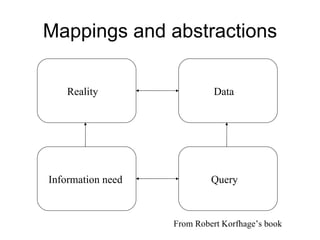
Mappings and abstractions

    Reality                  Data


Information need            Query


                   From Robert Korfhage’s book
Documents
• Not just printed paper
• Can be records, pages, sites, images,
  people, movies
• Document encoding (Unicode)
• Document representation
• Document preprocessing
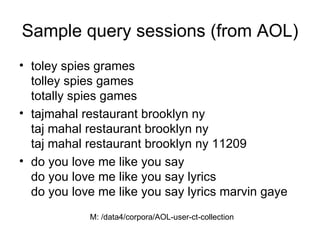
Sample query sessions (from AOL)
• toley spies grames
  tolley spies games
  totally spies games
• tajmahal restaurant brooklyn ny
  taj mahal restaurant brooklyn ny
  taj mahal restaurant brooklyn ny 11209
• do you love me like you say
  do you love me like you say lyrics
  do you love me like you say lyrics marvin gaye
            M: /data4/corpora/AOL-user-ct-collection
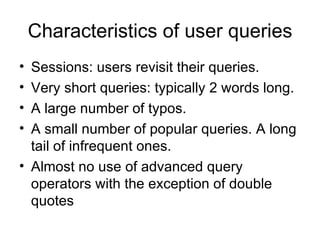
Characteristics of user queries
• Sessions: users revisit their queries.
• Very short queries: typically 2 words long.
• A large number of typos.
• A small number of popular queries. A long
  tail of infrequent ones.
• Almost no use of advanced query
  operators with the exception of double
  quotes
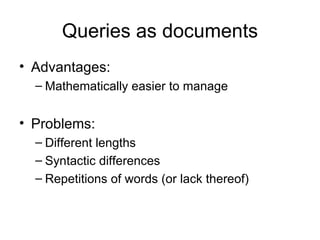
Queries as documents
• Advantages:
  – Mathematically easier to manage


• Problems:
  – Different lengths
  – Syntactic differences
  – Repetitions of words (or lack thereof)
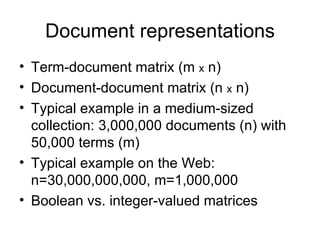
Document representations
• Term-document matrix (m x n)
• Document-document matrix (n x n)
• Typical example in a medium-sized
  collection: 3,000,000 documents (n) with
  50,000 terms (m)
• Typical example on the Web:
  n=30,000,000,000, m=1,000,000
• Boolean vs. integer-valued matrices
Storage issues
• Imagine a medium-sized collection with
  n=3,000,000 and m=50,000
• How large a term-document matrix will be
  needed?
• Is there any way to do better? Any
  heuristic?
Inverted index
• Instead of an incidence vector, use a
  posting table
• CLEVELAND: D1, D2, D6
• OHIO: D1, D5, D6, D7
• Use linked lists to be able to insert new
  document postings in order and to remove
  existing postings.
• Keep everything sorted! This gives you a
  logarithmic improvement in access.
Basic operations on inverted
              indexes
• Conjunction (AND) – iterative merge of the
  two postings: O(x+y)
• Disjunction (OR) – very similar
• Negation (NOT) – can we still do it in
  O(x+y)?
  – Example: MICHIGAN AND NOT OHIO
  – Example: MICHIGAN OR NOT OHIO
• Recursive operations
• Optimization: start with the smallest sets
Major IR models
•   Boolean
•   Vector
•   Probabilistic
•   Language modeling
•   Fuzzy retrieval
•   Latent semantic indexing
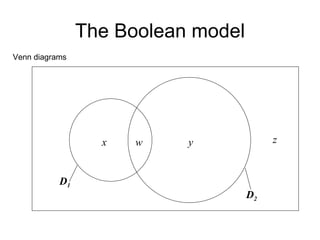
The Boolean model
Venn diagrams


                  x   w    y             z


           D1
                                    D2
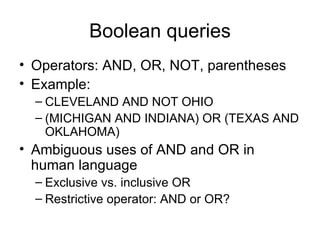
Boolean queries
• Operators: AND, OR, NOT, parentheses
• Example:
  – CLEVELAND AND NOT OHIO
  – (MICHIGAN AND INDIANA) OR (TEXAS AND
    OKLAHOMA)
• Ambiguous uses of AND and OR in
  human language
  – Exclusive vs. inclusive OR
  – Restrictive operator: AND or OR?
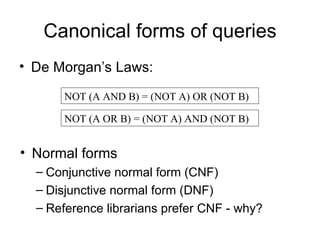
Canonical forms of queries
• De Morgan’s Laws:

      NOT (A AND B) = (NOT A) OR (NOT B)

      NOT (A OR B) = (NOT A) AND (NOT B)


• Normal forms
  – Conjunctive normal form (CNF)
  – Disjunctive normal form (DNF)
  – Reference librarians prefer CNF - why?
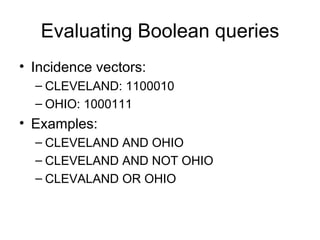
Evaluating Boolean queries
• Incidence vectors:
  – CLEVELAND: 1100010
  – OHIO: 1000111
• Examples:
  – CLEVELAND AND OHIO
  – CLEVELAND AND NOT OHIO
  – CLEVALAND OR OHIO
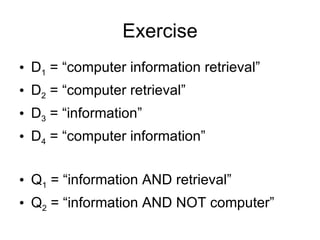
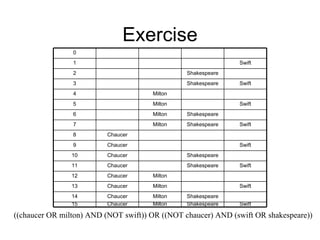
Exercise
• D1 = “computer information retrieval”
• D2 = “computer retrieval”
• D3 = “information”
• D4 = “computer information”


• Q1 = “information AND retrieval”
• Q2 = “information AND NOT computer”
Exercise
                0
                1                                             Swift
                2                               Shakespeare
                3                               Shakespeare   Swift
                4                     Milton
                5                     Milton                  Swift
                6                     Milton    Shakespeare
                7                     Milton    Shakespeare   Swift
                8        Chaucer
                9        Chaucer                              Swift
                10       Chaucer                Shakespeare
                11       Chaucer                Shakespeare   Swift
                12       Chaucer      Milton
                13       Chaucer      Milton                  Swift
                14       Chaucer      Milton    Shakespeare
                15       Chaucer      Milton    Shakespeare   Swift

((chaucer OR milton) AND (NOT swift)) OR ((NOT chaucer) AND (swift OR shakespeare))
How to deal with?
• Multi-word phrases?
• Document ranking?
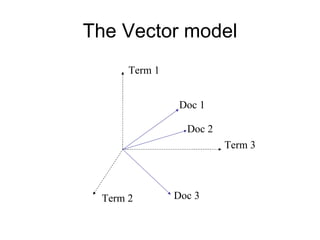
The Vector model
      Term 1


                Doc 1

                 Doc 2
                         Term 3


 Term 2        Doc 3
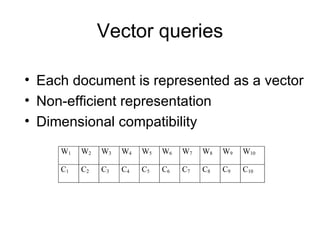
Vector queries

• Each document is represented as a vector
• Non-efficient representation
• Dimensional compatibility
     W1   W2   W3   W4   W5   W6   W7   W8   W9   W10

     C1   C2   C3   C4   C5   C6   C7   C8   C9   C10
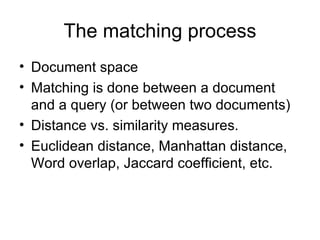
The matching process
• Document space
• Matching is done between a document
  and a query (or between two documents)
• Distance vs. similarity measures.
• Euclidean distance, Manhattan distance,
  Word overlap, Jaccard coefficient, etc.
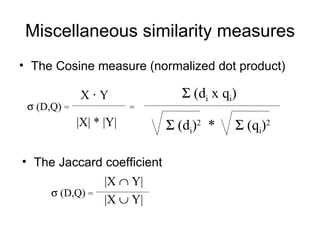
Miscellaneous similarity measures
• The Cosine measure (normalized dot product)

             X·Y               Σ (di x qi)
 σ (D,Q) =               =
             |X| * |Y|       Σ (di)2 *   Σ (qi)2

• The Jaccard coefficient
                   |X ∩ Y|
      σ (D,Q) =
                   |X ∪ Y|
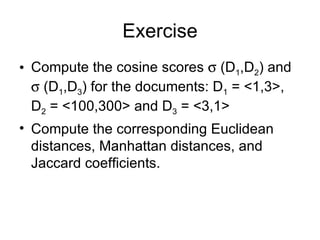
Exercise
• Compute the cosine scores σ (D1,D2) and
  σ (D1,D3) for the documents: D1 = <1,3>,
  D2 = <100,300> and D3 = <3,1>
• Compute the corresponding Euclidean
  distances, Manhattan distances, and
  Jaccard coefficients.
Readings
• (1): MRS1, MRS2, MRS5 (Zipf)
• (2): MRS7, MRS8

Ir1

  • 1.
    Search Engine Technology (1) Prof. Dragomir R. Radev radev@cs.columbia.edu
  • 2.
  • 7.
    Examples of searchengines • Conventional (library catalog). Search by keyword, title, author, etc. • Text-based (Lexis-Nexis, Google, Yahoo!). Search by keywords. Limited search using queries in natural language. • Multimedia (QBIC, WebSeek, SaFe) Search by visual appearance (shapes, colors,… ). • Question answering systems (Ask, NSIR, Answerbus) Search in (restricted) natural language • Clustering systems (Vivísimo, Clusty) • Research systems (Lemur, Nutch)
  • 8.
    What does ittake to build a search engine? • Decide what to index • Collect it • Index it (efficiently) • Keep the index up to date • Provide user-friendly query facilities
  • 9.
    What else? • Understandthe structure of the web for efficient crawling • Understand user information needs • Preprocess text and other unstructured data • Cluster data • Classify data • Evaluate performance
  • 10.
    Goals of thecourse • Understand how search engines work • Understand the limits of existing search technology • Learn to appreciate the sheer size of the Web • Learn to wrote code for text indexing and retrieval • Learn about the state of the art in IR research • Learn to analyze textual and semi-structured data sets • Learn to appreciate the diversity of texts on the Web • Learn to evaluate information retrieval • Learn about standardized document collections • Learn about text similarity measures • Learn about semantic dimensionality reduction • Learn about the idiosyncracies of hyperlinked document collections • Learn about web crawling • Learn to use existing software • Understand the dynamics of the Web by building appropriate mathematical models • Build working systems that assist users in finding useful information on the Web
  • 11.
    Course logistics • Thursdays6:10-8:00 • Office hours: TBA • URL: http://www.cs.columbia.edu/~cs6998 • Instructor: Dragomir Radev • Email: radev@cs.columbia.edu • TA: – Yves Petinot (ypetinot@cs.columbia.edu) – Kaushal Lahankar (knl2102@columbia.edu)
  • 12.
    Course outline • Classicdocument retrieval: storing, indexing, retrieval. • Web retrieval: crawling, query processing. • Text and web mining: classification, clustering. • Network analysis: random graph models, centrality, diameter and clustering coefficient.
  • 13.
    Syllabus • Introduction. • Queries and Documents. Models of Information retrieval. The Boolean model. The Vector model. • Document preprocessing. Tokenization. Stemming. The Porter algorithm. Storing, indexing and searching text. Inverted indexes. • Word distributions. The Zipf distribution. The Benford distribution. Heap's law. TF*IDF. Vector space similarity and ranking. • Retrieval evaluation. Precision and Recall. F-measure. Reference collections. The TREC conferences. • Automated indexing/labeling. Compression and coding. Optimal codes. • String matching. Approximate matching. • Query expansion. Relevance feedback. • Text classification. Naive Bayes. Feature selection. Decision trees.
  • 14.
    Syllabus • Linear classifiers. k-nearest neighbors. Perceptron. Kernel methods. Maximum-margin classifiers. Support vector machines. Semi-supervised learning. • Lexical semantics and Wordnet. • Latent semantic indexing. Singular value decomposition. • Vector space clustering. k-means clustering. EM clustering. • Random graph models. Properties of random graphs: clustering coefficient, betweenness, diameter, giant connected component, degree distribution. • Social network analysis. Small worlds and scale-free networks. Power law distributions. Centrality. • Graph-based methods. Harmonic functions. Random walks. • PageRank. Hubs and authorities. Bipartite graphs. HITS. • Models of the Web.
  • 15.
    Syllabus • Crawling the web. Webometrics. Measuring the size of the web. The Bow-tie- method. • Hypertext retrieval. Web-based IR. Document closures. Focused crawling. • Question answering • Burstiness. Self-triggerability • Information extraction • Adversarial IR. Human behavior on the web. • Text summarization POSSIBLE TOPICS • Discovering communities, spectral clustering • Semi-supervised retrieval • Natural language processing. XML retrieval. Text tiling. Human behavior on the web.
  • 16.
    Readings • required: InformationRetrieval by Manning, Schuetze, and Raghavan ( http://www-csli.stanford.edu/~schuetze/information-re ), freely available, hard copy for sale • optional: Modeling the Internet and the Web: Probabilistic Methods and Algorithms by Pierre Baldi, Paolo Frasconi, Padhraic Smyth, Wiley, 2003, ISBN: 0-470-84906-1 ( http://ibook.ics.uci.edu). • papers from SIGIR, WWW and journals (to be announced in class).
  • 17.
    Prerequisites • Linear algebra:vectors and matrices. • Calculus: Finding extrema of functions. • Probabilities: random variables, discrete and continuous distributions, Bayes theorem. • Programming: experience with at least one web- aware programming language such as Perl (highly recommended) or Java in a UNIX environment. • Required CS account
  • 18.
    Course requirements • Threeassignments (30%) – Some of them will be in Perl. The rest can be done in any appropriate language. All will involve some data analysis and evaluation • Final project (30%) – Research paper or software system. • Class participation (10%) • Final exam (30%)
  • 19.
    Final project format •Research paper - using the SIGIR format. Students will be in charge of problem formulation, literature survey, hypothesis formulation, experimental design, implementation, and possibly submission to a conference like SIGIR or WWW. • Software system - develop a working system or API. Students will be responsible for identifying a niche problem, implementing it and deploying it, either on the Web or as an open-source downloadable tool. The system can be either stand alone or an extension to an existing one.
  • 20.
    Project ideas • Build a question answering system. • Build a language identification system. • Social network analysis from the Web. • Participate in the Netflix challenge. • Query log analysis. • Build models of Web evolution. • Information diffusion in blogs or web. • Author-topic models of web pages. • Using the web for machine translation. • Building evolving models of web documents. • News recommendation system. • Compress the text of Wikipedia (losslessly). • Spelling correction using query logs. • Automatic query expansion.
  • 21.
    List of projectsfrom the past • Document Closures for Indexing • Tibet - Table Structure Recognition Library • Ruby Blog Memetracker • Sentence decomposition for more accurate information retrieval • Extracting Social Networks from LiveJournal • Google Suggest Programming Project (Java Swing Client and Lucene Bac • Leveraging Social Networks for Organizing and Browsing Shared Photogr • Media Bias and the Political Blogosphere • Measuring Similarity between search queries • Extracting Social Networks and Information about the people within them • LSI + dependency trees
  • 22.
    Available corpora • Netflix challenge • Timebank • AOL query logs • Wikipedia • Blogs • wt2g/wt10g/wt100g • Bio papers • dotgov • AAN • RTE • Email • Paraphrases • Generifs • GENIA • Web pages • Generifs • Political science corpus • Hansards • VAST • IMDB • del.icio.us • MTA/MTC • SMS • nie • News data: aquaint, tdt, nantc, reuters, • cnnsumm setimes, trec, tipster • Poliblog • Europarl multilingual • Sentiment • US congressional data • xml • DMOZ • epinions • Pubmedcentral • Enron • DUC/TAC
  • 23.
    Related courses elsewhere •Stanford (Chris Manning, Prabhakar Raghavan, and Hinrich Schuetze) • Cornell (Jon Kleinberg) • CMU (Yiming Yang and Jamie Callan) • UMass (James Allan) • UTexas (Ray Mooney) • Illinois (Chengxiang Zhai) • Johns Hopkins (David Yarowsky) • For a long list of courses related to Search Engines, Natural Language Processing, Machine Learning look here: http://tangra.si.umich.edu/clair/clair/courses.html
  • 24.
    SET FALL 2009 … 2.Models of Information retrieval The Vector model The Boolean model … …
  • 25.
    The web isreally large • 100 B pages • Dynamically generated content • New pages get added all the time • Technorati has 50M+ blogs • The size of the blogosphere doubles every 6 months • Yahoo deals with 12TB of data per day (according to Ron Brachman)
  • 26.
    Sample queries (fromExcite) In what year did baseball become an offical sport? play station codes . com birth control and depression government "WorkAbility I"+conference kitchen appliances where can I find a chines rosewood tiger electronics 58 Plymouth Fury How does the character Seyavash in Ferdowsi's Shahnameh exhibit characteristics of a hero? emeril Lagasse Hubble M.S Subalaksmi running
  • 27.
    Fun things todo with search engines • Googlewhack • Reduce document set size to 1 • Find query that will bring given URL in the top 10
  • 28.
    Key Terms Usedin IR • QUERY: a representation of what the user is looking for - can be a list of words or a phrase. • DOCUMENT: an information entity that the user wants to retrieve • COLLECTION: a set of documents • INDEX: a representation of information that makes querying easier • TERM: word or concept that appears in a document or a query
  • 29.
    Mappings and abstractions Reality Data Information need Query From Robert Korfhage’s book
  • 30.
    Documents • Not justprinted paper • Can be records, pages, sites, images, people, movies • Document encoding (Unicode) • Document representation • Document preprocessing
  • 31.
    Sample query sessions(from AOL) • toley spies grames tolley spies games totally spies games • tajmahal restaurant brooklyn ny taj mahal restaurant brooklyn ny taj mahal restaurant brooklyn ny 11209 • do you love me like you say do you love me like you say lyrics do you love me like you say lyrics marvin gaye M: /data4/corpora/AOL-user-ct-collection
  • 32.
    Characteristics of userqueries • Sessions: users revisit their queries. • Very short queries: typically 2 words long. • A large number of typos. • A small number of popular queries. A long tail of infrequent ones. • Almost no use of advanced query operators with the exception of double quotes
  • 33.
    Queries as documents •Advantages: – Mathematically easier to manage • Problems: – Different lengths – Syntactic differences – Repetitions of words (or lack thereof)
  • 34.
    Document representations • Term-documentmatrix (m x n) • Document-document matrix (n x n) • Typical example in a medium-sized collection: 3,000,000 documents (n) with 50,000 terms (m) • Typical example on the Web: n=30,000,000,000, m=1,000,000 • Boolean vs. integer-valued matrices
  • 35.
    Storage issues • Imaginea medium-sized collection with n=3,000,000 and m=50,000 • How large a term-document matrix will be needed? • Is there any way to do better? Any heuristic?
  • 36.
    Inverted index • Insteadof an incidence vector, use a posting table • CLEVELAND: D1, D2, D6 • OHIO: D1, D5, D6, D7 • Use linked lists to be able to insert new document postings in order and to remove existing postings. • Keep everything sorted! This gives you a logarithmic improvement in access.
  • 37.
    Basic operations oninverted indexes • Conjunction (AND) – iterative merge of the two postings: O(x+y) • Disjunction (OR) – very similar • Negation (NOT) – can we still do it in O(x+y)? – Example: MICHIGAN AND NOT OHIO – Example: MICHIGAN OR NOT OHIO • Recursive operations • Optimization: start with the smallest sets
  • 38.
    Major IR models • Boolean • Vector • Probabilistic • Language modeling • Fuzzy retrieval • Latent semantic indexing
  • 39.
    The Boolean model Venndiagrams x w y z D1 D2
  • 40.
    Boolean queries • Operators:AND, OR, NOT, parentheses • Example: – CLEVELAND AND NOT OHIO – (MICHIGAN AND INDIANA) OR (TEXAS AND OKLAHOMA) • Ambiguous uses of AND and OR in human language – Exclusive vs. inclusive OR – Restrictive operator: AND or OR?
  • 41.
    Canonical forms ofqueries • De Morgan’s Laws: NOT (A AND B) = (NOT A) OR (NOT B) NOT (A OR B) = (NOT A) AND (NOT B) • Normal forms – Conjunctive normal form (CNF) – Disjunctive normal form (DNF) – Reference librarians prefer CNF - why?
  • 42.
    Evaluating Boolean queries •Incidence vectors: – CLEVELAND: 1100010 – OHIO: 1000111 • Examples: – CLEVELAND AND OHIO – CLEVELAND AND NOT OHIO – CLEVALAND OR OHIO
  • 43.
    Exercise • D1 =“computer information retrieval” • D2 = “computer retrieval” • D3 = “information” • D4 = “computer information” • Q1 = “information AND retrieval” • Q2 = “information AND NOT computer”
  • 44.
    Exercise 0 1 Swift 2 Shakespeare 3 Shakespeare Swift 4 Milton 5 Milton Swift 6 Milton Shakespeare 7 Milton Shakespeare Swift 8 Chaucer 9 Chaucer Swift 10 Chaucer Shakespeare 11 Chaucer Shakespeare Swift 12 Chaucer Milton 13 Chaucer Milton Swift 14 Chaucer Milton Shakespeare 15 Chaucer Milton Shakespeare Swift ((chaucer OR milton) AND (NOT swift)) OR ((NOT chaucer) AND (swift OR shakespeare))
  • 45.
    How to dealwith? • Multi-word phrases? • Document ranking?
  • 46.
    The Vector model Term 1 Doc 1 Doc 2 Term 3 Term 2 Doc 3
  • 47.
    Vector queries • Eachdocument is represented as a vector • Non-efficient representation • Dimensional compatibility W1 W2 W3 W4 W5 W6 W7 W8 W9 W10 C1 C2 C3 C4 C5 C6 C7 C8 C9 C10
  • 48.
    The matching process •Document space • Matching is done between a document and a query (or between two documents) • Distance vs. similarity measures. • Euclidean distance, Manhattan distance, Word overlap, Jaccard coefficient, etc.
  • 49.
    Miscellaneous similarity measures •The Cosine measure (normalized dot product) X·Y Σ (di x qi) σ (D,Q) = = |X| * |Y| Σ (di)2 * Σ (qi)2 • The Jaccard coefficient |X ∩ Y| σ (D,Q) = |X ∪ Y|
  • 50.
    Exercise • Compute thecosine scores σ (D1,D2) and σ (D1,D3) for the documents: D1 = <1,3>, D2 = <100,300> and D3 = <3,1> • Compute the corresponding Euclidean distances, Manhattan distances, and Jaccard coefficients.
  • 51.
    Readings • (1): MRS1,MRS2, MRS5 (Zipf) • (2): MRS7, MRS8