December 01, 2015
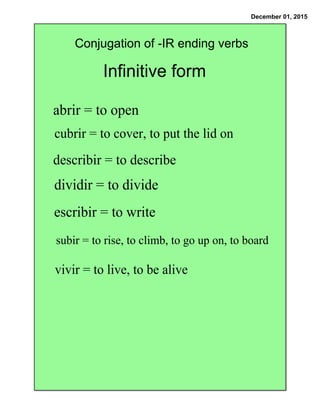
Conjugation of -IR ending verbs
abrir = to open
cubrir = to cover, to put the lid on
escribir = to write
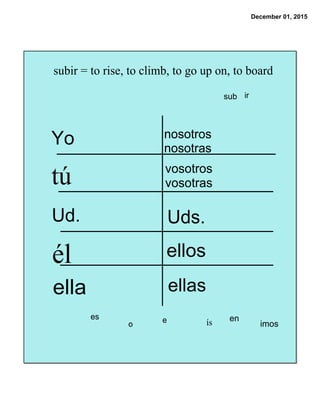
subir = to rise, to climb, to go up on, to board
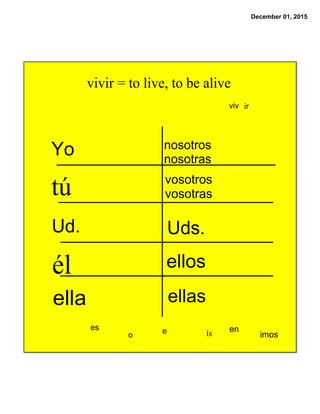
vivir = to live, to be alive
describir = to describe
dividir = to divide
Infinitive form
December 01, 2015
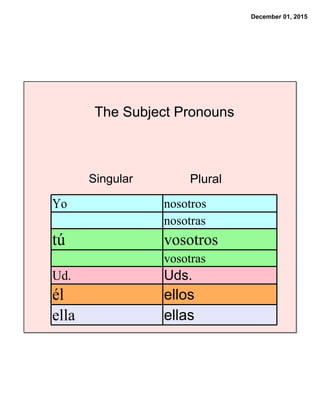
Singular Plural
Yo nosotros
nosotras
tú vosotros
vosotras
Ud. Uds.
él ellos
ella ellas
The Subject Pronouns
December 01, 2015
December 01, 2015
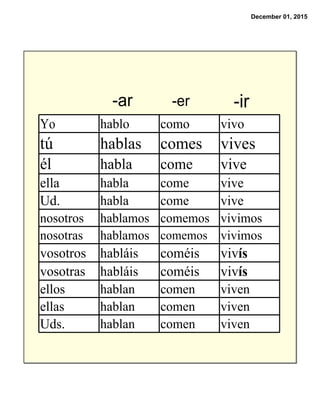
-ar -er -ir
Yo hablo como vivo
tú hablas comes vives
él habla come vive
ella habla come vive
Ud. habla come vive
nosotros hablamos comemos vivimos
nosotras hablamos comemos vivimos
vosotros habláis coméis vivís
vosotras habláis coméis vivís
ellos hablan comen viven
ellas hablan comen viven
Uds. hablan comen viven
December 01, 2015
December 01, 2015
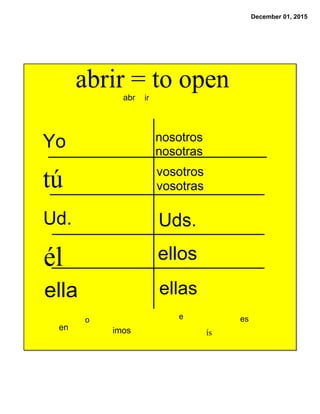
abrir = to openabr ir
o ese
imos ís
en
Yo nosotros
nosotras
vosotros
vosotras
Uds.
ellos
ellas
tú
Ud.
él
ella
December 01, 2015
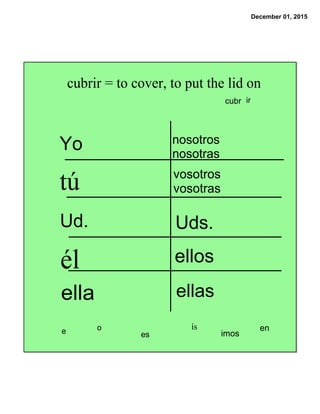
cubr ir
o
ese imos
ís en
cubrir = to cover, to put the lid on
Yo nosotros
nosotras
vosotros
vosotras
Uds.
ellos
ellas
tú
Ud.
él
ella
December 01, 2015
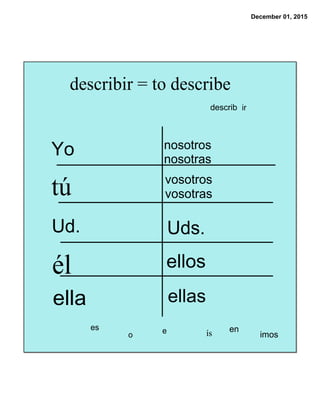
describ ir
o
es e imosís en
Yo nosotros
nosotras
vosotros
vosotras
Uds.
ellos
ellas
tú
Ud.
él
ella
describir = to describe
December 01, 2015
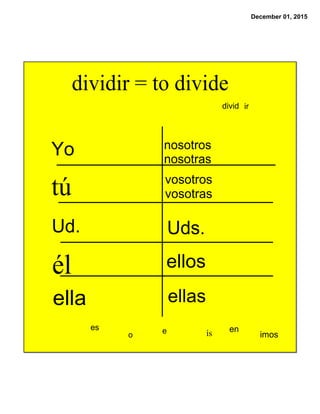
divid ir
o
es e imosís en
Yo nosotros
nosotras
vosotros
vosotras
Uds.
ellos
ellas
tú
Ud.
él
ella
dividir = to divide
December 01, 2015
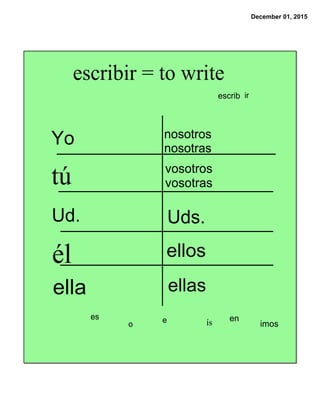
escrib ir
o
es e imosís en
Yo nosotros
nosotras
vosotros
vosotras
Uds.
ellos
ellas
tú
Ud.
él
ella
escribir = to write
December 01, 2015
sub ir
o
es e imosís en
Yo nosotros
nosotras
vosotros
vosotras
Uds.
ellos
ellas
tú
Ud.
él
ella
subir = to rise, to climb, to go up on, to board
December 01, 2015
viv ir
o
es e imosís en
Yo nosotros
nosotras
vosotros
vosotras
Uds.
ellos
ellas
tú
Ud.
él
ella
vivir = to live, to be alive
December 01, 2015
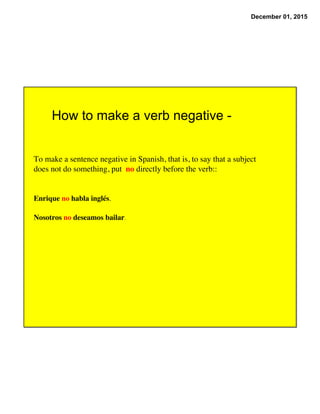
How to make a verb negative -
To make a sentence negative in Spanish, that is, to say that a subject
does not do something, put no directly before the verb::
Enrique no habla inglés.
Nosotros no deseamos bailar.
December 01, 2015
To ask a question, put the subject after the verb. An inverted question
mark is placed at the beginning of a question:
¿Canta Enrique en español?
¿Compra usted los sandwiches?
December 01, 2015
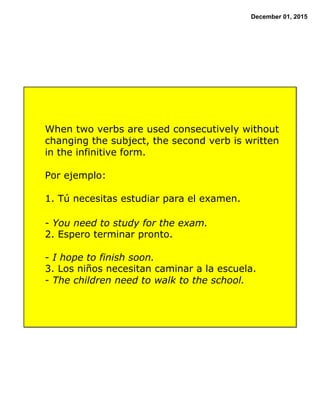
When two verbs are used consecutively without
changing the subject, the second verb is written
in the infinitive form.
Por ejemplo:
1. Tú necesitas estudiar para el examen.
- You need to study for the exam.
2. Espero terminar pronto.
- I hope to finish soon.
3. Los niños necesitan caminar a la escuela.
- The children need to walk to the school.
December 01, 2015
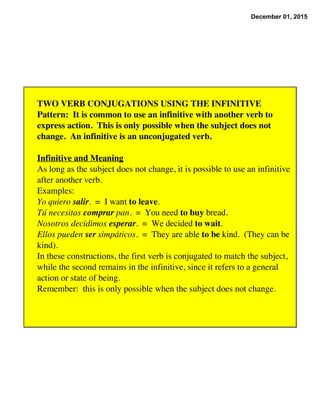
TWO VERB CONJUGATIONS USING THE INFINITIVE
Pattern:  It is common to use an infinitive with another verb to
express action.  This is only possible when the subject does not
change.  An infinitive is an unconjugated verb.
Infinitive and Meaning
As long as the subject does not change, it is possible to use an infinitive
after another verb.
Examples:
Yo quiero salir.  =  I want to leave.
Tú necesitas comprar pan.  =  You need to buy bread.
Nosotros decidimos esperar.  =  We decided to wait.
Ellos pueden ser simpáticos.  =  They are able to be kind.  (They can be
kind).
In these constructions, the first verb is conjugated to match the subject,
while the second remains in the infinitive, since it refers to a general
action or state of being.
Remember:  this is only possible when the subject does not change.

Ir verbs

  • 1.
    December 01, 2015 Conjugationof -IR ending verbs abrir = to open cubrir = to cover, to put the lid on escribir = to write subir = to rise, to climb, to go up on, to board vivir = to live, to be alive describir = to describe dividir = to divide Infinitive form
  • 2.
    December 01, 2015 SingularPlural Yo nosotros nosotras tú vosotros vosotras Ud. Uds. él ellos ella ellas The Subject Pronouns
  • 3.
  • 4.
    December 01, 2015 -ar-er -ir Yo hablo como vivo tú hablas comes vives él habla come vive ella habla come vive Ud. habla come vive nosotros hablamos comemos vivimos nosotras hablamos comemos vivimos vosotros habláis coméis vivís vosotras habláis coméis vivís ellos hablan comen viven ellas hablan comen viven Uds. hablan comen viven
  • 5.
  • 6.
    December 01, 2015 abrir= to openabr ir o ese imos ís en Yo nosotros nosotras vosotros vosotras Uds. ellos ellas tú Ud. él ella
  • 7.
    December 01, 2015 cubrir o ese imos ís en cubrir = to cover, to put the lid on Yo nosotros nosotras vosotros vosotras Uds. ellos ellas tú Ud. él ella
  • 8.
    December 01, 2015 describir o es e imosís en Yo nosotros nosotras vosotros vosotras Uds. ellos ellas tú Ud. él ella describir = to describe
  • 9.
    December 01, 2015 dividir o es e imosís en Yo nosotros nosotras vosotros vosotras Uds. ellos ellas tú Ud. él ella dividir = to divide
  • 10.
    December 01, 2015 escribir o es e imosís en Yo nosotros nosotras vosotros vosotras Uds. ellos ellas tú Ud. él ella escribir = to write
  • 11.
    December 01, 2015 subir o es e imosís en Yo nosotros nosotras vosotros vosotras Uds. ellos ellas tú Ud. él ella subir = to rise, to climb, to go up on, to board
  • 12.
    December 01, 2015 vivir o es e imosís en Yo nosotros nosotras vosotros vosotras Uds. ellos ellas tú Ud. él ella vivir = to live, to be alive
  • 13.
    December 01, 2015 Howto make a verb negative - To make a sentence negative in Spanish, that is, to say that a subject does not do something, put no directly before the verb:: Enrique no habla inglés. Nosotros no deseamos bailar.
  • 14.
    December 01, 2015 Toask a question, put the subject after the verb. An inverted question mark is placed at the beginning of a question: ¿Canta Enrique en español? ¿Compra usted los sandwiches?
  • 15.
    December 01, 2015 Whentwo verbs are used consecutively without changing the subject, the second verb is written in the infinitive form. Por ejemplo: 1. Tú necesitas estudiar para el examen. - You need to study for the exam. 2. Espero terminar pronto. - I hope to finish soon. 3. Los niños necesitan caminar a la escuela. - The children need to walk to the school.
  • 16.
    December 01, 2015 TWOVERB CONJUGATIONS USING THE INFINITIVE Pattern:  It is common to use an infinitive with another verb to express action.  This is only possible when the subject does not change.  An infinitive is an unconjugated verb. Infinitive and Meaning As long as the subject does not change, it is possible to use an infinitive after another verb. Examples: Yo quiero salir.  =  I want to leave. Tú necesitas comprar pan.  =  You need to buy bread. Nosotros decidimos esperar.  =  We decided to wait. Ellos pueden ser simpáticos.  =  They are able to be kind.  (They can be kind). In these constructions, the first verb is conjugated to match the subject, while the second remains in the infinitive, since it refers to a general action or state of being. Remember:  this is only possible when the subject does not change.