INFINITIVES AND GERUNDS
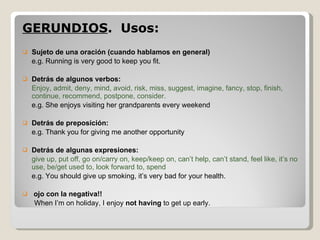
GERUNDIOS .  Usos:  Sujeto de una oración (cuando hablamos en general) e.g. Running is very good to keep you fit. Detrás de algunos verbos: Enjoy, admit, deny, mind, avoid, risk, miss, suggest, imagine, fancy, stop, finish, continue, recommend, postpone, consider. e.g. She enjoys visiting her grandparents every weekend Detrás de preposición: e.g. Thank you for giving me another opportunity Detrás de algunas expresiones: give up, put off, go on/carry on, keep/keep on, can’t help, can’t stand, feel like, it’s no use, be/get used to, look forward to, spend e.g. You should give up smoking, it’s very bad for your health. ojo con la negativa!!  When I’m on holiday, I enjoy  not having  to get up early.
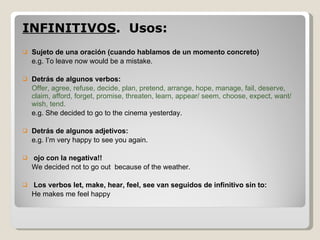
INFINITIVOS .  Usos:  Sujeto de una oración (cuando hablamos de un momento concreto) e.g. To leave now would be a mistake. Detrás de algunos verbos: Offer, agree, refuse, decide, plan, pretend, arrange, hope, manage, fail, deserve, claim, afford, forget, promise, threaten, learn, appear/ seem, choose, expect, want/ wish, tend. e.g. She decided to go to the cinema yesterday. Detrás de algunos adjetivos: e.g. I’m very happy to see you again. ojo con la negativa!! We decided not to go out  because of the weather. Los verbos let, make, hear, feel, see van seguidos de infinitivo sin to: He makes me feel happy
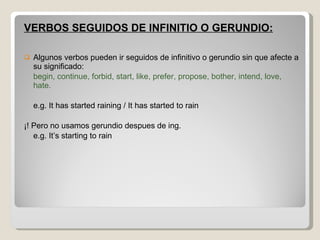
VERBOS SEGUIDOS DE INFINITIO O GERUNDIO: Algunos verbos pueden ir seguidos de infinitivo o gerundio sin que afecte a su significado: begin, continue, forbid, start, like, prefer, propose, bother, intend, love, hate. e.g. It has started raining / It has started to rain ¡! Pero no usamos gerundio despues de ing. e.g. It’s starting to rain
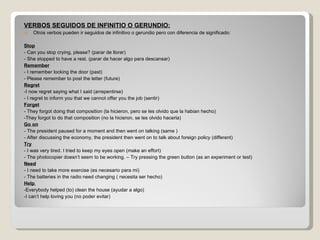
VERBOS SEGUIDOS DE INFINITIO O GERUNDIO: Otros verbos pueden ir seguidos de infinitivo o gerundio pero con diferencia de significado: Stop - Can you stop crying, please? (parar de llorar) - She stopped to have a rest. (parar de hacer algo para descansar) Remember - I remember locking the door (past) - Please remember to post the letter (future) Regret -I now regret saying what I said (arrepentirse) - I regret to inform you that we cannot offer you the job (sentir) Forget - They forgot doing that composition (la hicieron, pero se les olvido que la habian hecho) -They forgot to do that composition (no la hicieron, se les olvido hacerla) Go on - The president paused for a moment and then went on talking (same ) - After discussing the economy, the president then went on to talk about foreign policy (different) Try - I was very tired. I tried to keep my eyes open (make an effort) - The photocopier doesn’t seem to be working. – Try pressing the green button (as an experiment or test) Need - I need to take more exercise (es necesario para mi) - The batteries in the radio need changing ( necesita ser hecho) Help   -Everybody helped (to) clean the house (ayudar a algo) -I can’t help loving you (no poder evitar)  

Infinitives and gerunds

  • 1.
  • 2.
    GERUNDIOS . Usos: Sujeto de una oración (cuando hablamos en general) e.g. Running is very good to keep you fit. Detrás de algunos verbos: Enjoy, admit, deny, mind, avoid, risk, miss, suggest, imagine, fancy, stop, finish, continue, recommend, postpone, consider. e.g. She enjoys visiting her grandparents every weekend Detrás de preposición: e.g. Thank you for giving me another opportunity Detrás de algunas expresiones: give up, put off, go on/carry on, keep/keep on, can’t help, can’t stand, feel like, it’s no use, be/get used to, look forward to, spend e.g. You should give up smoking, it’s very bad for your health. ojo con la negativa!! When I’m on holiday, I enjoy not having to get up early.
  • 3.
    INFINITIVOS . Usos: Sujeto de una oración (cuando hablamos de un momento concreto) e.g. To leave now would be a mistake. Detrás de algunos verbos: Offer, agree, refuse, decide, plan, pretend, arrange, hope, manage, fail, deserve, claim, afford, forget, promise, threaten, learn, appear/ seem, choose, expect, want/ wish, tend. e.g. She decided to go to the cinema yesterday. Detrás de algunos adjetivos: e.g. I’m very happy to see you again. ojo con la negativa!! We decided not to go out because of the weather. Los verbos let, make, hear, feel, see van seguidos de infinitivo sin to: He makes me feel happy
  • 4.
    VERBOS SEGUIDOS DEINFINITIO O GERUNDIO: Algunos verbos pueden ir seguidos de infinitivo o gerundio sin que afecte a su significado: begin, continue, forbid, start, like, prefer, propose, bother, intend, love, hate. e.g. It has started raining / It has started to rain ¡! Pero no usamos gerundio despues de ing. e.g. It’s starting to rain
  • 5.
    VERBOS SEGUIDOS DEINFINITIO O GERUNDIO: Otros verbos pueden ir seguidos de infinitivo o gerundio pero con diferencia de significado: Stop - Can you stop crying, please? (parar de llorar) - She stopped to have a rest. (parar de hacer algo para descansar) Remember - I remember locking the door (past) - Please remember to post the letter (future) Regret -I now regret saying what I said (arrepentirse) - I regret to inform you that we cannot offer you the job (sentir) Forget - They forgot doing that composition (la hicieron, pero se les olvido que la habian hecho) -They forgot to do that composition (no la hicieron, se les olvido hacerla) Go on - The president paused for a moment and then went on talking (same ) - After discussing the economy, the president then went on to talk about foreign policy (different) Try - I was very tired. I tried to keep my eyes open (make an effort) - The photocopier doesn’t seem to be working. – Try pressing the green button (as an experiment or test) Need - I need to take more exercise (es necesario para mi) - The batteries in the radio need changing ( necesita ser hecho) Help -Everybody helped (to) clean the house (ayudar a algo) -I can’t help loving you (no poder evitar)