StudySpanish.com
Regular Verbs: Part III
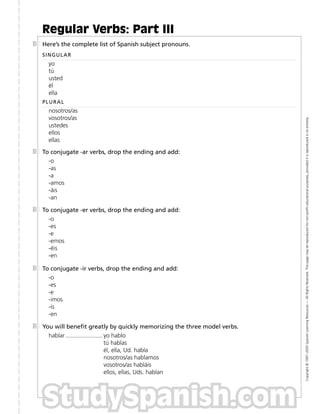
Here’s the complete list of Spanish subject pronouns.
SINGULAR
yo
tú
usted
él
ella
PLURAL
nosotros/as
vosotros/as
ustedes
ellos
ellas
To conjugate -ar verbs, drop the ending and add:
-o
-as
-a
-amos
-áis
-an
To conjugate -er verbs, drop the ending and add:
-o
-es
-e
-emos
-éis
-en
To conjugate -ir verbs, drop the ending and add:
-o
-es
-e
-imos
-ís
-en
You will benefit greatly by quickly memorizing the three model verbs.
hablar ...................... yo hablo
tú hablas
él, ella, Ud. habla
nosotros/as hablamos
vosotros/as habláis
ellos, ellas, Uds. hablan
Copyright
©
1997–2005
Spanish
Learning
Resources
—
All
Rights
Reserved.
This
page
may
be
reproduced
for
non-profit
educational
purposes,
provided
it
is
reproduced
in
its
entirety.
StudySpanish.com
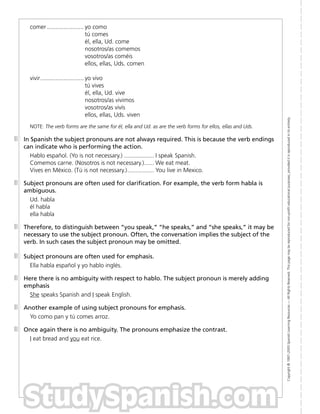
comer ...................... yo como
tú comes
él, ella, Ud. come
nosotros/as comemos
vosotros/as coméis
ellos, ellas, Uds. comen
vivir.......................... yo vivo
tú vives
él, ella, Ud. vive
nosotros/as vivimos
vosotros/as vivís
ellos, ellas, Uds. viven
NOTE: The verb forms are the same for él, ella and Ud. as are the verb forms for ellos, ellas and Uds.
In Spanish the subject pronouns are not always required. This is because the verb endings
can indicate who is performing the action.
Hablo español. (Yo is not necessary.) .................. I speak Spanish.
Comemos carne. (Nosotros is not necessary.)...... We eat meat.
Vives en México. (Tú is not necessary.)................ You live in Mexico.
Subject pronouns are often used for clarification. For example, the verb form habla is
ambiguous.
Ud. habla
él habla
ella habla
Therefore, to distinguish between “you speak,” “he speaks,” and “she speaks,” it may be
necessary to use the subject pronoun. Often, the conversation implies the subject of the
verb. In such cases the subject pronoun may be omitted.
Subject pronouns are often used for emphasis.
Ella habla español y yo hablo inglés.
Here there is no ambiguity with respect to hablo. The subject pronoun is merely adding
emphasis
She speaks Spanish and I speak English.
Another example of using subject pronouns for emphasis.
Yo como pan y tú comes arroz.
Once again there is no ambiguity. The pronouns emphasize the contrast.
I eat bread and you eat rice.
Copyright
©
1997–2005
Spanish
Learning
Resources
—
All
Rights
Reserved.
This
page
may
be
reproduced
for
non-profit
educational
purposes,
provided
it
is
reproduced
in
its
entirety.
StudySpanish.com
It is possible to use two verbs in a row. Just like in English, the first verb is conjugated,
while the second verb remains in the infinitive form.
Necesito hablar con Alfredo
I need to speak with Alfredo.
(necesitar, hablar)
Necesito + hablar + con Alfredo.
I need + to speak + with Alfredo.
Another example of two verbs used together:
Deseas vivir en España.
You wish to live in Spain.
(desear, vivir)
Deseas + vivir + en España.
You wish + to live + in Spain.
Hopefully, you have taken our advice and have been creating a special collection of verb
flashcards. If not, it’s not too late to start. Here is the entire list of cards to this point:
Verb Flashcards
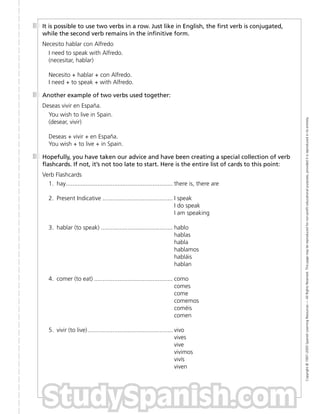
1. hay................................................................ there is, there are
2. Present Indicative .......................................... I speak
I do speak
I am speaking
3. hablar (to speak) ........................................... hablo
hablas
habla
hablamos
habláis
hablan
4. comer (to eat) ............................................... como
comes
come
comemos
coméis
comen
5. vivir (to live)................................................... vivo
vives
vive
vivimos
vivís
viven
Copyright
©
1997–2005
Spanish
Learning
Resources
—
All
Rights
Reserved.
This
page
may
be
reproduced
for
non-profit
educational
purposes,
provided
it
is
reproduced
in
its
entirety.
StudySpanish.com
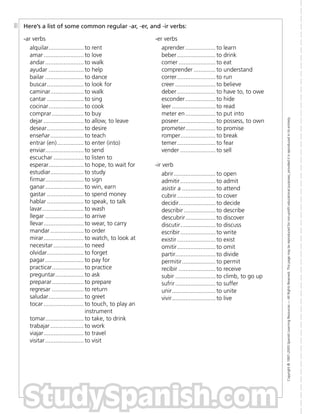
Here’s a list of some common regular -ar, -er, and -ir verbs:
-er verbs
aprender.................. to learn
beber....................... to drink
comer ...................... to eat
comprender ............. to understand
correr....................... to run
creer ........................ to believe
deber....................... to have to, to owe
esconder.................. to hide
leer .......................... to read
meter en.................. to put into
poseer...................... to possess, to own
prometer.................. to promise
romper..................... to break
temer....................... to fear
vender ..................... to sell
-ir verb
abrir......................... to open
admitir..................... to admit
asistir a .................... to attend
cubrir....................... to cover
decidir...................... to decide
describir................... to describe
descubrir.................. to discover
discutir..................... to discuss
escribir..................... to write
existir....................... to exist
omitir....................... to omit
partir........................ to divide
permitir.................... to permit
recibir ...................... to receive
subir ........................ to climb, to go up
sufrir........................ to suffer
unir.......................... to unite
vivir.......................... to live
-ar verbs
alquilar..................... to rent
amar........................ to love
andar....................... to walk
ayudar ..................... to help
bailar ....................... to dance
buscar...................... to look for
caminar.................... to walk
cantar ...................... to sing
cocinar..................... to cook
comprar................... to buy
dejar ........................ to allow, to leave
desear...................... to desire
enseñar.................... to teach
entrar (en)................ to enter (into)
enviar....................... to send
escuchar .................. to listen to
esperar..................... to hope, to wait for
estudiar.................... to study
firmar....................... to sign
ganar....................... to win, earn
gastar ...................... to spend money
hablar ...................... to speak, to talk
lavar......................... to wash
llegar ....................... to arrive
llevar........................ to wear, to carry
mandar.................... to order
mirar........................ to watch, to look at
necesitar .................. to need
olvidar...................... to forget
pagar....................... to pay for
practicar................... to practice
preguntar................. to ask
preparar................... to prepare
regresar ................... to return
saludar..................... to greet
tocar........................ to touch, to play an
instrument
tomar....................... to take, to drink
trabajar.................... to work
viajar........................ to travel
visitar....................... to visit
Copyright
©
1997–2005
Spanish
Learning
Resources
—
All
Rights
Reserved.
This
page
may
be
reproduced
for
non-profit
educational
purposes,
provided
it
is
reproduced
in
its
entirety.

El infinitivo -regular verb s-3

  • 1.
    StudySpanish.com Regular Verbs: PartIII Here’s the complete list of Spanish subject pronouns. SINGULAR yo tú usted él ella PLURAL nosotros/as vosotros/as ustedes ellos ellas To conjugate -ar verbs, drop the ending and add: -o -as -a -amos -áis -an To conjugate -er verbs, drop the ending and add: -o -es -e -emos -éis -en To conjugate -ir verbs, drop the ending and add: -o -es -e -imos -ís -en You will benefit greatly by quickly memorizing the three model verbs. hablar ...................... yo hablo tú hablas él, ella, Ud. habla nosotros/as hablamos vosotros/as habláis ellos, ellas, Uds. hablan Copyright © 1997–2005 Spanish Learning Resources — All Rights Reserved. This page may be reproduced for non-profit educational purposes, provided it is reproduced in its entirety.
  • 2.
    StudySpanish.com comer ...................... yocomo tú comes él, ella, Ud. come nosotros/as comemos vosotros/as coméis ellos, ellas, Uds. comen vivir.......................... yo vivo tú vives él, ella, Ud. vive nosotros/as vivimos vosotros/as vivís ellos, ellas, Uds. viven NOTE: The verb forms are the same for él, ella and Ud. as are the verb forms for ellos, ellas and Uds. In Spanish the subject pronouns are not always required. This is because the verb endings can indicate who is performing the action. Hablo español. (Yo is not necessary.) .................. I speak Spanish. Comemos carne. (Nosotros is not necessary.)...... We eat meat. Vives en México. (Tú is not necessary.)................ You live in Mexico. Subject pronouns are often used for clarification. For example, the verb form habla is ambiguous. Ud. habla él habla ella habla Therefore, to distinguish between “you speak,” “he speaks,” and “she speaks,” it may be necessary to use the subject pronoun. Often, the conversation implies the subject of the verb. In such cases the subject pronoun may be omitted. Subject pronouns are often used for emphasis. Ella habla español y yo hablo inglés. Here there is no ambiguity with respect to hablo. The subject pronoun is merely adding emphasis She speaks Spanish and I speak English. Another example of using subject pronouns for emphasis. Yo como pan y tú comes arroz. Once again there is no ambiguity. The pronouns emphasize the contrast. I eat bread and you eat rice. Copyright © 1997–2005 Spanish Learning Resources — All Rights Reserved. This page may be reproduced for non-profit educational purposes, provided it is reproduced in its entirety.
  • 3.
    StudySpanish.com It is possibleto use two verbs in a row. Just like in English, the first verb is conjugated, while the second verb remains in the infinitive form. Necesito hablar con Alfredo I need to speak with Alfredo. (necesitar, hablar) Necesito + hablar + con Alfredo. I need + to speak + with Alfredo. Another example of two verbs used together: Deseas vivir en España. You wish to live in Spain. (desear, vivir) Deseas + vivir + en España. You wish + to live + in Spain. Hopefully, you have taken our advice and have been creating a special collection of verb flashcards. If not, it’s not too late to start. Here is the entire list of cards to this point: Verb Flashcards 1. hay................................................................ there is, there are 2. Present Indicative .......................................... I speak I do speak I am speaking 3. hablar (to speak) ........................................... hablo hablas habla hablamos habláis hablan 4. comer (to eat) ............................................... como comes come comemos coméis comen 5. vivir (to live)................................................... vivo vives vive vivimos vivís viven Copyright © 1997–2005 Spanish Learning Resources — All Rights Reserved. This page may be reproduced for non-profit educational purposes, provided it is reproduced in its entirety.
  • 4.
    StudySpanish.com Here’s a listof some common regular -ar, -er, and -ir verbs: -er verbs aprender.................. to learn beber....................... to drink comer ...................... to eat comprender ............. to understand correr....................... to run creer ........................ to believe deber....................... to have to, to owe esconder.................. to hide leer .......................... to read meter en.................. to put into poseer...................... to possess, to own prometer.................. to promise romper..................... to break temer....................... to fear vender ..................... to sell -ir verb abrir......................... to open admitir..................... to admit asistir a .................... to attend cubrir....................... to cover decidir...................... to decide describir................... to describe descubrir.................. to discover discutir..................... to discuss escribir..................... to write existir....................... to exist omitir....................... to omit partir........................ to divide permitir.................... to permit recibir ...................... to receive subir ........................ to climb, to go up sufrir........................ to suffer unir.......................... to unite vivir.......................... to live -ar verbs alquilar..................... to rent amar........................ to love andar....................... to walk ayudar ..................... to help bailar ....................... to dance buscar...................... to look for caminar.................... to walk cantar ...................... to sing cocinar..................... to cook comprar................... to buy dejar ........................ to allow, to leave desear...................... to desire enseñar.................... to teach entrar (en)................ to enter (into) enviar....................... to send escuchar .................. to listen to esperar..................... to hope, to wait for estudiar.................... to study firmar....................... to sign ganar....................... to win, earn gastar ...................... to spend money hablar ...................... to speak, to talk lavar......................... to wash llegar ....................... to arrive llevar........................ to wear, to carry mandar.................... to order mirar........................ to watch, to look at necesitar .................. to need olvidar...................... to forget pagar....................... to pay for practicar................... to practice preguntar................. to ask preparar................... to prepare regresar ................... to return saludar..................... to greet tocar........................ to touch, to play an instrument tomar....................... to take, to drink trabajar.................... to work viajar........................ to travel visitar....................... to visit Copyright © 1997–2005 Spanish Learning Resources — All Rights Reserved. This page may be reproduced for non-profit educational purposes, provided it is reproduced in its entirety.