packetlife.net 
IPV6 
Protocol Header 
8 16 24 32 
Address Notation 
	 Eliminate leading zeros from all two-byte sets 
	 Replace up to one string of consecutive zeros 
with a double-colon (::) 
Address Formats 
Global unicast 
Global Prefix Subnet Interface ID 
48 16 64 
Link-local unicast 
Interface ID 
64 64 
Group ID 
8 4 4 112 
EUI-64 Formation 
Multicast 
Flags 
Scope 
MAC 
EUI-64 
	 Insert 0xfffe between the two halves of the MAC 
	 Flip the seventh bit (universal/local flag) to 1 
Extension Headers 
Ver Traffic Class Flow Label 
Payload Length Next Header Hop Limit 
Source Address 
Destination Address 
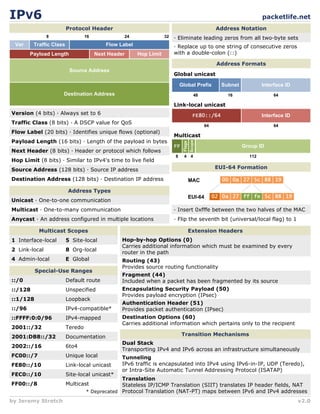
Version (4 bits) 	 Always set to 6 
Traffic Class (8 bits) 	 A DSCP value for QoS 
Flow Label (20 bits) 	 Identifies unique flows (optional) 
Payload Length (16 bits) 	 Length of the payload in bytes 
Next Header (8 bits) 	 Header or protocol which follows 
Hop Limit (8 bits) 	 Similar to IPv4's time to live field 
Source Address (128 bits) 	 Source IP address 
Destination Address (128 bits) 	 Destination IP address 
Address Types 
Unicast 	 One-to-one communication 
Multicast 	 One-to-many communication 
Anycast 	 An address configured in multiple locations 
Multicast Scopes 
1 Interface-local 5 Site-local 
2 Link-local 8 Org-local 
4 Admin-local E Global 
Special-Use Ranges 
::/0 
::/128 
Default route 
Unspecified 
::1/128 
::/96 
Loopback 
IPv4-compatible* 
::FFFF:0:0/96 
2001::/32 
IPv4-mapped 
Teredo 
2001:DB8::/32 
2002::/16 
Documentation 
6to4 
FC00::/7 
FE80::/10 
Unique local 
Link-local unicast 
FEC0::/10 
FF00::/8 
Site-local unicast* 
Multicast 
Hop-by-hop Options (0) 
Carries additional information which must be examined by every 
router in the path 
Routing (43) 
Provides source routing functionality 
Fragment (44) 
Included when a packet has been fragmented by its source 
Encapsulating Security Payload (50) 
Provides payload encryption (IPsec) 
Authentication Header (51) 
Provides packet authentication (IPsec) 
Destination Options (60) 
Carries additional information which pertains only to the recipient 
Transition Mechanisms 
Dual Stack 
Transporting IPv4 and IPv6 across an infrastructure simultaneously 
Tunneling 
IPv6 traffic is encapsulated into IPv4 using IPv6-in-IP, UDP (Teredo), 
or Intra-Site Automatic Tunnel Addressing Protocol (ISATAP) 
Translation 
Stateless IP/ICMP Translation (SIIT) translates IP header fields, NAT 
Protocol Translation (NAT-PT) maps between IPv6 and IPv4 addresses 
* Deprecated 
by Jeremy Stretch v2.0

IPv6

  • 1.
    packetlife.net IPV6 ProtocolHeader 8 16 24 32 Address Notation Eliminate leading zeros from all two-byte sets Replace up to one string of consecutive zeros with a double-colon (::) Address Formats Global unicast Global Prefix Subnet Interface ID 48 16 64 Link-local unicast Interface ID 64 64 Group ID 8 4 4 112 EUI-64 Formation Multicast Flags Scope MAC EUI-64 Insert 0xfffe between the two halves of the MAC Flip the seventh bit (universal/local flag) to 1 Extension Headers Ver Traffic Class Flow Label Payload Length Next Header Hop Limit Source Address Destination Address Version (4 bits) Always set to 6 Traffic Class (8 bits) A DSCP value for QoS Flow Label (20 bits) Identifies unique flows (optional) Payload Length (16 bits) Length of the payload in bytes Next Header (8 bits) Header or protocol which follows Hop Limit (8 bits) Similar to IPv4's time to live field Source Address (128 bits) Source IP address Destination Address (128 bits) Destination IP address Address Types Unicast One-to-one communication Multicast One-to-many communication Anycast An address configured in multiple locations Multicast Scopes 1 Interface-local 5 Site-local 2 Link-local 8 Org-local 4 Admin-local E Global Special-Use Ranges ::/0 ::/128 Default route Unspecified ::1/128 ::/96 Loopback IPv4-compatible* ::FFFF:0:0/96 2001::/32 IPv4-mapped Teredo 2001:DB8::/32 2002::/16 Documentation 6to4 FC00::/7 FE80::/10 Unique local Link-local unicast FEC0::/10 FF00::/8 Site-local unicast* Multicast Hop-by-hop Options (0) Carries additional information which must be examined by every router in the path Routing (43) Provides source routing functionality Fragment (44) Included when a packet has been fragmented by its source Encapsulating Security Payload (50) Provides payload encryption (IPsec) Authentication Header (51) Provides packet authentication (IPsec) Destination Options (60) Carries additional information which pertains only to the recipient Transition Mechanisms Dual Stack Transporting IPv4 and IPv6 across an infrastructure simultaneously Tunneling IPv6 traffic is encapsulated into IPv4 using IPv6-in-IP, UDP (Teredo), or Intra-Site Automatic Tunnel Addressing Protocol (ISATAP) Translation Stateless IP/ICMP Translation (SIIT) translates IP header fields, NAT Protocol Translation (NAT-PT) maps between IPv6 and IPv4 addresses * Deprecated by Jeremy Stretch v2.0