Sixth Assessment Report
Synthesis Report
20 March 2023
Sixth Assessment Report | Synthesis Report
Fog Opening the Dawn
Jeong Jinsil
Weather and Climate Photography &Video Contest 2021
Korea MeteorologicalAdministration
The State of Knowledge
about Climate Change
Global Warming of 1.5 ºC
Climate Change 2022:
Mitigation of Climate Change
WGIII
Climate Change and Land
Special Report
Ocean and Cryosphere in a
Changing Climate
Climate Change 2022:
Impacts, Adaptation and
Vulnerability
WGII
AR6 Climate Change 2021:
The Physical Science Basis
WGI
Sixth Assessment Report | Synthesis Report
The warning Pace and scale of climate action are
insuf
fi
cient to tackle climate change
Sixth Assessment Report | Synthesis Report
Adverse
impacts from
human-caused
change will
intensify
Water scarcity and food production
Health and wellbeing
Cities, settlements and infrastructure
Ecosystem structure, species range shifts and changes in timing
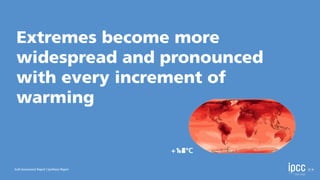
Extremes become more
widespread and pronounced
with every increment of
warming
Sixth Assessment Report | Synthesis Report
+1.5°C
+2°C
+3°C
+4°C
Sixth Assessment Report | Synthesis Report
hope
The
Mainstreaming effective and equitable climate
action now will reduce losses and damages
Multiple, feasible and effective options are
available to reduce GHG emissions
Climate action provides co-bene
fi
ts.
Sixth Assessment Report | Synthesis Report
for nature and people.
and adapt to human-caused climate change.
The hope
• Cut emissions quickly, sharply to create a
safer, sustainable world
• Scale up practices and infrastructure to
enhance resilience
• Cut global GHG emissions by nearly half
by 2030
• Action required along numerous
dimensions
Sixth Assessment Report | Synthesis Report
The
challenge
Sixth Assessment Report | Synthesis Report
The path forward is clear
Tried and tested
options available now
Need to be designed
for diverse contexts
Need to be scaled up
and applied widely
Fairness is
one of the
solutions
• Those who contributed the least to climate
change are often the most vulnerable to its
impacts.
• Millions exposed to acute food insecurity,
reduced water security.
• Biggest impacts in parts of Africa, Asia,
Central/South America, LDCs, Small Islands,
Arctic.
• People in highly vulnerable areas up to 15x
more likely to die in
fl
oods, droughts, storms
(compared to those in in most resilient areas)
Sixth Assessment Report | Synthesis Report
• 3-6 times the current climate investment
• But there is enough global
fi
nancing to
rapidly reduce emissions
• Developing countries require external
funding to meet adaptation needs
• Options are available to scale up
fi
nancing
Sixth Assessment Report | Synthesis Report
Increased
financing for
climate action
The way forward:
• Integrating measures to adapt to climate
change with actions to reduce emissions in
ways that provide wider bene
fi
ts:
• Improving peoples’ health and livelihoods
• Reducing poverty and hunger
• Clean energy, water and air
Sixth Assessment Report | Synthesis Report
Climate-resilient
development
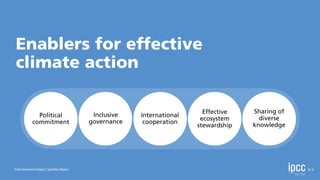
Enablers for effective
climate action
Sixth Assessment Report | Synthesis Report
Political
commitment
Sharing of
diverse
knowledge
International
cooperation
Effective
ecosystem
stewardship
Inclusive
governance
Human
factors also
enable action
Sixth Assessment Report | Synthesis Report
Trust
that some can contribute
more than others
Recognition
Collaboration
Sharing of
bene
fi
ts and
burdens
hundreds,
even thousands,
of years.
Sixth Assessment Report | Synthesis Report
Our choices will
reverberate for
IPCC AR6 SYR SlideDeck

IPCC AR6 SYR SlideDeck

  • 2.
  • 3.
    Sixth Assessment Report| Synthesis Report Fog Opening the Dawn Jeong Jinsil Weather and Climate Photography &Video Contest 2021 Korea MeteorologicalAdministration
  • 4.
    The State ofKnowledge about Climate Change Global Warming of 1.5 ºC Climate Change 2022: Mitigation of Climate Change WGIII Climate Change and Land Special Report Ocean and Cryosphere in a Changing Climate Climate Change 2022: Impacts, Adaptation and Vulnerability WGII AR6 Climate Change 2021: The Physical Science Basis WGI Sixth Assessment Report | Synthesis Report
  • 5.
    The warning Paceand scale of climate action are insuf fi cient to tackle climate change Sixth Assessment Report | Synthesis Report
  • 6.
    Sixth Assessment Report| Synthesis Report Adverse impacts from human-caused change will intensify Water scarcity and food production Health and wellbeing Cities, settlements and infrastructure Ecosystem structure, species range shifts and changes in timing
  • 7.
    Extremes become more widespreadand pronounced with every increment of warming Sixth Assessment Report | Synthesis Report +1.5°C +2°C +3°C +4°C
  • 8.
    Sixth Assessment Report| Synthesis Report hope The
  • 9.
    Mainstreaming effective andequitable climate action now will reduce losses and damages Multiple, feasible and effective options are available to reduce GHG emissions Climate action provides co-bene fi ts. Sixth Assessment Report | Synthesis Report for nature and people. and adapt to human-caused climate change. The hope
  • 10.
    • Cut emissionsquickly, sharply to create a safer, sustainable world • Scale up practices and infrastructure to enhance resilience • Cut global GHG emissions by nearly half by 2030 • Action required along numerous dimensions Sixth Assessment Report | Synthesis Report The challenge
  • 11.
    Sixth Assessment Report| Synthesis Report The path forward is clear Tried and tested options available now Need to be designed for diverse contexts Need to be scaled up and applied widely
  • 12.
    Fairness is one ofthe solutions • Those who contributed the least to climate change are often the most vulnerable to its impacts. • Millions exposed to acute food insecurity, reduced water security. • Biggest impacts in parts of Africa, Asia, Central/South America, LDCs, Small Islands, Arctic. • People in highly vulnerable areas up to 15x more likely to die in fl oods, droughts, storms (compared to those in in most resilient areas) Sixth Assessment Report | Synthesis Report
  • 13.
    • 3-6 timesthe current climate investment • But there is enough global fi nancing to rapidly reduce emissions • Developing countries require external funding to meet adaptation needs • Options are available to scale up fi nancing Sixth Assessment Report | Synthesis Report Increased financing for climate action
  • 14.
    The way forward: •Integrating measures to adapt to climate change with actions to reduce emissions in ways that provide wider bene fi ts: • Improving peoples’ health and livelihoods • Reducing poverty and hunger • Clean energy, water and air Sixth Assessment Report | Synthesis Report Climate-resilient development
  • 15.
    Enablers for effective climateaction Sixth Assessment Report | Synthesis Report Political commitment Sharing of diverse knowledge International cooperation Effective ecosystem stewardship Inclusive governance
  • 16.
    Human factors also enable action SixthAssessment Report | Synthesis Report Trust that some can contribute more than others Recognition Collaboration Sharing of bene fi ts and burdens
  • 17.
    hundreds, even thousands, of years. SixthAssessment Report | Synthesis Report Our choices will reverberate for