Automated Test Generation for
Unit Testing and Beyond
Annibale Panichella
a.panichella@tudelf.nl
@AnniPanic
1
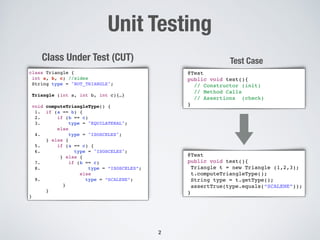
Unit Testing
2
class Triangle {
int a, b, c; //sides
String type = "NOT_TRIANGLE";
Triangle (int a, int b, int c){…}
void computeTriangleType() {
1. if (a == b) {
2. if (b == c)
3. type = "EQUILATERAL";
else
4. type = "ISOSCELES";
} else {
5. if (a == c) {
6. type = "ISOSCELES";
} else {
7. if (b == c)
8. type = “ISOSCELES”;
else
9. type = “SCALENE”;
}
}
}
Class Under Test (CUT)
@Test
public void test(){
// Constructor (init)
// Method Calls
// Assertions (check)
}
Test Case
@Test
public void test(){
Triangle t = new Triangle (1,2,3);
t.computeTriangleType();
String type = t.getType();
assertTrue(type.equals(“SCALENE”));
}
3
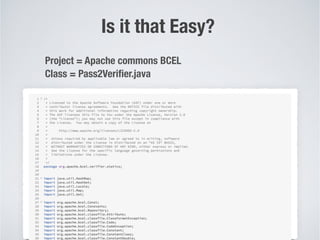
Is it that Easy?
Class = Pass2Verifier.java
Project = Apache commons BCEL
How to Generate Tests in
Reasonable Time?
4
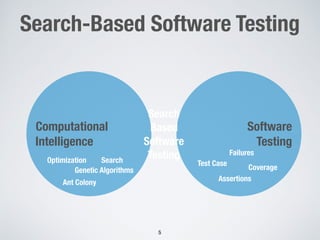
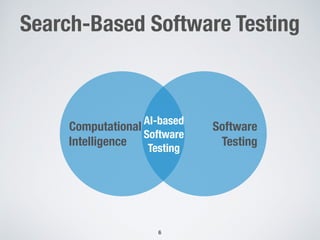
Search-Based Software Testing
5
Computational
Intelligence
Software_
Testing_
Search
Based
Software
TestingOptimization Search
Genetic Algorithms
Ant Colony
Test Case
Coverage
Assertions
Failures
Search-Based Software Testing
6
Computational
Intelligence
Software_
Testing_
AI-based
Software
Testing
Artificial Intelligence?
7
[Domingos2015 “The Master Algorithm”]
Neural Network
Regression
Support Vector
Tribe Origin Master Algorithm
Symbolists Logic, philosophy Inverse deduction
Connectionists Neuroscience Back-Propagation
Evolutionary Evolutionary biology Evolutionary Algorithms
Bayesian Statistics Probabilistic inference
Analogizers Psychology Kernel machines
Formal Methods
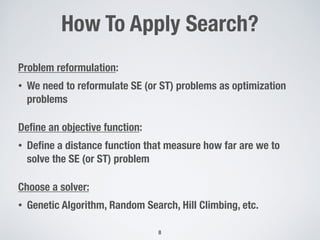
How To Apply Search?
8
Problem reformulation:
• We need to reformulate SE (or ST) problems as optimization
problems
Define an objective function:
• Define a distance function that measure how far are we to
solve the SE (or ST) problem
Choose a solver:
• Genetic Algorithm, Random Search, Hill Climbing, etc.
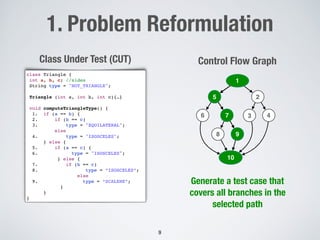
1. Problem Reformulation
9
class Triangle {
int a, b, c; //sides
String type = "NOT_TRIANGLE";
Triangle (int a, int b, int c){…}
void computeTriangleType() {
1. if (a == b) {
2. if (b == c)
3. type = "EQUILATERAL";
else
4. type = "ISOSCELES";
} else {
5. if (a == c) {
6. type = "ISOSCELES";
} else {
7. if (b == c)
8. type = “ISOSCELES”;
else
9. type = “SCALENE”;
}
}
}
Class Under Test (CUT)
1
25
6 7 3
98
10
4
Control Flow Graph
1
5
7
9
10
Generate a test case that
covers all branches in the
selected path
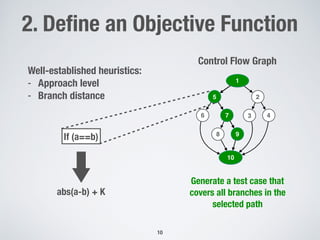
2. Define an Objective Function
10
1
25
6 7 3
98
10
4
Control Flow Graph
1
5
7
9
10
Generate a test case that
covers all branches in the
selected path
Well-established heuristics:
- Approach level
- Branch distance
abs(a-b) + K
If (a==b)
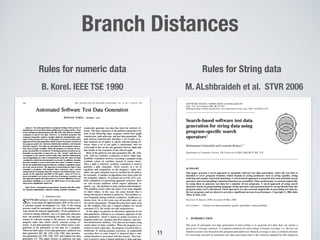
Branch Distances
11
Rules for numeric data Rules for String data
B. Korel. IEEE TSE 1990 M. ALshbraideh et al. STVR 2006
3. Choose a Solver
12
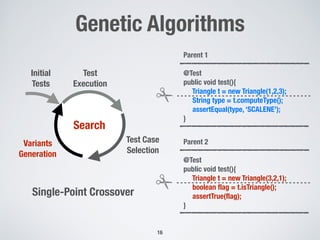
Genetic Algorithms
13
In 1975 he wrote the
ground-breaking book on
genetic algorithms,
"Adaptation in Natural and
Artificial Systems"
John Henry Holland
P. Tonella, “Evolutionary
Testing of Classes”, ISSTA
2004
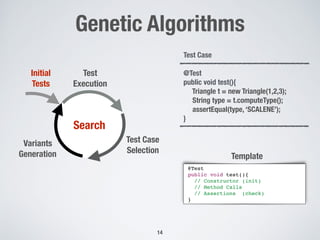
Genetic Algorithms
14
Test Case
Selection
Initial
Tests
Search
Test
Execution
Variants
Generation
Test Case
@Test
public void test(){
Triangle t = new Triangle(1,2,3);
String type = t.computeType();
assertEqual(type, ‘SCALENE’);
}
@Test
public void test(){
// Constructor (init)
// Method Calls
// Assertions (check)
}
Template
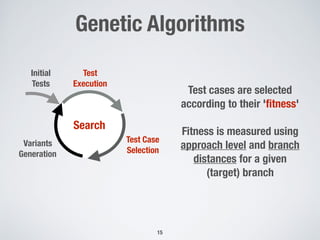
Genetic Algorithms
15
Test Case
Selection
Initial
Tests
Search
Test
Execution
Variants
Generation
Test cases are selected
according to their 'fitness'
Fitness is measured using
approach level and branch
distances for a given
(target) branch
16
Test Case
Selection
Initial
Tests
Search
Test
Execution
Variants
Generation
Parent 1
@Test
public void test(){
Triangle t = new Triangle(1,2,3);
String type = t.computeType();
assertEqual(type, ‘SCALENE’);
}
Parent 2
@Test
public void test(){
Triangle t = new Triangle(3,2,1);
boolean flag = t.isTriangle();
assertTrue(flag);
}
Single-Point Crossover
Genetic Algorithms
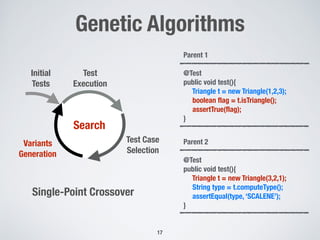
17
Test Case
Selection
Initial
Tests
Search
Test
Execution
Variants
Generation
Parent 1
@Test
public void test(){
Triangle t = new Triangle(1,2,3);
boolean flag = t.isTriangle();
assertTrue(flag);
}
Parent 2
@Test
public void test(){
Triangle t = new Triangle(3,2,1);
String type = t.computeType();
assertEqual(type, ‘SCALENE’);
}
Single-Point Crossover
Genetic Algorithms
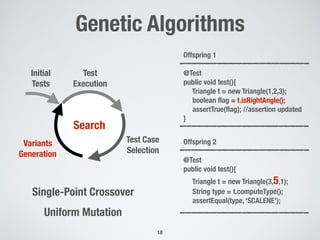
18
Test Case
Selection
Initial
Tests
Search
Test
Execution
Variants
Generation
Offspring 1
@Test
public void test(){
Triangle t = new Triangle(1,2,3);
boolean flag = t.isRightAngle();
assertTrue(flag); //assertion updated
}
Offspring 2
@Test
public void test(){
Triangle t = new Triangle(3,5,1);
String type = t.computeType();
assertEqual(type, ‘SCALENE’);
Single-Point Crossover
Uniform Mutation
Genetic Algorithms
19
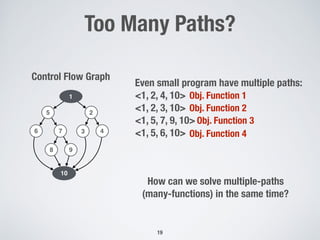
Too Many Paths?
1
25
6 7 3
98
10
4
Control Flow Graph
Even small program have multiple paths:
<1, 2, 4, 10>
<1, 2, 3, 10>
<1, 5, 7, 9, 10>
<1, 5, 6, 10>
Obj. Function 1
Obj. Function 2
Obj. Function 3
Obj. Function 4
How can we solve multiple-paths
(many-functions) in the same time?
How to Solve Multiple
Targets?
20
21
Single Target Approach
1
25
6 7 3
98
10
4
Control Flow Graph TestSuite = {}
For each uncovered target {
[Fit,Test] = GeneticAlgorithm(target)
If (Fit == 0)
TestSuite = TestSuite + Test
}
return(TestSuite)
Limitations:
1) In which order should we select the targets?
2) Some targets are more difficult than other
(how to split the time?)
3) Infeasible paths?
22
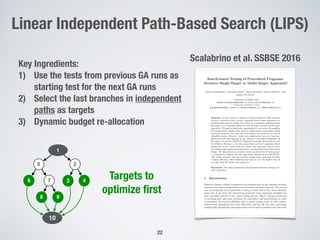
Linear Independent Path-Based Search (LIPS)
Key Ingredients:
1) Use the tests from previous GA runs as
starting test for the next GA runs
2) Select the last branches in independent
paths as targets
3) Dynamic budget re-allocation
1
25
6 7 3
98
10
4
Scalabrino et al. SSBSE 2016
Targets to
optimize first
23
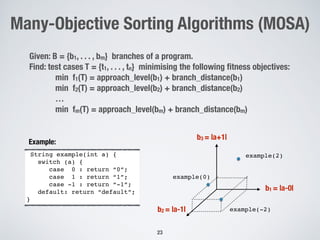
Many-Objective Sorting Algorithms (MOSA)
b1 = |a-0|
Example:
b2 = |a-1|
b3 = |a+1|
example(2)
example(0)
example(-2)
Given: B = {b1, . . . , bm} branches of a program.
Find: test cases T = {t1, . . . , tn} minimising the following fitness objectives:
min f1(T) = approach_level(b1) + branch_distance(b1)
min f2(T) = approach_level(b2) + branch_distance(b2)
…
min fm(T) = approach_level(bm) + branch_distance(bm)
String example(int a) {
switch (a) {
case 0 : return “0”;
case 1 : return “1”;
case -1 : return “-1”;
default: return “default”;
}
24
Many-Objective Sorting Algorithms (MOSA)
Objective 1
Objective 2
Not all non-dominated
solutions are optimal for
the purpose of testing
Min
Min
[A. Panichella, F. Kifetew,
P. Tonella ICST 2015]
Pareto
Front
These points are
better than others
25
DynaMOSA: Dynamic MOSA
1
25
6 7 3
98
10
4
Control Flow Graph
Rationale:
• Not all branches (objectives) are
independent from one another
• We cannot cover branch <3,10> without
covering <2,3>
Idea:
• Organize targets in levels based on their
structural dependencies
• Start the search with the first-level
targets, then optimize the second level,
and so on
1* Level
2* Level
3* Level
[A. Panichella, F. Kifetew,
P. Tonella, TSE 2018]
26
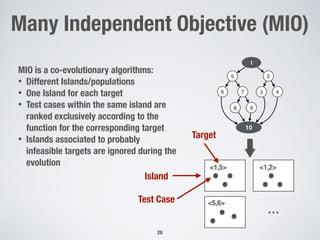
Many Independent Objective (MIO)
MIO is a co-evolutionary algorithms:
• Different Islands/populations
• One Island for each target
• Test cases within the same island are
ranked exclusively according to the
function for the corresponding target
• Islands associated to probably
infeasible targets are ignored during the
evolution
1
25
6 7 3
98
10
4
<1,5> <1,2>
<5,6>
…
Island
Test Case
Target
27
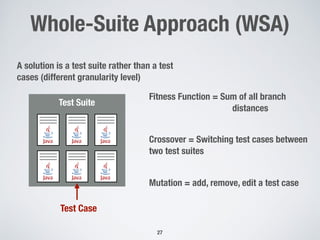
Whole-Suite Approach (WSA)
A solution is a test suite rather than a test
cases (different granularity level)
Test Suite
Test Case
Fitness Function = Sum of all branch
distances
Crossover = Switching test cases between
two test suites
Mutation = add, remove, edit a test case
28
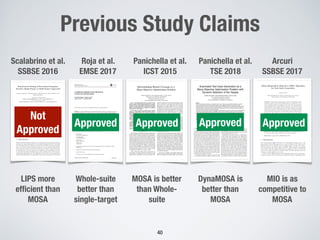
Previous Study Claims
Scalabrino et al.
SSBSE 2016
Roja et al.
EMSE 2017
Panichella et al.
ICST 2015
Panichella et al.
TSE 2018
Arcuri
SSBSE 2017
LIPS more
efficient than
MOSA
Whole-suite
better than
single-target
MOSA is better
than Whole-
suite
DynaMOSA is
better than
MOSA
MIO is as
competitive to
MOSA
Need forLarge-scale
Comparison
29
30
http://www.evosuite.org • Command Line
• Eclipse Plugin
• Intellij IDEA plugin
• Maven Plugin
• Measure Code Coverage
31
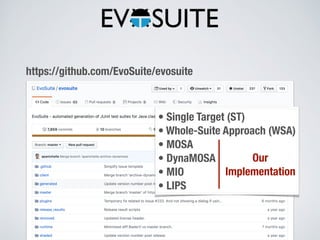
https://github.com/EvoSuite/evosuite
• Single Target (ST)
• Whole-Suite Approach (WSA)
• MOSA
• DynaMOSA
• MIO
• LIPS
Our
Implementation
Benchmark
32
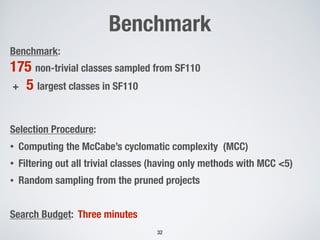
Benchmark:
175 non-trivial classes sampled from SF110
+ 5 largest classes in SF110
Selection Procedure:
• Computing the McCabe’s cyclomatic complexity (MCC)
• Filtering out all trivial classes (having only methods with MCC <5)
• Random sampling from the pruned projects
Search Budget: Three minutes
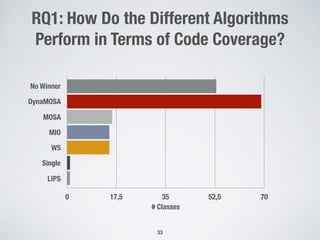
RQ1: How Do the Different Algorithms
Perform in Terms of Code Coverage?
33
# Classes
No Winner
DynaMOSA
MOSA
MIO
WS
Single
LIPS
0 17,5 35 52,5 70
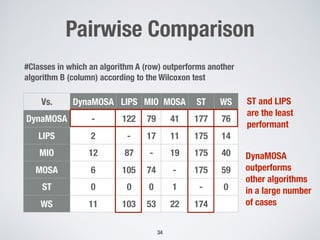
Pairwise Comparison
34
Vs. DynaMOSA LIPS MIO MOSA ST WS
DynaMOSA - 122 79 41 177 76
LIPS 2 - 17 11 175 14
MIO 12 87 - 19 175 40
MOSA 6 105 74 - 175 59
ST 0 0 0 1 - 0
WS 11 103 53 22 174
#Classes in which an algorithm A (row) outperforms another
algorithm B (column) according to the Wilcoxon test
DynaMOSA
outperforms
other algorithms
in a large number
of cases
ST and LIPS
are the least
performant
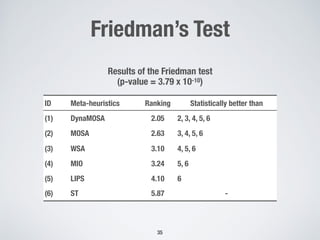
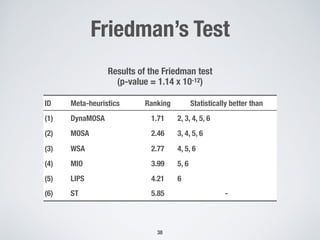
Friedman’s Test
35
ID Meta-heuristics Ranking Statistically better than
(1) DynaMOSA 2.05 2, 3, 4, 5, 6
(2) MOSA 2.63 3, 4, 5, 6
(3) WSA 3.10 4, 5, 6
(4) MIO 3.24 5, 6
(5) LIPS 4.10 6
(6) ST 5.87 -
Results of the Friedman test
(p-value = 3.79 x 10⁻¹⁰)
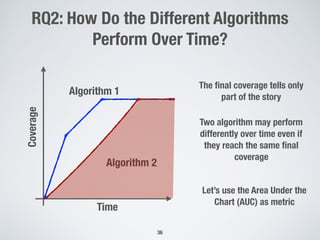
RQ2: How Do the Different Algorithms
Perform Over Time?
36
Coverage
Time
Algorithm 1
Algorithm 2
The final coverage tells only
part of the story
Two algorithm may perform
differently over time even if
they reach the same final
coverage
Let’s use the Area Under the
Chart (AUC) as metric
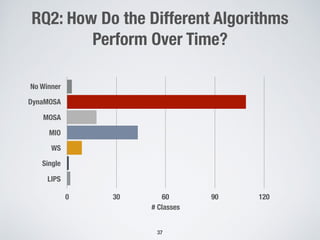
37
# Classes
No Winner
DynaMOSA
MOSA
MIO
WS
Single
LIPS
0 30 60 90 120
RQ2: How Do the Different Algorithms
Perform Over Time?
Friedman’s Test
38
ID Meta-heuristics Ranking Statistically better than
(1) DynaMOSA 1.71 2, 3, 4, 5, 6
(2) MOSA 2.46 3, 4, 5, 6
(3) WSA 2.77 4, 5, 6
(4) MIO 3.99 5, 6
(5) LIPS 4.21 6
(6) ST 5.85 -
Results of the Friedman test
(p-value = 1.14 x 10⁻¹²)
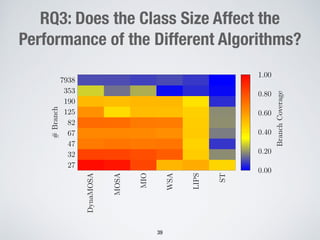
RQ3: Does the Class Size Affect the
Performance of the Different Algorithms?
39
Rank Approach Statistically better than
(1) 1.71 DynaMOSA (2), (3), (4), (5), (6)
(2) 2.46 MOSA (3), (4), (5), (6)
(3) 2.77 MIO (4), (5), (6)
(4) 3.99 WSA (5), (6)
(5) 4.21 LIPS (6)
(6) 5.85 ST -
DynaMOSA
MOSA
MIO
WSA
LIPS
ST
27
32
47
67
82
125
190
353
7938
#Branch
0.00
0.20
0.40
0.60
0.80
1.00
BranchCoverage
Figure 5: Heatmap showing the interaction between branch coverage a
40
Previous Study Claims
Scalabrino et al.
SSBSE 2016
Roja et al.
EMSE 2017
Panichella et al.
ICST 2015
Panichella et al.
TSE 2018
Arcuri
SSBSE 2017
LIPS more
efficient than
MOSA
Whole-suite
better than
single-target
MOSA is better
than Whole-
suite
DynaMOSA is
better than
MOSA
MIO is as
competitive to
MOSA
Approved Approved ApprovedApproved
Not
Approved
Demo
41
42
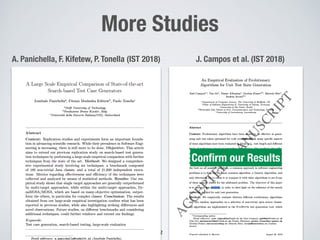
More Studies
A. Panichella, F. Kifetew, P. Tonella (IST 2018) J. Campos et al. (IST 2018)
Confirm our Results
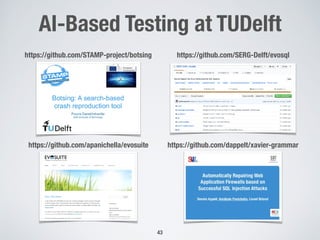
AI-Based Testing at TUDelft
43
https://github.com/STAMP-project/botsing https://github.com/SERG-Delft/evosql
https://github.com/apanichella/evosuite https://github.com/dappelt/xavier-grammar
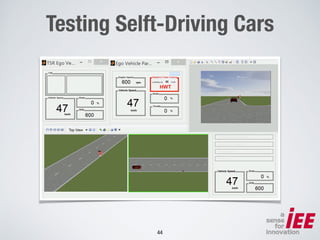
Testing Selft-Driving Cars
44
Automated Test Generation for
Unit Testing and Beyond
Annibale Panichella
a.panichella@tudelf.nl
@AnniPanic
45

IPA Fall Days 2019

  • 1.
    Automated Test Generationfor Unit Testing and Beyond Annibale Panichella a.panichella@tudelf.nl @AnniPanic 1
  • 2.
    Unit Testing 2 class Triangle{ int a, b, c; //sides String type = "NOT_TRIANGLE"; Triangle (int a, int b, int c){…} void computeTriangleType() { 1. if (a == b) { 2. if (b == c) 3. type = "EQUILATERAL"; else 4. type = "ISOSCELES"; } else { 5. if (a == c) { 6. type = "ISOSCELES"; } else { 7. if (b == c) 8. type = “ISOSCELES”; else 9. type = “SCALENE”; } } } Class Under Test (CUT) @Test public void test(){ // Constructor (init) // Method Calls // Assertions (check) } Test Case @Test public void test(){ Triangle t = new Triangle (1,2,3); t.computeTriangleType(); String type = t.getType(); assertTrue(type.equals(“SCALENE”)); }
  • 3.
    3 Is it thatEasy? Class = Pass2Verifier.java Project = Apache commons BCEL
  • 4.
    How to GenerateTests in Reasonable Time? 4
  • 5.
  • 6.
  • 7.
    Artificial Intelligence? 7 [Domingos2015 “TheMaster Algorithm”] Neural Network Regression Support Vector Tribe Origin Master Algorithm Symbolists Logic, philosophy Inverse deduction Connectionists Neuroscience Back-Propagation Evolutionary Evolutionary biology Evolutionary Algorithms Bayesian Statistics Probabilistic inference Analogizers Psychology Kernel machines Formal Methods
  • 8.
    How To ApplySearch? 8 Problem reformulation: • We need to reformulate SE (or ST) problems as optimization problems Define an objective function: • Define a distance function that measure how far are we to solve the SE (or ST) problem Choose a solver: • Genetic Algorithm, Random Search, Hill Climbing, etc.
  • 9.
    1. Problem Reformulation 9 classTriangle { int a, b, c; //sides String type = "NOT_TRIANGLE"; Triangle (int a, int b, int c){…} void computeTriangleType() { 1. if (a == b) { 2. if (b == c) 3. type = "EQUILATERAL"; else 4. type = "ISOSCELES"; } else { 5. if (a == c) { 6. type = "ISOSCELES"; } else { 7. if (b == c) 8. type = “ISOSCELES”; else 9. type = “SCALENE”; } } } Class Under Test (CUT) 1 25 6 7 3 98 10 4 Control Flow Graph 1 5 7 9 10 Generate a test case that covers all branches in the selected path
  • 10.
    2. Define anObjective Function 10 1 25 6 7 3 98 10 4 Control Flow Graph 1 5 7 9 10 Generate a test case that covers all branches in the selected path Well-established heuristics: - Approach level - Branch distance abs(a-b) + K If (a==b)
  • 11.
    Branch Distances 11 Rules fornumeric data Rules for String data B. Korel. IEEE TSE 1990 M. ALshbraideh et al. STVR 2006
  • 12.
    3. Choose aSolver 12
  • 13.
    Genetic Algorithms 13 In 1975he wrote the ground-breaking book on genetic algorithms, "Adaptation in Natural and Artificial Systems" John Henry Holland P. Tonella, “Evolutionary Testing of Classes”, ISSTA 2004
  • 14.
    Genetic Algorithms 14 Test Case Selection Initial Tests Search Test Execution Variants Generation TestCase @Test public void test(){ Triangle t = new Triangle(1,2,3); String type = t.computeType(); assertEqual(type, ‘SCALENE’); } @Test public void test(){ // Constructor (init) // Method Calls // Assertions (check) } Template
  • 15.
    Genetic Algorithms 15 Test Case Selection Initial Tests Search Test Execution Variants Generation Testcases are selected according to their 'fitness' Fitness is measured using approach level and branch distances for a given (target) branch
  • 16.
    16 Test Case Selection Initial Tests Search Test Execution Variants Generation Parent 1 @Test publicvoid test(){ Triangle t = new Triangle(1,2,3); String type = t.computeType(); assertEqual(type, ‘SCALENE’); } Parent 2 @Test public void test(){ Triangle t = new Triangle(3,2,1); boolean flag = t.isTriangle(); assertTrue(flag); } Single-Point Crossover Genetic Algorithms
  • 17.
    17 Test Case Selection Initial Tests Search Test Execution Variants Generation Parent 1 @Test publicvoid test(){ Triangle t = new Triangle(1,2,3); boolean flag = t.isTriangle(); assertTrue(flag); } Parent 2 @Test public void test(){ Triangle t = new Triangle(3,2,1); String type = t.computeType(); assertEqual(type, ‘SCALENE’); } Single-Point Crossover Genetic Algorithms
  • 18.
    18 Test Case Selection Initial Tests Search Test Execution Variants Generation Offspring 1 @Test publicvoid test(){ Triangle t = new Triangle(1,2,3); boolean flag = t.isRightAngle(); assertTrue(flag); //assertion updated } Offspring 2 @Test public void test(){ Triangle t = new Triangle(3,5,1); String type = t.computeType(); assertEqual(type, ‘SCALENE’); Single-Point Crossover Uniform Mutation Genetic Algorithms
  • 19.
    19 Too Many Paths? 1 25 67 3 98 10 4 Control Flow Graph Even small program have multiple paths: <1, 2, 4, 10> <1, 2, 3, 10> <1, 5, 7, 9, 10> <1, 5, 6, 10> Obj. Function 1 Obj. Function 2 Obj. Function 3 Obj. Function 4 How can we solve multiple-paths (many-functions) in the same time?
  • 20.
    How to SolveMultiple Targets? 20
  • 21.
    21 Single Target Approach 1 25 67 3 98 10 4 Control Flow Graph TestSuite = {} For each uncovered target { [Fit,Test] = GeneticAlgorithm(target) If (Fit == 0) TestSuite = TestSuite + Test } return(TestSuite) Limitations: 1) In which order should we select the targets? 2) Some targets are more difficult than other (how to split the time?) 3) Infeasible paths?
  • 22.
    22 Linear Independent Path-BasedSearch (LIPS) Key Ingredients: 1) Use the tests from previous GA runs as starting test for the next GA runs 2) Select the last branches in independent paths as targets 3) Dynamic budget re-allocation 1 25 6 7 3 98 10 4 Scalabrino et al. SSBSE 2016 Targets to optimize first
  • 23.
    23 Many-Objective Sorting Algorithms(MOSA) b1 = |a-0| Example: b2 = |a-1| b3 = |a+1| example(2) example(0) example(-2) Given: B = {b1, . . . , bm} branches of a program. Find: test cases T = {t1, . . . , tn} minimising the following fitness objectives: min f1(T) = approach_level(b1) + branch_distance(b1) min f2(T) = approach_level(b2) + branch_distance(b2) … min fm(T) = approach_level(bm) + branch_distance(bm) String example(int a) { switch (a) { case 0 : return “0”; case 1 : return “1”; case -1 : return “-1”; default: return “default”; }
  • 24.
    24 Many-Objective Sorting Algorithms(MOSA) Objective 1 Objective 2 Not all non-dominated solutions are optimal for the purpose of testing Min Min [A. Panichella, F. Kifetew, P. Tonella ICST 2015] Pareto Front These points are better than others
  • 25.
    25 DynaMOSA: Dynamic MOSA 1 25 67 3 98 10 4 Control Flow Graph Rationale: • Not all branches (objectives) are independent from one another • We cannot cover branch <3,10> without covering <2,3> Idea: • Organize targets in levels based on their structural dependencies • Start the search with the first-level targets, then optimize the second level, and so on 1* Level 2* Level 3* Level [A. Panichella, F. Kifetew, P. Tonella, TSE 2018]
  • 26.
    26 Many Independent Objective(MIO) MIO is a co-evolutionary algorithms: • Different Islands/populations • One Island for each target • Test cases within the same island are ranked exclusively according to the function for the corresponding target • Islands associated to probably infeasible targets are ignored during the evolution 1 25 6 7 3 98 10 4 <1,5> <1,2> <5,6> … Island Test Case Target
  • 27.
    27 Whole-Suite Approach (WSA) Asolution is a test suite rather than a test cases (different granularity level) Test Suite Test Case Fitness Function = Sum of all branch distances Crossover = Switching test cases between two test suites Mutation = add, remove, edit a test case
  • 28.
    28 Previous Study Claims Scalabrinoet al. SSBSE 2016 Roja et al. EMSE 2017 Panichella et al. ICST 2015 Panichella et al. TSE 2018 Arcuri SSBSE 2017 LIPS more efficient than MOSA Whole-suite better than single-target MOSA is better than Whole- suite DynaMOSA is better than MOSA MIO is as competitive to MOSA
  • 29.
  • 30.
    30 http://www.evosuite.org • CommandLine • Eclipse Plugin • Intellij IDEA plugin • Maven Plugin • Measure Code Coverage
  • 31.
    31 https://github.com/EvoSuite/evosuite • Single Target(ST) • Whole-Suite Approach (WSA) • MOSA • DynaMOSA • MIO • LIPS Our Implementation
  • 32.
    Benchmark 32 Benchmark: 175 non-trivial classessampled from SF110 + 5 largest classes in SF110 Selection Procedure: • Computing the McCabe’s cyclomatic complexity (MCC) • Filtering out all trivial classes (having only methods with MCC <5) • Random sampling from the pruned projects Search Budget: Three minutes
  • 33.
    RQ1: How Dothe Different Algorithms Perform in Terms of Code Coverage? 33 # Classes No Winner DynaMOSA MOSA MIO WS Single LIPS 0 17,5 35 52,5 70
  • 34.
    Pairwise Comparison 34 Vs. DynaMOSALIPS MIO MOSA ST WS DynaMOSA - 122 79 41 177 76 LIPS 2 - 17 11 175 14 MIO 12 87 - 19 175 40 MOSA 6 105 74 - 175 59 ST 0 0 0 1 - 0 WS 11 103 53 22 174 #Classes in which an algorithm A (row) outperforms another algorithm B (column) according to the Wilcoxon test DynaMOSA outperforms other algorithms in a large number of cases ST and LIPS are the least performant
  • 35.
    Friedman’s Test 35 ID Meta-heuristicsRanking Statistically better than (1) DynaMOSA 2.05 2, 3, 4, 5, 6 (2) MOSA 2.63 3, 4, 5, 6 (3) WSA 3.10 4, 5, 6 (4) MIO 3.24 5, 6 (5) LIPS 4.10 6 (6) ST 5.87 - Results of the Friedman test (p-value = 3.79 x 10⁻¹⁰)
  • 36.
    RQ2: How Dothe Different Algorithms Perform Over Time? 36 Coverage Time Algorithm 1 Algorithm 2 The final coverage tells only part of the story Two algorithm may perform differently over time even if they reach the same final coverage Let’s use the Area Under the Chart (AUC) as metric
  • 37.
    37 # Classes No Winner DynaMOSA MOSA MIO WS Single LIPS 030 60 90 120 RQ2: How Do the Different Algorithms Perform Over Time?
  • 38.
    Friedman’s Test 38 ID Meta-heuristicsRanking Statistically better than (1) DynaMOSA 1.71 2, 3, 4, 5, 6 (2) MOSA 2.46 3, 4, 5, 6 (3) WSA 2.77 4, 5, 6 (4) MIO 3.99 5, 6 (5) LIPS 4.21 6 (6) ST 5.85 - Results of the Friedman test (p-value = 1.14 x 10⁻¹²)
  • 39.
    RQ3: Does theClass Size Affect the Performance of the Different Algorithms? 39 Rank Approach Statistically better than (1) 1.71 DynaMOSA (2), (3), (4), (5), (6) (2) 2.46 MOSA (3), (4), (5), (6) (3) 2.77 MIO (4), (5), (6) (4) 3.99 WSA (5), (6) (5) 4.21 LIPS (6) (6) 5.85 ST - DynaMOSA MOSA MIO WSA LIPS ST 27 32 47 67 82 125 190 353 7938 #Branch 0.00 0.20 0.40 0.60 0.80 1.00 BranchCoverage Figure 5: Heatmap showing the interaction between branch coverage a
  • 40.
    40 Previous Study Claims Scalabrinoet al. SSBSE 2016 Roja et al. EMSE 2017 Panichella et al. ICST 2015 Panichella et al. TSE 2018 Arcuri SSBSE 2017 LIPS more efficient than MOSA Whole-suite better than single-target MOSA is better than Whole- suite DynaMOSA is better than MOSA MIO is as competitive to MOSA Approved Approved ApprovedApproved Not Approved
  • 41.
  • 42.
    42 More Studies A. Panichella,F. Kifetew, P. Tonella (IST 2018) J. Campos et al. (IST 2018) Confirm our Results
  • 43.
    AI-Based Testing atTUDelft 43 https://github.com/STAMP-project/botsing https://github.com/SERG-Delft/evosql https://github.com/apanichella/evosuite https://github.com/dappelt/xavier-grammar
  • 44.
  • 45.
    Automated Test Generationfor Unit Testing and Beyond Annibale Panichella a.panichella@tudelf.nl @AnniPanic 45