Trace-Checking CPS Properties: 

Bridging the Cyber-Physical Gap
Claudio Menghi
University of Luxembourg
Enrico Viganò
University of Luxembourg
Domenico Bianculli
University of Luxembourg
Lionel C. Briand
University of Luxembourg,
University of Ottawa 

Trace-Checking CPS Properties: 

Bridging the Cyber-Physical Gap
Claudio Menghi
University of Luxembourg
Enrico Viganò
University of Luxembourg
Domenico Bianculli
University of Luxembourg
Lionel C. Briand
University of Luxembourg,
University of Ottawa 

!3 Introduction
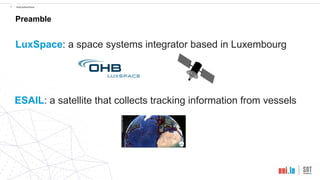
LuxSpace: a space systems integrator based in Luxembourg
Preamble
ESAIL: a satellite that collects tracking information from vessels
!4 Introduction
Objective
Support engineers
in verifying and validating CPS
!5 Introduction
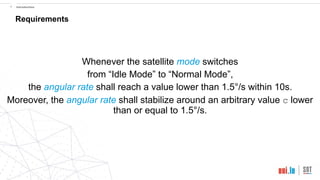
Requirements
Whenever the satellite mode switches
from “Idle Mode” to “Normal Mode”,
the angular rate shall reach a value lower than 1.5°/s within 10s.
Moreover, the angular rate shall stabilize around an arbitrary value c lower
than or equal to 1.5°/s.
!6 Introduction
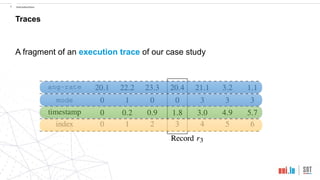
Traces
A fragment of an execution trace of our case study
!7 Introduction
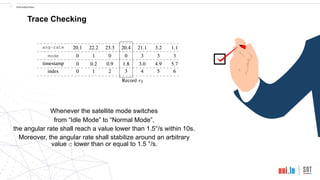
Trace Checking
Whenever the satellite mode switches
from “Idle Mode” to “Normal Mode”,
the angular rate shall reach a value lower than 1.5°/s within 10s.
Moreover, the angular rate shall stabilize around an arbitrary
value c lower than or equal to 1.5 °/s.
!8 Introduction
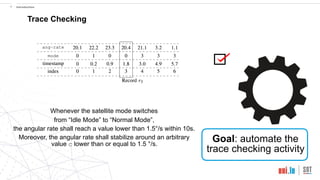
Trace Checking
Goal: automate the
trace checking activity
Whenever the satellite mode switches
from “Idle Mode” to “Normal Mode”,
the angular rate shall reach a value lower than 1.5°/s within 10s.
Moreover, the angular rate shall stabilize around an arbitrary
value c lower than or equal to 1.5 °/s.
!9 Introduction
Goals
Goal 1: Support a language that can express complex CPS requirements
Requirements that involve software and physical components
Goal 2: Applicable on industrial execution traces
Provides results within practical time limits
!10 Introduction
Contributions
Hybrid Logic of Signals (HLS)
ThEodorE
Goal 1: Support a language that can express complex CPS requirements
Requirements that involve software and physical components
Goal 2: Applicable on industrial execution traces
Provides results within practical time limits
Hybrid Logic of
Signals
11
!12 Hybrid Logic of Signals
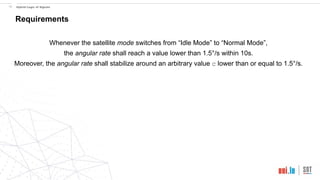
Requirements
Whenever the satellite mode switches from “Idle Mode” to “Normal Mode”,
the angular rate shall reach a value lower than 1.5°/s within 10s.
Moreover, the angular rate shall stabilize around an arbitrary value c lower than or equal to 1.5°/s.
!13 Hybrid Logic of Signals
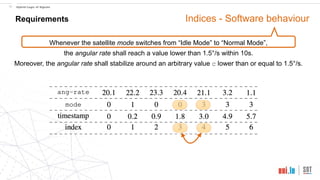
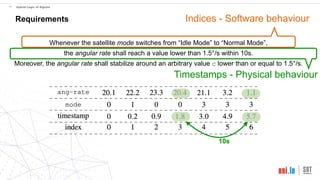
Requirements Indices - Software behaviour
Whenever the satellite mode switches from “Idle Mode” to “Normal Mode”,
the angular rate shall reach a value lower than 1.5°/s within 10s.
Moreover, the angular rate shall stabilize around an arbitrary value c lower than or equal to 1.5°/s.
!14 Hybrid Logic of Signals
Requirements
Timestamps - Physical behaviour
10s
Whenever the satellite mode switches from “Idle Mode” to “Normal Mode”,
the angular rate shall reach a value lower than 1.5°/s within 10s.
Moreover, the angular rate shall stabilize around an arbitrary value c lower than or equal to 1.5°/s.
Indices - Software behaviour
Whenever the satellite mode switches from “Idle Mode” to “Normal Mode”,
the angular rate shall reach a value lower than 1.5°/s within 10s.
Moreover, the angular rate shall stabilize around an arbitrary value c lower than or equal to 1.5°/s.
!15 Hybrid Logic of Signals
Requirements
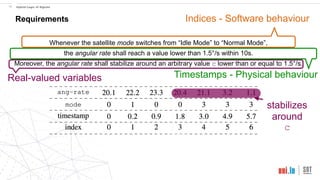
Real-valued variables
Requirements
Timestamps - Physical behaviour
stabilizes
around
c
Indices - Software behaviour
exists 𝜌 such that (𝜌<1.5 and
forall σ0 in [0;5] such that
((mode @i σ0 ) = 0 and (mode @i (σ0 + 1)) = 3)
implies
exists τ0 in [0s;10s] such that
(ang-rate @t (τ0 + i2t(σ0 )) < 𝜌)))
!16 Hybrid Logic of Signals
Expressing CPS requirements
exists 𝜌 such that (𝜌<1.5 and
forall σ0 in [0;5] such that
((mode @i σ0 ) = 0 and (mode @i (σ0 + 1)) = 3)
implies
exists τ0 in [0s;10s] such that
(ang-rate @t (τ0 + i2t(σ0 )) < 𝜌)))
!17 Hybrid Logic of Signals
Expressing CPS requirements HLS allows using existential and universal
quantifiers with
exists 𝜌 such that (𝜌<1.5 and
forall σ0 in [0;5] such that
((mode @i σ0 ) = 0 and (mode @i (σ0 + 1)) = 3)
implies
exists τ0 in [0s;10s] such that
(ang-rate @t (τ0 + i2t(σ0 )) < 𝜌)))
!18 Hybrid Logic of Signals
Expressing CPS requirements HLS allows using existential and universal
quantifiers with
• timestamp variables
exists 𝜌 such that (𝜌<1.5 and
forall σ0 in [0;5] such that
((mode @i σ0 ) = 0 and (mode @i (σ0 + 1)) = 3)
implies
exists τ0 in [0s;10s] such that
(ang-rate @t (τ0 + i2t(σ0 )) < 𝜌)))
!19 Hybrid Logic of Signals
Expressing CPS requirements HLS allows using existential and universal
quantifiers with
• timestamp variables
• index variables
exists 𝜌 such that (𝜌<1.5 and
forall σ0 in [0;5] such that
((mode @i σ0 ) = 0 and (mode @i (σ0 + 1)) = 3)
implies
exists τ0 in [0s;10s] such that
(ang-rate @t (τ0 + i2t(σ0 )) < 𝜌)))
!20 Hybrid Logic of Signals
Expressing CPS requirements HLS allows using existential and universal
quantifiers with
• timestamp variables
• index variables
• real-valued variables
exists 𝜌 such that (𝜌<1.5 and
forall σ0 in [0;5] such that
((mode @i σ0 ) = 0 and (mode @i (σ0 + 1)) = 3)
implies
exists τ0 in [0s;10s] such that
(ang-rate @t (τ0 + i2t(σ0 )) < 𝜌)))
!21 Hybrid Logic of Signals
Expressing CPS requirements HLS allows using existential and universal
quantifiers with
• timestamp variables
• index variables
• real-valued variables
HLS supports specifications that use
!22 Hybrid Logic of Signals
Expressing CPS requirements
exists 𝜌 such that (𝜌<1.5 and
forall σ0 in [0;5] such that
((mode @i σ0 ) = 0 and (mode @i (σ0 + 1)) = 3)
implies
exists τ0 in [0s;10s] such that
(ang-rate @t (τ0 + i2t(σ0 )) < 𝜌)))
HLS allows using existential and universal
quantifiers with
• timestamp variables
• index variables
• real-valued variables
HLS supports specifications that use
• a signal at a certain timestamp
!23 Hybrid Logic of Signals
Expressing CPS requirements
exists 𝜌 such that (𝜌<1.5 and
forall σ0 in [0;5] such that
((mode @i σ0 ) = 0 and (mode @i (σ0 + 1)) = 3)
implies
exists τ0 in [0s;10s] such that
(ang-rate @t (τ0 + i2t(σ0 )) < 𝜌)))
HLS allows using existential and universal
quantifiers with
• timestamp variables
• index variables
• real-valued variables
HLS supports specifications that use
• a signal at a certain timestamp
• a signal at a certain index
!24 Hybrid Logic of Signals
Expressing CPS requirements
exists 𝜌 such that (𝜌<1.5 and
forall σ0 in [0;5] such that
((mode @i σ0 ) = 0 and (mode @i (σ0 + 1)) = 3)
implies
exists τ0 in [0s;10s] such that
(ang-rate @t (τ0 + i2t(σ0 )) < 𝜌)))
HLS allows using existential and universal
quantifiers with
• timestamp variables
• index variables
• real-valued variables
HLS supports specifications that use
• a signal at a certain timestamp
• a signal at a certain index
• the timestamp of an index (and vice versa)
HLS allows using existential and universal
quantifiers with
• timestamp variables
• index variables
• real-valued variables
HLS supports specifications that use
• a signal at a certain timestamp
• a signal at a certain index
• the timestamp of an index (and vice versa)
• expressions combining timestamps,
indices, and real-valued variables
!25 Hybrid Logic of Signals
exists 𝜌 such that (𝜌<1.5 and
forall σ0 in [0;5] such that
((mode @i σ0 ) = 0 and (mode @i (σ0 + 1)) = 3)
implies
exists τ0 in [0s;10s] such that
(ang-rate @t (τ0 + i2t(σ0 )) < 𝜌)))
Expressing CPS requirements
Section title
Text
Title in Arial Bold 24 pt
Optional: subtitle in Arial 14
!26
ThEodorE
!27 ThEodorE
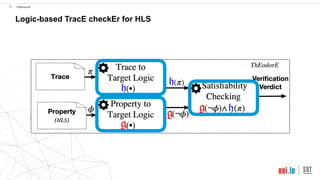
Logic-based TracE checkEr for HLS
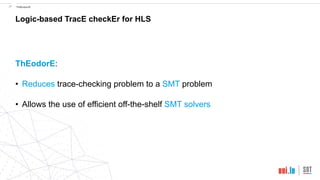
ThEodorE:
• Reduces trace-checking problem to a SMT problem
• Allows the use of efficient off-the-shelf SMT solvers
!28 ThEodorE
Logic-based TracE checkEr for HLS
!29
Optional: subtitle in Arial 14
Evaluation
!30 Evaluation
• RQ1 (Expressiveness): To which extent can Hybrid Logic of Signals
express requirements from industrial CPS applications?
• RQ2 (Applicability): Can ThEodorE verify CPS requirements on industrial
execution traces? 

Research questions
!31 Evaluation
RQ1 (Expressiveness)
• We considered 212 industrial requirements from ESAIL
• We compared the expressiveness of the Hybrid Logic of Signals (HLS) with
SB-TempPsy-DSL and STL
!32 Evaluation
RQ1 (Expressiveness)
The answer to RQ1 is that
HLS could express all the requirements of our case study,
many more than SB-TemPsy-DSL (+31%) and STL (+51%).
!33 Evaluation
RQ2 (Applicability)
• We considered 747 trace-requirement combinations
• We compared the applicability of ThEodorE with SB-Tempsy-Check and
Breach
!34 Evaluation
RQ2 (Applicability)
The answer to RQ2 is that
ThEodorE computed a verdict for 74.5% trace-requirement combinations.
ThEodorE produced a verdict for 67.9% of the 337 trace-requirement
combinations that could not be checked by the other tools.
!35
Optional: subtitle in Arial 14
Conclusions
!36 Conclusions
Conclusions
• The goal of this work is to support engineers in verifying and validating CPS
• We proposed
• Hybrid Logic of Signals: a language to express complex industrial CPS
requirements
• ThEodorE: an efficient trace-checking tool that can analyse
requirements expressed using the Hybrid Logic of Signals
!37 Conclusions
Conclusions
• HLS was able to express all the CPS requirements
• HLS supported a much wider set of properties than other languages
• ThEodorE checked most of the requirements within practical time limits
Trace-Checking CPS Properties: 

Bridging the Cyber-Physical Gap
Claudio Menghi
University of Luxembourg
claudio.menghi@uni.lu
Enrico Viganò
University of Luxembourg
enrico.vigano@uni.lu
Domenico Bianculli
University of Luxembourg
domenico.bianculli@uni.lu
Lionel C. Briand
University of Luxembourg,
University of Ottawa
lionel.briand@uni.lu 


Trace-Checking CPS Properties: Bridging the Cyber-Physical Gap

  • 1.
    Trace-Checking CPS Properties:
 Bridging the Cyber-Physical Gap Claudio Menghi University of Luxembourg Enrico Viganò University of Luxembourg Domenico Bianculli University of Luxembourg Lionel C. Briand University of Luxembourg, University of Ottawa 

  • 2.
    Trace-Checking CPS Properties:
 Bridging the Cyber-Physical Gap Claudio Menghi University of Luxembourg Enrico Viganò University of Luxembourg Domenico Bianculli University of Luxembourg Lionel C. Briand University of Luxembourg, University of Ottawa 

  • 3.
    !3 Introduction LuxSpace: aspace systems integrator based in Luxembourg Preamble ESAIL: a satellite that collects tracking information from vessels
  • 4.
  • 5.
    !5 Introduction Requirements Whenever thesatellite mode switches from “Idle Mode” to “Normal Mode”, the angular rate shall reach a value lower than 1.5°/s within 10s. Moreover, the angular rate shall stabilize around an arbitrary value c lower than or equal to 1.5°/s.
  • 6.
    !6 Introduction Traces A fragmentof an execution trace of our case study
  • 7.
    !7 Introduction Trace Checking Wheneverthe satellite mode switches from “Idle Mode” to “Normal Mode”, the angular rate shall reach a value lower than 1.5°/s within 10s. Moreover, the angular rate shall stabilize around an arbitrary value c lower than or equal to 1.5 °/s.
  • 8.
    !8 Introduction Trace Checking Goal:automate the trace checking activity Whenever the satellite mode switches from “Idle Mode” to “Normal Mode”, the angular rate shall reach a value lower than 1.5°/s within 10s. Moreover, the angular rate shall stabilize around an arbitrary value c lower than or equal to 1.5 °/s.
  • 9.
    !9 Introduction Goals Goal 1:Support a language that can express complex CPS requirements Requirements that involve software and physical components Goal 2: Applicable on industrial execution traces Provides results within practical time limits
  • 10.
    !10 Introduction Contributions Hybrid Logicof Signals (HLS) ThEodorE Goal 1: Support a language that can express complex CPS requirements Requirements that involve software and physical components Goal 2: Applicable on industrial execution traces Provides results within practical time limits
  • 11.
  • 12.
    !12 Hybrid Logicof Signals Requirements Whenever the satellite mode switches from “Idle Mode” to “Normal Mode”, the angular rate shall reach a value lower than 1.5°/s within 10s. Moreover, the angular rate shall stabilize around an arbitrary value c lower than or equal to 1.5°/s.
  • 13.
    !13 Hybrid Logicof Signals Requirements Indices - Software behaviour Whenever the satellite mode switches from “Idle Mode” to “Normal Mode”, the angular rate shall reach a value lower than 1.5°/s within 10s. Moreover, the angular rate shall stabilize around an arbitrary value c lower than or equal to 1.5°/s.
  • 14.
    !14 Hybrid Logicof Signals Requirements Timestamps - Physical behaviour 10s Whenever the satellite mode switches from “Idle Mode” to “Normal Mode”, the angular rate shall reach a value lower than 1.5°/s within 10s. Moreover, the angular rate shall stabilize around an arbitrary value c lower than or equal to 1.5°/s. Indices - Software behaviour
  • 15.
    Whenever the satellitemode switches from “Idle Mode” to “Normal Mode”, the angular rate shall reach a value lower than 1.5°/s within 10s. Moreover, the angular rate shall stabilize around an arbitrary value c lower than or equal to 1.5°/s. !15 Hybrid Logic of Signals Requirements Real-valued variables Requirements Timestamps - Physical behaviour stabilizes around c Indices - Software behaviour
  • 16.
    exists 𝜌 suchthat (𝜌<1.5 and forall σ0 in [0;5] such that ((mode @i σ0 ) = 0 and (mode @i (σ0 + 1)) = 3) implies exists τ0 in [0s;10s] such that (ang-rate @t (τ0 + i2t(σ0 )) < 𝜌))) !16 Hybrid Logic of Signals Expressing CPS requirements
  • 17.
    exists 𝜌 suchthat (𝜌<1.5 and forall σ0 in [0;5] such that ((mode @i σ0 ) = 0 and (mode @i (σ0 + 1)) = 3) implies exists τ0 in [0s;10s] such that (ang-rate @t (τ0 + i2t(σ0 )) < 𝜌))) !17 Hybrid Logic of Signals Expressing CPS requirements HLS allows using existential and universal quantifiers with
  • 18.
    exists 𝜌 suchthat (𝜌<1.5 and forall σ0 in [0;5] such that ((mode @i σ0 ) = 0 and (mode @i (σ0 + 1)) = 3) implies exists τ0 in [0s;10s] such that (ang-rate @t (τ0 + i2t(σ0 )) < 𝜌))) !18 Hybrid Logic of Signals Expressing CPS requirements HLS allows using existential and universal quantifiers with • timestamp variables
  • 19.
    exists 𝜌 suchthat (𝜌<1.5 and forall σ0 in [0;5] such that ((mode @i σ0 ) = 0 and (mode @i (σ0 + 1)) = 3) implies exists τ0 in [0s;10s] such that (ang-rate @t (τ0 + i2t(σ0 )) < 𝜌))) !19 Hybrid Logic of Signals Expressing CPS requirements HLS allows using existential and universal quantifiers with • timestamp variables • index variables
  • 20.
    exists 𝜌 suchthat (𝜌<1.5 and forall σ0 in [0;5] such that ((mode @i σ0 ) = 0 and (mode @i (σ0 + 1)) = 3) implies exists τ0 in [0s;10s] such that (ang-rate @t (τ0 + i2t(σ0 )) < 𝜌))) !20 Hybrid Logic of Signals Expressing CPS requirements HLS allows using existential and universal quantifiers with • timestamp variables • index variables • real-valued variables
  • 21.
    exists 𝜌 suchthat (𝜌<1.5 and forall σ0 in [0;5] such that ((mode @i σ0 ) = 0 and (mode @i (σ0 + 1)) = 3) implies exists τ0 in [0s;10s] such that (ang-rate @t (τ0 + i2t(σ0 )) < 𝜌))) !21 Hybrid Logic of Signals Expressing CPS requirements HLS allows using existential and universal quantifiers with • timestamp variables • index variables • real-valued variables HLS supports specifications that use
  • 22.
    !22 Hybrid Logicof Signals Expressing CPS requirements exists 𝜌 such that (𝜌<1.5 and forall σ0 in [0;5] such that ((mode @i σ0 ) = 0 and (mode @i (σ0 + 1)) = 3) implies exists τ0 in [0s;10s] such that (ang-rate @t (τ0 + i2t(σ0 )) < 𝜌))) HLS allows using existential and universal quantifiers with • timestamp variables • index variables • real-valued variables HLS supports specifications that use • a signal at a certain timestamp
  • 23.
    !23 Hybrid Logicof Signals Expressing CPS requirements exists 𝜌 such that (𝜌<1.5 and forall σ0 in [0;5] such that ((mode @i σ0 ) = 0 and (mode @i (σ0 + 1)) = 3) implies exists τ0 in [0s;10s] such that (ang-rate @t (τ0 + i2t(σ0 )) < 𝜌))) HLS allows using existential and universal quantifiers with • timestamp variables • index variables • real-valued variables HLS supports specifications that use • a signal at a certain timestamp • a signal at a certain index
  • 24.
    !24 Hybrid Logicof Signals Expressing CPS requirements exists 𝜌 such that (𝜌<1.5 and forall σ0 in [0;5] such that ((mode @i σ0 ) = 0 and (mode @i (σ0 + 1)) = 3) implies exists τ0 in [0s;10s] such that (ang-rate @t (τ0 + i2t(σ0 )) < 𝜌))) HLS allows using existential and universal quantifiers with • timestamp variables • index variables • real-valued variables HLS supports specifications that use • a signal at a certain timestamp • a signal at a certain index • the timestamp of an index (and vice versa)
  • 25.
    HLS allows usingexistential and universal quantifiers with • timestamp variables • index variables • real-valued variables HLS supports specifications that use • a signal at a certain timestamp • a signal at a certain index • the timestamp of an index (and vice versa) • expressions combining timestamps, indices, and real-valued variables !25 Hybrid Logic of Signals exists 𝜌 such that (𝜌<1.5 and forall σ0 in [0;5] such that ((mode @i σ0 ) = 0 and (mode @i (σ0 + 1)) = 3) implies exists τ0 in [0s;10s] such that (ang-rate @t (τ0 + i2t(σ0 )) < 𝜌))) Expressing CPS requirements
  • 26.
    Section title Text Title inArial Bold 24 pt Optional: subtitle in Arial 14 !26 ThEodorE
  • 27.
    !27 ThEodorE Logic-based TracEcheckEr for HLS ThEodorE: • Reduces trace-checking problem to a SMT problem • Allows the use of efficient off-the-shelf SMT solvers
  • 28.
  • 29.
    !29 Optional: subtitle inArial 14 Evaluation
  • 30.
    !30 Evaluation • RQ1(Expressiveness): To which extent can Hybrid Logic of Signals express requirements from industrial CPS applications? • RQ2 (Applicability): Can ThEodorE verify CPS requirements on industrial execution traces? 
 Research questions
  • 31.
    !31 Evaluation RQ1 (Expressiveness) •We considered 212 industrial requirements from ESAIL • We compared the expressiveness of the Hybrid Logic of Signals (HLS) with SB-TempPsy-DSL and STL
  • 32.
    !32 Evaluation RQ1 (Expressiveness) Theanswer to RQ1 is that HLS could express all the requirements of our case study, many more than SB-TemPsy-DSL (+31%) and STL (+51%).
  • 33.
    !33 Evaluation RQ2 (Applicability) •We considered 747 trace-requirement combinations • We compared the applicability of ThEodorE with SB-Tempsy-Check and Breach
  • 34.
    !34 Evaluation RQ2 (Applicability) Theanswer to RQ2 is that ThEodorE computed a verdict for 74.5% trace-requirement combinations. ThEodorE produced a verdict for 67.9% of the 337 trace-requirement combinations that could not be checked by the other tools.
  • 35.
    !35 Optional: subtitle inArial 14 Conclusions
  • 36.
    !36 Conclusions Conclusions • Thegoal of this work is to support engineers in verifying and validating CPS • We proposed • Hybrid Logic of Signals: a language to express complex industrial CPS requirements • ThEodorE: an efficient trace-checking tool that can analyse requirements expressed using the Hybrid Logic of Signals
  • 37.
    !37 Conclusions Conclusions • HLSwas able to express all the CPS requirements • HLS supported a much wider set of properties than other languages • ThEodorE checked most of the requirements within practical time limits
  • 38.
    Trace-Checking CPS Properties:
 Bridging the Cyber-Physical Gap Claudio Menghi University of Luxembourg claudio.menghi@uni.lu Enrico Viganò University of Luxembourg enrico.vigano@uni.lu Domenico Bianculli University of Luxembourg domenico.bianculli@uni.lu Lionel C. Briand University of Luxembourg, University of Ottawa lionel.briand@uni.lu