Incremental Control Dependency Frontier
Exploration for Many-Criteria
Test Case Generation
Annibale Panichella, Fitsum M. Kifetew, Paolo Tonella
September 11, 2017
!1
Background
Rojas et al. SSBSE 2015
"Optimising for several criteria at
the same time is feasible without
increasing computational costs"
!2
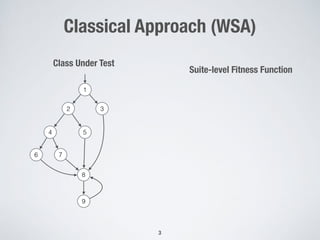
Classical Approach (WSA)
1
2 3
4 5
8
Class Under Test
7
9
6
Suite-level Fitness Function
3
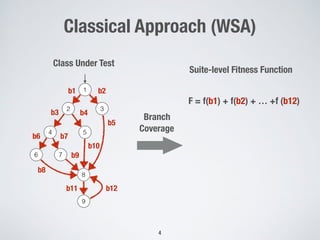
Classical Approach (WSA)
1
2 3
4 5
8
7
9
6
Suite-level Fitness Function
Branch
Coverage
b2b1
b3 b4
b5
b6 b7
b8
b9
b10
b11 b12
F = f(b1) + f(b2) + … +f (b12)
Class Under Test
4
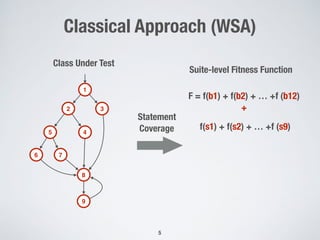
Classical Approach (WSA)
Suite-level Fitness Function
Statement
Coverage
F = f(b1) + f(b2) + … +f (b12)
+
f(s1) + f(s2) + … +f (s9)
1
2 3
5 4
8
7
9
6
Class Under Test
5
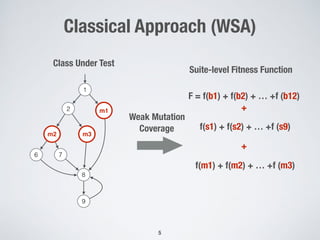
Classical Approach (WSA)
Suite-level Fitness Function
Weak Mutation
Coverage
F = f(b1) + f(b2) + … +f (b12)
+
f(s1) + f(s2) + … +f (s9)
f(m1) + f(m2) + … +f (m3)
+
1
2 m1
m2 m3
8
7
9
6
Class Under Test
5
Incremental Exploration
7
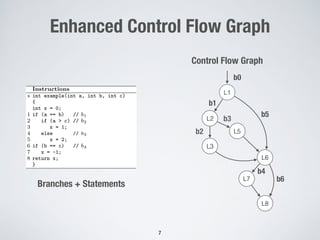
Enhanced Control Flow Graph
6 Annibale Panichella1
, Fitsum Meshesha Kifetew2
, and Paolo Tonella3
(a) Example program (b) Single criterion (c) Multiple criteria
Fig. 1. Code (left), CDG (middle), and ECDG (right) of an example program
Algorithm 1: MC-DynaMOSA
Input:
B = {⌧1, . . . , ⌧m} the set of coverage targets of a program.
CDG = hN, E, si: control dependency graph of the program
Result: A test suite T
L1
L2
L5
L3
b1
b4
b2
b3
L6
L7
L8
b5
b6
b0
Control Flow Graph
Branches + Statements
7
Enhanced Control Flow Graph
6 Annibale Panichella1
, Fitsum Meshesha Kifetew2
, and Paolo Tonella3
(a) Example program (b) Single criterion (c) Multiple criteria
Fig. 1. Code (left), CDG (middle), and ECDG (right) of an example program
Algorithm 1: MC-DynaMOSA
Input:
B = {⌧1, . . . , ⌧m} the set of coverage targets of a program.
CDG = hN, E, si: control dependency graph of the program
Result: A test suite T
L1
L2
L5
b1
b4
b2
L7
L8
b5
b6
b0
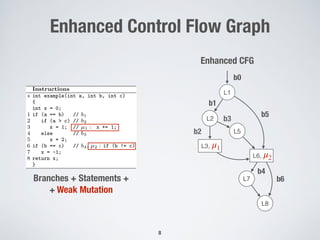
Enhanced CFG
L3, μ1
L6, μ2
Branches + Statements +

+ Weak Mutation
b3
8
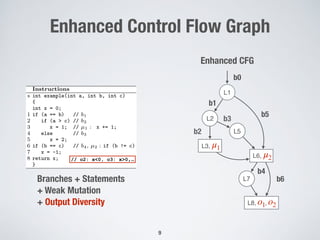
Enhanced Control Flow Graph
6 Annibale Panichella1
, Fitsum Meshesha Kifetew2
, and Paolo Tonella3
(a) Example program (b) Single criterion (c) Multiple criteria
Fig. 1. Code (left), CDG (middle), and ECDG (right) of an example program
Algorithm 1: MC-DynaMOSA
Input:
B = {⌧1, . . . , ⌧m} the set of coverage targets of a program.
CDG = hN, E, si: control dependency graph of the program
Result: A test suite T
L1
L2
L5
b1
b4
b2
L7
b5
b6
b0
Enhanced CFG
L3, μ1
L6, μ2// o2: x<0, o3: x>0,…
L8, o1, o2
Branches + Statements

+ Weak Mutation
+ Output Diversity
b3
9
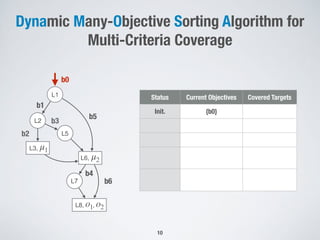
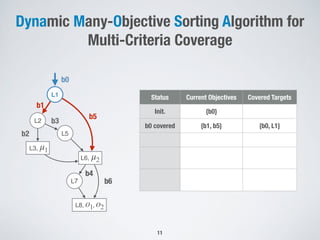
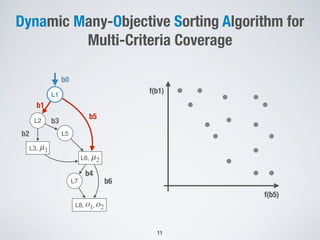
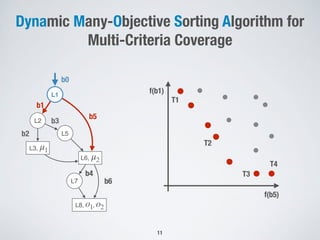
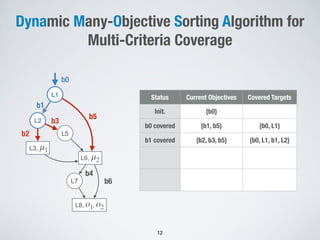
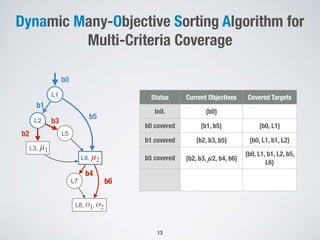
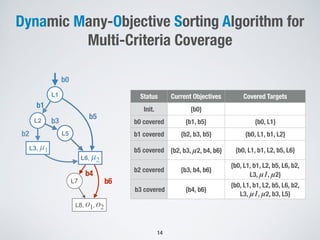
Dynamic Many-Objective Sorting Algorithm for
Multi-Criteria Coverage
L1
L2
L5
b1
b4
b2
L7
b5
b6
b0
L3, μ1
L6, μ2
L8, o1, o2
b3
Status Current Objectives Covered Targets
Init. {b0}
10
Dynamic Many-Objective Sorting Algorithm for
Multi-Criteria Coverage
L1
L2
L5
b1
b4
b2
L7
b5
b6
b0
L3, μ1
L6, μ2
L8, o1, o2
b3
Status Current Objectives Covered Targets
Init. {b0}
b0 covered {b1, b5} {b0, L1}
11
Dynamic Many-Objective Sorting Algorithm for
Multi-Criteria Coverage
L1
L2
L5
b1
b4
b2
L7
b5
b6
b0
L3, μ1
L6, μ2
L8, o1, o2
b3
11
f(b1)
f(b5)
Dynamic Many-Objective Sorting Algorithm for
Multi-Criteria Coverage
L1
L2
L5
b1
b4
b2
L7
b5
b6
b0
L3, μ1
L6, μ2
L8, o1, o2
b3
11
f(b1)
f(b5)
T1
T2
T3
T4
Dynamic Many-Objective Sorting Algorithm for
Multi-Criteria Coverage
L1
L2
L5
b1
b4
b2
L7
b5
b6
b0
L3, μ1
L6, μ2
L8, o1, o2
b3
Status Current Objectives Covered Targets
Init. {b0}
b0 covered {b1, b5} {b0, L1}
b1 covered {b2, b3, b5} {b0, L1, b1, L2}
12
Dynamic Many-Objective Sorting Algorithm for
Multi-Criteria Coverage
L1
L2
L5
b1
b4
b2
L7
b5
b6
b0
L3, μ1
L6, μ2
L8, o1, o2
b3
Status Current Objectives Covered Targets
Init. {b0}
b0 covered {b1, b5} {b0, L1}
b1 covered {b2, b3, b5} {b0, L1, b1, L2}
b5 covered {b2, b3, µ2, b4, b6}
{b0, L1, b1, L2, b5,
L6}
13
Dynamic Many-Objective Sorting Algorithm for
Multi-Criteria Coverage
L1
L2
L5
b1
b4
b2
L7
b5
b6
b0
L3, μ1
L6, μ2
L8, o1, o2
b3
Status Current Objectives Covered Targets
Init. {b0}
b0 covered {b1, b5} {b0, L1}
b1 covered {b2, b3, b5} {b0, L1, b1, L2}
b5 covered {b2, b3, µ2, b4, b6} {b0, L1, b1, L2, b5, L6}
b2 covered {b3, b4, b6}
{b0, L1, b1, L2, b5, L6, b2,
L3, µ1, µ2}
b3 covered {b4, b6}
{b0, L1, b1, L2, b5, L6, b2,
L3, µ1, µ2, b3, L5}
14
Empirical Study
18
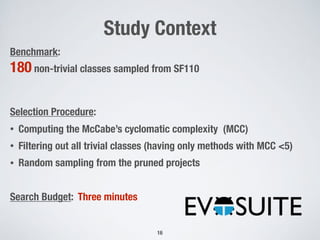
Study Context
Benchmark:
180 non-trivial classes sampled from SF110
Selection Procedure:
• Computing the McCabe’s cyclomatic complexity (MCC)
• Filtering out all trivial classes (having only methods with MCC <5)
• Random sampling from the pruned projects
Search Budget: Three minutes
16
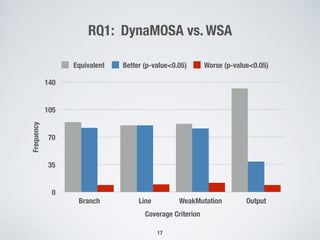
RQ1: DynaMOSA vs. WSAFrequency
0
35
70
105
140
Coverage Criterion
Branch Line WeakMutation Output
Equivalent Better (p-value<0.05) Worse (p-value<0.05)
17
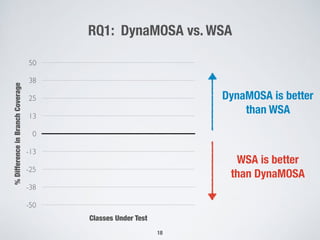
DynaMOSA is better
than WSA
WSA is better
than DynaMOSA
RQ1: DynaMOSA vs. WSA
%DifferenceinBranchCoverage
-50
-38
-25
-13
0
13
25
38
50
Classes Under Test
18
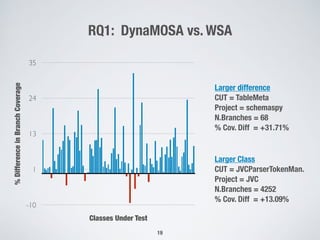
RQ1: DynaMOSA vs. WSA
%DifferenceinBranchCoverage
-10
1
13
24
35
Classes Under Test
Larger difference
CUT = TableMeta
Project = schemaspy
N.Branches = 68
% Cov. Diff = +31.71%
Larger Class
CUT = JVCParserTokenMan.
Project = JVC
N.Branches = 4252
% Cov. Diff = +13.09%
19
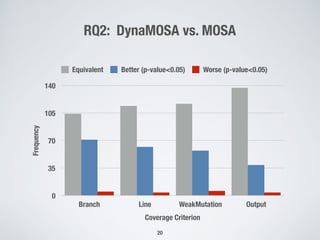
RQ2: DynaMOSA vs. MOSAFrequency
0
35
70
105
140
Coverage Criterion
Branch Line WeakMutation Output
Equivalent Better (p-value<0.05) Worse (p-value<0.05)
20
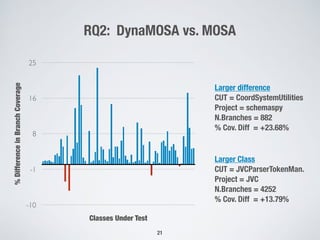
RQ2: DynaMOSA vs. MOSA
%DifferenceinBranchCoverage
-10
-1
8
16
25
Classes Under Test
Larger difference
CUT = CoordSystemUtilities
Project = schemaspy
N.Branches = 882
% Cov. Diff = +23.68%
Larger Class
CUT = JVCParserTokenMan.
Project = JVC
N.Branches = 4252
% Cov. Diff = +13.79%
21
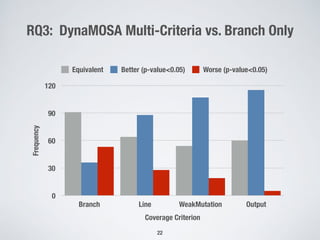
RQ3: DynaMOSA Multi-Criteria vs. Branch OnlyFrequency
0
30
60
90
120
Coverage Criterion
Branch Line WeakMutation Output
Equivalent Better (p-value<0.05) Worse (p-value<0.05)
22
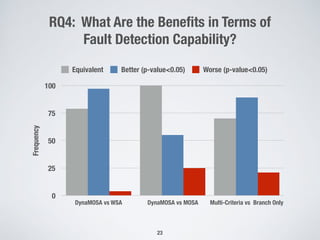
RQ4: What Are the Benefits in Terms of
Fault Detection Capability?Frequency
0
25
50
75
100
DynaMOSA vs WSA DynaMOSA vs MOSA Multi-Criteria vs Branch Only
Equivalent Better (p-value<0.05) Worse (p-value<0.05)
23
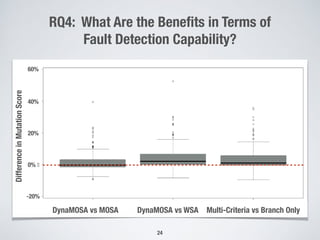
RQ4: What Are the Benefits in Terms of
Fault Detection Capability?
DynaMOSA vs MOSA DynaMOSA vs WSA Multi-Criteria vs Branch Only
DifferenceinMutationScore
60%
40%
20%
0%
-20%
24
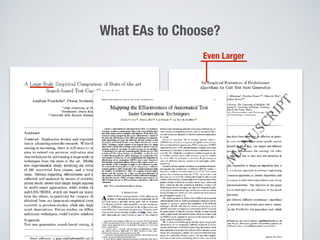
What EAs to Choose?
Even Larger
Incremental Control Dependency Frontier
Exploration for Many-Criteria
Test Case Generation
Annibale Panichella, Fitsum M. Kifetew, Paolo Tonella
September 11, 2017

Incremental Control Dependency Frontier Exploration for Many-Criteria Test Case Generation

  • 1.
    Incremental Control DependencyFrontier Exploration for Many-Criteria Test Case Generation Annibale Panichella, Fitsum M. Kifetew, Paolo Tonella September 11, 2017 !1
  • 2.
    Background Rojas et al.SSBSE 2015 "Optimising for several criteria at the same time is feasible without increasing computational costs" !2
  • 3.
    Classical Approach (WSA) 1 23 4 5 8 Class Under Test 7 9 6 Suite-level Fitness Function 3
  • 4.
    Classical Approach (WSA) 1 23 4 5 8 7 9 6 Suite-level Fitness Function Branch Coverage b2b1 b3 b4 b5 b6 b7 b8 b9 b10 b11 b12 F = f(b1) + f(b2) + … +f (b12) Class Under Test 4
  • 5.
    Classical Approach (WSA) Suite-levelFitness Function Statement Coverage F = f(b1) + f(b2) + … +f (b12) + f(s1) + f(s2) + … +f (s9) 1 2 3 5 4 8 7 9 6 Class Under Test 5
  • 6.
    Classical Approach (WSA) Suite-levelFitness Function Weak Mutation Coverage F = f(b1) + f(b2) + … +f (b12) + f(s1) + f(s2) + … +f (s9) f(m1) + f(m2) + … +f (m3) + 1 2 m1 m2 m3 8 7 9 6 Class Under Test 5
  • 7.
  • 8.
    Enhanced Control FlowGraph 6 Annibale Panichella1 , Fitsum Meshesha Kifetew2 , and Paolo Tonella3 (a) Example program (b) Single criterion (c) Multiple criteria Fig. 1. Code (left), CDG (middle), and ECDG (right) of an example program Algorithm 1: MC-DynaMOSA Input: B = {⌧1, . . . , ⌧m} the set of coverage targets of a program. CDG = hN, E, si: control dependency graph of the program Result: A test suite T L1 L2 L5 L3 b1 b4 b2 b3 L6 L7 L8 b5 b6 b0 Control Flow Graph Branches + Statements 7
  • 9.
    Enhanced Control FlowGraph 6 Annibale Panichella1 , Fitsum Meshesha Kifetew2 , and Paolo Tonella3 (a) Example program (b) Single criterion (c) Multiple criteria Fig. 1. Code (left), CDG (middle), and ECDG (right) of an example program Algorithm 1: MC-DynaMOSA Input: B = {⌧1, . . . , ⌧m} the set of coverage targets of a program. CDG = hN, E, si: control dependency graph of the program Result: A test suite T L1 L2 L5 b1 b4 b2 L7 L8 b5 b6 b0 Enhanced CFG L3, μ1 L6, μ2 Branches + Statements +
 + Weak Mutation b3 8
  • 10.
    Enhanced Control FlowGraph 6 Annibale Panichella1 , Fitsum Meshesha Kifetew2 , and Paolo Tonella3 (a) Example program (b) Single criterion (c) Multiple criteria Fig. 1. Code (left), CDG (middle), and ECDG (right) of an example program Algorithm 1: MC-DynaMOSA Input: B = {⌧1, . . . , ⌧m} the set of coverage targets of a program. CDG = hN, E, si: control dependency graph of the program Result: A test suite T L1 L2 L5 b1 b4 b2 L7 b5 b6 b0 Enhanced CFG L3, μ1 L6, μ2// o2: x<0, o3: x>0,… L8, o1, o2 Branches + Statements
 + Weak Mutation + Output Diversity b3 9
  • 11.
    Dynamic Many-Objective SortingAlgorithm for Multi-Criteria Coverage L1 L2 L5 b1 b4 b2 L7 b5 b6 b0 L3, μ1 L6, μ2 L8, o1, o2 b3 Status Current Objectives Covered Targets Init. {b0} 10
  • 12.
    Dynamic Many-Objective SortingAlgorithm for Multi-Criteria Coverage L1 L2 L5 b1 b4 b2 L7 b5 b6 b0 L3, μ1 L6, μ2 L8, o1, o2 b3 Status Current Objectives Covered Targets Init. {b0} b0 covered {b1, b5} {b0, L1} 11
  • 13.
    Dynamic Many-Objective SortingAlgorithm for Multi-Criteria Coverage L1 L2 L5 b1 b4 b2 L7 b5 b6 b0 L3, μ1 L6, μ2 L8, o1, o2 b3 11 f(b1) f(b5)
  • 14.
    Dynamic Many-Objective SortingAlgorithm for Multi-Criteria Coverage L1 L2 L5 b1 b4 b2 L7 b5 b6 b0 L3, μ1 L6, μ2 L8, o1, o2 b3 11 f(b1) f(b5) T1 T2 T3 T4
  • 15.
    Dynamic Many-Objective SortingAlgorithm for Multi-Criteria Coverage L1 L2 L5 b1 b4 b2 L7 b5 b6 b0 L3, μ1 L6, μ2 L8, o1, o2 b3 Status Current Objectives Covered Targets Init. {b0} b0 covered {b1, b5} {b0, L1} b1 covered {b2, b3, b5} {b0, L1, b1, L2} 12
  • 16.
    Dynamic Many-Objective SortingAlgorithm for Multi-Criteria Coverage L1 L2 L5 b1 b4 b2 L7 b5 b6 b0 L3, μ1 L6, μ2 L8, o1, o2 b3 Status Current Objectives Covered Targets Init. {b0} b0 covered {b1, b5} {b0, L1} b1 covered {b2, b3, b5} {b0, L1, b1, L2} b5 covered {b2, b3, µ2, b4, b6} {b0, L1, b1, L2, b5, L6} 13
  • 17.
    Dynamic Many-Objective SortingAlgorithm for Multi-Criteria Coverage L1 L2 L5 b1 b4 b2 L7 b5 b6 b0 L3, μ1 L6, μ2 L8, o1, o2 b3 Status Current Objectives Covered Targets Init. {b0} b0 covered {b1, b5} {b0, L1} b1 covered {b2, b3, b5} {b0, L1, b1, L2} b5 covered {b2, b3, µ2, b4, b6} {b0, L1, b1, L2, b5, L6} b2 covered {b3, b4, b6} {b0, L1, b1, L2, b5, L6, b2, L3, µ1, µ2} b3 covered {b4, b6} {b0, L1, b1, L2, b5, L6, b2, L3, µ1, µ2, b3, L5} 14
  • 18.
  • 19.
    Study Context Benchmark: 180 non-trivialclasses sampled from SF110 Selection Procedure: • Computing the McCabe’s cyclomatic complexity (MCC) • Filtering out all trivial classes (having only methods with MCC <5) • Random sampling from the pruned projects Search Budget: Three minutes 16
  • 20.
    RQ1: DynaMOSA vs.WSAFrequency 0 35 70 105 140 Coverage Criterion Branch Line WeakMutation Output Equivalent Better (p-value<0.05) Worse (p-value<0.05) 17
  • 21.
    DynaMOSA is better thanWSA WSA is better than DynaMOSA RQ1: DynaMOSA vs. WSA %DifferenceinBranchCoverage -50 -38 -25 -13 0 13 25 38 50 Classes Under Test 18
  • 22.
    RQ1: DynaMOSA vs.WSA %DifferenceinBranchCoverage -10 1 13 24 35 Classes Under Test Larger difference CUT = TableMeta Project = schemaspy N.Branches = 68 % Cov. Diff = +31.71% Larger Class CUT = JVCParserTokenMan. Project = JVC N.Branches = 4252 % Cov. Diff = +13.09% 19
  • 23.
    RQ2: DynaMOSA vs.MOSAFrequency 0 35 70 105 140 Coverage Criterion Branch Line WeakMutation Output Equivalent Better (p-value<0.05) Worse (p-value<0.05) 20
  • 24.
    RQ2: DynaMOSA vs.MOSA %DifferenceinBranchCoverage -10 -1 8 16 25 Classes Under Test Larger difference CUT = CoordSystemUtilities Project = schemaspy N.Branches = 882 % Cov. Diff = +23.68% Larger Class CUT = JVCParserTokenMan. Project = JVC N.Branches = 4252 % Cov. Diff = +13.79% 21
  • 25.
    RQ3: DynaMOSA Multi-Criteriavs. Branch OnlyFrequency 0 30 60 90 120 Coverage Criterion Branch Line WeakMutation Output Equivalent Better (p-value<0.05) Worse (p-value<0.05) 22
  • 26.
    RQ4: What Arethe Benefits in Terms of Fault Detection Capability?Frequency 0 25 50 75 100 DynaMOSA vs WSA DynaMOSA vs MOSA Multi-Criteria vs Branch Only Equivalent Better (p-value<0.05) Worse (p-value<0.05) 23
  • 27.
    RQ4: What Arethe Benefits in Terms of Fault Detection Capability? DynaMOSA vs MOSA DynaMOSA vs WSA Multi-Criteria vs Branch Only DifferenceinMutationScore 60% 40% 20% 0% -20% 24
  • 28.
    What EAs toChoose? Even Larger
  • 29.
    Incremental Control DependencyFrontier Exploration for Many-Criteria Test Case Generation Annibale Panichella, Fitsum M. Kifetew, Paolo Tonella September 11, 2017