Avoiding Big Mistakes
in Scientific Computing
Or: How to Write Code That Doesn’t Jeopardize
Your Professional Reputation or Patient’s Lives


                                                Jeff Allen
                  Quantitative Biomedical Research Center
                          UT Southwestern Medical Center
                                    BSCI5096 - 3.26.2013
Motivation


• Anil Potti scandal at Duke
  – Genomic signature identified that would identify
    the best chemo based on a patient‟s genes.
  – Over 100 patients enrolled in clinical trials.
  – Later discovered gross mishandling of data and
    invalidating bugs in software
  – Alleged manipulation of data
  – Watch: Lecture from Keith Baggerly
Outline


•   Revision Control
•   Reproducibility and Replicability
•   Ensuring Code Quality
•   Resources
Outline


• Revision Control
  – Introduction & Concepts
  – Git & GitHub
• Reproducibility and Replicability
• Ensuring Code Quality
• Resources
Revision Control


• Tracks changes to files over time
• Keeps a complete log of all changes ever
  made to any file in a project
• Supports more collaboration on projects
  – Provides an authoritative repository for the code
  – Gracefully catch and handle conflicts in files
• Various forms in use today including
  Mercurial, Git, Subversion
Git


• Modern distributed revision control system
  – “Distributed” means you have the entire history of
    the project on your local machine.
  – Don‟t have to be online to develop.
• Makes improvements in performance and
  usability on past systems.
• Open-Source and free
GitHub

• A website that hosts Git repositories.
• You can “push” your own Git repositories to
  their site to gain:
  – A web interface – easier way to view your files and
    track changes
  – Control who has access to which projects
  – Project organization – hosts documentation, bug-
    tracking, etc.
  – Social platform – the “Facebook” of coding
  – Client-Side graphical user interface
GITHUB DEMONSTRATION
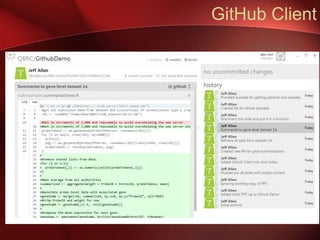
GitHub Client - GUI


•   Only works with GitHub.
•   Much easier to use and navigate.
•   Mac and Windows versions.
•   On campus: Need to open Git Shell and run:
    git config --global http.proxy http://proxy.swmed.edu:3128
GitHub Client
GITHUB CLIENT DEMO
Use Cases

• “This function used to work.”
  – Look at the changes made to that file since it last
    worked.
• “Please send me the code used in this
  publication.”
  – Revert the project back to any point in its history
• “I found a bug and fixed it.”
  – (Optionally) Allow others to contribute to your
    projects.
Outline


• Revision Control
• Reproducibility and Replicability
  – Replicability
  – Reproducibility
• Ensuring Code Quality
• Resources
“‘Replicable’ means „other people get exactly
the same results when doing exactly the same
thing‟, while ‘reproducible’ means „something
similar happens in other people's hands.‟ The
latter is far stronger, in general, because it
indicates that your results are not merely some
quirk of your setup and may actually be right.”
                     C. TITUS BROWN
                         http://ivory.idyll.org/blog/replication-i.html
Replicability


• In order for analysis to be replicable, another
  researcher must have access to:
  – The exact same code you used
  – The exact same data you used
• Any changes (including bug-fixes and other
  corrections) in your code or data from what
  you provide will make your results irreplicable.
  – Must track in a revision control system
Reproducibility


• Requires much more time and effort
• Independently arrive at the same conclusions
  – Potentially using the same data
  – Using different techniques and parameters
• May take as much time to reproduce results
  as it did to produce them the first time
• Should be done in high-stakes (i.e. clinical)
  applications
Recommended Practices

a. Use a revision control system such as GitHub
b. To ensure replicability, clone your repository
   on another computer and re-run all your
   analysis. Ensure you get the same results.
  •   This is a good test of replicability.
  •   Knowing you‟ll have to do this will make you write
      better organized code.
c. If it‟s really important, ask a colleague to
   reproduce.
Outline


• Revision Control
• Reproducibility and Replicability
• Ensuring Code Quality
  – Automated Testing
  – Code reviews
• Resources
Automated Testing


• Unit testing
   – Very specific target
   – May have multiple tests
     per function
                                 install.packages(
                                        “testthat”)
• Many unit testing
  frameworks                     library(testthat)
   – In R: testthat, and Runit
Testing Example - Square

Code

square <- function(x){
  sq <- 0
  for (i in 1:x){
     sq <- sq + x
  }
  return(sq)
}
Testing Example - Square

Code                     Tests
                         expect_that(
square <- function(x){      square(3),
  sq <- 0                   equals(9)
  for (i in 1:x){        ) #Passes
     sq <- sq + x
  }
  return(sq)
}
Testing Example - Square

Code                     Tests
                         expect_that(square(3),
square <- function(x){     equals(9)) #Passes
  sq <- 0                expect_that(square(5),
  for (i in 1:x){          equals(25)) #Passes
     sq <- sq + x
  }
  return(sq)
}
Test-Driven Development (TDD)


• If you see a bug:
  1.   Write a test that fails
  2.   Fix the bug
  3.   Show that the test now passes
  4.   Commit to revision control
Testing Example - Square

Code                     Tests
                         expect_that(square(3),
square <- function(x){     equals(9)) #Passes
  sq <- 0                expect_that(square(5),
  for (i in 1:x){          equals(25)) #Passes
     sq <- sq + x
  }
  return(sq)
}
Testing Example - Square

Code                     Tests
                         expect_that(square(3),
square <- function(x){     equals(9)) #Passes
  sq <- 0                expect_that(square(5),
  for (i in 1:x){          equals(25)) #Passes
     sq <- sq + x        expect_that(square(2.5),
  }                        equals(6.25)) #Fails
  return(sq)
}
Testing Example - Square

Code                     Tests
                         expect_that(square(3),
square <- function(x){     equals(9)) #Passes
  sq <- 0                expect_that(square(5),
  for (i in 1:x){          equals(25)) #Passes
     sq <- sq + x        expect_that(square(2.5),
  }                        equals(6.25)) #Fails
  return(sq)             expect_that(square(-2),
}                          equals(4)) #Fails
Test-Driven Development (TDD)


• If you see a bug:
  1.   Write a test that fails
  2.   Fix the bug
  3.   Show that the test now passes
  4.   Commit to revision control
Testing Example - Square

Code


square <- function(x){
  sq <- x * x
  return(sq)
}
Test-Driven Development (TDD)


• If you see a bug:
  1.   Write a test that fails
  2.   Fix the bug
  3.   Show that the test now passes
  4.   Commit to revision control
Testing Example - Square

Code


square <- function(x){
  sq <- x * x
  return(sq)
}
Testing Example - Square

Code                     Tests
                         expect_that(square(3),
                           equals(9)) #Passes
                         expect_that(square(5),
square <- function(x){
                           equals(25)) #Passes
  sq <- x * x
                         expect_that(square(2.5),
  return(sq)
                           equals(6.25)) #Passes
}
                         expect_that(square(-2),
                           equals(4)) #Passes
Test-Driven Development (TDD)


• If you see a bug:
  1.   Write a test that fails
  2.   Fix the bug
  3.   Show that the test now passes
  4.   Commit to revision control
Test-Driven Development (TDD)


• Advantages
  – Ensure that problematic areas are well-tested
  – Regression testing – ensure old bugs don‟t ever
    come back
  – Confidently approach old code
  – More assured in handling someone else‟s code
  – Saves you time over manual testing
Code Reviews


• Get more than one set of eyes on your code
• Lightweight
  – Email to get quick feedback
  – GitHub is great for this
• Formal
  – Have a meeting to audit
  – Less than 500 LOC per meeting
Extreme – Pair Programming

•   Two programmers share a single workstation
•   Both participate, though only one can type
•   Significant learning opportunities for both
•   Can strategically pair:
    – Senior with Junior, mentoring
    – Statistician with Developer, mutual learning
• Improvements in code quality
  compensate for short-term efficiency loss
    – fewer bugs, easier code to maintain
Testing Example - Square

Code                     Tests
                         expect_that(square(3),
                           equals(9)) #Passes
                         expect_that(square(5),
square <- function(x){
                           equals(25)) #Passes
  sq <- x * x
                         expect_that(square(2.5),
  return(sq)
                           equals(6.25)) #Passes
}
                         expect_that(square(-2),
                           equals(4)) #Passes
Testing Example - Square

Code                     Tests
                         expect_that(square(3),
                           equals(9)) #Passes
                         expect_that(square(5),
square <- function(x){     equals(25)) #Passes
  x^2                    expect_that(square(2.5),
}                          equals(6.25)) #Passes
                         expect_that(square(-2),
                           equals(4)) #Passes
Outline


•   Revision Control
•   Reproducibility and Replicability
•   Ensuring Code Quality
•   Resources
Resources

• Software Carpentry
  – www.software-carpentry.org
  – Volunteer organization focused on teaching these
    topics to scientific audiences
  – Contact us (Jeffrey.Allen@UTSouthwestern.edu) if
    you‟d be interested in attending a local Boot Camp
• GitHub Documentation
  – https://help.github.com/
  – Great documentation on how to use Git and/or
    GitHub
Resources


• Unit Testing in R
  – http://cran.r-
    project.org/web/packages/RUnit/index.html
  – http://cran.r-
    project.org/web/packages/testthat/index.html
  – http://journal.r-project.org/archive/2011-
    1/RJournal_2011-1_Wickham.pdf
Suggested Next Steps


• Watch Lecture from Keith Baggerly
• Register for a GitHub account (free), explore
• Write an R function and cover it with unit tests
  using the test_that framework
  • Then check into a public GitHub repo

Scientific Software Development

  • 1.
    Avoiding Big Mistakes inScientific Computing Or: How to Write Code That Doesn’t Jeopardize Your Professional Reputation or Patient’s Lives Jeff Allen Quantitative Biomedical Research Center UT Southwestern Medical Center BSCI5096 - 3.26.2013
  • 2.
    Motivation • Anil Pottiscandal at Duke – Genomic signature identified that would identify the best chemo based on a patient‟s genes. – Over 100 patients enrolled in clinical trials. – Later discovered gross mishandling of data and invalidating bugs in software – Alleged manipulation of data – Watch: Lecture from Keith Baggerly
  • 3.
    Outline • Revision Control • Reproducibility and Replicability • Ensuring Code Quality • Resources
  • 4.
    Outline • Revision Control – Introduction & Concepts – Git & GitHub • Reproducibility and Replicability • Ensuring Code Quality • Resources
  • 5.
    Revision Control • Trackschanges to files over time • Keeps a complete log of all changes ever made to any file in a project • Supports more collaboration on projects – Provides an authoritative repository for the code – Gracefully catch and handle conflicts in files • Various forms in use today including Mercurial, Git, Subversion
  • 6.
    Git • Modern distributedrevision control system – “Distributed” means you have the entire history of the project on your local machine. – Don‟t have to be online to develop. • Makes improvements in performance and usability on past systems. • Open-Source and free
  • 7.
    GitHub • A websitethat hosts Git repositories. • You can “push” your own Git repositories to their site to gain: – A web interface – easier way to view your files and track changes – Control who has access to which projects – Project organization – hosts documentation, bug- tracking, etc. – Social platform – the “Facebook” of coding – Client-Side graphical user interface
  • 8.
  • 9.
    GitHub Client -GUI • Only works with GitHub. • Much easier to use and navigate. • Mac and Windows versions. • On campus: Need to open Git Shell and run: git config --global http.proxy http://proxy.swmed.edu:3128
  • 10.
  • 11.
  • 12.
    Use Cases • “Thisfunction used to work.” – Look at the changes made to that file since it last worked. • “Please send me the code used in this publication.” – Revert the project back to any point in its history • “I found a bug and fixed it.” – (Optionally) Allow others to contribute to your projects.
  • 13.
    Outline • Revision Control •Reproducibility and Replicability – Replicability – Reproducibility • Ensuring Code Quality • Resources
  • 14.
    “‘Replicable’ means „otherpeople get exactly the same results when doing exactly the same thing‟, while ‘reproducible’ means „something similar happens in other people's hands.‟ The latter is far stronger, in general, because it indicates that your results are not merely some quirk of your setup and may actually be right.” C. TITUS BROWN http://ivory.idyll.org/blog/replication-i.html
  • 15.
    Replicability • In orderfor analysis to be replicable, another researcher must have access to: – The exact same code you used – The exact same data you used • Any changes (including bug-fixes and other corrections) in your code or data from what you provide will make your results irreplicable. – Must track in a revision control system
  • 16.
    Reproducibility • Requires muchmore time and effort • Independently arrive at the same conclusions – Potentially using the same data – Using different techniques and parameters • May take as much time to reproduce results as it did to produce them the first time • Should be done in high-stakes (i.e. clinical) applications
  • 17.
    Recommended Practices a. Usea revision control system such as GitHub b. To ensure replicability, clone your repository on another computer and re-run all your analysis. Ensure you get the same results. • This is a good test of replicability. • Knowing you‟ll have to do this will make you write better organized code. c. If it‟s really important, ask a colleague to reproduce.
  • 18.
    Outline • Revision Control •Reproducibility and Replicability • Ensuring Code Quality – Automated Testing – Code reviews • Resources
  • 19.
    Automated Testing • Unittesting – Very specific target – May have multiple tests per function install.packages( “testthat”) • Many unit testing frameworks library(testthat) – In R: testthat, and Runit
  • 20.
    Testing Example -Square Code square <- function(x){ sq <- 0 for (i in 1:x){ sq <- sq + x } return(sq) }
  • 21.
    Testing Example -Square Code Tests expect_that( square <- function(x){ square(3), sq <- 0 equals(9) for (i in 1:x){ ) #Passes sq <- sq + x } return(sq) }
  • 22.
    Testing Example -Square Code Tests expect_that(square(3), square <- function(x){ equals(9)) #Passes sq <- 0 expect_that(square(5), for (i in 1:x){ equals(25)) #Passes sq <- sq + x } return(sq) }
  • 23.
    Test-Driven Development (TDD) •If you see a bug: 1. Write a test that fails 2. Fix the bug 3. Show that the test now passes 4. Commit to revision control
  • 24.
    Testing Example -Square Code Tests expect_that(square(3), square <- function(x){ equals(9)) #Passes sq <- 0 expect_that(square(5), for (i in 1:x){ equals(25)) #Passes sq <- sq + x } return(sq) }
  • 25.
    Testing Example -Square Code Tests expect_that(square(3), square <- function(x){ equals(9)) #Passes sq <- 0 expect_that(square(5), for (i in 1:x){ equals(25)) #Passes sq <- sq + x expect_that(square(2.5), } equals(6.25)) #Fails return(sq) }
  • 26.
    Testing Example -Square Code Tests expect_that(square(3), square <- function(x){ equals(9)) #Passes sq <- 0 expect_that(square(5), for (i in 1:x){ equals(25)) #Passes sq <- sq + x expect_that(square(2.5), } equals(6.25)) #Fails return(sq) expect_that(square(-2), } equals(4)) #Fails
  • 27.
    Test-Driven Development (TDD) •If you see a bug: 1. Write a test that fails 2. Fix the bug 3. Show that the test now passes 4. Commit to revision control
  • 28.
    Testing Example -Square Code square <- function(x){ sq <- x * x return(sq) }
  • 29.
    Test-Driven Development (TDD) •If you see a bug: 1. Write a test that fails 2. Fix the bug 3. Show that the test now passes 4. Commit to revision control
  • 30.
    Testing Example -Square Code square <- function(x){ sq <- x * x return(sq) }
  • 31.
    Testing Example -Square Code Tests expect_that(square(3), equals(9)) #Passes expect_that(square(5), square <- function(x){ equals(25)) #Passes sq <- x * x expect_that(square(2.5), return(sq) equals(6.25)) #Passes } expect_that(square(-2), equals(4)) #Passes
  • 32.
    Test-Driven Development (TDD) •If you see a bug: 1. Write a test that fails 2. Fix the bug 3. Show that the test now passes 4. Commit to revision control
  • 33.
    Test-Driven Development (TDD) •Advantages – Ensure that problematic areas are well-tested – Regression testing – ensure old bugs don‟t ever come back – Confidently approach old code – More assured in handling someone else‟s code – Saves you time over manual testing
  • 34.
    Code Reviews • Getmore than one set of eyes on your code • Lightweight – Email to get quick feedback – GitHub is great for this • Formal – Have a meeting to audit – Less than 500 LOC per meeting
  • 35.
    Extreme – PairProgramming • Two programmers share a single workstation • Both participate, though only one can type • Significant learning opportunities for both • Can strategically pair: – Senior with Junior, mentoring – Statistician with Developer, mutual learning • Improvements in code quality compensate for short-term efficiency loss – fewer bugs, easier code to maintain
  • 36.
    Testing Example -Square Code Tests expect_that(square(3), equals(9)) #Passes expect_that(square(5), square <- function(x){ equals(25)) #Passes sq <- x * x expect_that(square(2.5), return(sq) equals(6.25)) #Passes } expect_that(square(-2), equals(4)) #Passes
  • 37.
    Testing Example -Square Code Tests expect_that(square(3), equals(9)) #Passes expect_that(square(5), square <- function(x){ equals(25)) #Passes x^2 expect_that(square(2.5), } equals(6.25)) #Passes expect_that(square(-2), equals(4)) #Passes
  • 38.
    Outline • Revision Control • Reproducibility and Replicability • Ensuring Code Quality • Resources
  • 39.
    Resources • Software Carpentry – www.software-carpentry.org – Volunteer organization focused on teaching these topics to scientific audiences – Contact us (Jeffrey.Allen@UTSouthwestern.edu) if you‟d be interested in attending a local Boot Camp • GitHub Documentation – https://help.github.com/ – Great documentation on how to use Git and/or GitHub
  • 40.
    Resources • Unit Testingin R – http://cran.r- project.org/web/packages/RUnit/index.html – http://cran.r- project.org/web/packages/testthat/index.html – http://journal.r-project.org/archive/2011- 1/RJournal_2011-1_Wickham.pdf
  • 41.
    Suggested Next Steps •Watch Lecture from Keith Baggerly • Register for a GitHub account (free), explore • Write an R function and cover it with unit tests using the test_that framework • Then check into a public GitHub repo

Editor's Notes

  • #6 Every good programmer I know uses, most bad ones I know don’t.
  • #8 You can use Git without Github. GitHub is one of the options for hosting Git repositories.
  • #9 Overview, list of projectsPublic v PrivateShow commitsShow diff of a commitShow comments/discussion on commitShow tagsShow wiki – devtools - https://github.com/hadley/devtools/Show issuesShow pull requests
  • #16 Only true way to achieve replicability in a project under development is to use a revision control system
  • #23 Spot two problems with this function 1. negatives 2. decimals
  • #25 What would our new tests look like?
  • #27 expect_that(square(2.5),equals(6.25))expect_that(square(-2),equals(4)) square &lt;- function(x){sq &lt;- 0 for (i in 1:x){sq &lt;- sq + x } return(sq) }test_that(&quot;Square function works on various input types&quot;, {expect_that(square(3), equals(9))expect_that(square(5), equals(25))expect_that(square(2.5), equals(6.25))expect_that(square(-2), equals(4))})
  • #31 square &lt;- function(x){sq &lt;- x * x return(sq) }test_that(&quot;Square function works on various input types&quot;, {expect_that(square(3), equals(9))expect_that(square(5), equals(25))expect_that(square(2.5), equals(6.25))expect_that(square(-2), equals(4))})
  • #35 Lightweight Email your code and have a peer or more experienced programmer look through the code and suggest improvements Demo GitHubFormal Schedule a meeting with a handful of other programmers to audit the code you’ve written Should be less than 500 LOC per meeting Target around 200LOC per hour Selectively pick sections of code to review formally
  • #37 Demo GitHub code comments
  • #38 square &lt;- function(x){ x ^ 2}test_that(&quot;Square function works on various input types&quot;, {expect_that(square(3), equals(9))expect_that(square(5), equals(25))expect_that(square(2.5), equals(6.25))expect_that(square(-2), equals(4))})