PHYSICAL PHARMACEUTICS; SOLUBILITY OF DRUGS; UNIT I.pdf
1.
Mr. Sakhare R.S.
D., B., M. Pharm, B. A., (PhD.)
Gpat 2020, Niper 2020, Gpat 2022, Niper PhD entrance 2022, SRTMUN PET 2022 Qualified
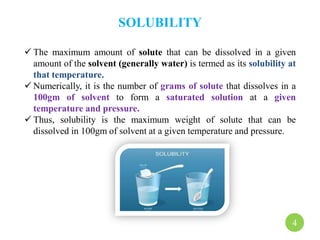
Assistant Professor,
Dept. of Pharmaceutics,
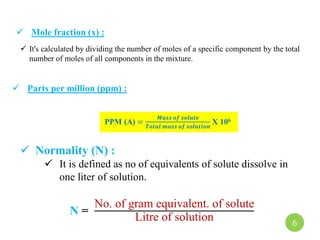
Latur College of Pharmacy, Hasegaon
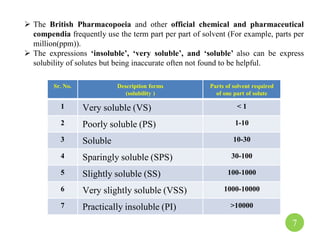
SOLUBILITY OF DRUGS
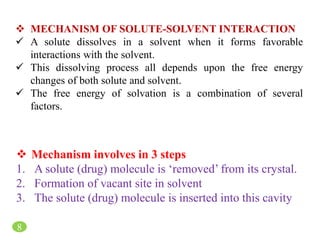
2.
Contents:
Solubilityof drugs :
Solubility expressions, mechanisms of solute solvent interactions, ideal solubility
parameters, solvation & association, quantitative approach to the factors influencing
solubility of drugs, diffusion principles in biological systems.
Solubility of gas in liquids, solubility of liquids in liquids, (Binary solutions, ideal
solutions) Raoult’s law, real solutions.
Partially miscible liquids, Critical solution temperature and applications.
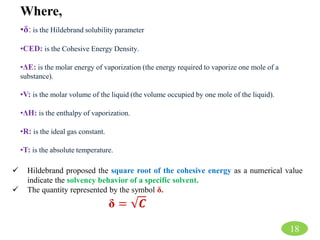
Distribution law, its limitations and applications.
1
3.
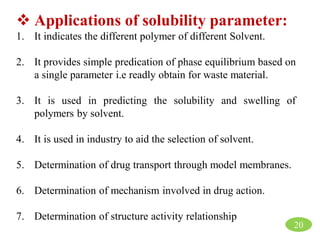
• Introduction
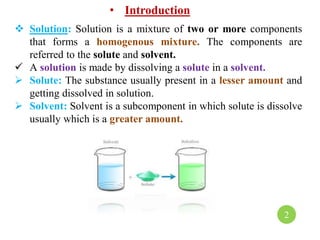
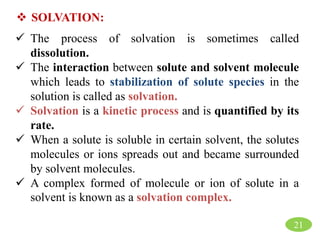
Solution:Solution is a mixture of two or more components
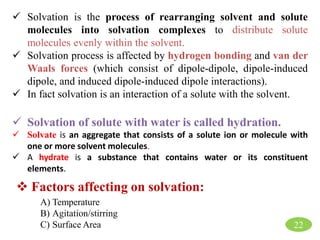
that forms a homogenous mixture. The components are
referred to the solute and solvent.
A solution is made by dissolving a solute in a solvent.
Solute: The substance usually present in a lesser amount and
getting dissolved in solution.
Solvent: Solvent is a subcomponent in which solute is dissolve
usually which is a greater amount.
2
4.
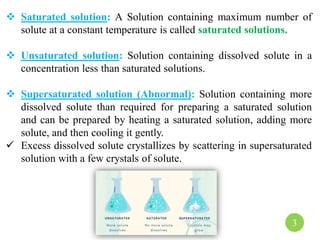
Saturated solution:A Solution containing maximum number of
solute at a constant temperature is called saturated solutions.
Unsaturated solution: Solution containing dissolved solute in a
concentration less than saturated solutions.
Supersaturated solution (Abnormal): Solution containing more
dissolved solute than required for preparing a saturated solution
and can be prepared by heating a saturated solution, adding more
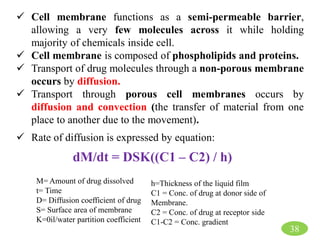
solute, and then cooling it gently.
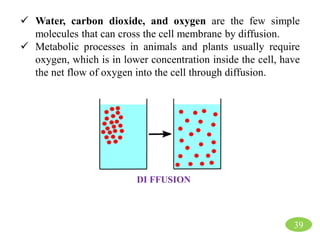
Excess dissolved solute crystallizes by scattering in supersaturated
solution with a few crystals of solute.
3
5.
SOLUBILITY
The maximumamount of solute that can be dissolved in a given
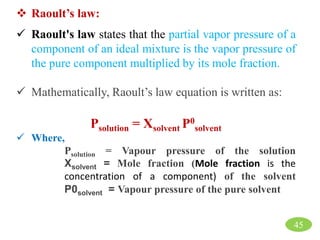
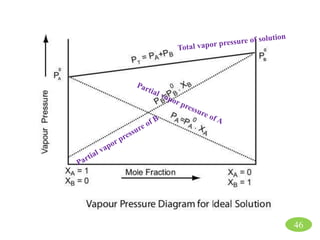
amount of the solvent (generally water) is termed as its solubility at
that temperature.
Numerically, it is the number of grams of solute that dissolves in a
100gm of solvent to form a saturated solution at a given
temperature and pressure.
Thus, solubility is the maximum weight of solute that can be
dissolved in 100gm of solvent at a given temperature and pressure.
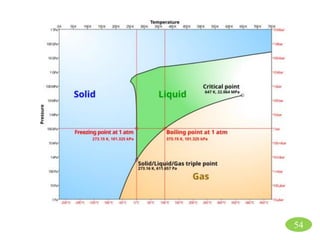
4
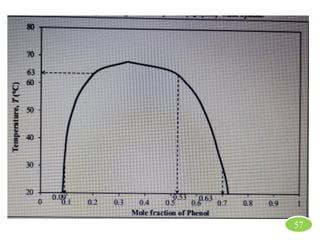
6.
SOLUBILITY EXPRESSION:
The solubility of a drug or other substance in a solvent can be
expressed quantitatively in numerous terms viz. percent by
mass (W/W), percent by volume (V/V), molality (m), molarity
(M), mole fraction (x), and parts per million (ppm), etc.
5
Percent by mass (W/W) :
% W/W =
𝑴𝒂𝒔𝒔 𝒐𝒇 𝒔𝒐𝒍𝒖𝒕𝒆
𝑴𝒂𝒔𝒔 𝒐𝒇 𝒔𝒐𝒍𝒗𝒆𝒏𝒕
X 100
Percent by volume (V/V) :
% V/V =
𝑽𝒐𝒍𝒖𝒎𝒆 𝒐𝒇 𝒔𝒐𝒍𝒖𝒕𝒆
𝑽𝒐𝒍𝒖𝒎𝒆 𝒐𝒇 𝒔𝒐𝒍𝒗𝒆𝒏𝒕
X 100
Molality (m) :
m =
𝑴𝒂𝒔𝒔 𝒐𝒇 𝒔𝒐𝒍𝒖𝒕𝒆
𝑴𝒂𝒔𝒔 𝒐𝒇 𝒔𝒐𝒍𝒗𝒆𝒏𝒕 (𝑲𝒈)
Molarity(M) :
m =
𝑴𝒂𝒔𝒔 𝒐𝒇 𝒔𝒐𝒍𝒖𝒕𝒆
𝑽𝒐𝒍𝒖𝒎𝒆 𝒐𝒇 𝒔𝒐𝒍𝒗𝒆𝒏𝒕 (𝑳𝒊𝒕𝒓𝒆𝒔)
7.
Parts permillion (ppm) :
PPM (A) =
𝑴𝒂𝒔𝒔 𝒐𝒇 𝒔𝒐𝒍𝒖𝒕𝒆
𝑻𝒐𝒕𝒂𝒍 𝒎𝒂𝒔𝒔 𝒐𝒇 𝒔𝒐𝒍𝒖𝒕𝒊𝒐𝒏
X 106
It's calculated by dividing the number of moles of a specific component by the total
number of moles of all components in the mixture.
Mole fraction (x) :
Normality (N) :
It is defined as no of equivalents of solute dissolve in
one liter of solution.
N =
No. of gram equivalent. of solute
Litre of solution 6
8.
Sr. No. Descriptionforms
(solubility )
Parts of solvent required
of one part of solute
1 Very soluble (VS) < 1
2 Poorly soluble (PS) 1-10
3 Soluble 10-30
4 Sparingly soluble (SPS) 30-100
5 Slightly soluble (SS) 100-1000
6 Very slightly soluble (VSS) 1000-10000
7 Practically insoluble (PI) >10000
The British Pharmacopoeia and other official chemical and pharmaceutical
compendia frequently use the term part per part of solvent (For example, parts per
million(ppm)).
The expressions ‘insoluble’, ‘very soluble’, and ‘soluble’ also can be express
solubility of solutes but being inaccurate often not found to be helpful.
7
9.
8
MECHANISM OFSOLUTE-SOLVENT INTERACTION
A solute dissolves in a solvent when it forms favorable
interactions with the solvent.
This dissolving process all depends upon the free energy
changes of both solute and solvent.
The free energy of solvation is a combination of several
factors.
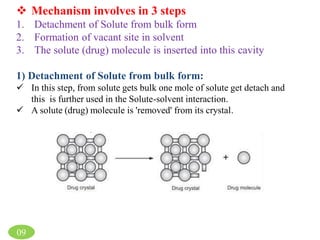
Mechanism involves in 3 steps
1. A solute (drug) molecule is ‘removed’ from its crystal.
2. Formation of vacant site in solvent
3. The solute (drug) molecule is inserted into this cavity
10.
09
Mechanism involvesin 3 steps
1. Detachment of Solute from bulk form
2. Formation of vacant site in solvent
3. The solute (drug) molecule is inserted into this cavity
1) Detachment of Solute from bulk form:
In this step, from solute gets bulk one mole of solute get detach and
this is further used in the Solute-solvent interaction.
A solute (drug) molecule is 'removed' from its crystal.
11.
10
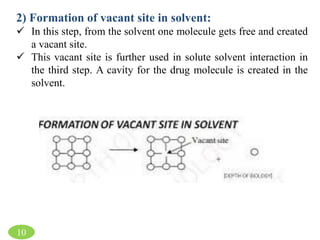
2) Formation ofvacant site in solvent:
In this step, from the solvent one molecule gets free and created
a vacant site.
This vacant site is further used in solute solvent interaction in
the third step. A cavity for the drug molecule is created in the
solvent.
12.
11
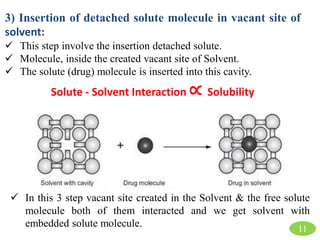
3) Insertion ofdetached solute molecule in vacant site of
solvent:
This step involve the insertion detached solute.
Molecule, inside the created vacant site of Solvent.
The solute (drug) molecule is inserted into this cavity.
Solute - Solvent Interaction ∝ Solubility
In this 3 step vacant site created in the Solvent & the free solute
molecule both of them interacted and we get solvent with
embedded solute molecule.
13.
12
Dissolution oftenoccurs when the solute-solvent
interactions are similar to the solvent-solute interactions ,
signified by the term “Like dissolves like”.
Hence polar solute dissolve in polar solvents, whereas non-
polar solutes dissolve in non-polar solvents.
Dissimilar nature of solute and solvent makes solute
insoluble in the solvent.
Substances dissolve when solvent-solute attraction is
greater than solvent-solvent attraction and solute-solute
attraction.
Polar solutes dissolve in polar solvents. Example: Salt &
Sugar dissolves in water.
Non polar solutes dissolve in non polar solvent. Example:
Naphthalene dissolves in benzene.
14.
13
Polar solvent:A drugs solubility is owned to the solvent’s polarity.
i.e., to its dipole moment (a measure of the separation of positive and
negative electrical charges in a molecule or system). Ionic solutes and
other polar substances dissolve in polar solvents. Water and alcohol
mix in all proportions.
However, Hildebrand showed that dipole moments alone cannot
explain the water solubility of polar substances.
The solute’s ability to form hydrogen bonds is a more significant factor
than the polarity as reflected in high dipole moment.
Alcohols, aldehydes, ketones amines and other oxygen and nitrogen
containing compounds having the ability to forms hydrogen bonds
with water, gets dissolved in water.
15.
Non-Polar solvent:
Solvents that are composed of atoms that have small differences
in electronegativity (Electronegativity is the tendency of an atom to
attract electrons towards itself when it is part of a chemical bond) and
are called non-polar solvents.
They contains bonds between atoms with similar
electronegativity's, such as carbon and hydrogen.
In the non polar molecules the dipole moment is zero due
nearly equal in electronegativity of bonding atoms and also
due to symmetry in structure.
Bond between atoms with similar electronegativity will lack
partial charges.
Generally, non polar molecules dissolve in non-polar solvents.
Ex. CCl4 will dissolve in benzene.
14
16.
Semi-Polar solvent:
Semipolar solvents such as ketones can induce a
certain degree of polarity in non-polar solvent
molecules.
For example, benzene which is readily polarizable,
becomes soluble in alcohol.
They can act as a intermediate solvents to bring
about miscibility of polar and non-polar liquids.
Example: acetone increases solubility of ether in
water.
15
17.
16
IDEAL SOLUBILITYPARAMETERS
Solubility parameters provides numerical methods to
predict interaction between material.
It is used for estimation of whether substance will dissolve
in another substance or not.
If values of solubility parameter are same then we can say
that one substance is soluble in another.
Two types of solubility parameter:
1) Hildebrand solubility parameter
2) Hansen Solubility parameter
18.
17
Hildebrand solubilityparameter (δ) :
It is an ability of liquid to act as a solvent.
Joel H. Hildebrand in 1936.
The solubility parameter is a numerical value that indicates
relative solvency behavior of specific solvent.
It is derived from the cohesive energy density of the solvent,
which in turn is derived from the heat of vaporization.
Hildebrand solubility parameter (δ):
Square root of cohesive energy density
Cohesive energy density is the force of attraction per unit
volume of solvent.
δ = √(CED) = √(-ΔE/V) = √((ΔH - RT)/V)
19.
•δ: is theHildebrand solubility parameter
•CED: is the Cohesive Energy Density.
•ΔE: is the molar energy of vaporization (the energy required to vaporize one mole of a
substance).
•V: is the molar volume of the liquid (the volume occupied by one mole of the liquid).
•ΔH: is the enthalpy of vaporization.
•R: is the ideal gas constant.
•T: is the absolute temperature.
Where,
18
Hildebrand proposed the square root of the cohesive energy as a numerical value
indicate the solvency behavior of a specific solvent.
The quantity represented by the symbol δ.
δ = 𝑪
20.
19
Hansen solubilityparameter (δt):
This parameter is a way of predicting solubility, if one
material will dissolve in another and form a solution.
They are based on the idea that like dissolves like where one
molecule is defined as being 'like' another if it bonds to itself
in a similar way.
The most widely accepted three component system to date is
the three parameter system developed by Charles M.
Hansen in 1966.
The Hansen parameter divided the total Hildebrand value into
three parts.
Hansen solubility parameter (δt):
δt= δd + δp + δh
δd = The energy from dispersion forces between molecules
δp = The energy from dipolar intermolecular force between
molecules.
δh = The energy from hydrogen bonds between molecules
21.
Applications ofsolubility parameter:
1. It indicates the different polymer of different Solvent.
2. It provides simple predication of phase equilibrium based on
a single parameter i.e readly obtain for waste material.
3. It is used in predicting the solubility and swelling of
polymers by solvent.
4. It is used in industry to aid the selection of solvent.
5. Determination of drug transport through model membranes.
6. Determination of mechanism involved in drug action.
7. Determination of structure activity relationship
20
22.
21
SOLVATION:
Theprocess of solvation is sometimes called
dissolution.
The interaction between solute and solvent molecule
which leads to stabilization of solute species in the
solution is called as solvation.
Solvation is a kinetic process and is quantified by its
rate.
When a solute is soluble in certain solvent, the solutes
molecules or ions spreads out and became surrounded
by solvent molecules.
A complex formed of molecule or ion of solute in a
solvent is known as a solvation complex.
23.
22
Solvation isthe process of rearranging solvent and solute
molecules into solvation complexes to distribute solute
molecules evenly within the solvent.
Solvation process is affected by hydrogen bonding and van der
Waals forces (which consist of dipole-dipole, dipole-induced
dipole, and induced dipole-induced dipole interactions).
In fact solvation is an interaction of a solute with the solvent.
Solvation of solute with water is called hydration.
Solvate is an aggregate that consists of a solute ion or molecule with
one or more solvent molecules.
A hydrate is a substance that contains water or its constituent
elements.
Factors affecting on solvation:
A) Temperature
B) Agitation/stirring
C) Surface Area
24.
23
ASSOCIATION:
Associationmeans joining/addition.
The association is a phenomenon in which apposite
electrically charged ions come together in a solution and
form a separate/distinct chemical entity.
The process of association is reverse of dissolution.
The extent of ionic association depends in the dielectric
constant of the solvent.
The ions of apposite charge are naturally attracted to each
another by electrostatic force.
This is described by Coulomb’s Law :- “The magnetic
electrostatic force of attraction between two appositely
electrically charge ions is directly proportional to the product
of magnitudes of charges and inversely proportional to the
square of distance between them.”
25.
24
i.e.:
F =k |q₁q₂| / r²
Where, F is the electrostatic force. .
q1 & q2 is the magnitude of electric charge.
K is the dielectric constant for medium.
r is the distance between ions.
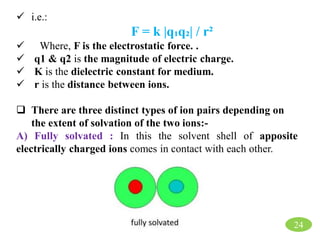
There are three distinct types of ion pairs depending on
the extent of solvation of the two ions:-
A) Fully solvated : In this the solvent shell of apposite
electrically charged ions comes in contact with each other.
26.
25
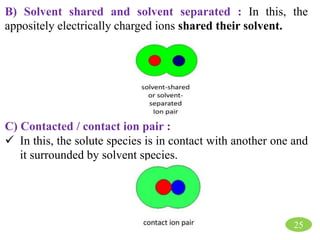
B) Solvent sharedand solvent separated : In this, the
appositely electrically charged ions shared their solvent.
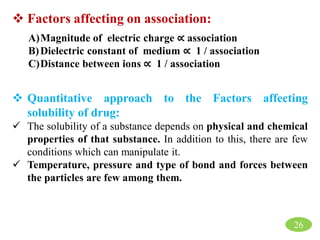
C) Contacted / contact ion pair :
In this, the solute species is in contact with another one and
it surrounded by solvent species.
27.
26
Factors affectingon association:
A)Magnitude of electric charge ∝ association
B)Dielectric constant of medium ∝ 1 / association
C)Distance between ions ∝ 1 / association
Quantitative approach to the Factors affecting
solubility of drug:
The solubility of a substance depends on physical and chemical
properties of that substance. In addition to this, there are few
conditions which can manipulate it.
Temperature, pressure and type of bond and forces between
the particles are few among them.
28.
27
1) Temperature:
Generally,increase in temperature increases solubility
of solids in solvent.
Although in many cases solubility increases with the
rise in temperature and decreases with the fall of
temperature, it is not necessary in all the cases.
It means there are exceptions that solubility decreases
with increase in temperature.
Case 1 :- Increase in solubility with temperature :-
If the solution process is endothermic (i.e. absorb
energy) then solubility will increased as the
temperature is increased.
Endothermic : Temperature ∝ solubility
29.
28
With theincrease temperature : solubility of KI,
NaNO3, KNO3 increases. Here the reaction is
endothermic.
Case 2 :- Decrease in solubility with temperature :-
If the solution process releases energy (i.e. exothermic)
then the solubility will decrease with the increasing with
the increase in temperature.
Exothermic : Temperature ∝ 1 / solubility
With the increase temperature : solubility of HCL, NH3,
SO2 decreases. Here the reaction is exothermic. (All gases
solubility decreases as the temperature of solution
increases)
30.
29
Nature ofsolvent: (Like dissolves like)
The solubility of solute depends on the nature of solute
and solvent.
The polarity of solute and the polarity of the solvent
affect the solubility.
For example:- polar solvents dissolve polar solutes and
non-polar solvents dissolve non-polar solutes.
The boiling point of liquid & melting point of solid:
We can correlate solubility with melting point and
boiling point.
Both reflects the strengths of interaction between the
molecules in the pure liquid or the solid state.
In general, the aqueous solubility decreases with
increasing boiling and melting point.
31.
30
Crystal properties:
Polymorphs have the same chemical structure but
different physical properties such as solubility, density,
hardness and compression characteristics.
A drug that exists as an amorphous form (non
crystalline form) generally dissolves more rapidly than
the some drug in crystalline form.
Note: Amorphous salt dissolve faster as compared to
crystalline salt.
Molecular Size:
Molecular size will affect the solubility.
The larger the numbers of molecule, higher its
molecular weight, the less soluble the substance.
32.
31
Larger moleculesare more difficult to surround with
solvent molecules in order to solvate the solution.
In case of organic compounds the amount of carbon
branching will increase the solubility.
Since, more branching will reduce the size (or volume)
of the molecule and make it easier to solvate the
molecule with solvent.
Example: n-butane and tertiary butyl structures.
Substituents in molecular structure:
Substituents can be classified either hydrophobic or
hydrophilic, depending on their polarity.
a) Polar groups such as –OH capable of H-bonding with
water molecule impart low solubility.
b) Non-polar group such as –CH3 & -Cl are hydrophobic
and impart low solubility.
33.
32
c) Ionizationof the substituents increases solubility.
Surface area of drug particles:
↑ Particle size → ↑ Surface Area → ↑ Solubility
But this is valid up to certain extent and beyond which,
in the very fine particle static force is developed and club
to form aggregation.
pH:
pH is one of the primary influence on the solubility of
most drug that contains ionizable groups.
Large number of drugs are weak acids and weak bases.
Solubility depend upon the degree of the saturation
(ionized/unionized).
Degree of ionization depends upon the pH (acid & base).
34.
33
Strong (acidic/ basic) drugs : ionized at all pH.
Weak (acidic / basic) drugs : ionized only at certain pH.
Most of the drugs are weak acids or weak bases.
Ionized drugs are not very lipid soluble, only non-
ionizable form of drug crosses membrane readily.
Weak acids become highly ionized as pH increases.
Weak bases become highly ionized as pH decreases.
Solute-solvent interaction:
Relation between solute-solvent interactions is very
important in determining solubility.
Strong solute-solvent interaction--- ↑ Solubility
Weak solute-solvent interaction--- ↓ Solubility
35.
34
Effect ofsurfactants (solubilizing agents):
Solubility of poor soluble drugs may be enhanced by a
technique known as micellar solubilisation, which
involve the use of surfactants for increasing the solubility.
When a surfactant having a hydrophilic (water loving)
and a lipophilic or hydrophobic (water hating) portion is
added to a liquid, it rearranges itself to form a spherical
aggregate known as micelle.
Effect of Pressure:
In case of solids and liquids solutes, there is no effect of
pressure on the solubility. But in case of gases
decreasing pressure will lead to decrease in solubility.
↓ Pressure ----------↓ Solubility
↑ Pressure ---------- ↑ Solubility
36.
Presence ofSalt ( Salting out ) :--
The liberation of dissolved gases from solution with
the addition of an electrolyte like Nacl or non
electrolyte such as sucrose is called Salting out.
Presence of salting out increases the solubility of
gases in liquid.
35
37.
36
DIFFUSION PRINCIPLEIN BIOLOGICAL SYSTEMS
Diffusion is defined as a process of mass transfer of
individual molecules of a substance caused by random
molecular motion and associated with a concentration
gradient.
The rate of diffusion depends on temperature, size of
the particles, and the size of the concentration
gradient.
Selectively permeable cell membrane creates two forms
of diffusion namely –
Osmosis for the diffusion of water
Dialysis for the diffusion of solutes
38.
37
1. Osmosis :-It is the passage of solvent across a membrane
which is semipermeable in nature.
2. Dialysis :- Separation process based on unequal rates of
passage of solutes and solvent through micro porous
membranes, carried out in batch or continuous mode.
The apparatus used is called dialyzer.
Diffusion is one principle method of movement of substances
within cells, as well as for essential small molecules to cross the
cell membrane.
Cell membranes act as barriers to most, but not at all,
molecules.
39.
38
Cell membranefunctions as a semi-permeable barrier,
allowing a very few molecules across it while holding
majority of chemicals inside cell.
Cell membrane is composed of phospholipids and proteins.
Transport of drug molecules through a non-porous membrane
occurs by diffusion.
Transport through porous cell membranes occurs by
diffusion and convection (the transfer of material from one
place to another due to the movement).
Rate of diffusion is expressed by equation:
dM/dt = DSK((C1 – C2) / h)
M= Amount of drug dissolved
t= Time
D= Diffusion coefficient of drug
S= Surface area of membrane
K=0il/water partition coefficient
h=Thickness of the liquid film
C1 = Conc. of drug at donor side of
Membrane.
C2 = Conc. of drug at receptor side
C1-C2 = Conc. gradient
40.
Water, carbondioxide, and oxygen are the few simple
molecules that can cross the cell membrane by diffusion.
Metabolic processes in animals and plants usually require
oxygen, which is in lower concentration inside the cell, have
the net flow of oxygen into the cell through diffusion.
DI FFUSION
39
41.
SOLUBILITY OFGAS IN LIQUIDS:
Concentration of dissolved gas in the liquid when it is in
equilibrium with the pure gas above the solution.
Example includes effervescent preparations containing
dissolved carbon dioxide, ammonia water and hydrochloride
gas.
Aerosol products containing nitrogen or carbon dioxide as
propellant.
Factors Affecting Solubility of Gas in Liquids :
The solubility of gas in liquids depends on pressure,
temperature, salt present, chemical reaction and micellar
solubilization.
40
42.
1. Pressure:
Liquidsand solids do not show any change of solubility
with changes in pressure.
But, solubility of gases in liquids, depends on the pressure
of the gas in contact with the liquid.
At higher gas pressure, more gas is dissolved in liquids.
The effect of pressure on the solubility of gas is given
Henry's law which states that in dilute solution the mass of
gas which dissolves in each volume of liquid solvent at
constant temperature is directly proportional to partial
pressure of gas.
2. Temperature:
As the temperature increases the solubility of most gases
decreases due increased tendency of gas to expand.
3. Salting out
41
43.
SOLUBILITY OFLIQUIDS IN LIQUIDS
Binary Solutions:
It is very common for two or more liquids to be mixed
together to make a solution. Therefore, we need to know
what liquids can be mixed together without precipitation.
Examples of pharmaceutical solutions of liquid dissolved in
liquids are hydro alcoholic solutions, aromatic waters,
spirits, elixirs, lotions, sprays and some medicated oils that
contain mixture of two or more miscible oils.
When two or more liquids mixed together they can be
completely miscible, partially miscible or practically
immiscible.
42
44.
Completely miscibleliquids mix uniformly in all
proportions and hence do not get separated.
Partially miscible liquids form two immiscible liquid layers,
each of which is saturated solution of one liquid in the
other. Such liquid pairs are called as conjugated liquid
pairs.
Immiscibility refers to those systems which do not mix
with each other at all such as water and liquid paraffin or
water and oil.
Ideal Solutions:
An ideal solution is one in which there is no change in the
properties of the components other than dilution when they
are mixed to form the solution.
In another way it can be stated as a solution which shows no
shrinkage or expansion (the action of becoming bigger) when
components are mixed to form solution.
43
45.
No heatis evolved or absorbed during the solution formation.
The final volume of real solution is an additive property of
the individual component.
Ideal solutions are formed by mixing different substances
having similar properties and therefore there is complete
uniformity of attractive intermolecular forces.
Solution that obeys Raoult's law is known as the ideal
solution and the solution that doesn't obey Raoult's law is
known as the non-ideal solution.
The solubility in this case depends on temperature, the
melting point of solute and the molar heat of fusion (∆Hf)
[the amount of heat required to melt a frozen solvent].
44
46.
Raoult’s law:
Raoult's law states that the partial vapor pressure of a
component of an ideal mixture is the vapor pressure of
the pure component multiplied by its mole fraction.
Mathematically, Raoult’s law equation is written as:
Psolution = Χsolvent P0
solvent
Where,
Psolution = Vapour pressure of the solution
Χsolvent = Mole fraction (Mole fraction is the
concentration of a component) of the solvent
P0solvent = Vapour pressure of the pure solvent
45
Limitations of Raoult'sLaw
Raoult's law work only for ideal solutions over entire range of
concentrations. An ideal solution obeys Raoult's law.
It is not applicable to electrolytic solutions.
Only very dilute solutions are applicable to Raoult's law.
Raoult's law assumes constant temperature and pressure. At high
pressures or varying temperatures, the law's applicability may be limited.
While applying this law to real solutions it has following limitations:
Raoult's law is applicable only for solutes which are non-volatile in
nature.
Raoult's law does not apply if the added solute associates or dissociates
in solvent.
If association takes place the number of particles or molecules decreases
causing reduction in lowering of vapour pressure.
47
49.
Real solutions:
Realsolutions show change in the total volume of the
solution upon mixing its different components together.
Also, there is absorption or evolution heat during
mixing and solution formation.
For example, at room temperature when 100 ml of
sulfuric acid is mixed with 100 ml of water. The total
volume of solution becomes 180 ml rather than 200 ml.
During mixing of acid and water considerable heat is
evolved causing reduction in total volume of the
solution.
48
50.
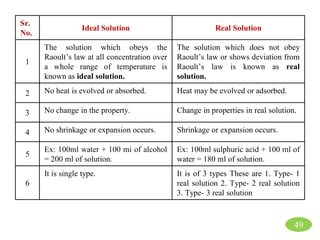
Sr.
No.
Ideal Solution RealSolution
1
The solution which obeys the
Raoult’s law at all concentration over
a whole range of temperature is
known as ideal solution.
The solution which does not obey
Raoult’s law or shows deviation from
Raoult’s law is known as real
solution.
2 No heat is evolved or absorbed. Heat may be evolved or adsorbed.
3 No change in the property. Change in properties in real solution.
4 No shrinkage or expansion occurs. Shrinkage or expansion occurs.
5
Ex: 100ml water + 100 mi of alcohol
= 200 ml of solution.
Ex: 100ml sulphuric acid + 100 ml of
water = 180 ml of solution.
6
It is single type. It is of 3 types These are 1. Type- 1
real solution 2. Type- 2 real solution
3. Type- 3 real solution
49
51.
Partially miscible liquids:
liquid/liquid systems are mainly divided into two categories
depending on the solubility of one substance in the other.
The categories are complete miscibility and partial
miscibility.
Miscibility is the common solubilities of the components in
liquid-liquid systems.
Partial miscibility is when the substances only mix partially.
When certain liquids are mixed, they might not be fully
miscible and instead form two distinct layers. This happens
when the liquids have limited solubility in each other, leading
to a separation into two phases.
A classic example is mixing phenol and water, where the two
liquids form two separate layers: one rich in phenol and the
other rich in water, but each layer still contains some of the
other liquid. 50
52.
Some liquidsare practically immiscible (For
example, Water and Mercury), while others (For
example, Water and Ethyl alcohol, Acetone) mix
with one another in all proportions.
The mutual solubility or miscibility of two liquids is a
function of temperature and composition.
When two liquids (liquid A and liquid B) are partially
soluble in each other, two liquid phases can be
observed. At equilibrium, each phase contains liquid A
& liquid B in amounts that reflect their mutual
solubility.
51
53.
CRITICAL SOLUTIONTEMPERATURE
The temperature at which two partially miscible
liquids become completely miscible is called critical
solution temperature.
A phase diagram is a plot describing conditions of
temperature and pressure under which two or more
physical states coexist in dynamic equilibrium.
It means phase diagram is a graphical representation
of chemical equilibrium.
This diagram is also called as Pressure- Temperature
graph.
52
54.
C.S.T isof 2 types :
1. Upper Consolute Temperature
2. Lower Consolute Temperature
1. Upper Consolute Temperature:
The temperature at or above which the component of 2 liquid
phase system behaves as like a single liquid phase system.
Ex: Phenol-Water System, .C.S.T --- 66.8 ℃.
2. Lower Consolute Temperature:
The minimum temperature lower which 2 liquid phase
completely miscible with each other and behaves like a single
phase .
Ex:- Triethylamine-water, C.S.T --- 18.5 ℃.
53
In phasediagram of water there are three lines or curves
that separate the area of each phase.
At any point on line there exist equilibrium between phases
shown by area i.e. solid/liquid, liquid/vapour and
solid/vapour.
The line OA, OB and 0C represents equilibrium between
liquid and vapour, solid and liquid; and, solid and vapour
phases, respectively.
55
57.
The twoliquids form two separate phases, an organic phase (phenol)
and an aqueous phase (water). The relative amounts of each phase
depend on the specific concentrations of phenol and water in the
system.
A typical phase diagram for the phenol-water system would include a
curve separating the two-phase region from the one-phase region,
called the "binodal" curve, and another curve separating the two-
phase region from the three-phase region called the "spinodal" curve.
The binodal curve represents the boundary where the two phases are in
equilibrium. The spinodal curve represents the boundary where the two
phases are unstable and can separate into three components.
The phase diagram can also be represented in a ternary diagram, a
graph with the system's three components (phenol, water, and the
liquid-liquid mixture) at the corners. The compositions of the liquid-
liquid mixture will be represented as a point between the phenol and
water corner on the ternary diagram.
Phenol-water system
56
Critical solutiontemperature allows the temperature limits for
some reactions to be determined if it requires that two liquids
are miscible.
It is used to determine the water content in substances such
as methyl and ethyl alcohols. Here the system is usually the
alcohol and a hydrocarbon, such as -hexane or dicyclohexyl.
The water is, insoluble in the hydrocarbon. Thus, the methyl
alcohol-cyclohexane system has a Critical solution
temperature 45 - 50 °C and even presence of 0.1 % water
produces a rise of 0-15 °C in the Critical solution temperature.
" Critical solution temperature may be taken as a criterion
for the purity of a substance.” If there are small amounts of
impurities present in CST values, the value will be impacted
very strongly. It is usually a linear relationship between CST
value and impurity concentration.
Applications of critical solution temperature
58
60.
DISTRIBUTION LAW
Statement:
The distribution of solute between 2 immiscible liquid phases at a constant
temperature is called as distribution Law or partition Co-efficient or distribution
Co-efficient or distribution ratio.
Derivation:
If a substance is distributed between 2 immiscible solvent 1 and 2 and if C1 and C2
are the equilibrium concentration of the substance in solvent 1 &2 the equilibrium
expression become,
𝐶1 /𝐶2 = 𝑘 = 𝑘𝐷
Where, K or KD = Distribution Co- efficient or Distribution ratio or Partition Co –
efficient.
Solvent-1- is organic layer
Solvent-2- is Aqueous layer
𝐶1 (Organic ) / 𝐶2 ( Aqueous ) = 𝑘𝐷
Solvent-1- aqueous layer,
Solvent-2- Organic layer
𝐶1 ( Aqueous ) / 𝐶2 ( Organic ) = 𝑘𝐷
59
61.
Limitations ofDistribution Law
The selected solvent liquid pair must immiscible with each
other.
The experimental temperature must be maintained
constant. As temperature has effect on solubility of solute, any
change in temperature during determinations may change the
findings.
The solute in question should be in same molecular state in
both the solvents. If any chemical change is observed the
concentration of species common to both solvents only should
be considered.
Solute must present in both the solvent at low
concentrations.
Samples should be withdrawn for analysis only after
achievement of equilibrium. Early equilibrium attainment can
be possible by vigorous shaking.
60
62.
Applications ofDistribution Law
Partition coefficient first finds applications in medicinal
chemistry and drug design.
It has proved useful in other related areas such as drug
absorption, bioavailability, toxicity, bioaccumulation and
metabolism.
Partition coefficient values are helpful in knowing the
hydrophobic drug receptor interactions.
Partition coefficient help to understand the mechanism of
preservative action of weak acids and determination of its
optimum concentration for the effectiveness of action.
From the partition coefficient general idea about the drugs
solubility in solvent can be judged.
It can be further useful in drugs solubility enhancement.
To study release of drug from gels, ointments and creams
partition coefficient is a very important consideration.
61