SUMIT SINGH
 General Packet Radio Service is a radio technology for
GSM networks that adds packet-switching protocols,
shorter set-up time for ISP connections, and offer the
possibility to charge by amount of data sent rather than
connect time.
 GPRS promises to support flexible data transmission
rates typically up to 20 or 30 Kbps (with a theoretical
maximum of 171.2 Kbps), as well as continuous
connection to the network.
 A 2.5G enhancement to GSM, GPRS is the most
significant step towards 3G, needing similar business
model, and service and network architectures.
 Inefficient use of the radio interface resources.
 The call establishment time is too long
 Download takes too long.
 Only text SMS is supported
 GSM is too expensive for serving in the Internet and
sometimes the user had to pay for a connection for which
he didn’t get any data at all (data losses).
 Efficient utilization of radio resources where in a
channel can be shared by multiple user.
 User pays for the volume of data transmitted.
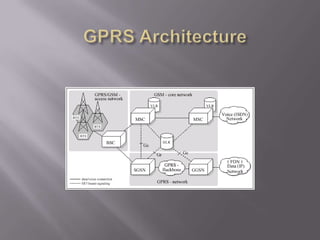
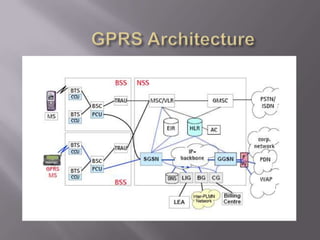
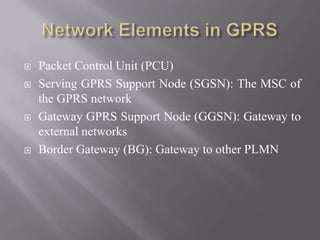
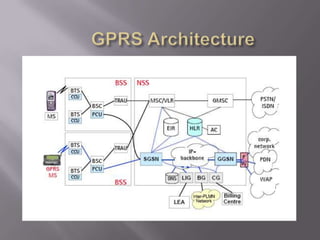
 Packet Control Unit (PCU)
 Serving GPRS Support Node (SGSN): The MSC of
the GPRS network
 Gateway GPRS Support Node (GGSN): Gateway to
external networks
 Border Gateway (BG): Gateway to other PLMN
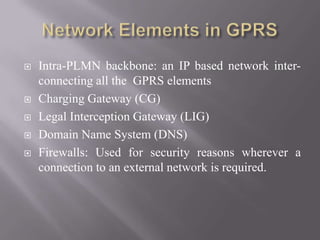
 Intra-PLMN backbone: an IP based network inter-
connecting all the GPRS elements
 Charging Gateway (CG)
 Legal Interception Gateway (LIG)
 Domain Name System (DNS)
 Firewalls: Used for security reasons wherever a
connection to an external network is required.
 IP stands for Internet Protocol.
 It specifies the format of packets, also called
datagrams, and the addressing scheme.
 IP by itself is something like the postal system. It
allows you to address a package and drop it in the
system, but there’s no direct link between you and
the recipient.
 IP when combined with a higher- level protocol
called Transport Control Protocol (TCP) enables to
establishes a virtual connection between a
destination and a source.
 The virtual connection so formed with the
combination of TCP and IP ( and hence TCP/IP),
enables the two hosts to send messages back and
forth for a period of time.
 Identifies host uniquely on a TCP/IP network.
 Consist of 32 bits arranged in 4 octets.
 Can be represented in decimal notation as A.B.C.D
where A,B,C,D can be any decimal number between
0 to 255.
 Overall 232 = 4295 million IP addresses
 IP address consist of two parts:
Network Id and Host Id
 Subnet Mask identifies the Net Id and Host Id.
 Internet Assigned Number Authority (IANA) assigns
IP Addresses to companies
 Public IP addresses are range of IP addresses
recognised by Internet for routing data traffic.
 Private IP addresses are range of IP addresses used
to create separate islands of network following same
IP schema.
 The pool of Private IP addresses are:
From 10.0.0.0 to 10.255.255.255
From 172.16.0.0 to 172.31.255.255
From 192.168.0.0 to 192.168.255.255
 Static IP Host configuration means that the IP
address remains with the host forever until manually
changed.
 Dynamic IP Host Configuration means same or
different IP address allocated to the host every time
it logs on to the network.
 DHCP stands for Dynamic Host Configuration
Protocol
 Dynamic IP Host Configuration is done with the
help of DHCP protocol and the server running this
service is called DHCP Server.
 Used to provide connectivity between different
host with in a same network.
 The same network means the Network Id of all
the host must be same.
 Used to provide connectivity between hosts which
are part of different network.
 Host belonging to different network are identified
by different Net Id.
 Once a packet is delivered to a host, the question
arises to which application process should the
transport layer deliver it.
 TCP and UDP provide an addressing method to
separate different application processes inside the IP
capable devices, and this is referred to as Port
Numbers.
 Each application running on the IP capable device is
allotted one port number.
 Port number runs from 0 to 65536.
 A socket is simply a combination of IP address and
Port number.
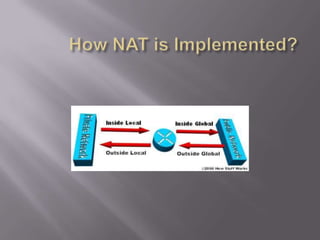
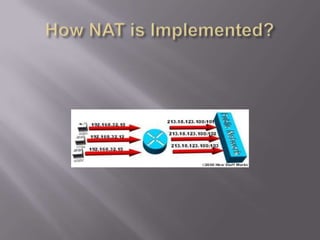
 NAT stands for Network Address Translation.
 It is a way of translating a range of IP addresses to
different range of IP address(es).
 Often used for saving public IP address and is
implemented in routers/ firewall connected to the
external network.
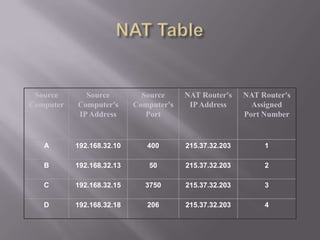
Source
Computer
Source
Computer's
IPAddress
Source
Computer's
Port
NAT Router's
IPAddress
NAT Router's
Assigned
Port Number
A 192.168.32.10 400 215.37.32.203 1
B 192.168.32.13 50 215.37.32.203 2
C 192.168.32.15 3750 215.37.32.203 3
D 192.168.32.18 206 215.37.32.203 4
 Domain name system is an application layer
protocol which is used to convert difficult to
remember 32 bit IP address to more easily
remembered symbolic names.
example
www.google.com <-> 64.233.161.104
 The DNS in GPRS network helps to find the correct
GGSN IP address based on the Access Point Name
(APN) supplied by the MS.
 A firewall is simply a program or hardware device
that filters the information coming through the
Internet connection into your private network or
computer system. If an incoming packet of
information is flagged by the filters, it is not
allowed through.
 Firewalls use one or more of three methods to
control traffic flowing in and out of the network:
- Packet filtering
- Proxy service
 Packets (small chunks of data) are analysed against
a set of filters.
 Packets that make it through the filters are sent to
the requesting system and all others are discarded.
 Information from the Internet is retrieved by the
firewall and then sent to the requesting system and
vice versa.
IP fundamentals
IP fundamentals

IP fundamentals

  • 1.
  • 2.
     General PacketRadio Service is a radio technology for GSM networks that adds packet-switching protocols, shorter set-up time for ISP connections, and offer the possibility to charge by amount of data sent rather than connect time.  GPRS promises to support flexible data transmission rates typically up to 20 or 30 Kbps (with a theoretical maximum of 171.2 Kbps), as well as continuous connection to the network.  A 2.5G enhancement to GSM, GPRS is the most significant step towards 3G, needing similar business model, and service and network architectures.
  • 3.
     Inefficient useof the radio interface resources.  The call establishment time is too long  Download takes too long.  Only text SMS is supported  GSM is too expensive for serving in the Internet and sometimes the user had to pay for a connection for which he didn’t get any data at all (data losses).
  • 4.
     Efficient utilizationof radio resources where in a channel can be shared by multiple user.  User pays for the volume of data transmitted.
  • 7.
     Packet ControlUnit (PCU)  Serving GPRS Support Node (SGSN): The MSC of the GPRS network  Gateway GPRS Support Node (GGSN): Gateway to external networks  Border Gateway (BG): Gateway to other PLMN
  • 8.
     Intra-PLMN backbone:an IP based network inter- connecting all the GPRS elements  Charging Gateway (CG)  Legal Interception Gateway (LIG)  Domain Name System (DNS)  Firewalls: Used for security reasons wherever a connection to an external network is required.
  • 10.
     IP standsfor Internet Protocol.  It specifies the format of packets, also called datagrams, and the addressing scheme.  IP by itself is something like the postal system. It allows you to address a package and drop it in the system, but there’s no direct link between you and the recipient.
  • 11.
     IP whencombined with a higher- level protocol called Transport Control Protocol (TCP) enables to establishes a virtual connection between a destination and a source.  The virtual connection so formed with the combination of TCP and IP ( and hence TCP/IP), enables the two hosts to send messages back and forth for a period of time.
  • 12.
     Identifies hostuniquely on a TCP/IP network.  Consist of 32 bits arranged in 4 octets.  Can be represented in decimal notation as A.B.C.D where A,B,C,D can be any decimal number between 0 to 255.  Overall 232 = 4295 million IP addresses  IP address consist of two parts: Network Id and Host Id  Subnet Mask identifies the Net Id and Host Id.  Internet Assigned Number Authority (IANA) assigns IP Addresses to companies
  • 13.
     Public IPaddresses are range of IP addresses recognised by Internet for routing data traffic.  Private IP addresses are range of IP addresses used to create separate islands of network following same IP schema.  The pool of Private IP addresses are: From 10.0.0.0 to 10.255.255.255 From 172.16.0.0 to 172.31.255.255 From 192.168.0.0 to 192.168.255.255
  • 14.
     Static IPHost configuration means that the IP address remains with the host forever until manually changed.  Dynamic IP Host Configuration means same or different IP address allocated to the host every time it logs on to the network.
  • 15.
     DHCP standsfor Dynamic Host Configuration Protocol  Dynamic IP Host Configuration is done with the help of DHCP protocol and the server running this service is called DHCP Server.
  • 16.
     Used toprovide connectivity between different host with in a same network.  The same network means the Network Id of all the host must be same.
  • 17.
     Used toprovide connectivity between hosts which are part of different network.  Host belonging to different network are identified by different Net Id.
  • 18.
     Once apacket is delivered to a host, the question arises to which application process should the transport layer deliver it.  TCP and UDP provide an addressing method to separate different application processes inside the IP capable devices, and this is referred to as Port Numbers.  Each application running on the IP capable device is allotted one port number.  Port number runs from 0 to 65536.
  • 19.
     A socketis simply a combination of IP address and Port number.
  • 20.
     NAT standsfor Network Address Translation.  It is a way of translating a range of IP addresses to different range of IP address(es).  Often used for saving public IP address and is implemented in routers/ firewall connected to the external network.
  • 23.
    Source Computer Source Computer's IPAddress Source Computer's Port NAT Router's IPAddress NAT Router's Assigned PortNumber A 192.168.32.10 400 215.37.32.203 1 B 192.168.32.13 50 215.37.32.203 2 C 192.168.32.15 3750 215.37.32.203 3 D 192.168.32.18 206 215.37.32.203 4
  • 24.
     Domain namesystem is an application layer protocol which is used to convert difficult to remember 32 bit IP address to more easily remembered symbolic names. example www.google.com <-> 64.233.161.104  The DNS in GPRS network helps to find the correct GGSN IP address based on the Access Point Name (APN) supplied by the MS.
  • 25.
     A firewallis simply a program or hardware device that filters the information coming through the Internet connection into your private network or computer system. If an incoming packet of information is flagged by the filters, it is not allowed through.  Firewalls use one or more of three methods to control traffic flowing in and out of the network: - Packet filtering - Proxy service
  • 26.
     Packets (smallchunks of data) are analysed against a set of filters.  Packets that make it through the filters are sent to the requesting system and all others are discarded.
  • 27.
     Information fromthe Internet is retrieved by the firewall and then sent to the requesting system and vice versa.