Reserved IP Addresses
Nangarhar University
Faculty Of Computer Science
Networking and Communication Dept.
Spring- 2014
Reserved IP Addresses
• Certain IP addresses are reserved and cannot
be assigned to individual devices on a
network.
• These reserved addresses include a network
address, which is used to identify the network
itself, and a broadcast address, which is used
for broadcasting packets to all of the devices
on a network
Reserved IP Addresses
• This topic describes the types of reserved IP
addresses and provides examples of each.
Reserved IP Addresses
Network Address
• An IP address that has binary 0s in all host bit
positions is reserved for the network address
• Therefore, as a Class A network example,
10.0.0.0 is the IP address of the network
containing the host 10.1.2.3
Network Address
• As a Class B network example, the IP address
172.16.0.0 is a network address, while
192.16.1.0 would be a Class C network.
• A router uses the network IP address when it
searches its IP route table for the destination
network location.
• A broadcast address is a special Internet
Protocol (IP) address used to transmit
messages and data packets to network
systems. Network administrators (NA) verify
successful data packet transmission via
broadcast addresses.
Directed Broadcast Address
• To send data to all the devices on a network, a
broadcast address is used. Broadcast IP addresses
end with binary 1s in the entire host part of the
address (the host field).
• For the network in the example (172.16.0.0), in
which the last 16 bits make up the host field (or
host part of the address), the broadcast that
would be sent out to all devices on that network
would include a destination address of
172.16.255.255.
• The directed broadcast is capable of being
routed. However, for some versions of the
Cisco IOS operating system, routing directed
broadcasts is not the default behavior.
Local Broadcast Address
• If an IP device wants to communicate with all
devices on the local network, it sets the
destination address to all 1s
(255.255.255.255) and transmits the packet
• For example, hosts that do not know their
network number and are asking some server
for it may use this address. The local broadcast
is never routed.
• In computer networking, the broadcast
address is used to distribute a signal across a
network, commonly used to declare to other
devices on a network that a new device has
connected to the network and to give those
other devices information about the newly
connected device. The broadcast address on a
network is commonly an address that ends
with 255.
• The limited broadcast address is the address
formed by setting all 32 bits of the IP address
to 1 (255.255.255.255). The limited broadcast
address is used when an IP node must
perform a one-to-everyone delivery on the
local network but the network ID is unknown.
Local Loopback Address
• A local loopback address is used to let the
system send a message to itself for testing. A
typical local loopback IP address is 127.0.0.1.
Auto configuration IP Addresses
• When neither a statically nor a dynamically
configured IP address is found on startup,
those hosts supporting IPv4 link-local
addresses (RFC 3927) will generate an address
in the 169.254/16 prefix range.
Network ID
• The network portion of an IP address is also
referred to as the network ID, which is important
because most hosts on a network can directly
communicate only with devices in the same
network
• If the hosts need to communicate with devices
that have interfaces assigned to some other
network ID, there must be a network device that
can route data between the networks.
• This is true even when the devices share the
same physical media segment.
Network ID
• A network ID enables a router to put a packet
onto the appropriate network segment.
Host ID
• Each class of a network allows a fixed number
of hosts In a Class A network, the first octet is
assigned to the network, leaving the last three
octets to be assigned to hosts.
• The first host address in each network (all 0s)
is reserved for the actual network address,
and the final host address in each network (all
1s) is reserved for broadcasts.
Host ID
• The maximum number of hosts in a Class A
network is 2 to the power of 24 and
(subtracting the network and broadcast
reserved addresses means minus 2), or
16,777,214.
Conti…
• In a Class B network, the first two octets are
assigned to the network, leaving the final two
octets to be assigned to hosts
• The maximum number of hosts in a Class B
network is 2 to the power of 16 minus 2 or
65,534.
• In a Class C network, the first three octets are
assigned to the network. This leaves the final
octet to be assigned to hosts, so the maximum
number of hosts is
• 2 to the power of 8 minus 2 or 254
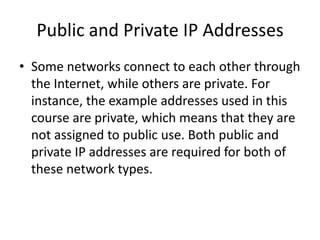
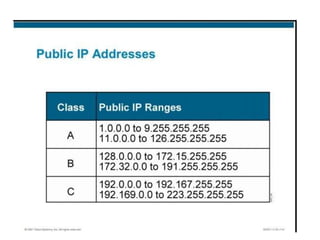
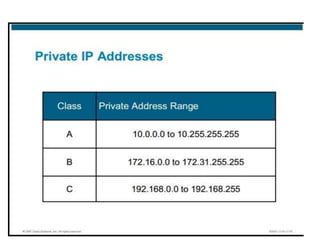
Public and Private IP Addresses
• Some networks connect to each other through
the Internet, while others are private. For
instance, the example addresses used in this
course are private, which means that they are
not assigned to public use. Both public and
private IP addresses are required for both of
these network types.
Pub
IP
Address
Class
Total # Of
Bits For
Network
ID / Host
ID
First
Octet of
IP
Address
# Of
Network
ID Bits
Used To
Identify
Class
Usable #
Of
Network
ID Bits
Number
of
Possible
Network
IDs
# Of Host
IDs Per
Network
ID
Class A 8 / 24 0xxx xxxx 1 8-1 = 7 27-2 = 126
224-2 =
16,277,21
4
Class B 16 / 16 10xx xxxx 2 16-2 = 14
214 =
16,384
216-2 =
65,534
Class C 24 / 8 110x xxxx 3 24-3 = 21
221 =
2,097,152
28-2 = 254
Class A network
• The network ID is not allowed to have all its
bits set to 0 or all bits set to 1. The 127
network ID is excluded from this address class.
Class B, C Network
• Unlike Class A networks, all network IDs in this
range are available for use.
• Like with Class B networks, all the network IDs
are available for use on networks. This is the
last of the network classes that will be used
for network devices on a TCP/IP network.
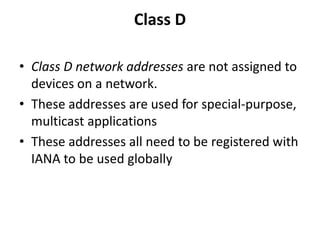
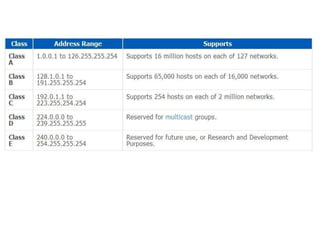
Class D
• Class D network addresses are not assigned to
devices on a network.
• These addresses are used for special-purpose,
multicast applications
• These addresses all need to be registered with
IANA to be used globally
Class D
• Addresses in this class have the first bits of
the first octet set to 1110, yielding addresses
in the first octet ranging from 11100000 to
11101111, or 224 to 239.
Class E
• If Class D is special, Class E addresses are even
more special. There is no defined use for this
address class. Officially, it is listed as reserved
for usage and testing by IANA
• Class E was updated to “reserved for future
use.”
Reserved ip addresses

Reserved ip addresses

  • 1.
    Reserved IP Addresses NangarharUniversity Faculty Of Computer Science Networking and Communication Dept. Spring- 2014
  • 2.
    Reserved IP Addresses •Certain IP addresses are reserved and cannot be assigned to individual devices on a network. • These reserved addresses include a network address, which is used to identify the network itself, and a broadcast address, which is used for broadcasting packets to all of the devices on a network
  • 3.
    Reserved IP Addresses •This topic describes the types of reserved IP addresses and provides examples of each.
  • 4.
  • 5.
    Network Address • AnIP address that has binary 0s in all host bit positions is reserved for the network address • Therefore, as a Class A network example, 10.0.0.0 is the IP address of the network containing the host 10.1.2.3
  • 6.
    Network Address • Asa Class B network example, the IP address 172.16.0.0 is a network address, while 192.16.1.0 would be a Class C network. • A router uses the network IP address when it searches its IP route table for the destination network location.
  • 7.
    • A broadcastaddress is a special Internet Protocol (IP) address used to transmit messages and data packets to network systems. Network administrators (NA) verify successful data packet transmission via broadcast addresses.
  • 8.
    Directed Broadcast Address •To send data to all the devices on a network, a broadcast address is used. Broadcast IP addresses end with binary 1s in the entire host part of the address (the host field). • For the network in the example (172.16.0.0), in which the last 16 bits make up the host field (or host part of the address), the broadcast that would be sent out to all devices on that network would include a destination address of 172.16.255.255.
  • 9.
    • The directedbroadcast is capable of being routed. However, for some versions of the Cisco IOS operating system, routing directed broadcasts is not the default behavior.
  • 10.
    Local Broadcast Address •If an IP device wants to communicate with all devices on the local network, it sets the destination address to all 1s (255.255.255.255) and transmits the packet • For example, hosts that do not know their network number and are asking some server for it may use this address. The local broadcast is never routed.
  • 11.
    • In computernetworking, the broadcast address is used to distribute a signal across a network, commonly used to declare to other devices on a network that a new device has connected to the network and to give those other devices information about the newly connected device. The broadcast address on a network is commonly an address that ends with 255.
  • 12.
    • The limitedbroadcast address is the address formed by setting all 32 bits of the IP address to 1 (255.255.255.255). The limited broadcast address is used when an IP node must perform a one-to-everyone delivery on the local network but the network ID is unknown.
  • 13.
    Local Loopback Address •A local loopback address is used to let the system send a message to itself for testing. A typical local loopback IP address is 127.0.0.1.
  • 14.
    Auto configuration IPAddresses • When neither a statically nor a dynamically configured IP address is found on startup, those hosts supporting IPv4 link-local addresses (RFC 3927) will generate an address in the 169.254/16 prefix range.
  • 15.
    Network ID • Thenetwork portion of an IP address is also referred to as the network ID, which is important because most hosts on a network can directly communicate only with devices in the same network • If the hosts need to communicate with devices that have interfaces assigned to some other network ID, there must be a network device that can route data between the networks. • This is true even when the devices share the same physical media segment.
  • 16.
    Network ID • Anetwork ID enables a router to put a packet onto the appropriate network segment.
  • 17.
    Host ID • Eachclass of a network allows a fixed number of hosts In a Class A network, the first octet is assigned to the network, leaving the last three octets to be assigned to hosts. • The first host address in each network (all 0s) is reserved for the actual network address, and the final host address in each network (all 1s) is reserved for broadcasts.
  • 18.
    Host ID • Themaximum number of hosts in a Class A network is 2 to the power of 24 and (subtracting the network and broadcast reserved addresses means minus 2), or 16,777,214.
  • 19.
    Conti… • In aClass B network, the first two octets are assigned to the network, leaving the final two octets to be assigned to hosts • The maximum number of hosts in a Class B network is 2 to the power of 16 minus 2 or 65,534.
  • 20.
    • In aClass C network, the first three octets are assigned to the network. This leaves the final octet to be assigned to hosts, so the maximum number of hosts is • 2 to the power of 8 minus 2 or 254
  • 21.
    Public and PrivateIP Addresses • Some networks connect to each other through the Internet, while others are private. For instance, the example addresses used in this course are private, which means that they are not assigned to public use. Both public and private IP addresses are required for both of these network types.
  • 23.
  • 24.
    IP Address Class Total # Of BitsFor Network ID / Host ID First Octet of IP Address # Of Network ID Bits Used To Identify Class Usable # Of Network ID Bits Number of Possible Network IDs # Of Host IDs Per Network ID Class A 8 / 24 0xxx xxxx 1 8-1 = 7 27-2 = 126 224-2 = 16,277,21 4 Class B 16 / 16 10xx xxxx 2 16-2 = 14 214 = 16,384 216-2 = 65,534 Class C 24 / 8 110x xxxx 3 24-3 = 21 221 = 2,097,152 28-2 = 254
  • 25.
    Class A network •The network ID is not allowed to have all its bits set to 0 or all bits set to 1. The 127 network ID is excluded from this address class.
  • 26.
    Class B, CNetwork • Unlike Class A networks, all network IDs in this range are available for use. • Like with Class B networks, all the network IDs are available for use on networks. This is the last of the network classes that will be used for network devices on a TCP/IP network.
  • 27.
    Class D • ClassD network addresses are not assigned to devices on a network. • These addresses are used for special-purpose, multicast applications • These addresses all need to be registered with IANA to be used globally
  • 28.
    Class D • Addressesin this class have the first bits of the first octet set to 1110, yielding addresses in the first octet ranging from 11100000 to 11101111, or 224 to 239.
  • 29.
    Class E • IfClass D is special, Class E addresses are even more special. There is no defined use for this address class. Officially, it is listed as reserved for usage and testing by IANA • Class E was updated to “reserved for future use.”