PRESENTED BY:-
Nishant Goel
B.TECH (cs)
1
MANAGING A CISCO NETWORK
WHAT IS CCNA?
• CCNA is an entry-level certification for the
Cisco certified professional program.
• It validates the ability to install, configure,
operate and troubleshoot switched and
routed networks.
• Its curriculum includes IP, RIP, EIGRP, OSPF,
VLAN, Frame Relay and ACL.
2
INTERNETWORKING
• It is the practice of connecting hosts of two different
network via gateways.
• Two or more connected LANs that can pass data and
share resources.
3
NETWORK
It is the practice of linking two or more computing
devices for the purpose of sharing data.
NETWORK DEVICES
4
Connect
dissimilar LANs on
the same
protocol
Connect similarLANs withdissimilarmedia
Connect a no.
of ethernet
cables from
various
devices
together
Forward data between
two parts of a network
IP ADDRESSING
5
Two types --
IPv4
IPv6
CLASSES
• Class A 1 - 126 126 16 million
(N.H.H.H)
• Class B 128 – 191 16,344 6500
(N.N.H.H)
• Class C 192 – 223 2,097,152 254
(N.N.N.H)
• Class D 224 - 239 Reserved for multicast groups.
• Class E 240 - 254 Reserved for future use, or Research
and Development Purposes.
6
CLASSES RANGE NO. OF NETWORKS NO. OF HOSTS
Types of IP address
7
Public Private
Range of private IP address:-
Class A --- 10.0.0.0 – 10.255.255.255
Class B --- 172.16.0.0 – 172.31.255.255
Class C --- 192.168.0.0 – 192.168.255.255
SUBNETTING
• SUBNET MASK:-
No. of bits of host and network
8
Analogy
• It is the same as taking a barrel of 100
apples and dividing it into 10 barrels of 10
apples each.
9
10
10
10
1010
10
10
10
10
10
10 barrels x 10 apples = 100 apples
100 Apples (10 * 10)
Cont…
• Borrow host bit for subnetting
• Subnet only network ID.
• Increases the no. of network from one IP address
10
CLASSLESS
(VLSM)CLASSFULL
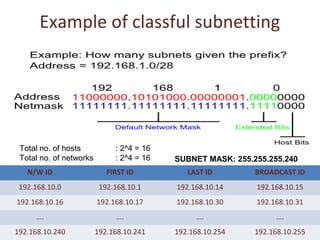
Example of classful subnetting
11
Total no. of hosts : 2^4 = 16
Total no. of networks : 2^4 = 16 SUBNET MASK: 255.255.255.240
N/W ID FIRST ID LAST ID BROADCAST ID
192.168.10.0 192.168.10.1 192.168.10.14 192.168.10.15
192.168.10.16 192.168.10.17 192.168.10.30 192.168.10.31
…. …. …. ….
192.168.10.240 192.168.10.241 192.168.10.254 192.168.10.255
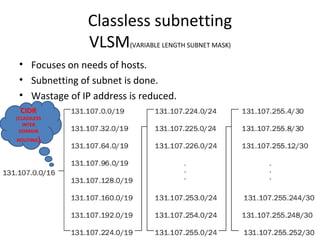
Classless subnetting
VLSM(VARIABLE LENGTH SUBNET MASK)
• Focuses on needs of hosts.
• Subnetting of subnet is done.
• Wastage of IP address is reduced.
12
CIDR
(CLASSLESS
INTER
DOMAIN
ROUTING)
Subnet Example
13
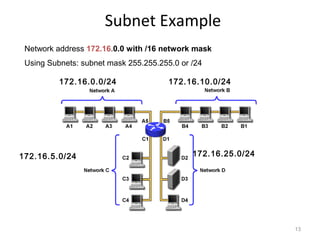
Network address 172.16.0.0 with /16 network mask
Using Subnets: subnet mask 255.255.255.0 or /24
172.16.0.0/24 172.16.10.0/24
172.16.5.0/24 172.16.25.0/24
ROUTING
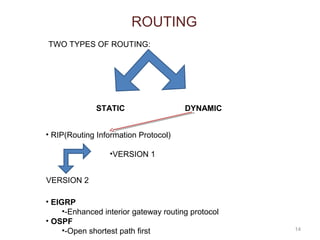
TWO TYPES OF ROUTING:
VERSION 2
• RIP(Routing Information Protocol)
•VERSION 1
• EIGRP
•-Enhanced interior gateway routing protocol
• OSPF
•-Open shortest path first
STATIC DYNAMIC
14
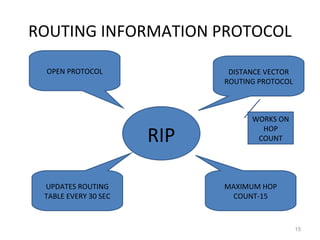
ROUTING INFORMATION PROTOCOL
15
RIP
OPEN PROTOCOL DISTANCE VECTOR
ROUTING PROTOCOL
UPDATES ROUTING
TABLE EVERY 30 SEC
MAXIMUM HOP
COUNT-15
WORKS ON
HOP
COUNT
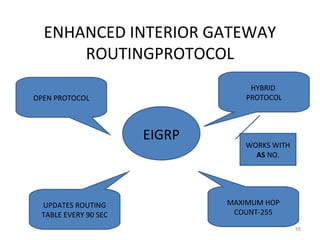
ENHANCED INTERIOR GATEWAY
ROUTINGPROTOCOL
16
EIGRP
OPEN PROTOCOL
HYBRID
PROTOCOL
UPDATES ROUTING
TABLE EVERY 90 SEC
MAXIMUM HOP
COUNT-255
WORKS WITH
AS NO.
OPEN SHORTEST PATH FIRST
17
OSPF
OPEN PROTOCOL WORKS WITH AREA
UPDATES ROUTING TABLE
WHEN NETWORK
CHANGES MAXIMUM HOP
COUNT-UNLIMITED
BACKBONE
AREA-0
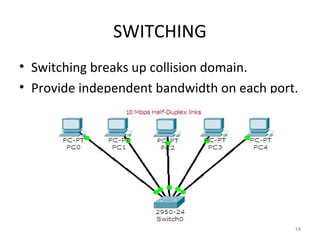
SWITCHING
• Switching breaks up collision domain.
• Provide independent bandwidth on each port.
18
VLAN
• A single switch is break up in multiple VLAN’s.
• By default, VLAN 1 is created.
• It greatly enhance network security.
• It increases the number of broadcast domain
while decreasing their size.
– Show switching packet tracer
19
INTERVLAN
• Used to communicate between different
VLANs in same switch with different network
• Router is used with a trunk port for
communication between network
• Router has an interface in each VLAN.
– Show pkt
20
STP
• Its main task is to stop network loops from
occuring on layer 2 network(bridges and
switches)
• It finds all the links and make sure that no
loops occur
• Reduce redundancy
21
22
With the
lowest
priority or
MAC
address
Forwarding port
Blocked port
23

CCNA SUMMER TRAINNING PPT

  • 1.
    PRESENTED BY:- Nishant Goel B.TECH(cs) 1 MANAGING A CISCO NETWORK
  • 2.
    WHAT IS CCNA? •CCNA is an entry-level certification for the Cisco certified professional program. • It validates the ability to install, configure, operate and troubleshoot switched and routed networks. • Its curriculum includes IP, RIP, EIGRP, OSPF, VLAN, Frame Relay and ACL. 2
  • 3.
    INTERNETWORKING • It isthe practice of connecting hosts of two different network via gateways. • Two or more connected LANs that can pass data and share resources. 3 NETWORK It is the practice of linking two or more computing devices for the purpose of sharing data.
  • 4.
    NETWORK DEVICES 4 Connect dissimilar LANson the same protocol Connect similarLANs withdissimilarmedia Connect a no. of ethernet cables from various devices together Forward data between two parts of a network
  • 5.
  • 6.
    CLASSES • Class A1 - 126 126 16 million (N.H.H.H) • Class B 128 – 191 16,344 6500 (N.N.H.H) • Class C 192 – 223 2,097,152 254 (N.N.N.H) • Class D 224 - 239 Reserved for multicast groups. • Class E 240 - 254 Reserved for future use, or Research and Development Purposes. 6 CLASSES RANGE NO. OF NETWORKS NO. OF HOSTS
  • 7.
    Types of IPaddress 7 Public Private Range of private IP address:- Class A --- 10.0.0.0 – 10.255.255.255 Class B --- 172.16.0.0 – 172.31.255.255 Class C --- 192.168.0.0 – 192.168.255.255
  • 8.
    SUBNETTING • SUBNET MASK:- No.of bits of host and network 8
  • 9.
    Analogy • It isthe same as taking a barrel of 100 apples and dividing it into 10 barrels of 10 apples each. 9 10 10 10 1010 10 10 10 10 10 10 barrels x 10 apples = 100 apples 100 Apples (10 * 10)
  • 10.
    Cont… • Borrow hostbit for subnetting • Subnet only network ID. • Increases the no. of network from one IP address 10 CLASSLESS (VLSM)CLASSFULL
  • 11.
    Example of classfulsubnetting 11 Total no. of hosts : 2^4 = 16 Total no. of networks : 2^4 = 16 SUBNET MASK: 255.255.255.240 N/W ID FIRST ID LAST ID BROADCAST ID 192.168.10.0 192.168.10.1 192.168.10.14 192.168.10.15 192.168.10.16 192.168.10.17 192.168.10.30 192.168.10.31 …. …. …. …. 192.168.10.240 192.168.10.241 192.168.10.254 192.168.10.255
  • 12.
    Classless subnetting VLSM(VARIABLE LENGTHSUBNET MASK) • Focuses on needs of hosts. • Subnetting of subnet is done. • Wastage of IP address is reduced. 12 CIDR (CLASSLESS INTER DOMAIN ROUTING)
  • 13.
    Subnet Example 13 Network address172.16.0.0 with /16 network mask Using Subnets: subnet mask 255.255.255.0 or /24 172.16.0.0/24 172.16.10.0/24 172.16.5.0/24 172.16.25.0/24
  • 14.
    ROUTING TWO TYPES OFROUTING: VERSION 2 • RIP(Routing Information Protocol) •VERSION 1 • EIGRP •-Enhanced interior gateway routing protocol • OSPF •-Open shortest path first STATIC DYNAMIC 14
  • 15.
    ROUTING INFORMATION PROTOCOL 15 RIP OPENPROTOCOL DISTANCE VECTOR ROUTING PROTOCOL UPDATES ROUTING TABLE EVERY 30 SEC MAXIMUM HOP COUNT-15 WORKS ON HOP COUNT
  • 16.
    ENHANCED INTERIOR GATEWAY ROUTINGPROTOCOL 16 EIGRP OPENPROTOCOL HYBRID PROTOCOL UPDATES ROUTING TABLE EVERY 90 SEC MAXIMUM HOP COUNT-255 WORKS WITH AS NO.
  • 17.
    OPEN SHORTEST PATHFIRST 17 OSPF OPEN PROTOCOL WORKS WITH AREA UPDATES ROUTING TABLE WHEN NETWORK CHANGES MAXIMUM HOP COUNT-UNLIMITED BACKBONE AREA-0
  • 18.
    SWITCHING • Switching breaksup collision domain. • Provide independent bandwidth on each port. 18
  • 19.
    VLAN • A singleswitch is break up in multiple VLAN’s. • By default, VLAN 1 is created. • It greatly enhance network security. • It increases the number of broadcast domain while decreasing their size. – Show switching packet tracer 19
  • 20.
    INTERVLAN • Used tocommunicate between different VLANs in same switch with different network • Router is used with a trunk port for communication between network • Router has an interface in each VLAN. – Show pkt 20
  • 21.
    STP • Its maintask is to stop network loops from occuring on layer 2 network(bridges and switches) • It finds all the links and make sure that no loops occur • Reduce redundancy 21
  • 22.
  • 23.