INTERNET OF THINGS
(IOT) FORENSICS
CHALLENGES & TOOLS
Muhammad Awais
FURC-S21-MSCS-003
IOT
The Internet of Things (IoT) integrates various sensors,
objects and smart nodes that are capable of communicating
with each other without human intervention [1]
i) Wearable devices like smart watches, glasses or health
monitoring systems.
ii)smart home appliances like smart locks, sensors for
temperature, gas or ambient light.
iii) smart vehicles, drones and applications for industrial
automation and logistics.
The worldwide IoT market: $1.7 trillion in 2020
IOT Forensics
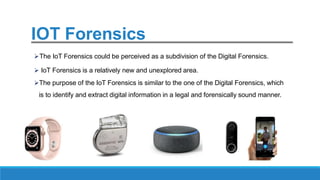
The IoT Forensics could be perceived as a subdivision of the Digital Forensics.
 IoT Forensics is a relatively new and unexplored area.
The purpose of the IoT Forensics is similar to the one of the Digital Forensics, which
is to identify and extract digital information in a legal and forensically sound manner.
The need of IOT forensics
Extensive attack surface
Despite all the benefits and the wide prospects of IOT, some IOT technologies are particularly
vulnerable to cyber-attacks.
IoT devices with public interfaces are exposed to greater risk levels because they could bring a
malware to the private network from a less secure public space [2].
New cyber-physical security threats
Using IoT technology, virtual crimes could step across the limit of cyberspace and threaten
human life.
Contains Digital traces
IoT devices which is able prove or disprove certain hypothesis, and could, help the forensics
professionals find answers and reconstruct the crime scene [3].
Challenges
in IoT
Forensics The IoT Forensics field is encountering an array of
challenges, none of which has a simple solution.
General Issues.
Evidence Identification, Collection and Preservation
issues.
Evidence Analysis and Correlation.
Evidence Presentation
General Issues
Lack of a methodology and framework for IoT forensics.
There is a lack of appropriate tools for IoT forensics.
Impact
 Could contaminate or destroy evidence.
Absence of common forensic model could jeopardize the trust and agreements in cross
jurisdictional investigations.
Evidence Identification, Collection
and Preservation issues
Detecting the presence of IoT systems, and identification of IoT devices that can provide
evidence in an investigation.
Lack of training for first responders.
Wide range of software and/or hardware specifications.
Lifespan limitations
Evidence Identification, Collection
and Preservation issues
Impact
Data could be easily overwritten.
The responding officers often neglect or shut down the system directly, without first
creating the necessary forensic image.
Evidence Analysis and Correlation
Overwhelming amount of data that an IoT system might produce.
Time Lining and Limited Correlation of Evidence.
Metadata – vast majority of IOT devices do not store any metadata.
Impact
The amount can be overwhelming for an investigator and the tools used.
Creating a time-line can be challenging.
Evidence Analysis and Correlation
Evidence Presentation
Jury most probably has only basic understanding of cloud computing and forensics.
It would be a challenging task to explain to them the technicalities behind such a complex
architecture in the very limited time of the trial.
Will the court accept the methodology and tools used since they are not yet standardized.
Impact
if an investigative body chooses unsuitable methods for acquisition it can harm the
data integrity and can easily be challenged in Court due to omissions in the way of
collection.
Presentation
IOT
FORENSICS
METHODS
AND TOOLS
There are very few tools designed specifically for IOT
forensics
There is no unique methodology to investigate in a
IOT environment
None of the approaches has been widely accepted by
the forensics community.
Most of the approaches are still of theoretical nature.
Perform standard data acquisition
Various proven techniques and procedures for Digital forensics are still applicable to IoT
devices.
if an IoT device can be connected to a computer, the internal storage of the device can be
forensically imaged.
Various Digital forensic tools are available to perform standard data acquisitions
e.g.:
 FTK Imager (Free Tool)
 X-ways forensics (Paid Tool)
 ENCASE (Paid Tool)
Limitations
In IoT forensics, where traditional investigative techniques & tools have a very low
success rate.
Useless against Proprietary echo systems e.g.: apple, amazon.
Occasionally, formats of the collected data are invalid or vendor specific.
Perform standard data acquisition
Interface testing
Most IoT devices have web interfaces.
Can get general knowledge of how the system works
By testing the interface investigators can validate whether the relevant digital evidence is
present and its condition.
Investigators can identify any indicators of compromise.
Limitations
Can lead to accidental contamination of evidence.
Oxygen Forensic Detective
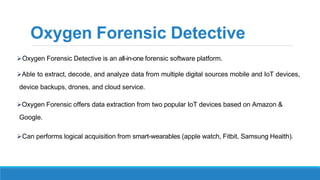
Oxygen Forensic Detective is an all-in-one forensic software platform.
Able to extract, decode, and analyze data from multiple digital sources mobile and IoT devices,
device backups, drones, and cloud service.
Oxygen Forensic offers data extraction from two popular IoT devices based on Amazon &
Google.
Can performs logical acquisition from smart-wearables (apple watch, Fitbit, Samsung Health).
Limitations
Its support for range of devices is limited.
It uses a brute force technique which can take a lot of time to complete the process.
Oxygen Forensic suite is very expensive.
Oxygen Forensic Detective
Elcomsoft iOS Forensic Toolkit
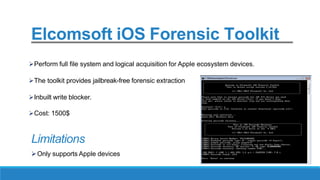
Perform full file system and logical acquisition for Apple ecosystem devices.
The toolkit provides jailbreak-free forensic extraction
Inbuilt write blocker.
Cost: 1500$
Limitations
Only supports Apple devices
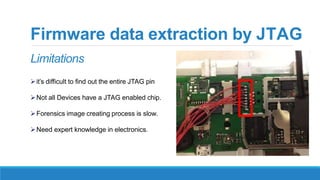
Firmware data extraction by JTAG
JTAG stands for Joint Test Action Group is a common hardware interface that provides a way to
communicate directly with the chips on a board.
The port was initially designed for testing PCB (Printed Circuit Boards).
JTAG Forensics involves acquiring firmware data using standard Test Access Ports (TAPs).
Doesn’t require specific data cables for each make/model.
The data is transferred in a raw format.
Able to recover data from damaged devices. [5]
it’s difficult to find out the entire JTAG pin
Not all Devices have a JTAG enabled chip.
Forensics image creating process is slow.
Need expert knowledge in electronics.
Firmware data extraction by JTAG
Limitations
Firmware data extraction by UART
UART is Universal Asynchronous Receiver/Transmitter.
UART is a widely used method.
It is a hardware device which is a part of Integrated circuitry and used for serial
communications.
UART converter translates serial data into readable data via USB.
Hardware complexity is low. [5]
It can accidently reset the devices
to factory settings resulting in loss of
data.
Size of a data frame is limited to 9
bits.
Firmware data extraction by UART
Limitations
Future
Developments IoT forensics is a new area open for research. There is
already a need for practical solutions to questions that
arise during investigations that include IoT.
Therefore, researchers and forensics professionals
work hard to present new tools and methodologies that
could mitigate IOT forensic challenges.
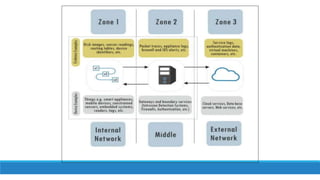
The 1-2-3 Zones Approach
1-2-3 zones are correspond to three areas of IoT forensics: device, network and cloud.
This method makes it is easier to plan and systematize an IoT investigation.
Reduces the complexity and the timing of investigations,
All zones can be investigate in parallelly or a zone of greatest priority can be investigated first. [6]
IOTdots
IoTDots general architecture divides into two parts:
IoTDots - Modifier (ITM)
 performs source code analysis of smart applications
 Detects relevant forensic information
 The tracing logs are stored in an IoT database
IoTDots - Analyzer (ITA)
 uses the log information stored in the IoT database with data processing and
machine learning techniques to perform forensic investigation. [1], [5], [6]
Reference
[1]Avoine, G. and Hernandez-Castro,J., n.d. Security of Ubiquitous Computing Systems.
[2]R. C. Joshi and E. S. Pilli, Computer Communications and Networks Fundamentals of
Network Forensics A Research Perspective. 2016.
[3]D. Quick and K. K. R. Choo, ‘IoT Device Forensics and Data Reduction’, IEEE Access, vol. 6,
pp. 47566–47574, 2018.
4 Slideshare.net. 2021. Iot forensics. [online] Available at:
<https://www.slideshare.net/AbeisAb/iot-forensics-117926663.
5Linkedin.com. 2021. Internet of Things Forensics: Challenges and Approaches. Evaluation of
Digital Forensic Tools. [online] Available at: <https://www.linkedin.com/pulse/internet-things-
forensics-challenges-approaches-tools-hamal-b-k
6M. Stoyanova, Y. Nikoloudakis, S. Panagiotakis, E. Pallis and E. K. Markakis, "A Survey on
the Internet of Things (IoT) Forensics: Challenges, Approaches, and Open Issues," in IEEE
Communications Surveys & Tutorials,
7 S. Zawoad and R. Hasan, ‘FAIoT: Towards Building a Forensics Aware Eco System for the
Internet of Things’,
8Hyunji Chung, Jungheum Park, and Sangjin Lee. Digital forensic approaches for amazon
alexa ecosystem. Digital Investigation, 22:S15–S25, 2017.
THANK YOU !!!
Everything is connected...
Forensics-aware model for the
IoT (FAIoT)
The FAIoT paper [592] formally defined IoT forensics and listed its challenges.
Proposed a conceptual model for executing Digital Forensics in the IoT infrastructure.
with a centralized trusted evidence repository to ease the process of evidence collection
and analysis. [7]
The FAIoT consists of three parts:
 secure evidence preservation module.
 secure provenance module.
 access to evidence through an API.

IOT Forensics

  • 1.
    INTERNET OF THINGS (IOT)FORENSICS CHALLENGES & TOOLS Muhammad Awais FURC-S21-MSCS-003
  • 2.
    IOT The Internet ofThings (IoT) integrates various sensors, objects and smart nodes that are capable of communicating with each other without human intervention [1] i) Wearable devices like smart watches, glasses or health monitoring systems. ii)smart home appliances like smart locks, sensors for temperature, gas or ambient light. iii) smart vehicles, drones and applications for industrial automation and logistics. The worldwide IoT market: $1.7 trillion in 2020
  • 3.
    IOT Forensics The IoTForensics could be perceived as a subdivision of the Digital Forensics.  IoT Forensics is a relatively new and unexplored area. The purpose of the IoT Forensics is similar to the one of the Digital Forensics, which is to identify and extract digital information in a legal and forensically sound manner.
  • 4.
    The need ofIOT forensics Extensive attack surface Despite all the benefits and the wide prospects of IOT, some IOT technologies are particularly vulnerable to cyber-attacks. IoT devices with public interfaces are exposed to greater risk levels because they could bring a malware to the private network from a less secure public space [2]. New cyber-physical security threats Using IoT technology, virtual crimes could step across the limit of cyberspace and threaten human life. Contains Digital traces IoT devices which is able prove or disprove certain hypothesis, and could, help the forensics professionals find answers and reconstruct the crime scene [3].
  • 5.
    Challenges in IoT Forensics TheIoT Forensics field is encountering an array of challenges, none of which has a simple solution. General Issues. Evidence Identification, Collection and Preservation issues. Evidence Analysis and Correlation. Evidence Presentation
  • 6.
    General Issues Lack ofa methodology and framework for IoT forensics. There is a lack of appropriate tools for IoT forensics. Impact  Could contaminate or destroy evidence. Absence of common forensic model could jeopardize the trust and agreements in cross jurisdictional investigations.
  • 7.
    Evidence Identification, Collection andPreservation issues Detecting the presence of IoT systems, and identification of IoT devices that can provide evidence in an investigation. Lack of training for first responders. Wide range of software and/or hardware specifications. Lifespan limitations
  • 8.
    Evidence Identification, Collection andPreservation issues Impact Data could be easily overwritten. The responding officers often neglect or shut down the system directly, without first creating the necessary forensic image.
  • 9.
    Evidence Analysis andCorrelation Overwhelming amount of data that an IoT system might produce. Time Lining and Limited Correlation of Evidence. Metadata – vast majority of IOT devices do not store any metadata.
  • 10.
    Impact The amount canbe overwhelming for an investigator and the tools used. Creating a time-line can be challenging. Evidence Analysis and Correlation
  • 11.
    Evidence Presentation Jury mostprobably has only basic understanding of cloud computing and forensics. It would be a challenging task to explain to them the technicalities behind such a complex architecture in the very limited time of the trial. Will the court accept the methodology and tools used since they are not yet standardized.
  • 12.
    Impact if an investigativebody chooses unsuitable methods for acquisition it can harm the data integrity and can easily be challenged in Court due to omissions in the way of collection. Presentation
  • 13.
    IOT FORENSICS METHODS AND TOOLS There arevery few tools designed specifically for IOT forensics There is no unique methodology to investigate in a IOT environment None of the approaches has been widely accepted by the forensics community. Most of the approaches are still of theoretical nature.
  • 14.
    Perform standard dataacquisition Various proven techniques and procedures for Digital forensics are still applicable to IoT devices. if an IoT device can be connected to a computer, the internal storage of the device can be forensically imaged. Various Digital forensic tools are available to perform standard data acquisitions e.g.:  FTK Imager (Free Tool)  X-ways forensics (Paid Tool)  ENCASE (Paid Tool)
  • 15.
    Limitations In IoT forensics,where traditional investigative techniques & tools have a very low success rate. Useless against Proprietary echo systems e.g.: apple, amazon. Occasionally, formats of the collected data are invalid or vendor specific. Perform standard data acquisition
  • 16.
    Interface testing Most IoTdevices have web interfaces. Can get general knowledge of how the system works By testing the interface investigators can validate whether the relevant digital evidence is present and its condition. Investigators can identify any indicators of compromise. Limitations Can lead to accidental contamination of evidence.
  • 17.
    Oxygen Forensic Detective OxygenForensic Detective is an all-in-one forensic software platform. Able to extract, decode, and analyze data from multiple digital sources mobile and IoT devices, device backups, drones, and cloud service. Oxygen Forensic offers data extraction from two popular IoT devices based on Amazon & Google. Can performs logical acquisition from smart-wearables (apple watch, Fitbit, Samsung Health).
  • 18.
    Limitations Its support forrange of devices is limited. It uses a brute force technique which can take a lot of time to complete the process. Oxygen Forensic suite is very expensive. Oxygen Forensic Detective
  • 19.
    Elcomsoft iOS ForensicToolkit Perform full file system and logical acquisition for Apple ecosystem devices. The toolkit provides jailbreak-free forensic extraction Inbuilt write blocker. Cost: 1500$ Limitations Only supports Apple devices
  • 20.
    Firmware data extractionby JTAG JTAG stands for Joint Test Action Group is a common hardware interface that provides a way to communicate directly with the chips on a board. The port was initially designed for testing PCB (Printed Circuit Boards). JTAG Forensics involves acquiring firmware data using standard Test Access Ports (TAPs). Doesn’t require specific data cables for each make/model. The data is transferred in a raw format. Able to recover data from damaged devices. [5]
  • 21.
    it’s difficult tofind out the entire JTAG pin Not all Devices have a JTAG enabled chip. Forensics image creating process is slow. Need expert knowledge in electronics. Firmware data extraction by JTAG Limitations
  • 22.
    Firmware data extractionby UART UART is Universal Asynchronous Receiver/Transmitter. UART is a widely used method. It is a hardware device which is a part of Integrated circuitry and used for serial communications. UART converter translates serial data into readable data via USB. Hardware complexity is low. [5]
  • 23.
    It can accidentlyreset the devices to factory settings resulting in loss of data. Size of a data frame is limited to 9 bits. Firmware data extraction by UART Limitations
  • 24.
    Future Developments IoT forensicsis a new area open for research. There is already a need for practical solutions to questions that arise during investigations that include IoT. Therefore, researchers and forensics professionals work hard to present new tools and methodologies that could mitigate IOT forensic challenges.
  • 25.
    The 1-2-3 ZonesApproach 1-2-3 zones are correspond to three areas of IoT forensics: device, network and cloud. This method makes it is easier to plan and systematize an IoT investigation. Reduces the complexity and the timing of investigations, All zones can be investigate in parallelly or a zone of greatest priority can be investigated first. [6]
  • 27.
    IOTdots IoTDots general architecturedivides into two parts: IoTDots - Modifier (ITM)  performs source code analysis of smart applications  Detects relevant forensic information  The tracing logs are stored in an IoT database IoTDots - Analyzer (ITA)  uses the log information stored in the IoT database with data processing and machine learning techniques to perform forensic investigation. [1], [5], [6]
  • 28.
    Reference [1]Avoine, G. andHernandez-Castro,J., n.d. Security of Ubiquitous Computing Systems. [2]R. C. Joshi and E. S. Pilli, Computer Communications and Networks Fundamentals of Network Forensics A Research Perspective. 2016. [3]D. Quick and K. K. R. Choo, ‘IoT Device Forensics and Data Reduction’, IEEE Access, vol. 6, pp. 47566–47574, 2018. 4 Slideshare.net. 2021. Iot forensics. [online] Available at: <https://www.slideshare.net/AbeisAb/iot-forensics-117926663. 5Linkedin.com. 2021. Internet of Things Forensics: Challenges and Approaches. Evaluation of Digital Forensic Tools. [online] Available at: <https://www.linkedin.com/pulse/internet-things- forensics-challenges-approaches-tools-hamal-b-k 6M. Stoyanova, Y. Nikoloudakis, S. Panagiotakis, E. Pallis and E. K. Markakis, "A Survey on the Internet of Things (IoT) Forensics: Challenges, Approaches, and Open Issues," in IEEE Communications Surveys & Tutorials, 7 S. Zawoad and R. Hasan, ‘FAIoT: Towards Building a Forensics Aware Eco System for the Internet of Things’, 8Hyunji Chung, Jungheum Park, and Sangjin Lee. Digital forensic approaches for amazon alexa ecosystem. Digital Investigation, 22:S15–S25, 2017.
  • 29.
    THANK YOU !!! Everythingis connected...
  • 30.
    Forensics-aware model forthe IoT (FAIoT) The FAIoT paper [592] formally defined IoT forensics and listed its challenges. Proposed a conceptual model for executing Digital Forensics in the IoT infrastructure. with a centralized trusted evidence repository to ease the process of evidence collection and analysis. [7] The FAIoT consists of three parts:  secure evidence preservation module.  secure provenance module.  access to evidence through an API.