Azure AD Connect
Get your Hybrid Identity
in four steps!
Ronny de Jong
Consultant & MVP | Inovativ
@ronnydejong
Agenda
 Making Hybrid Identity Simple
 More topologies, more scenarios
 Walk through Express & Custom Setup
 Monitor your Hybrid Identity
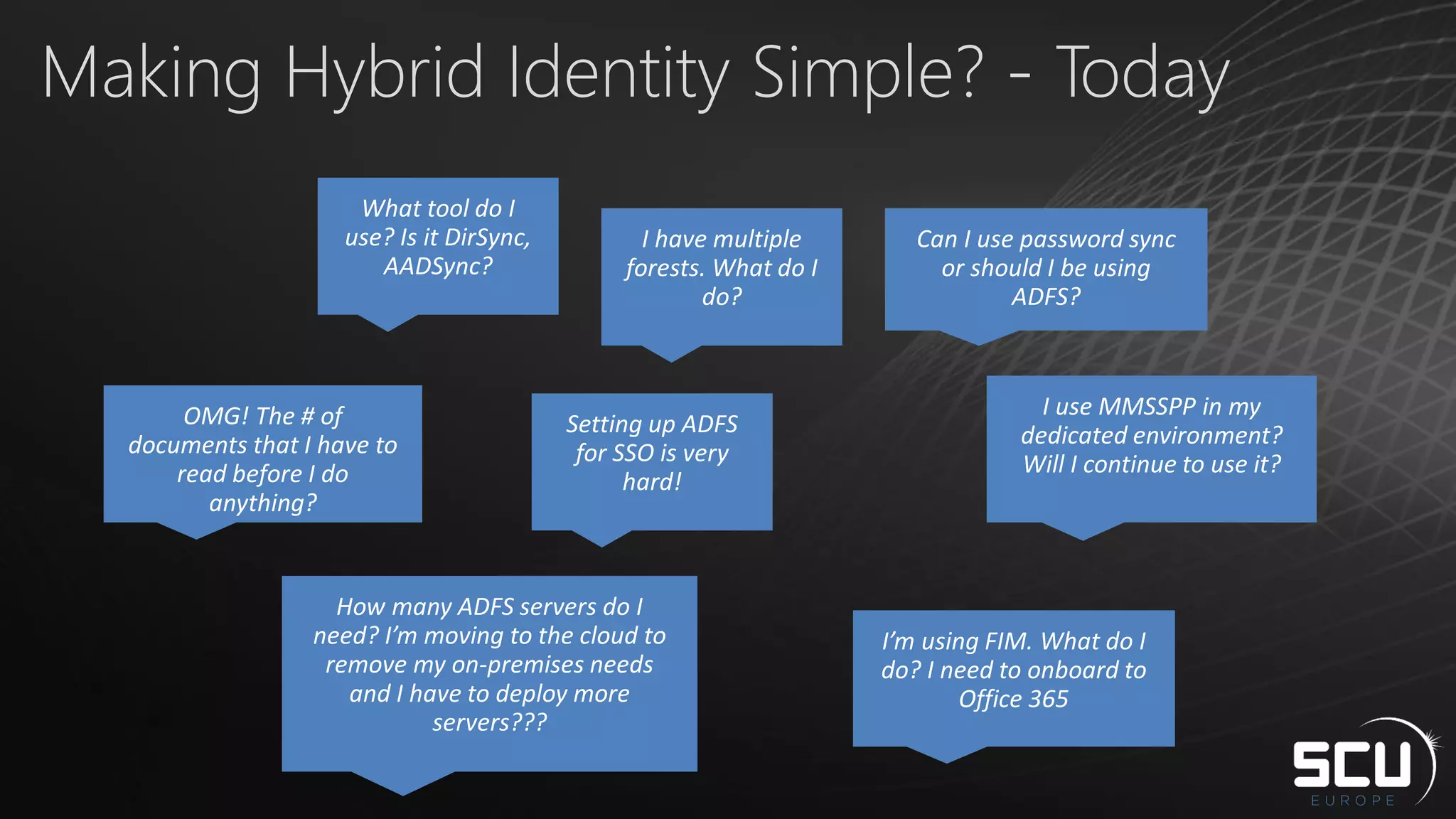
Making Hybrid Identity Simple? - Today
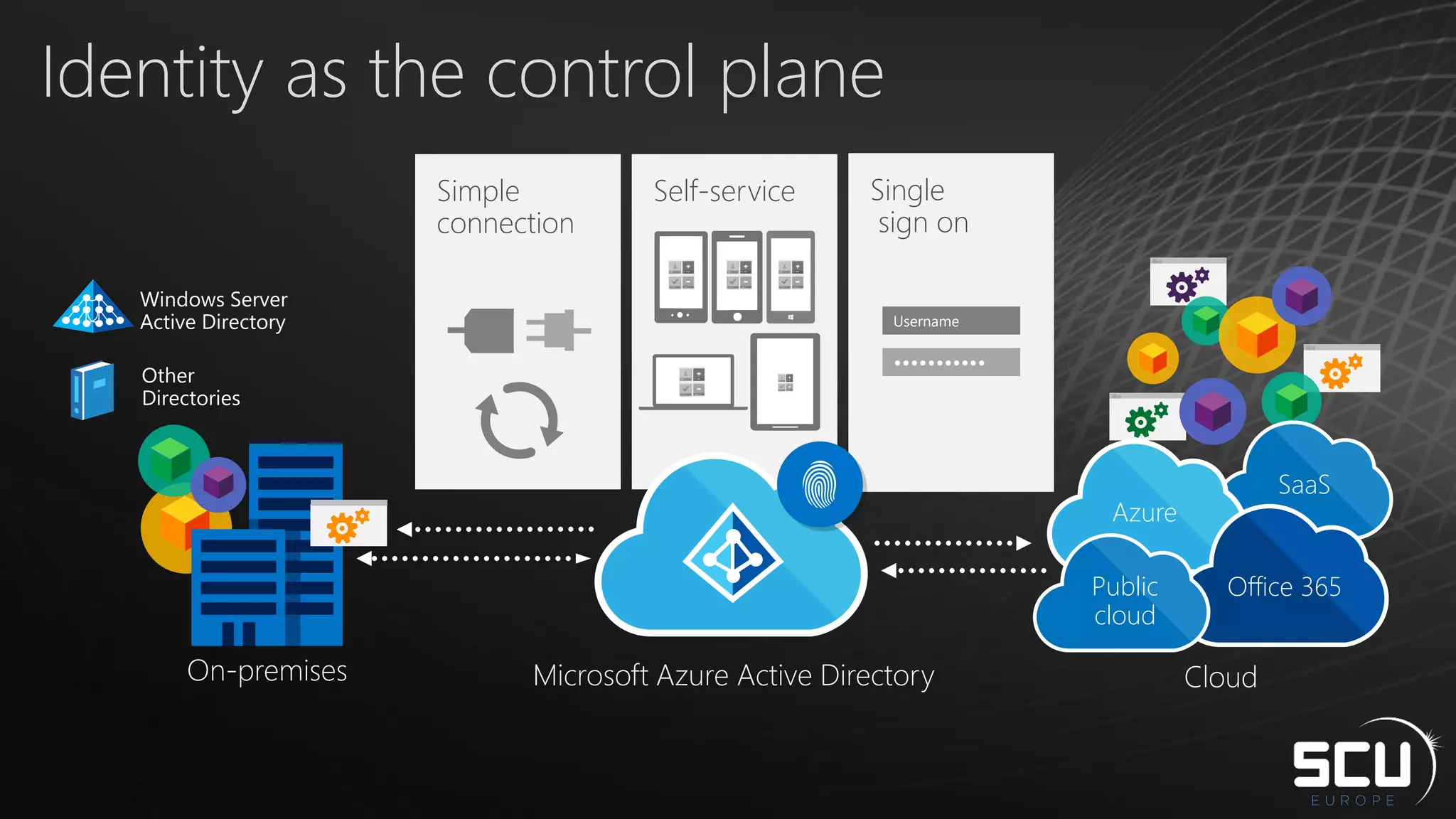
Self-service Single
sign on
•••••••••••
Username
Identity as the control plane
Simple
connection
Cloud
SaaS
Azure
Office 365Public
cloud
Other
Directories
Windows Server
Active Directory
On-premises Microsoft Azure Active Directory
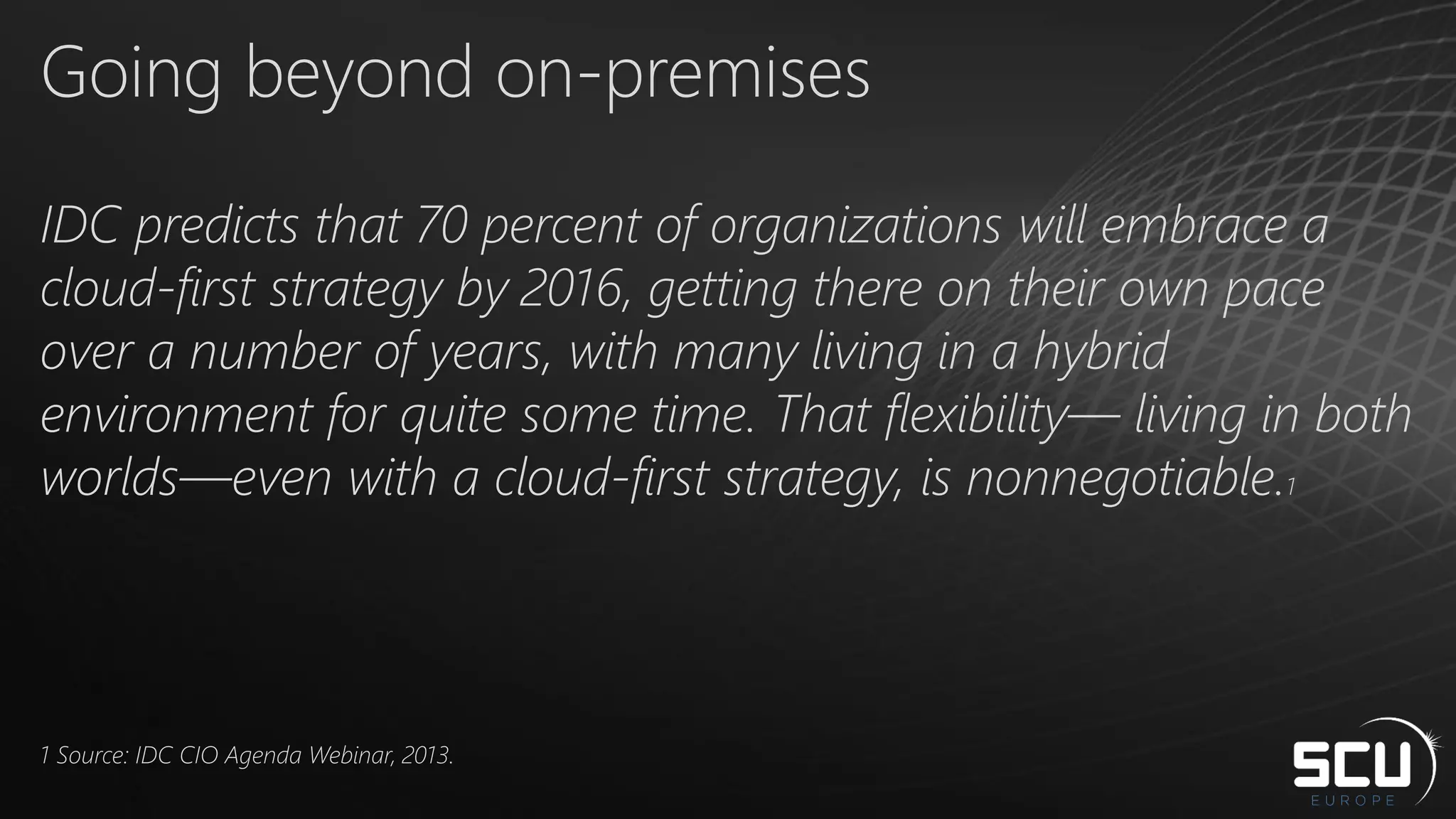
Going beyond on-premises
IDC predicts that 70 percent of organizations will embrace a
cloud-first strategy by 2016, getting there on their own pace
over a number of years, with many living in a hybrid
environment for quite some time. That flexibility— living in both
worlds—even with a cloud-first strategy, is nonnegotiable.1
1 Source: IDC CIO Agenda Webinar, 2013.
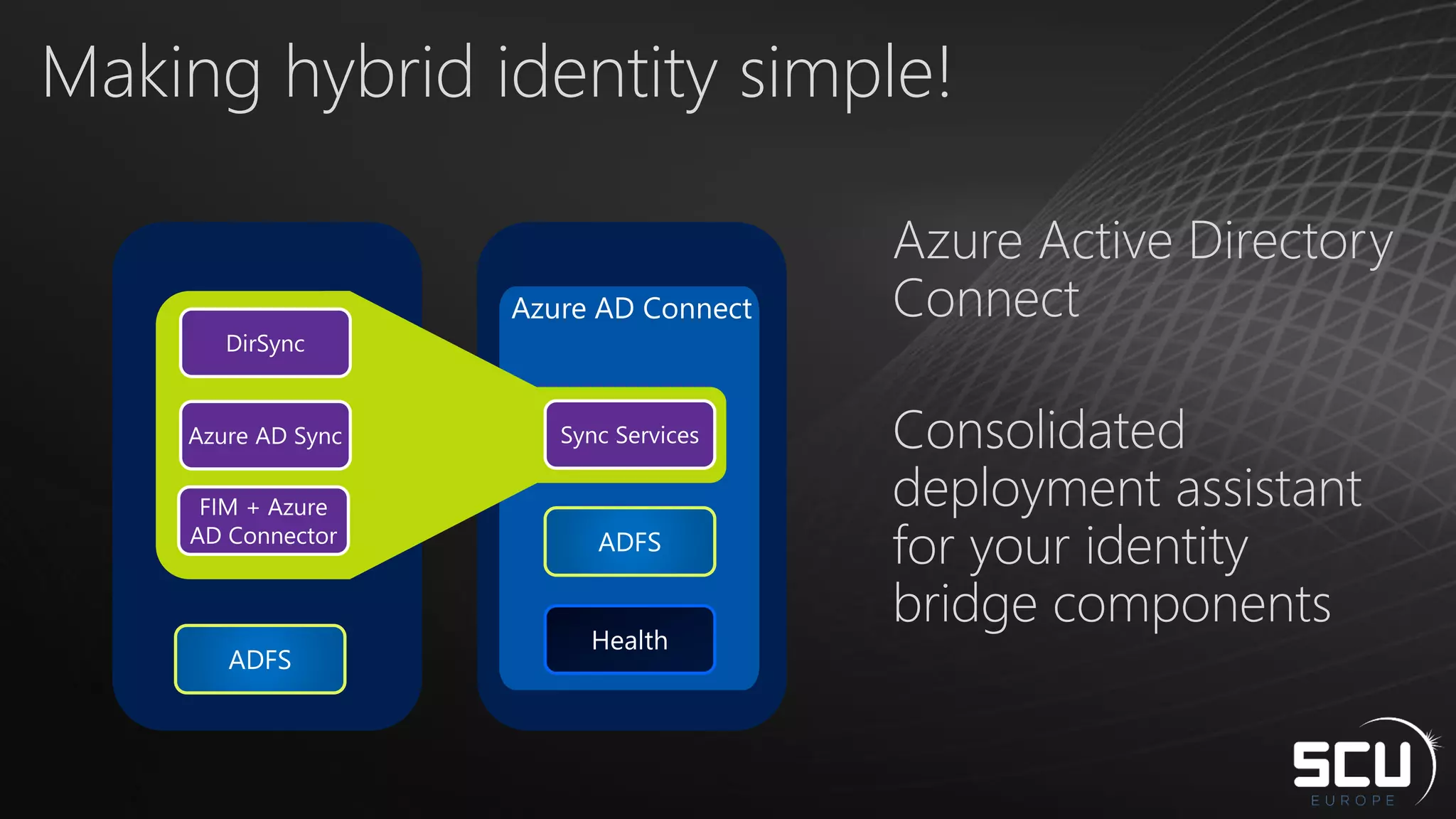
Making hybrid identity simple!
Azure Active Directory
Connect
Consolidated
deployment assistant
for your identity
bridge components
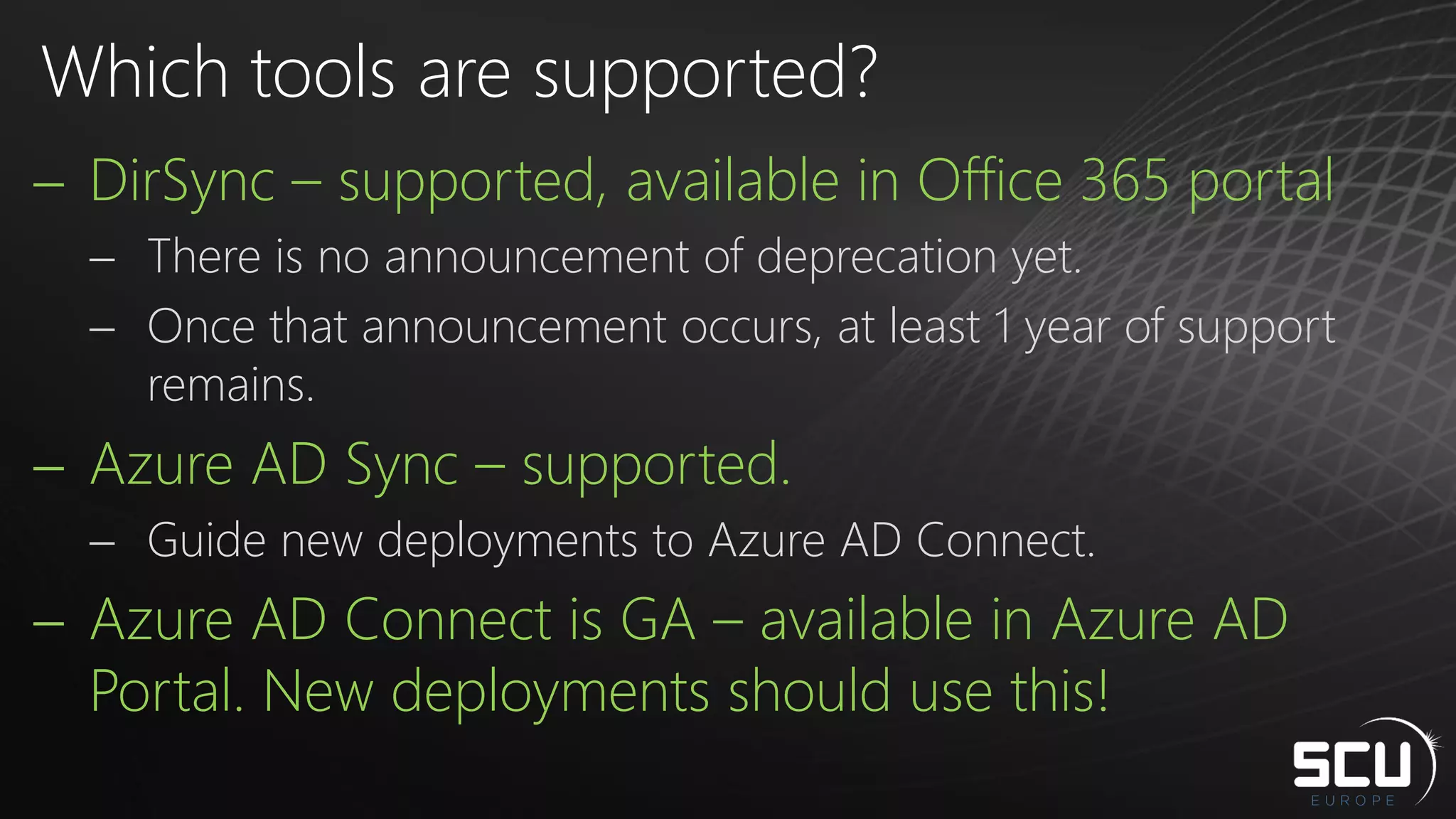
 DirSync – supported, available in Office 365 portal
 There is no announcement of deprecation yet.
 Once that announcement occurs, at least 1 year of support
remains.
 Azure AD Sync – supported.
 Guide new deployments to Azure AD Connect.
 Azure AD Connect is GA – available in Azure AD
Portal. New deployments should use this!
Which tools are supported?
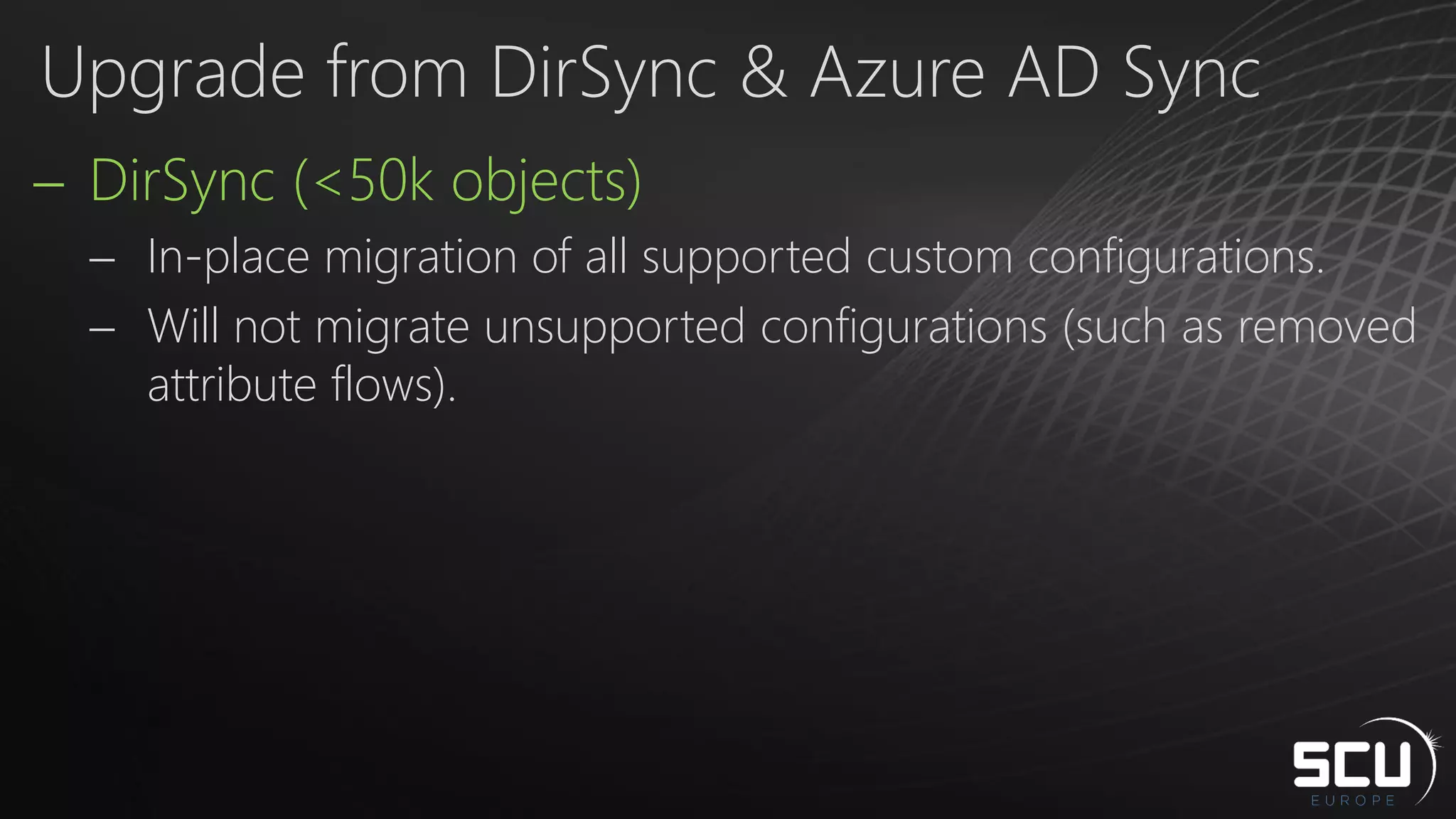
 DirSync (<50k objects)
 In-place migration of all supported custom configurations.
 Will not migrate unsupported configurations (such as removed
attribute flows).
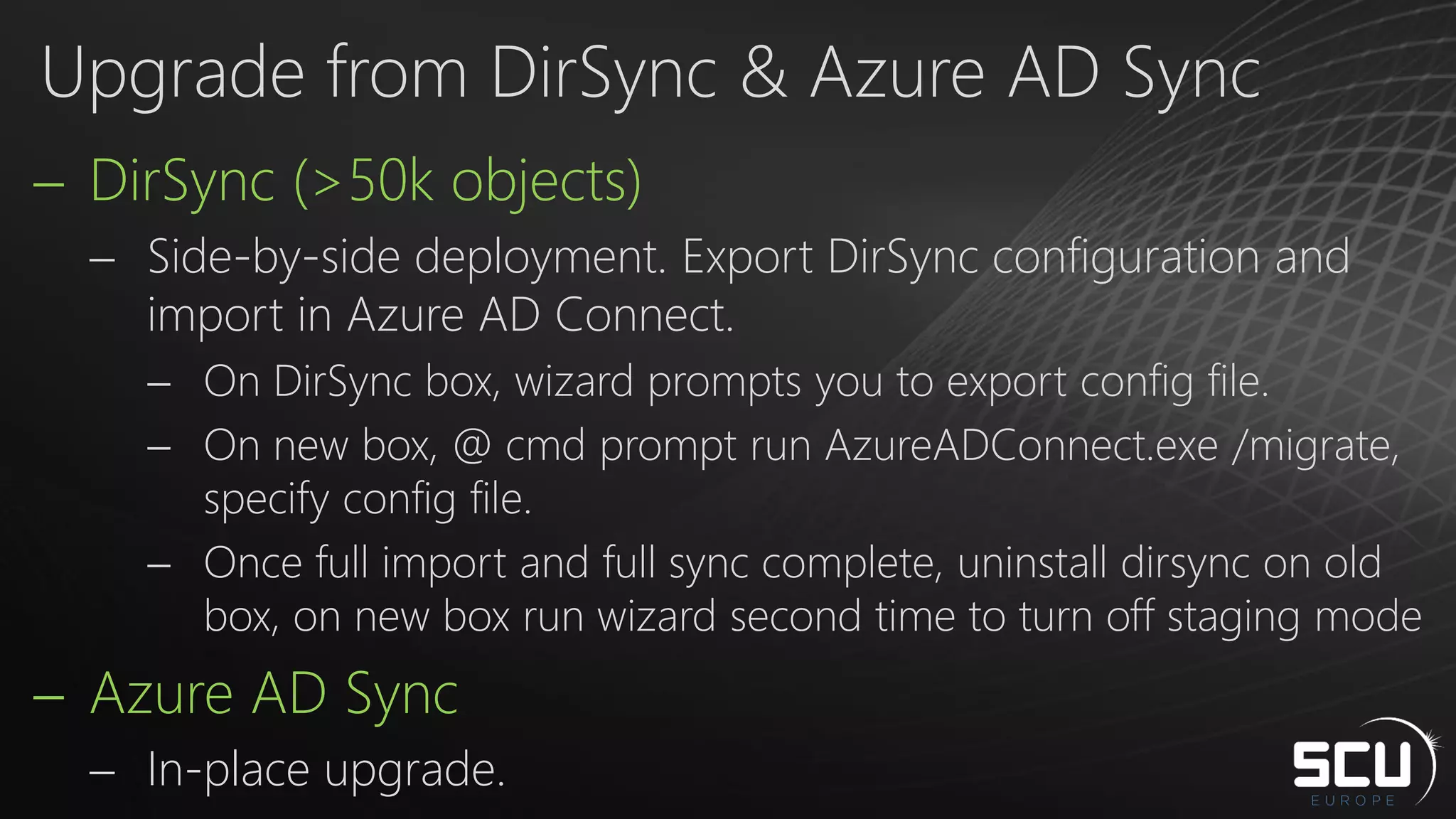
Upgrade from DirSync & Azure AD Sync
 DirSync (>50k objects)
 Side-by-side deployment. Export DirSync configuration and
import in Azure AD Connect.
 On DirSync box, wizard prompts you to export config file.
 On new box, @ cmd prompt run AzureADConnect.exe /migrate,
specify config file.
 Once full import and full sync complete, uninstall dirsync on old
box, on new box run wizard second time to turn off staging mode
 Azure AD Sync
 In-place upgrade.
Upgrade from DirSync & Azure AD Sync
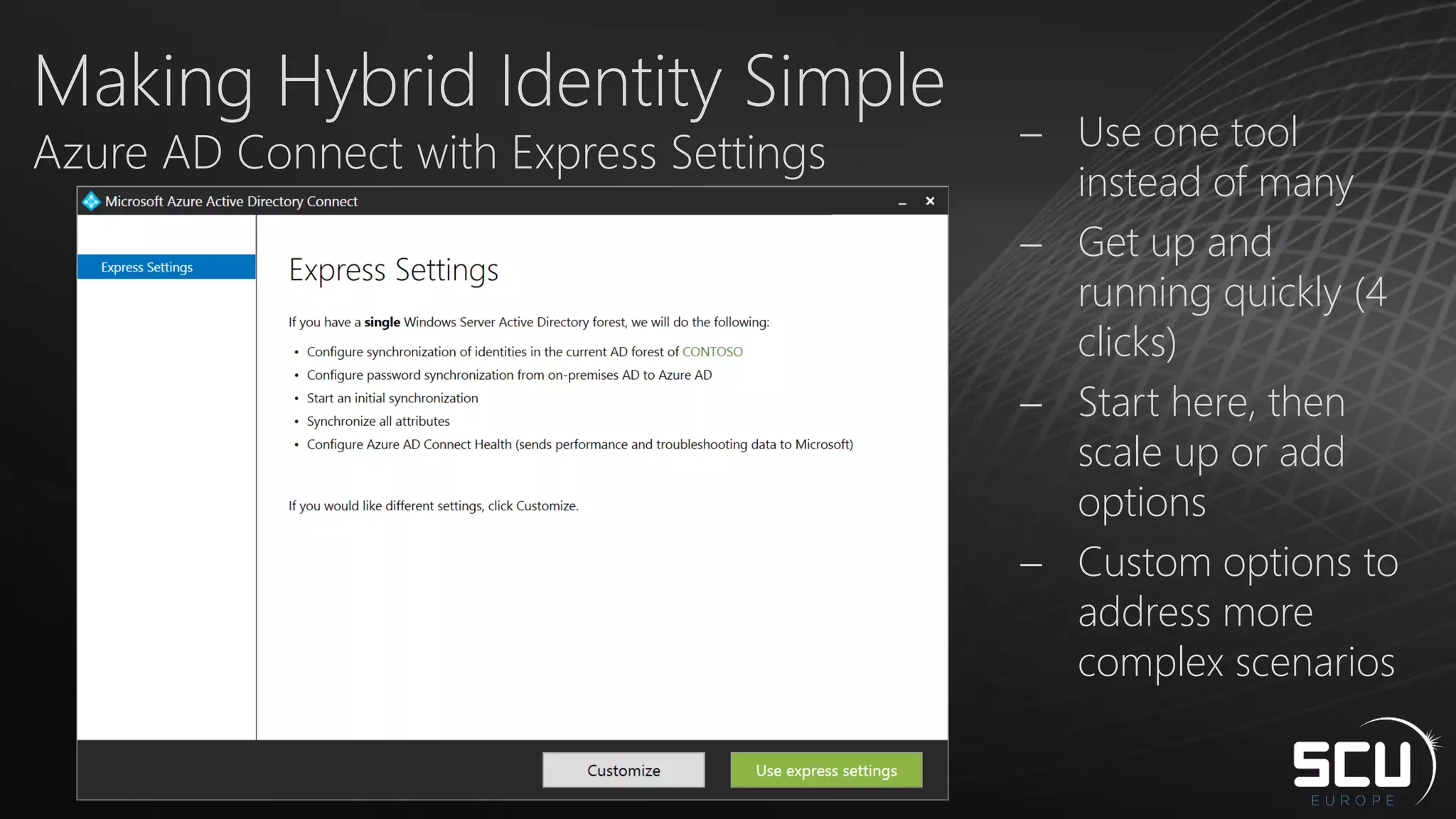
Making Hybrid Identity Simple
Azure AD Connect with Express Settings  Use one tool
instead of many
 Get up and
running quickly (4
clicks)
 Start here, then
scale up or add
options
 Custom options to
address more
complex scenarios
Demo
Express Setup
More topologies,
more scenarios
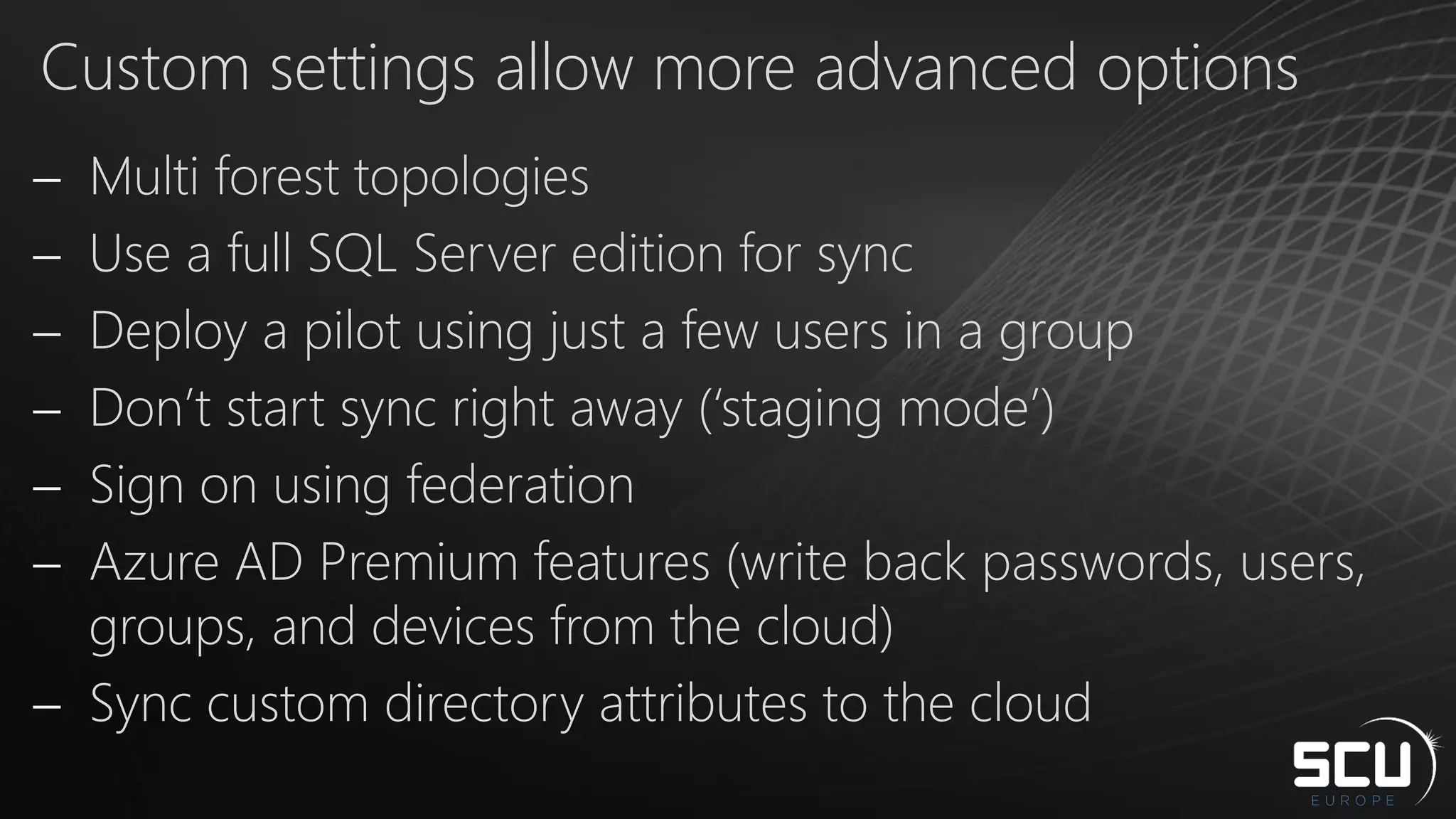
 Multi forest topologies
 Use a full SQL Server edition for sync
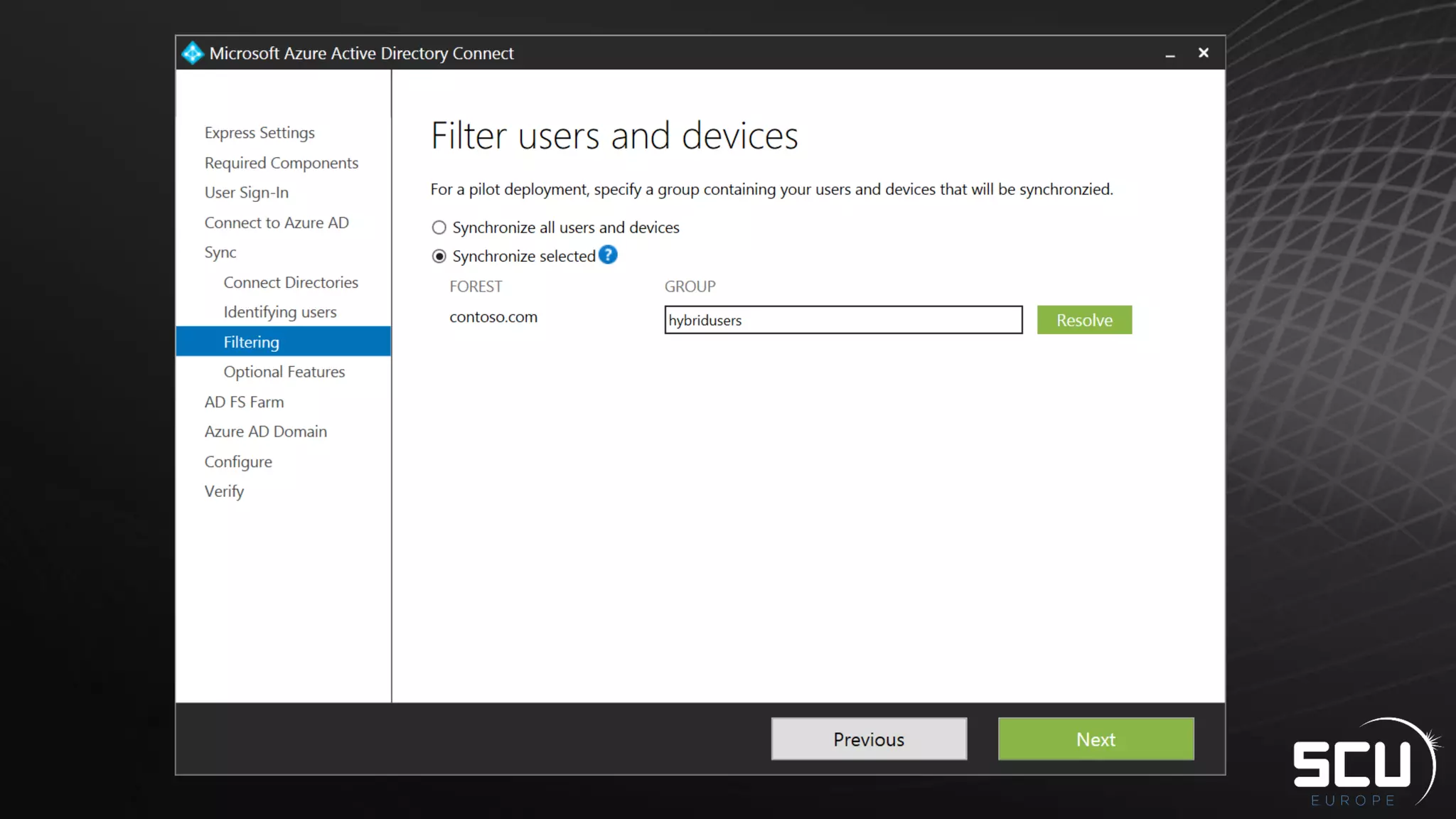
 Deploy a pilot using just a few users in a group
 Don’t start sync right away (‘staging mode’)
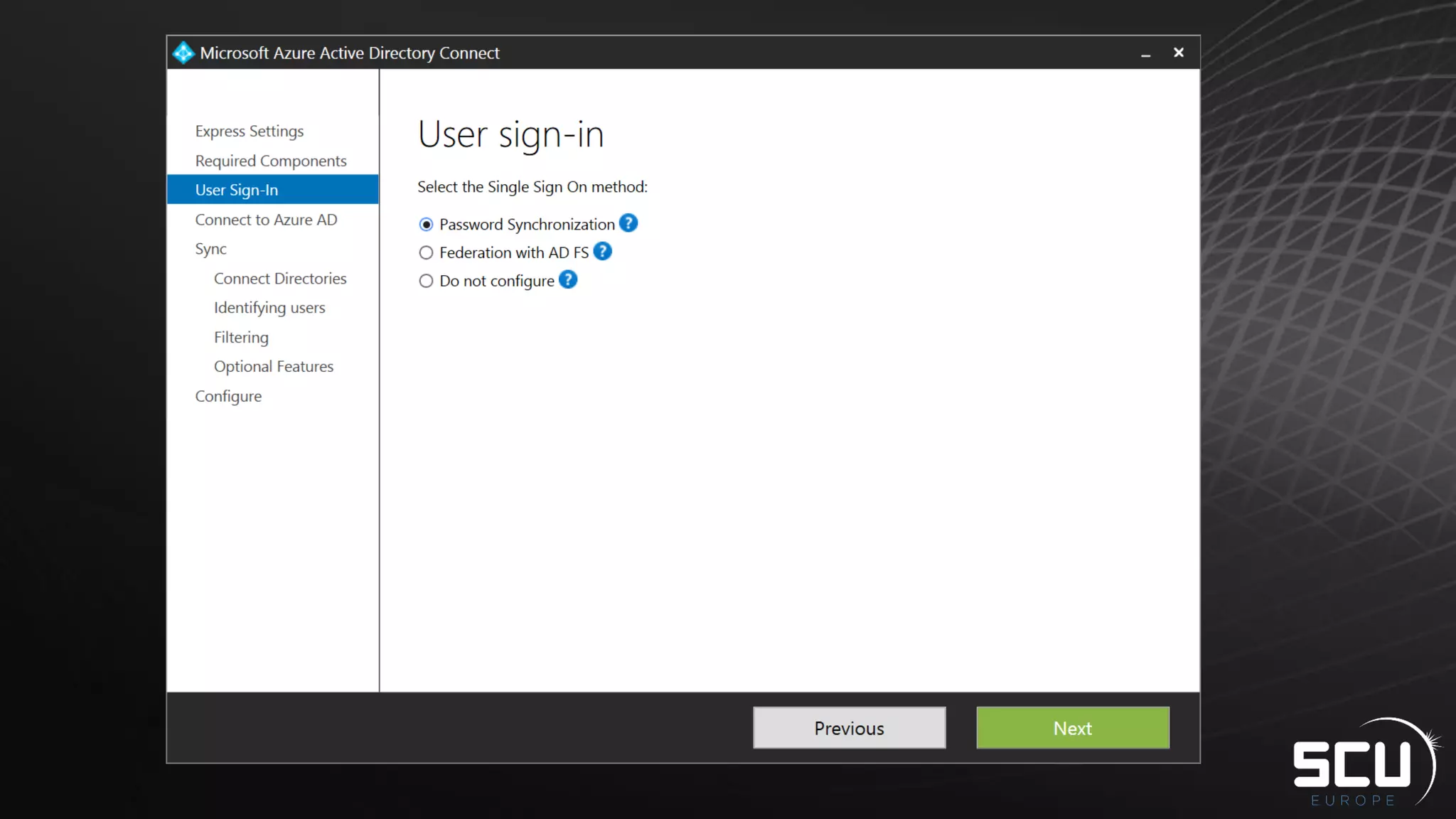
 Sign on using federation
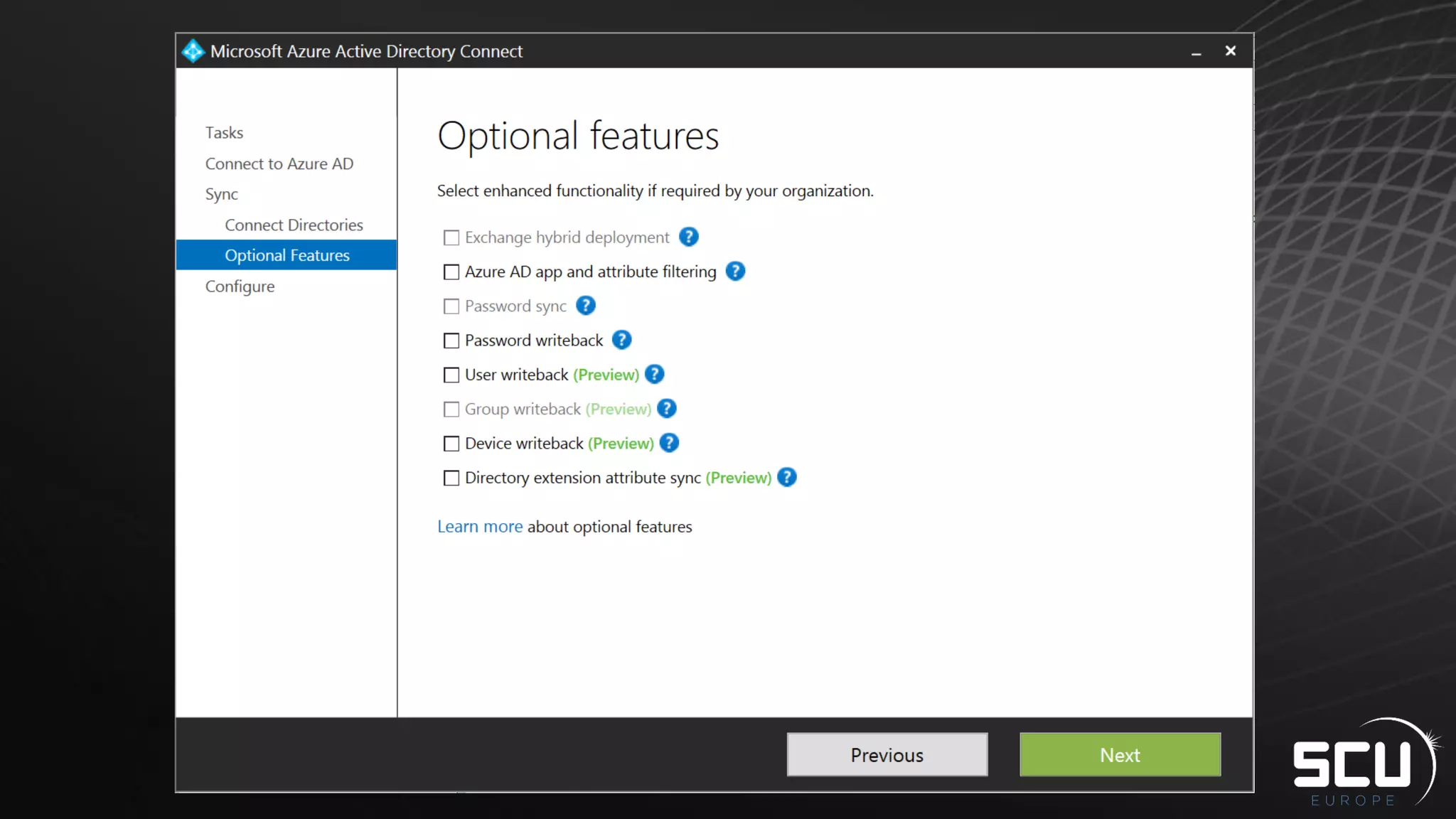
 Azure AD Premium features (write back passwords, users,
groups, and devices from the cloud)
 Sync custom directory attributes to the cloud
Custom settings allow more advanced options
 For all scenarios (Express Settings or Custom)
 Office 365 or Azure AD subscription – free trial is OK
 For custom Azure AD domains, configure your public DNS records
 AD users have UPNs (IDFix)
 Just for AD FS
 SSL certificate is trusted on all ADFS+WAP host (Use a certificate based on a key
pair generated by a legacy Cryptographic Service Provider (CSP). Certificates with the CNG
private key are not supported).
 Enable WinRM on all remote targets
 Federation service name resolves
 For write-back scenarios
 AAD Premium, prepare Active Directory
Make sure you do first
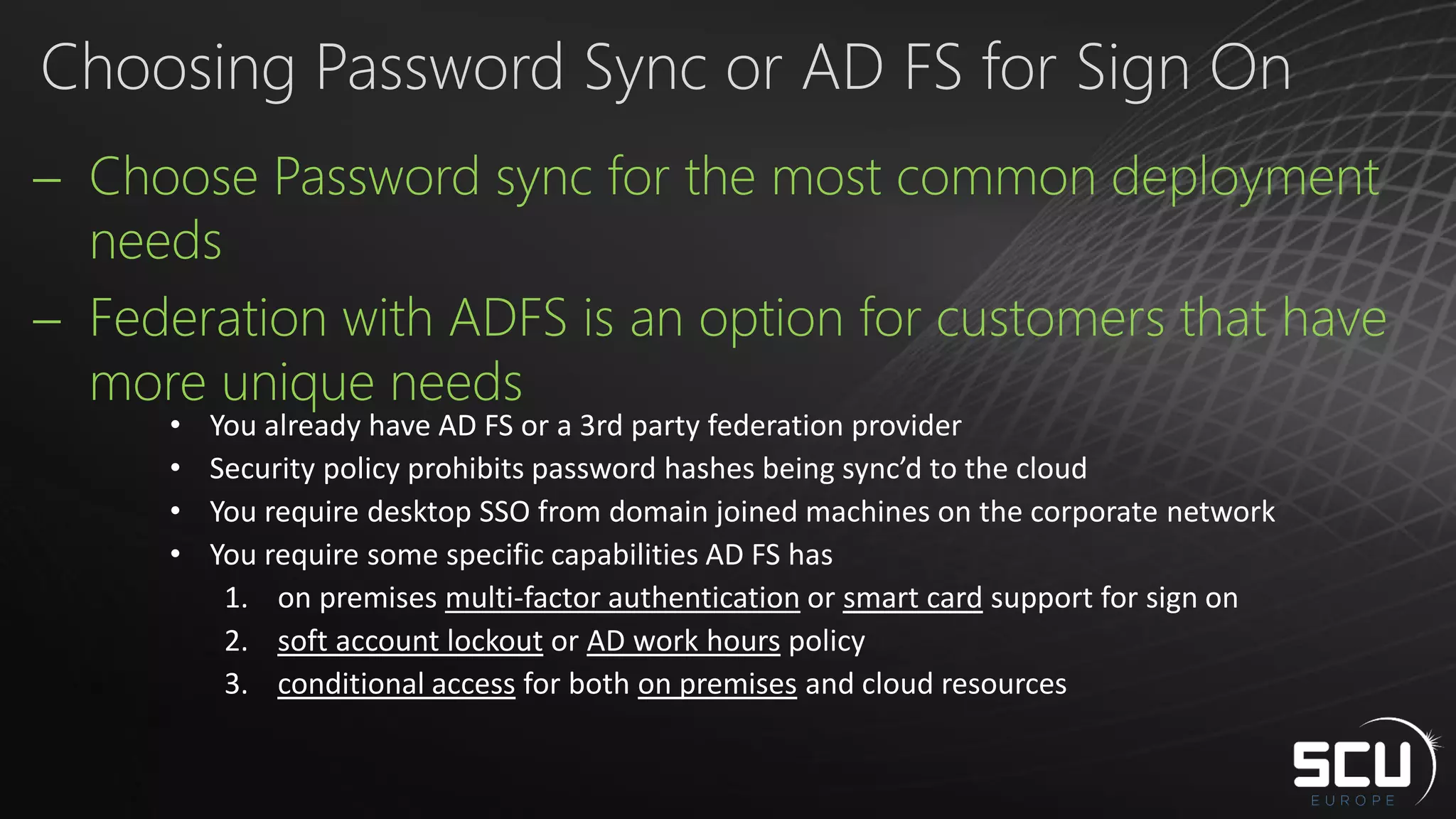
 Choose Password sync for the most common deployment
needs
 Federation with ADFS is an option for customers that have
more unique needs
Choosing Password Sync or AD FS for Sign On
• You already have AD FS or a 3rd party federation provider
• Security policy prohibits password hashes being sync’d to the cloud
• You require desktop SSO from domain joined machines on the corporate network
• You require some specific capabilities AD FS has
1. on premises multi-factor authentication or smart card support for sign on
2. soft account lockout or AD work hours policy
3. conditional access for both on premises and cloud resources
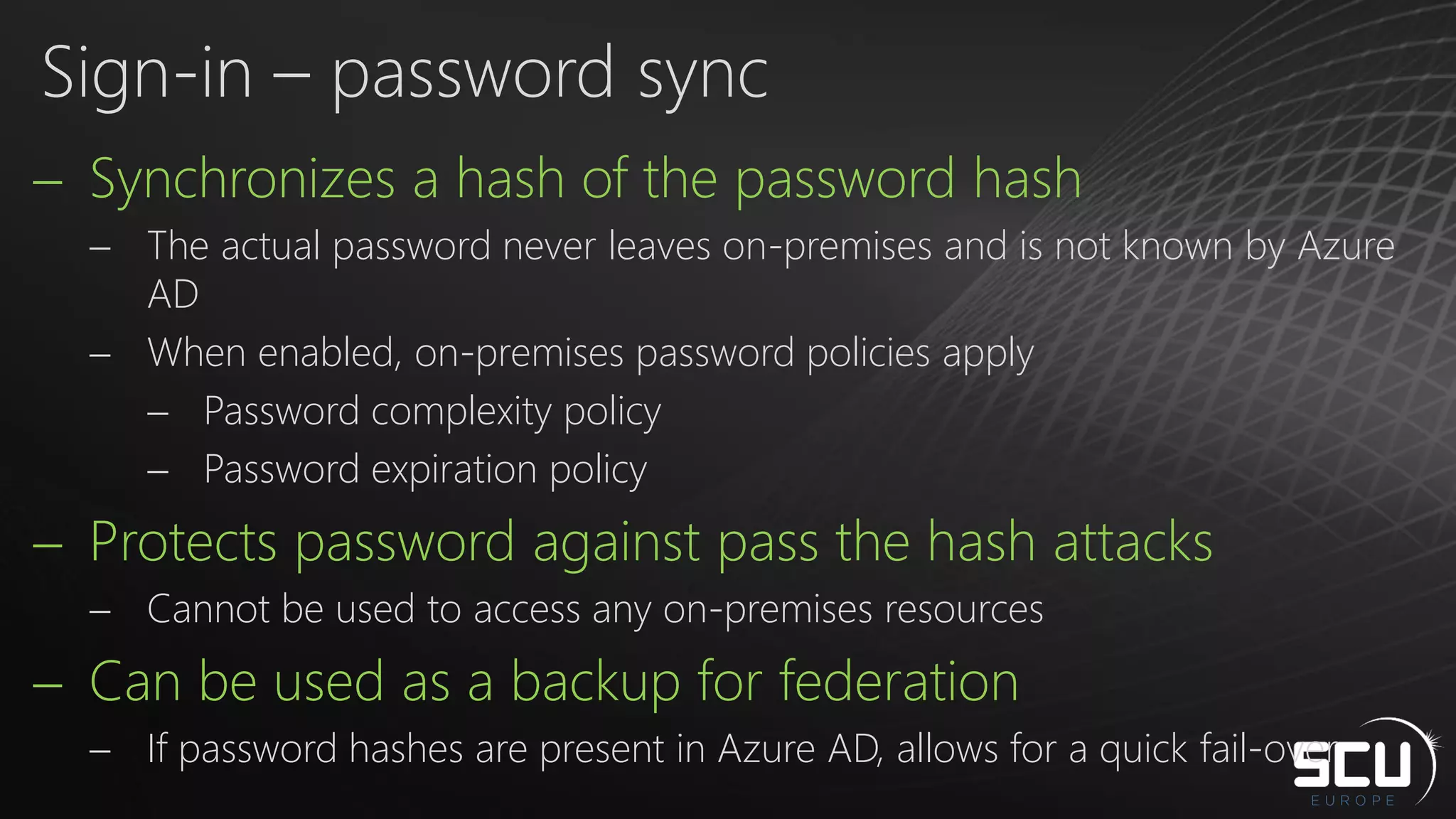
 Synchronizes a hash of the password hash
 The actual password never leaves on-premises and is not known by Azure
AD
 When enabled, on-premises password policies apply
 Password complexity policy
 Password expiration policy
 Protects password against pass the hash attacks
 Cannot be used to access any on-premises resources
 Can be used as a backup for federation
 If password hashes are present in Azure AD, allows for a quick fail-over
Sign-in – password sync
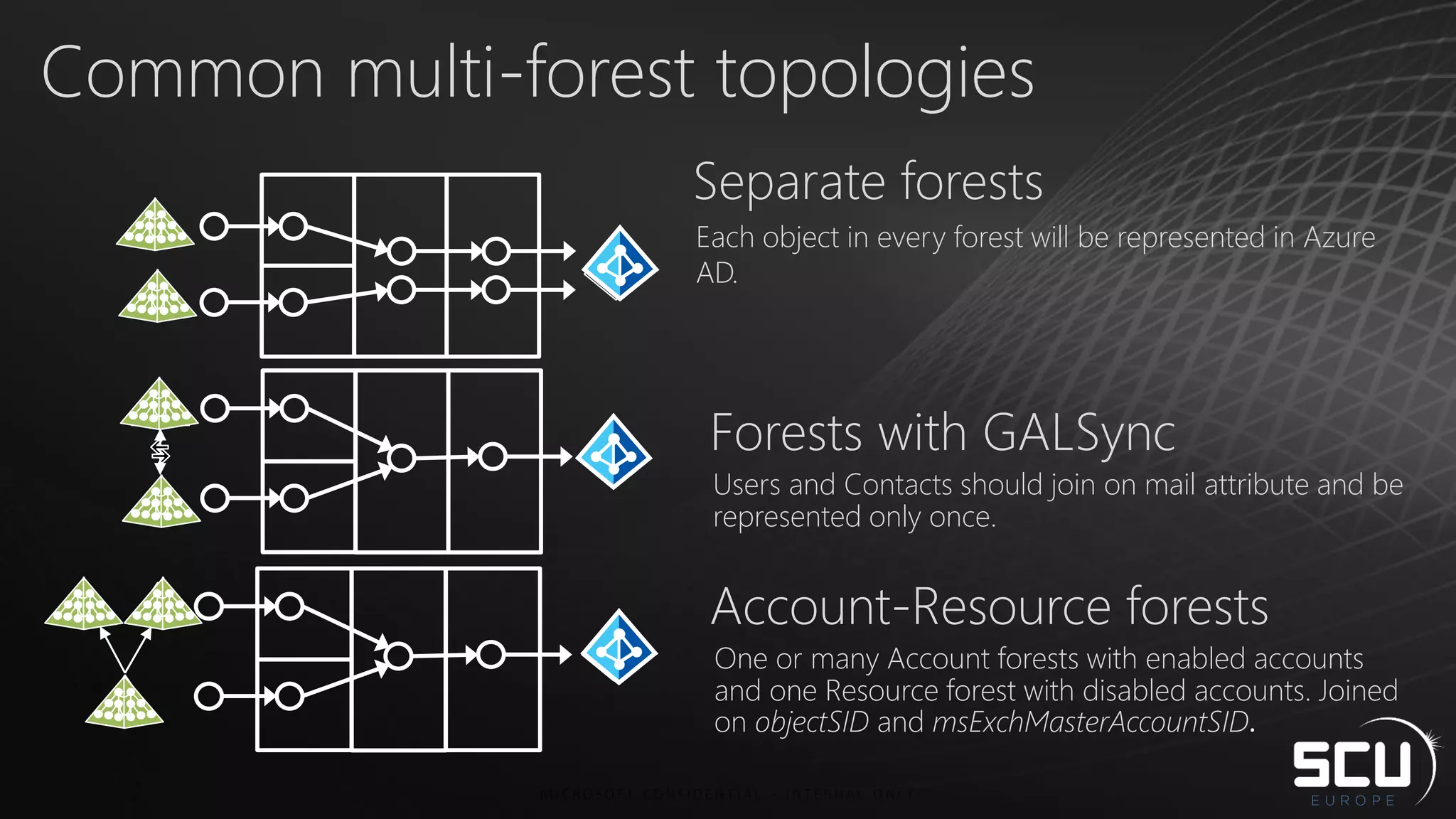
Common multi-forest topologies
Separate forests
Each object in every forest will be represented in Azure
AD.
Forests with GALSync
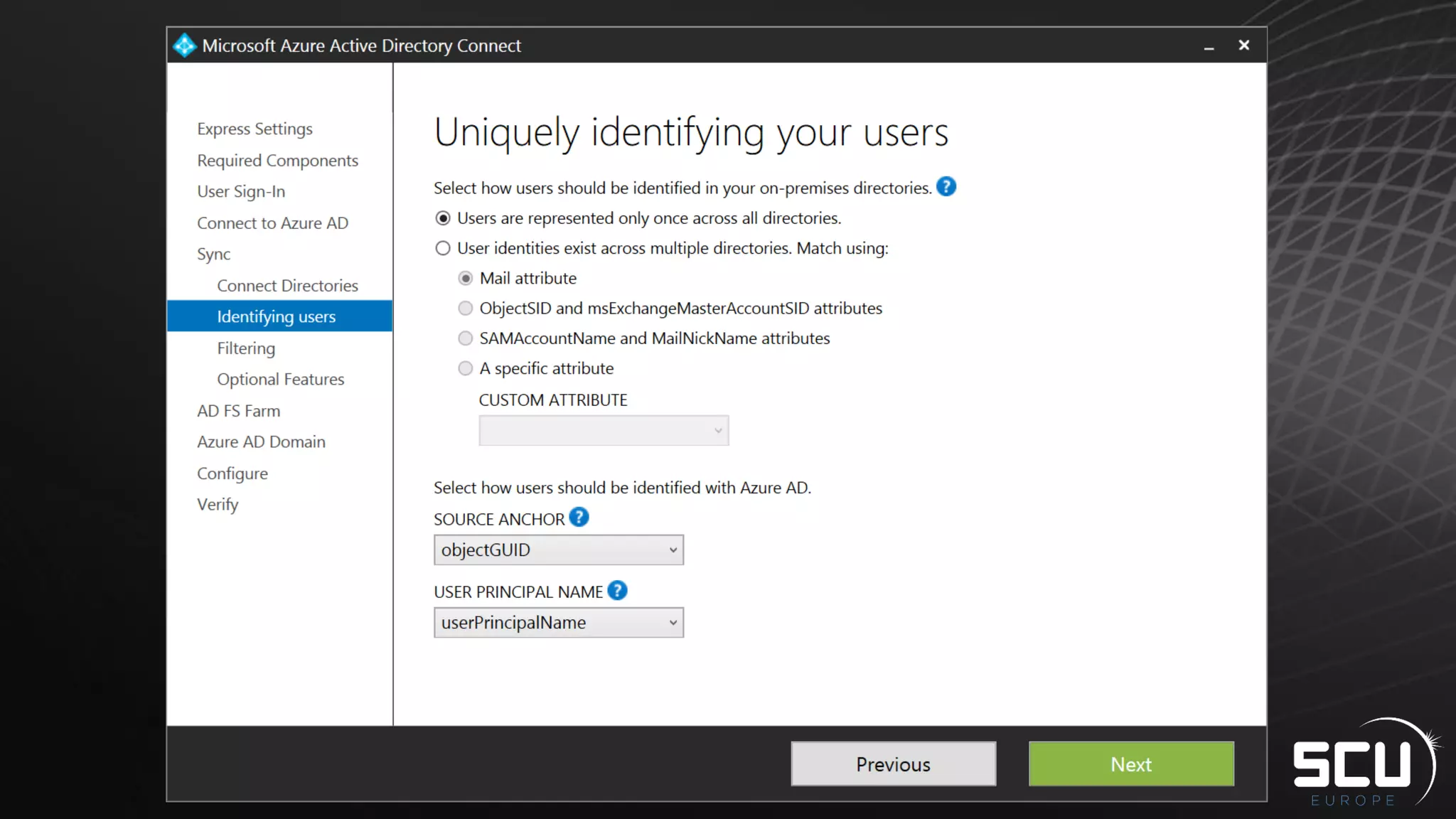
Users and Contacts should join on mail attribute and be
represented only once.
Account-Resource forests
One or many Account forests with enabled accounts
and one Resource forest with disabled accounts. Joined
on objectSID and msExchMasterAccountSID
 Intended to make it easy to pilot and evaluate
Azure AD and Office 365
 In from AD for User, Group, and Contact -> sets cloudFiltered to TRUE if
NOT in group
 When you add/remove users from group -> they are added/removed in
AAD
 Only objects which are direct members of the group will be present in
Azure AD
 Remove the filter when ready to ‘go live’
 2nd pass Wizard option under Customize Synchronization Options
Filter users and devices based on group
 Password write-back
 Change and set password in Azure AD and have the password policy
verified with on-premise Windows Server Active Directory.
 User write-back
 A user created in Azure AD is created in on-premise AD.
Optional Features – Write-back
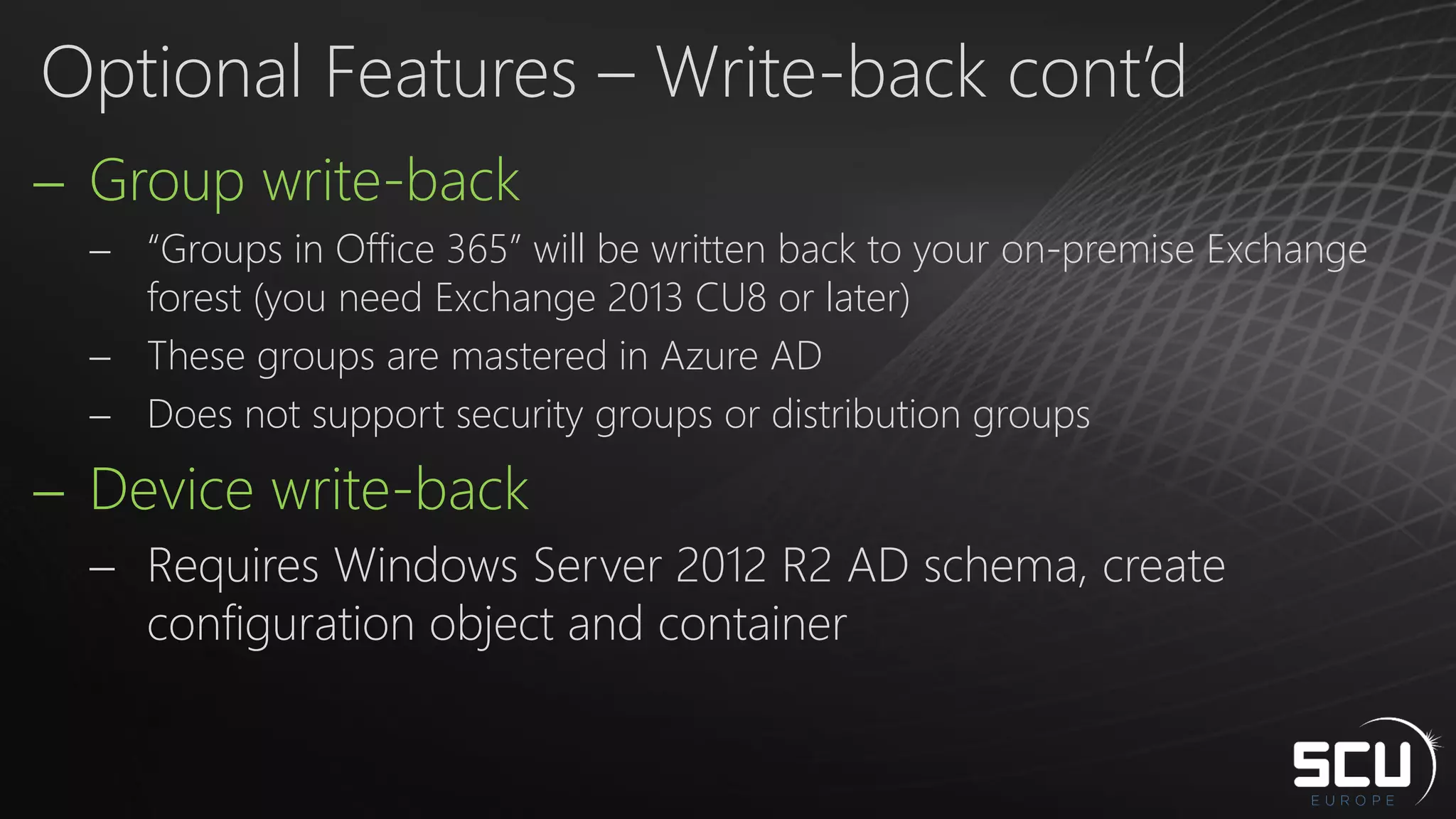
 Group write-back
 “Groups in Office 365” will be written back to your on-premise Exchange
forest (you need Exchange 2013 CU8 or later)
 These groups are mastered in Azure AD
 Does not support security groups or distribution groups
 Device write-back
 Requires Windows Server 2012 R2 AD schema, create
configuration object and container
Optional Features – Write-back cont’d
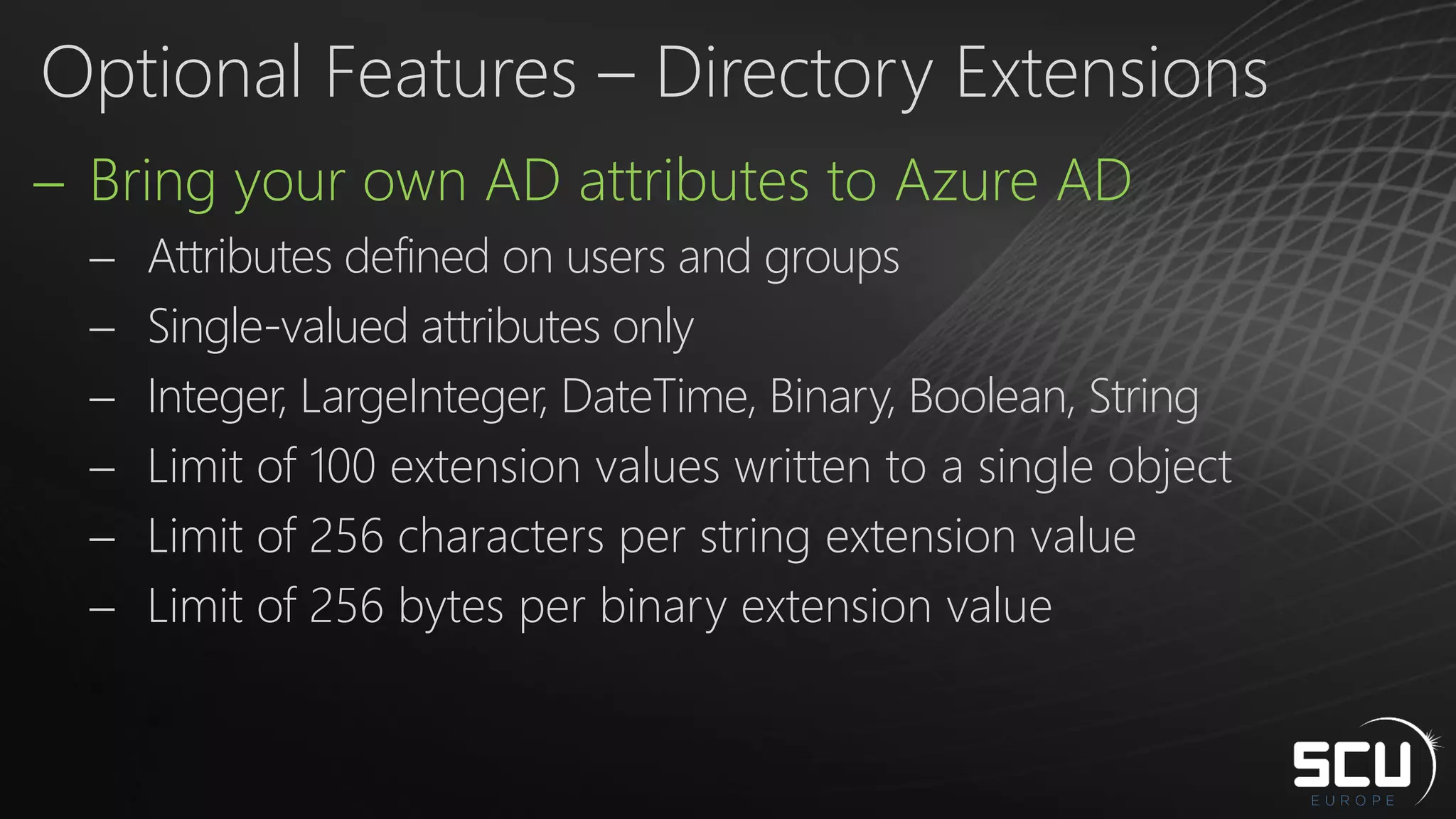
 Bring your own AD attributes to Azure AD
 Attributes defined on users and groups
 Single-valued attributes only
 Integer, LargeInteger, DateTime, Binary, Boolean, String
 Limit of 100 extension values written to a single object
 Limit of 256 characters per string extension value
 Limit of 256 bytes per binary extension value
Optional Features – Directory Extensions
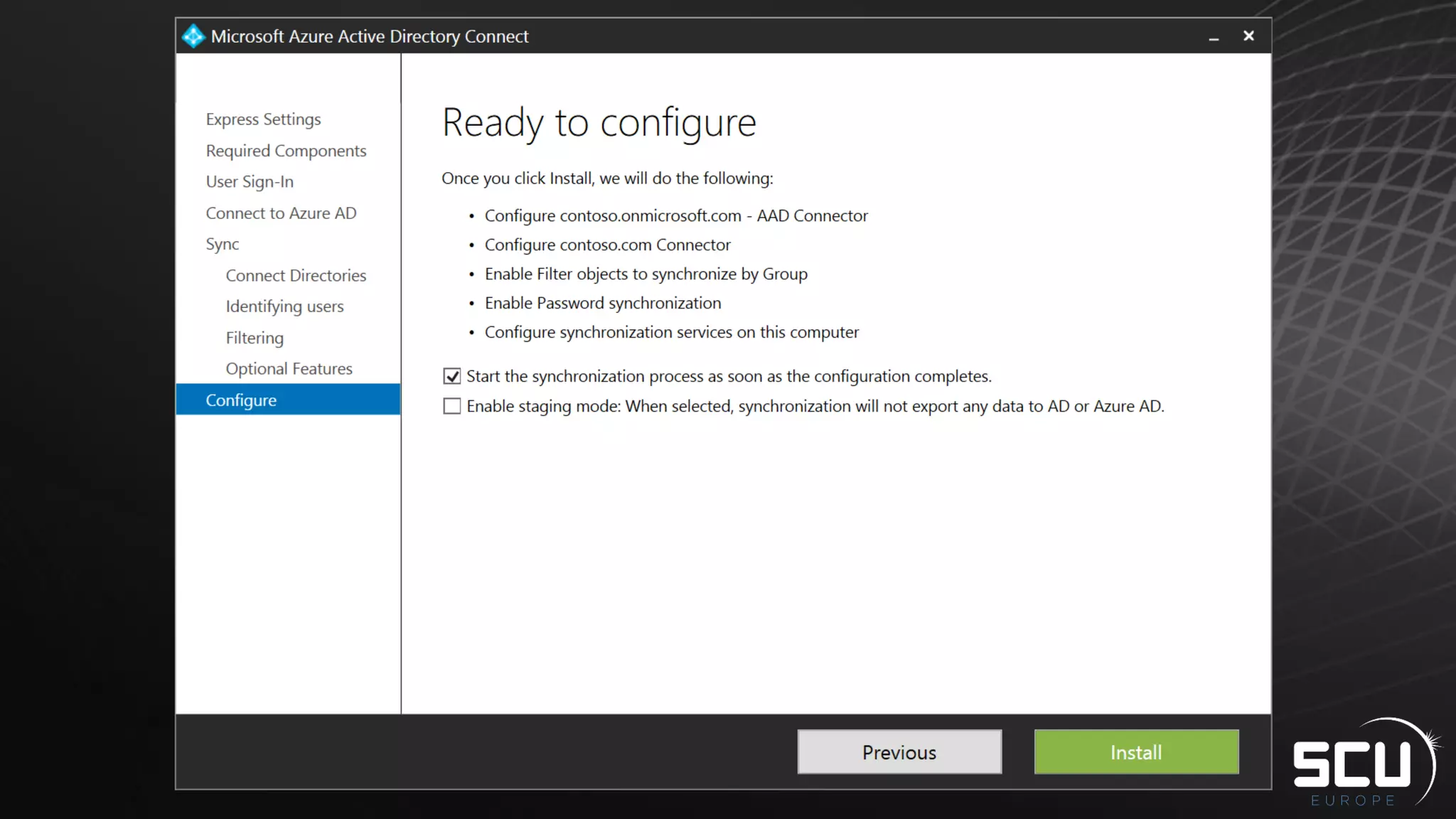
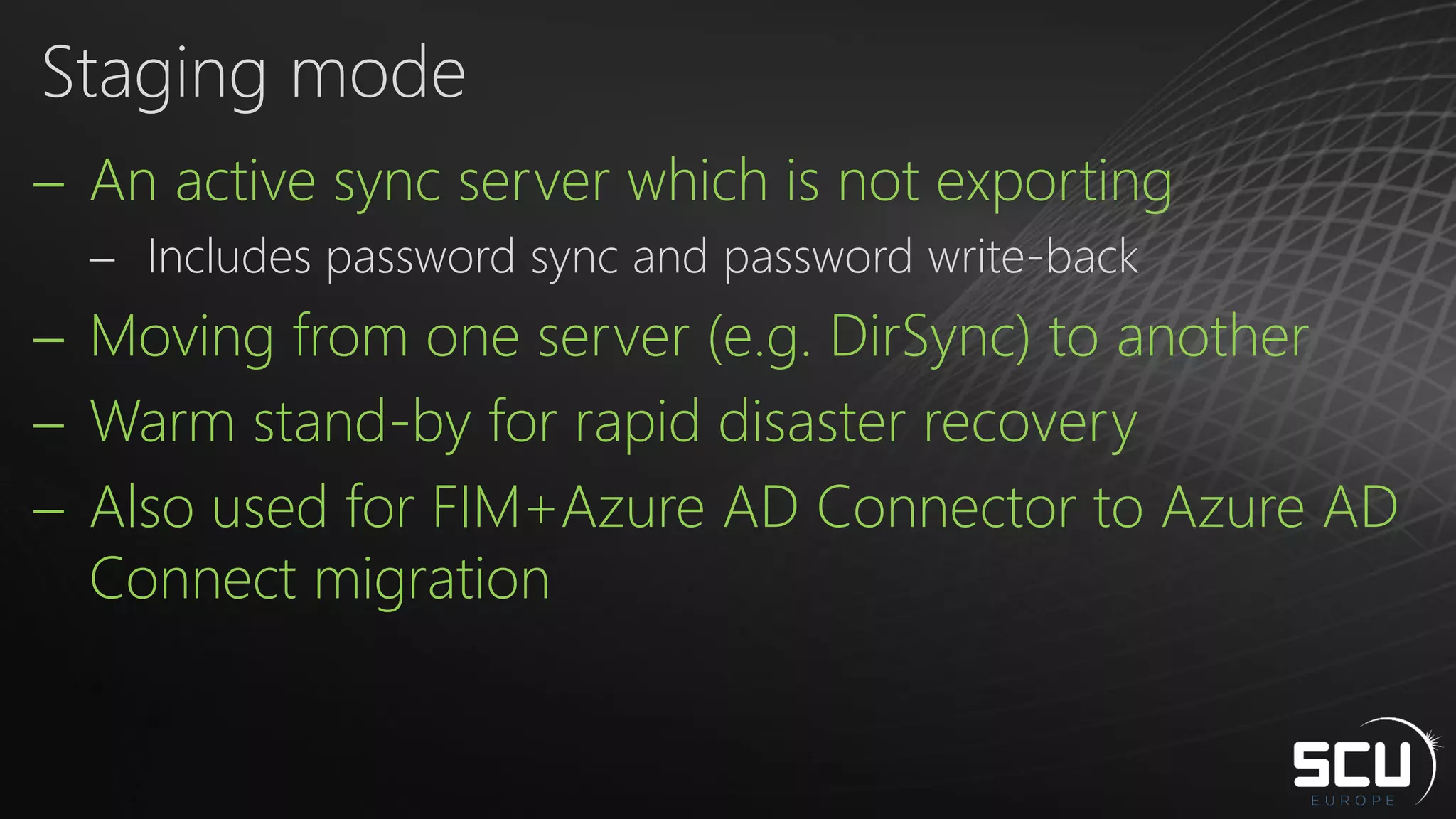
 An active sync server which is not exporting
 Includes password sync and password write-back
 Moving from one server (e.g. DirSync) to another
 Warm stand-by for rapid disaster recovery
 Also used for FIM+Azure AD Connector to Azure AD
Connect migration
Staging mode
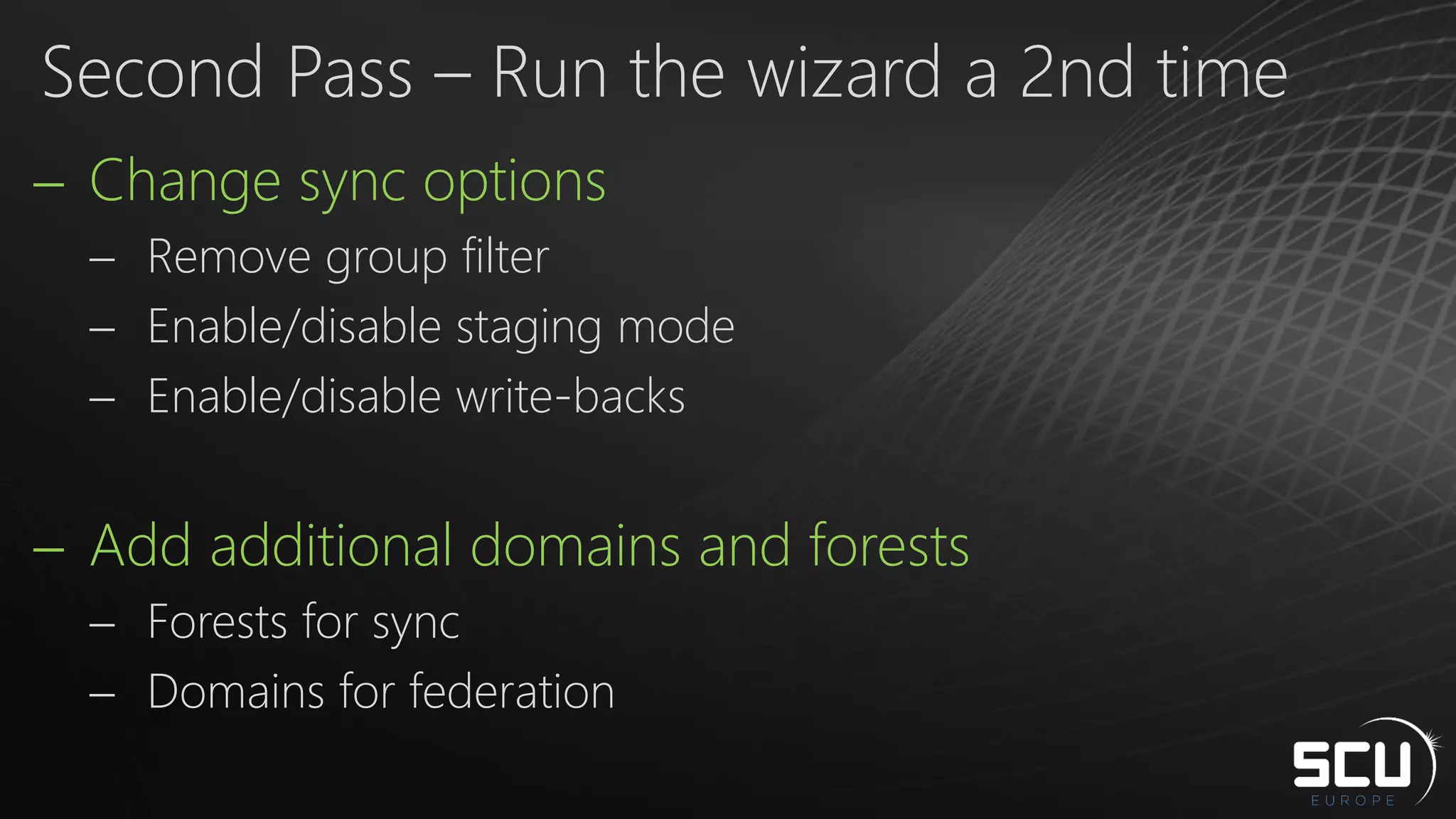
 Change sync options
 Remove group filter
 Enable/disable staging mode
 Enable/disable write-backs
 Add additional domains and forests
 Forests for sync
 Domains for federation
Second Pass – Run the wizard a 2nd time
Demo
Custom Setup: Enable Federation
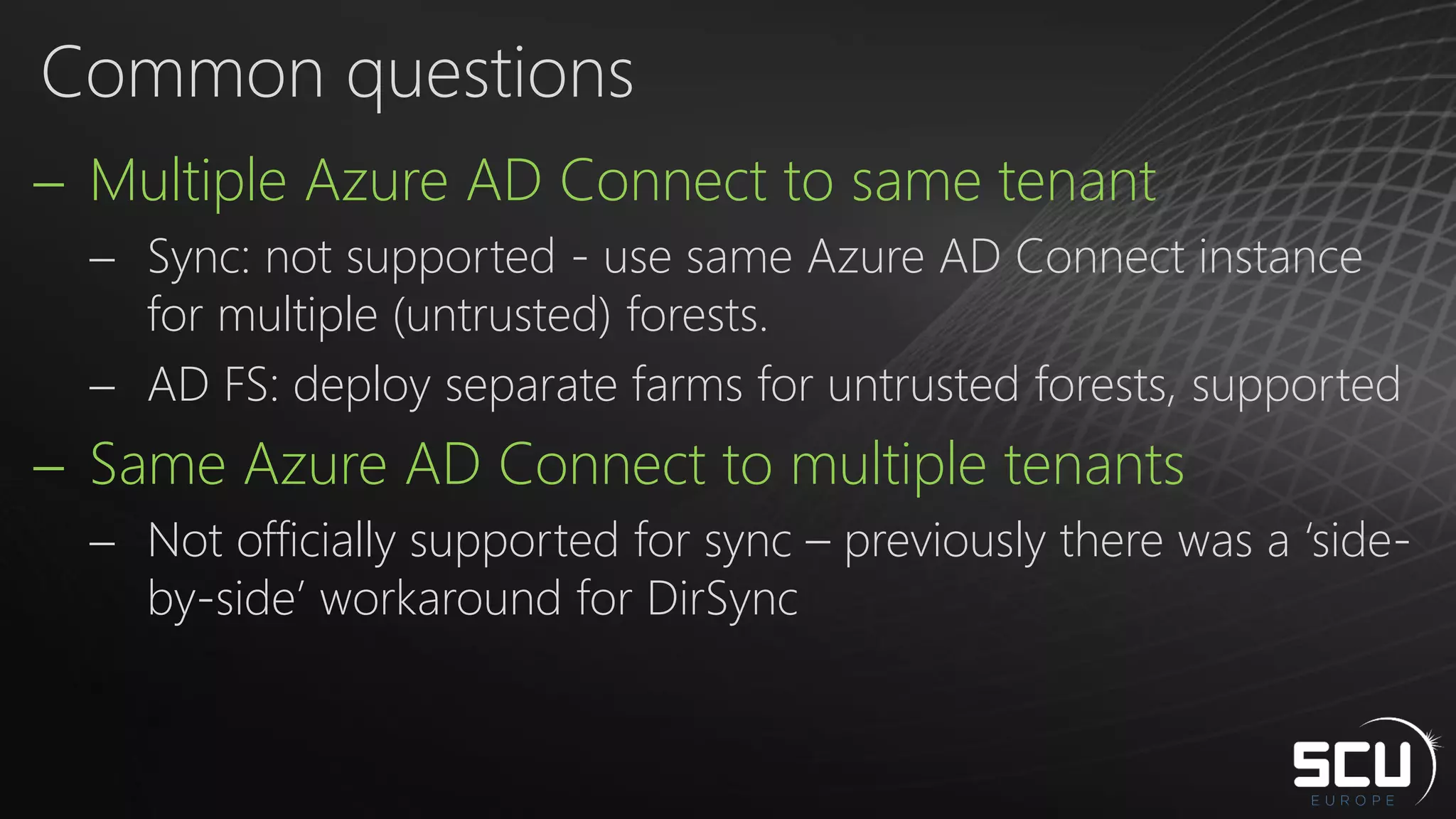
 Multiple Azure AD Connect to same tenant
 Sync: not supported - use same Azure AD Connect instance
for multiple (untrusted) forests.
 AD FS: deploy separate farms for untrusted forests, supported
 Same Azure AD Connect to multiple tenants
 Not officially supported for sync – previously there was a ‘side-
by-side’ workaround for DirSync
Common questions
 Included in Azure AD/Office 365 license:
 The installation wizard
 Synchronize from on-premises to Azure AD regardless of
source directory
 Write-back for Exchange hybrid deployment
 Requires Azure AD Premium:
 Write-back (password, user, group, ….)
 Additional licenses required for:
 SQL Server if needed
Licensing
 Accidental delete prevention
 On by default
 Cannot export more than 500 deletes (default)
 Can be configured with:
 Enable-ADSyncExportDeletionThreshold
 Disable-ADSyncExportDeletionThreshold
 Configuration stored in Azure AD
Export Deletion Threshold
Monitor Your Hybrid Identity!
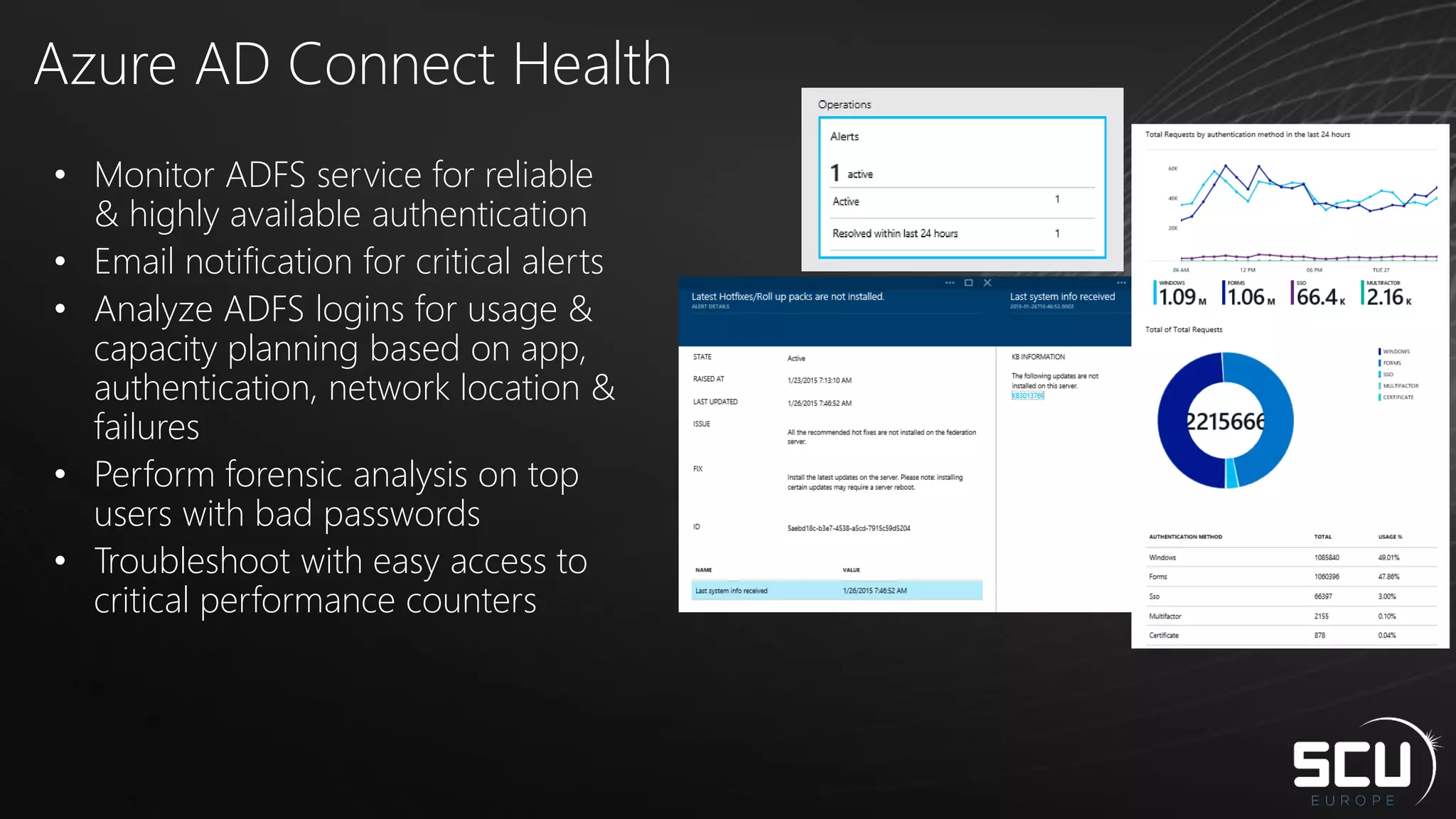
Azure AD Connect Health
• Monitor ADFS service for reliable
& highly available authentication
• Email notification for critical alerts
• Analyze ADFS logins for usage &
capacity planning based on app,
authentication, network location &
failures
• Perform forensic analysis on top
users with bad passwords
• Troubleshoot with easy access to
critical performance counters
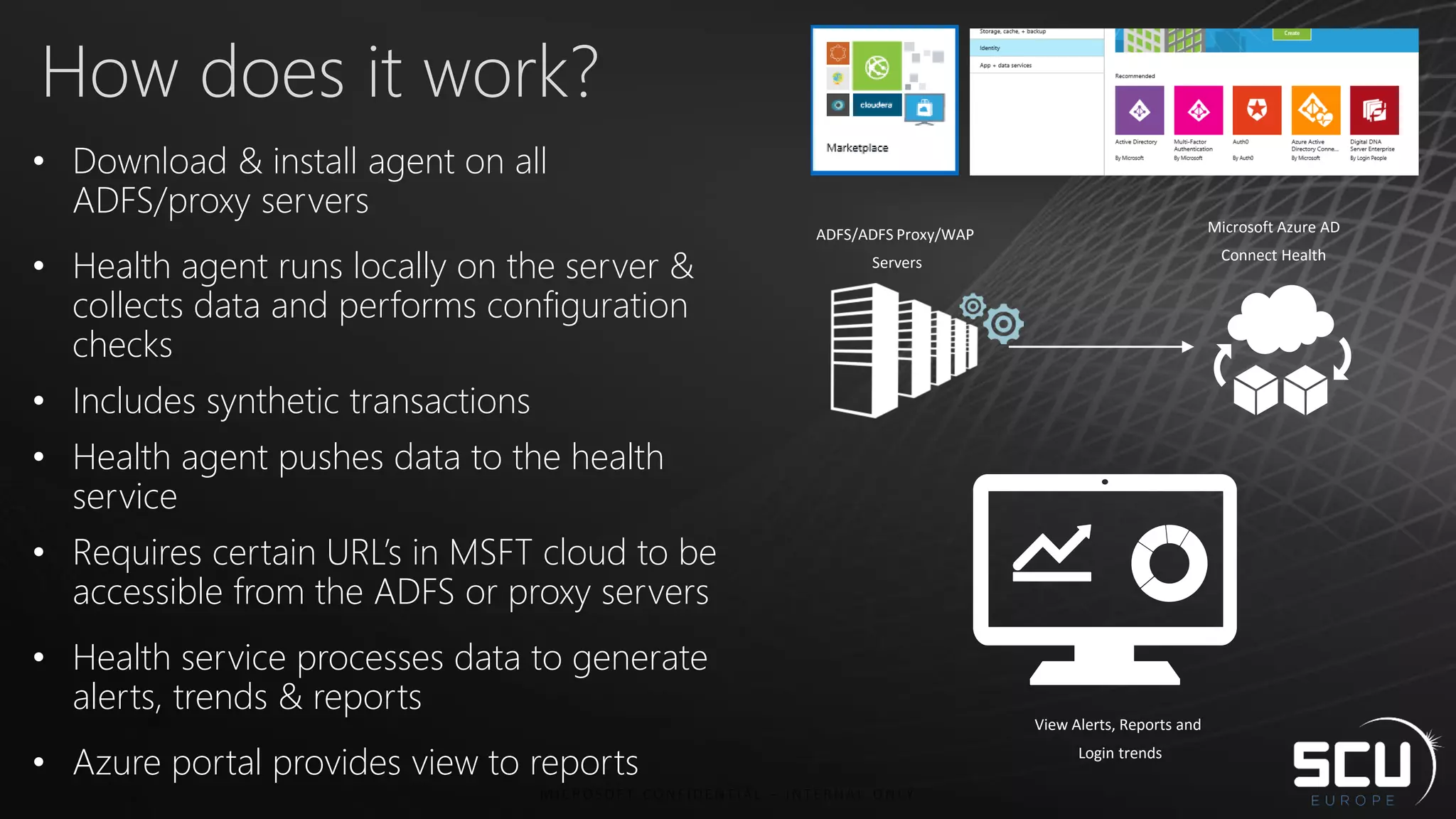
How does it work?
• Download & install agent on all
ADFS/proxy servers
• Health agent runs locally on the server &
collects data and performs configuration
checks
• Includes synthetic transactions
• Health agent pushes data to the health
service
• Requires certain URL’s in MSFT cloud to be
accessible from the ADFS or proxy servers
• Health service processes data to generate
alerts, trends & reports
• Azure portal provides view to reports
ADFS/ADFS Proxy/WAP
Servers
Microsoft Azure AD
Connect Health
View Alerts, Reports and
Login trends
Demo
Azure AD Connect Health
 Session Objective(s):
 Understand the default configurations the wizard creates
 Understand what can be done with the wizard and what
requires additional config
 Azure AD Connect is the (sync+authn) tool going
forward for connecting on premise directories to
Azure AD / O365
Session Objectives And Takeaways
Q & A Time...
Next Session 14:30 – 15:30:
"Azure Automation – Introduction
Jakob Gottlieb Svendsen"
Thanks To All Our Sponsors
We Need Your Feedback
 SCU Europe session planner planning.systemcenteruniverse.ch
 SCU Europe WP app
 Watch out for a survey invitation after the conference

Get your Hybrid Identity in 4 steps with Azure AD Connect

  • 1.
    Azure AD Connect Getyour Hybrid Identity in four steps! Ronny de Jong Consultant & MVP | Inovativ @ronnydejong
  • 2.
    Agenda  Making HybridIdentity Simple  More topologies, more scenarios  Walk through Express & Custom Setup  Monitor your Hybrid Identity
  • 3.
    Making Hybrid IdentitySimple? - Today
  • 4.
    Self-service Single sign on ••••••••••• Username Identityas the control plane Simple connection Cloud SaaS Azure Office 365Public cloud Other Directories Windows Server Active Directory On-premises Microsoft Azure Active Directory
  • 5.
    Going beyond on-premises IDCpredicts that 70 percent of organizations will embrace a cloud-first strategy by 2016, getting there on their own pace over a number of years, with many living in a hybrid environment for quite some time. That flexibility— living in both worlds—even with a cloud-first strategy, is nonnegotiable.1 1 Source: IDC CIO Agenda Webinar, 2013.
  • 6.
    Making hybrid identitysimple! Azure Active Directory Connect Consolidated deployment assistant for your identity bridge components
  • 7.
     DirSync –supported, available in Office 365 portal  There is no announcement of deprecation yet.  Once that announcement occurs, at least 1 year of support remains.  Azure AD Sync – supported.  Guide new deployments to Azure AD Connect.  Azure AD Connect is GA – available in Azure AD Portal. New deployments should use this! Which tools are supported?
  • 8.
     DirSync (<50kobjects)  In-place migration of all supported custom configurations.  Will not migrate unsupported configurations (such as removed attribute flows). Upgrade from DirSync & Azure AD Sync
  • 9.
     DirSync (>50kobjects)  Side-by-side deployment. Export DirSync configuration and import in Azure AD Connect.  On DirSync box, wizard prompts you to export config file.  On new box, @ cmd prompt run AzureADConnect.exe /migrate, specify config file.  Once full import and full sync complete, uninstall dirsync on old box, on new box run wizard second time to turn off staging mode  Azure AD Sync  In-place upgrade. Upgrade from DirSync & Azure AD Sync
  • 10.
    Making Hybrid IdentitySimple Azure AD Connect with Express Settings  Use one tool instead of many  Get up and running quickly (4 clicks)  Start here, then scale up or add options  Custom options to address more complex scenarios
  • 11.
  • 12.
  • 13.
     Multi foresttopologies  Use a full SQL Server edition for sync  Deploy a pilot using just a few users in a group  Don’t start sync right away (‘staging mode’)  Sign on using federation  Azure AD Premium features (write back passwords, users, groups, and devices from the cloud)  Sync custom directory attributes to the cloud Custom settings allow more advanced options
  • 14.
     For allscenarios (Express Settings or Custom)  Office 365 or Azure AD subscription – free trial is OK  For custom Azure AD domains, configure your public DNS records  AD users have UPNs (IDFix)  Just for AD FS  SSL certificate is trusted on all ADFS+WAP host (Use a certificate based on a key pair generated by a legacy Cryptographic Service Provider (CSP). Certificates with the CNG private key are not supported).  Enable WinRM on all remote targets  Federation service name resolves  For write-back scenarios  AAD Premium, prepare Active Directory Make sure you do first
  • 16.
     Choose Passwordsync for the most common deployment needs  Federation with ADFS is an option for customers that have more unique needs Choosing Password Sync or AD FS for Sign On • You already have AD FS or a 3rd party federation provider • Security policy prohibits password hashes being sync’d to the cloud • You require desktop SSO from domain joined machines on the corporate network • You require some specific capabilities AD FS has 1. on premises multi-factor authentication or smart card support for sign on 2. soft account lockout or AD work hours policy 3. conditional access for both on premises and cloud resources
  • 17.
     Synchronizes ahash of the password hash  The actual password never leaves on-premises and is not known by Azure AD  When enabled, on-premises password policies apply  Password complexity policy  Password expiration policy  Protects password against pass the hash attacks  Cannot be used to access any on-premises resources  Can be used as a backup for federation  If password hashes are present in Azure AD, allows for a quick fail-over Sign-in – password sync
  • 18.
    Common multi-forest topologies Separateforests Each object in every forest will be represented in Azure AD. Forests with GALSync Users and Contacts should join on mail attribute and be represented only once. Account-Resource forests One or many Account forests with enabled accounts and one Resource forest with disabled accounts. Joined on objectSID and msExchMasterAccountSID
  • 21.
     Intended tomake it easy to pilot and evaluate Azure AD and Office 365  In from AD for User, Group, and Contact -> sets cloudFiltered to TRUE if NOT in group  When you add/remove users from group -> they are added/removed in AAD  Only objects which are direct members of the group will be present in Azure AD  Remove the filter when ready to ‘go live’  2nd pass Wizard option under Customize Synchronization Options Filter users and devices based on group
  • 23.
     Password write-back Change and set password in Azure AD and have the password policy verified with on-premise Windows Server Active Directory.  User write-back  A user created in Azure AD is created in on-premise AD. Optional Features – Write-back
  • 24.
     Group write-back “Groups in Office 365” will be written back to your on-premise Exchange forest (you need Exchange 2013 CU8 or later)  These groups are mastered in Azure AD  Does not support security groups or distribution groups  Device write-back  Requires Windows Server 2012 R2 AD schema, create configuration object and container Optional Features – Write-back cont’d
  • 25.
     Bring yourown AD attributes to Azure AD  Attributes defined on users and groups  Single-valued attributes only  Integer, LargeInteger, DateTime, Binary, Boolean, String  Limit of 100 extension values written to a single object  Limit of 256 characters per string extension value  Limit of 256 bytes per binary extension value Optional Features – Directory Extensions
  • 27.
     An activesync server which is not exporting  Includes password sync and password write-back  Moving from one server (e.g. DirSync) to another  Warm stand-by for rapid disaster recovery  Also used for FIM+Azure AD Connector to Azure AD Connect migration Staging mode
  • 28.
     Change syncoptions  Remove group filter  Enable/disable staging mode  Enable/disable write-backs  Add additional domains and forests  Forests for sync  Domains for federation Second Pass – Run the wizard a 2nd time
  • 29.
  • 30.
     Multiple AzureAD Connect to same tenant  Sync: not supported - use same Azure AD Connect instance for multiple (untrusted) forests.  AD FS: deploy separate farms for untrusted forests, supported  Same Azure AD Connect to multiple tenants  Not officially supported for sync – previously there was a ‘side- by-side’ workaround for DirSync Common questions
  • 31.
     Included inAzure AD/Office 365 license:  The installation wizard  Synchronize from on-premises to Azure AD regardless of source directory  Write-back for Exchange hybrid deployment  Requires Azure AD Premium:  Write-back (password, user, group, ….)  Additional licenses required for:  SQL Server if needed Licensing
  • 32.
     Accidental deleteprevention  On by default  Cannot export more than 500 deletes (default)  Can be configured with:  Enable-ADSyncExportDeletionThreshold  Disable-ADSyncExportDeletionThreshold  Configuration stored in Azure AD Export Deletion Threshold
  • 33.
  • 34.
    Azure AD ConnectHealth • Monitor ADFS service for reliable & highly available authentication • Email notification for critical alerts • Analyze ADFS logins for usage & capacity planning based on app, authentication, network location & failures • Perform forensic analysis on top users with bad passwords • Troubleshoot with easy access to critical performance counters
  • 35.
    How does itwork? • Download & install agent on all ADFS/proxy servers • Health agent runs locally on the server & collects data and performs configuration checks • Includes synthetic transactions • Health agent pushes data to the health service • Requires certain URL’s in MSFT cloud to be accessible from the ADFS or proxy servers • Health service processes data to generate alerts, trends & reports • Azure portal provides view to reports ADFS/ADFS Proxy/WAP Servers Microsoft Azure AD Connect Health View Alerts, Reports and Login trends
  • 36.
  • 37.
     Session Objective(s): Understand the default configurations the wizard creates  Understand what can be done with the wizard and what requires additional config  Azure AD Connect is the (sync+authn) tool going forward for connecting on premise directories to Azure AD / O365 Session Objectives And Takeaways
  • 38.
    Q & ATime... Next Session 14:30 – 15:30: "Azure Automation – Introduction Jakob Gottlieb Svendsen"
  • 39.
    Thanks To AllOur Sponsors
  • 40.
    We Need YourFeedback  SCU Europe session planner planning.systemcenteruniverse.ch  SCU Europe WP app  Watch out for a survey invitation after the conference