I/o SYSTEM & Case study
Submitted To:
Ms. R. Madhubala, MCA.,
By
G.Lavanya(14BIT010)
Disk Structure
Disk Scheduling
Disk Management
Direct Memory Access
Swap-Space Management
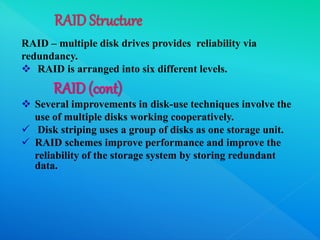
RAID Structure
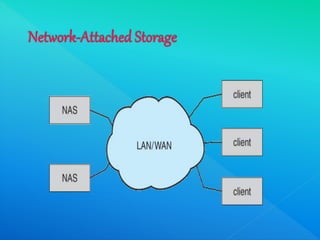
Network Attached Storage
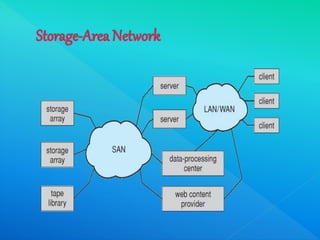
Disk Attachment
Stable-Storage Implementation
Windows 2000
MS-DOS Environment
 Disk drives are addressed as large 1 -dimensional arrays
of logical blocks , where the logical block is the smallest
unit of transfer.
 The 1 -dimensional array of logical blocks is mapped
into the sectors of the disk sequentially.
 Sector 0 is the first sector of the first track on the
outermost cylinder.
 Mapping proceeds in order through that track, then the
rest of the tracks in that cylinder, and then through the
rest of the cylinders from outermost to innermost.
 The operating system is responsible for using hardware
 efficiently — for the disk drives, this means having a fast
access time and disk bandwidth.
 Access time has two major components
 Seek time is the time for the disk are to move the heads to
the cylinder containing the desired sector.
 Rotational latency is the additional time waiting for the
disk to rotate the desired sector to the disk head.
 Minimize seek time
 Seek time » seek distance
 Disk bandwidth is the total number of bytes transferred,
divided by the total time between the first request for
service and the completion of the last transfer.
 SSTF is common and has a natural appeal
 SCAN and C- SCAN perform better for systems that
place a heavy load on the disk.
 Performance depends on the number and types of
requests.
 Requests for disk service can be influenced by the fileal
location method.
 The disk- scheduling algorithm should be written as a
separate module of the operating system, allowing it to be
replaced with a different algorithm if necessary.
 Either SSTF or LOOK is a reasonable choice for the
default algorithm.
 Low-level formatting , or physical formatting — Dividing
a disk into sectors that the disk controller can read and
write.
 To use a disk to hold files, the operating system still
needs to record its own data structures on the disk.
 Partition the disk into one or more groups of cylinders.
 Logical formatting or “making a file system”.
 Boot block initializes system.
 The bootstrap is stored in ROM.
 Bootstrap loader program.
 Methods such as sector sparing used to handle bad
blocks.
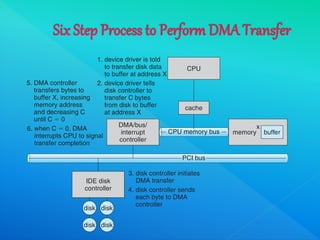
 Used to avoid programmed I/O (one byte at a time) for large
data movement
 Requires DMA controller
 Bypasses CPU to transfer data directly between I/O device
and memory
 OS writes DMA command block into memory
 Source and destination addresses
 Read or write mode
 Count of bytes
 Writes location of command block to DMA controller
 Bus mastering of DMA controller – grabs bus from CPU
• Cycle stealing from CPU but still much more efficient
 When done, interrupts to signal completion
 Version that is aware of virtual addresses can be even more
efficient - DVMA
 Swap-space — Virtual memory uses disk space as an
extension of main memory.
 Swap-space can be carved out of the normal file
system or more commonly, it can be in a separate disk
partition.
 Swap-space management:
 4.3BSD allocates swap space when process starts; holds
text segment (the program) and data segment.
 Kernel uses swap maps to track swap-space use.
 Solaris 2 allocates swap space only when a page is forced
out of physical memory, not when the virtual memory
page is first created.
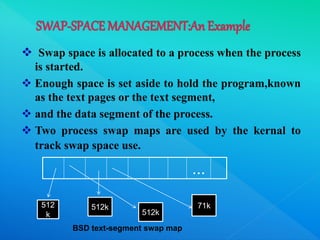
 Swap space is allocated to a process when the process
is started.
 Enough space is set aside to hold the program,known
as the text pages or the text segment,
 and the data segment of the process.
 Two process swap maps are used by the kernal to
track swap space use.
...
512
k
512k
512k
71k
BSD text-segment swap map
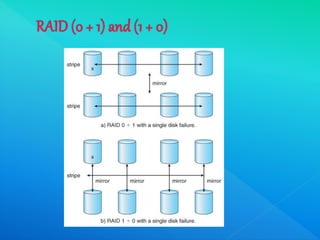
RAID – multiple disk drives provides reliability via
redundancy.
 RAID is arranged into six different levels.
RAID (cont)
 Several improvements in disk-use techniques involve the
use of multiple disks working cooperatively.
 Disk striping uses a group of disks as one storage unit.
 RAID schemes improve performance and improve the
reliability of the storage system by storing redundant
data.
Disks may be attached one of two ways:
1. Host attached via an I/O port
2. Network attached via a network connection
 Microsoft windows 2000 operating system is a 32-bit
preemptive multitask operating system for Intel
Pentium and later microprocessors.
 The success windows NT operating system , it was
previously named windows version 5.0.
History:
 In 1980’s Microsoft and IBM cooperated to develop the
os/2 operating system.
 Thus portability now refers to portability Intel
architecture systems.
 Extensibility refers to the capacity of an operating system
to keep advances in computing technology.
 Among them environmental subsystems that can different
operating systems.
 An operating system is portable if it can be moved from
one hardware to another with relatively few changes.
 All processor –dependent code is isolated in a link library
called the Hardware-abstraction layer(HAL).
 It provides source level compatibility to application that a
IEEE 1003.1
 The user-mode subsystem are in two categories.The
environmental subsystem emulates different
operating systems that was subsystems provide
security function.
Hardware –Abstraction Layer:
 HAL is the layer of software that hides hardware
differences from of the operating system , to help make
windows 2000 portable.
 For performance reasons , I/O drivers can access the
hardware directly.
 The kernel of windows 2000 provides the foundation for
the executive and subsystems.
 The kernel is never paged out of memory and its execution
preempted.
 An object type in windows 2000 is a subsystem data type
that has a set of attributes and a set of operations.
 The thread object is the entity that is run kernel and is
associated with a process object.
 Timer objects are used to keep track of the time and to
signal timeouts when operations take and need to be
interrupted.
 The virtual memory operation of the windows 2000
executive is the Virtual memory manager.
 The VM manager windows 2000 uses a page-based
management scheme with a page size of the data that are
assigned to a process but are not in physical memory
stored in the paging file on disk.
 Windows provides an alternative ,called a section object
to present a block of memory.
 I/O manager is responsible for file systems cache
management device and network drivers.
 The I/O Manager converts the requests it receives into a
standard called I/O request packet(IRP).
 Eack cache block is described a virtual-address control
block(VACB)that stores the virtual address and offset for
that view as well as the number of processes that are using
that manager.
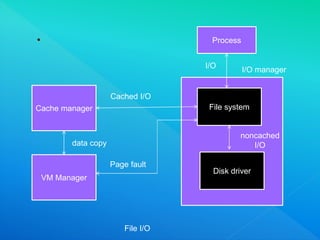
Disk driver
File system
Process
Cache manager
VM Manager
Cached I/O
data copy
Page fault
I/O
I/O manager
noncached
I/O
File I/O
 The MS-DOS environment does not have the
complexity of the other 2000 environmental
subsystems.
 It is provide by a win32 application the virtual DOS
machine(VDM).
File system:
 Historically MS-DOS systems have used the file
allocation table.
 The 16-bit FAT file system has several shortcomings
including fragmentation a size limitation of 2 GB and
a access protection.
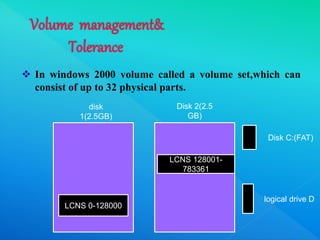
 In windows 2000 volume called a volume set,which can
consist of up to 32 physical parts.
LCNS 0-128000
LCNS 128001-
783361
Disk C:(FAT)
logical drive D
disk
1(2.5GB)
Disk 2(2.5
GB)
 The several message-block(SMB) protocol was first
introduced.
 The system uses the protocol to send I/O request over the
network SMB protocol has four message types.
 Windows 2000 uses the data-link control(DLC) protocol to
access IBM frames and HP printers that are connected
directly to the network.
 The AppleTalk protocol was designed as a low-cost
connectivity .

I/O System and Case study

  • 1.
    I/o SYSTEM &Case study Submitted To: Ms. R. Madhubala, MCA., By G.Lavanya(14BIT010)
  • 2.
    Disk Structure Disk Scheduling DiskManagement Direct Memory Access Swap-Space Management RAID Structure Network Attached Storage Disk Attachment Stable-Storage Implementation Windows 2000 MS-DOS Environment
  • 3.
     Disk drivesare addressed as large 1 -dimensional arrays of logical blocks , where the logical block is the smallest unit of transfer.  The 1 -dimensional array of logical blocks is mapped into the sectors of the disk sequentially.  Sector 0 is the first sector of the first track on the outermost cylinder.  Mapping proceeds in order through that track, then the rest of the tracks in that cylinder, and then through the rest of the cylinders from outermost to innermost.
  • 4.
     The operatingsystem is responsible for using hardware  efficiently — for the disk drives, this means having a fast access time and disk bandwidth.  Access time has two major components  Seek time is the time for the disk are to move the heads to the cylinder containing the desired sector.  Rotational latency is the additional time waiting for the disk to rotate the desired sector to the disk head.  Minimize seek time  Seek time » seek distance  Disk bandwidth is the total number of bytes transferred, divided by the total time between the first request for service and the completion of the last transfer.
  • 5.
     SSTF iscommon and has a natural appeal  SCAN and C- SCAN perform better for systems that place a heavy load on the disk.  Performance depends on the number and types of requests.  Requests for disk service can be influenced by the fileal location method.  The disk- scheduling algorithm should be written as a separate module of the operating system, allowing it to be replaced with a different algorithm if necessary.  Either SSTF or LOOK is a reasonable choice for the default algorithm.
  • 6.
     Low-level formatting, or physical formatting — Dividing a disk into sectors that the disk controller can read and write.  To use a disk to hold files, the operating system still needs to record its own data structures on the disk.  Partition the disk into one or more groups of cylinders.  Logical formatting or “making a file system”.  Boot block initializes system.  The bootstrap is stored in ROM.  Bootstrap loader program.  Methods such as sector sparing used to handle bad blocks.
  • 7.
     Used toavoid programmed I/O (one byte at a time) for large data movement  Requires DMA controller  Bypasses CPU to transfer data directly between I/O device and memory  OS writes DMA command block into memory  Source and destination addresses  Read or write mode  Count of bytes  Writes location of command block to DMA controller  Bus mastering of DMA controller – grabs bus from CPU • Cycle stealing from CPU but still much more efficient  When done, interrupts to signal completion  Version that is aware of virtual addresses can be even more efficient - DVMA
  • 9.
     Swap-space —Virtual memory uses disk space as an extension of main memory.  Swap-space can be carved out of the normal file system or more commonly, it can be in a separate disk partition.  Swap-space management:  4.3BSD allocates swap space when process starts; holds text segment (the program) and data segment.  Kernel uses swap maps to track swap-space use.  Solaris 2 allocates swap space only when a page is forced out of physical memory, not when the virtual memory page is first created.
  • 10.
     Swap spaceis allocated to a process when the process is started.  Enough space is set aside to hold the program,known as the text pages or the text segment,  and the data segment of the process.  Two process swap maps are used by the kernal to track swap space use. ... 512 k 512k 512k 71k BSD text-segment swap map
  • 11.
    RAID – multipledisk drives provides reliability via redundancy.  RAID is arranged into six different levels. RAID (cont)  Several improvements in disk-use techniques involve the use of multiple disks working cooperatively.  Disk striping uses a group of disks as one storage unit.  RAID schemes improve performance and improve the reliability of the storage system by storing redundant data.
  • 15.
    Disks may beattached one of two ways: 1. Host attached via an I/O port 2. Network attached via a network connection
  • 16.
     Microsoft windows2000 operating system is a 32-bit preemptive multitask operating system for Intel Pentium and later microprocessors.  The success windows NT operating system , it was previously named windows version 5.0. History:  In 1980’s Microsoft and IBM cooperated to develop the os/2 operating system.  Thus portability now refers to portability Intel architecture systems.
  • 17.
     Extensibility refersto the capacity of an operating system to keep advances in computing technology.  Among them environmental subsystems that can different operating systems.  An operating system is portable if it can be moved from one hardware to another with relatively few changes.  All processor –dependent code is isolated in a link library called the Hardware-abstraction layer(HAL).  It provides source level compatibility to application that a IEEE 1003.1
  • 18.
     The user-modesubsystem are in two categories.The environmental subsystem emulates different operating systems that was subsystems provide security function. Hardware –Abstraction Layer:  HAL is the layer of software that hides hardware differences from of the operating system , to help make windows 2000 portable.  For performance reasons , I/O drivers can access the hardware directly.
  • 19.
     The kernelof windows 2000 provides the foundation for the executive and subsystems.  The kernel is never paged out of memory and its execution preempted.  An object type in windows 2000 is a subsystem data type that has a set of attributes and a set of operations.  The thread object is the entity that is run kernel and is associated with a process object.  Timer objects are used to keep track of the time and to signal timeouts when operations take and need to be interrupted.
  • 20.
     The virtualmemory operation of the windows 2000 executive is the Virtual memory manager.  The VM manager windows 2000 uses a page-based management scheme with a page size of the data that are assigned to a process but are not in physical memory stored in the paging file on disk.  Windows provides an alternative ,called a section object to present a block of memory.
  • 21.
     I/O manageris responsible for file systems cache management device and network drivers.  The I/O Manager converts the requests it receives into a standard called I/O request packet(IRP).  Eack cache block is described a virtual-address control block(VACB)that stores the virtual address and offset for that view as well as the number of processes that are using that manager.
  • 22.
    Disk driver File system Process Cachemanager VM Manager Cached I/O data copy Page fault I/O I/O manager noncached I/O File I/O
  • 23.
     The MS-DOSenvironment does not have the complexity of the other 2000 environmental subsystems.  It is provide by a win32 application the virtual DOS machine(VDM). File system:  Historically MS-DOS systems have used the file allocation table.  The 16-bit FAT file system has several shortcomings including fragmentation a size limitation of 2 GB and a access protection.
  • 24.
     In windows2000 volume called a volume set,which can consist of up to 32 physical parts. LCNS 0-128000 LCNS 128001- 783361 Disk C:(FAT) logical drive D disk 1(2.5GB) Disk 2(2.5 GB)
  • 25.
     The severalmessage-block(SMB) protocol was first introduced.  The system uses the protocol to send I/O request over the network SMB protocol has four message types.  Windows 2000 uses the data-link control(DLC) protocol to access IBM frames and HP printers that are connected directly to the network.  The AppleTalk protocol was designed as a low-cost connectivity .