Digital Professionalism & Social Media
for Post Graduate Researchers
Bernadette John
Bernadette.john@digitalprofessionalism.com
27th February, 2014
Biomedical Research Centre for Mental Health &
Dementia at SLAM
DIGITAL PROFESSIONALISM
• The competences and values expected of a
professional when engaged in social and
digital communication
Challenges presented by
Social Media
• Confusion about the extent to which
information is private
• Ease with which information can be broadcast
• Informality of social networking – can be quite
easy to fall foul of defamation laws or act
“unprofessionally”
• Personal & professional boundaries can be
rendered porous (J Shreather, BMA 2011)
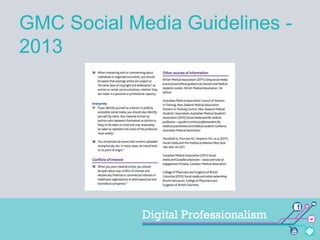
GMC Social Media Guidelines 2013
DIGITAL FOOTPRINT
A Digital Footprint is of interest to;
•
•
•
•

You personally
Your Profession
Your Employer
Your Patients
You Personally
Your Profession
Your Employer
Your Clients
Excuses people give for using
material from the internet
• There was no "copyright" logo or any other
watermark on the photo
• It is on the internet, therefore it is free to use
• I won't make money off this photo. It's just for
teaching/academic purposes
• I credited the photographer so it's good advertising
for him
(Adapted from Greenslade 2013)
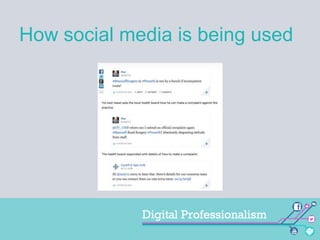
How social media is being used
REMEMBER
• If you are not a paying customer for the
applications you are using, you are the
commodity.
Case Study
• Select a role model from your Area.
• Research that person online
• List the elements that you find in terms of
positive and negative
•
•
•
•
•
•
•
•
•
•
•
•
•
•
•
•
•
•
•
•
•
•

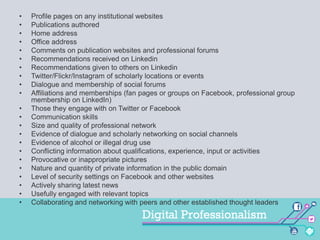
Profile pages on any institutional websites
Publications authored
Home address
Office address
Comments on publication websites and professional forums
Recommendations received on Linkedin
Recommendations given to others on Linkedin
Twitter/Flickr/Instagram of scholarly locations or events
Dialogue and membership of social forums
Affiliations and memberships (fan pages or groups on Facebook, professional group
membership on LinkedIn)
Those they engage with on Twitter or Facebook
Communication skills
Size and quality of professional network
Evidence of dialogue and scholarly networking on social channels
Evidence of alcohol or illegal drug use
Conflicting information about qualifications, experience, input or activities
Provocative or inappropriate pictures
Nature and quantity of private information in the public domain
Level of security settings on Facebook and other websites
Actively sharing latest news
Usefully engaged with relevant topics
Collaborating and networking with peers and other established thought leaders
Analysis
• Is there anything specific that makes this person more appealing as
a professional role model?
• Does this person create a good impression of those practicing this
profession?
• As a client, would you feel that the material you have found impacts
on your trust of the profession and the individual in a positive or
negative way?
• Can you find any material online about this person at all?
• How would that influence your perception of this person as a
professional?
Points for practice
• Search for yourself and conduct this exercise
on yourself
• Reflect on what elements you feel you should
be creating to embellish your professional
profile and personal Digital Profile
Resources
• StrengthsFinder by Tom Rath - an online gallup
tool to help establish your strengths
• Woolfram – analysis of your Facebook
presence
http://www.wolframalpha.com/facebook/
Privacy is Dead
• Professional is merging with public through
the ubiquitous adoption of social media
SOCIAL MEDIA REVOLUTION
• http://youtu.be/x0EnhXn5boM
The task of the modern educator is
not to cut down jungles but to
irrigate deserts” C.S. Lewis
Consciously architect your online
profile
- Your offline reputation too!
Deliberately amplify the quantity of positive
material to be found about you online and limit
the damage of anything negative
Brand Yourself
• Open accounts across at least 5 platforms
(Google +, Twitter, Facebook, Linkedin, Slideshare, Wordpress
blog)
• Use a familiar avatar, make your self easy to find
• Use a similar backdrop, theme, banner etc
• Buy yourname.com
• Consider everything that you do on your mobile device,
potentially public – Snapchat and Whats App too, even
comments on newspapers
• Google yourself regularly
INFOGRAPHICS
• Visualising data via infographics, and
promotion via social media can assist with
achieving broader reach for research
outcomes
LinkedIn
• Consider engaging in honest dialogue with
other researchers on your study about the
flaws and strengths of your research study – in
a specified group
• Reach out to and engage in dialogue with
established thought leaders in your area in
that group
Twitter
• Consider reaching out to appropriate editors in
broadsheet newspapers as a follower, build up
rapport
• Follow thought leaders in your area
• If numerous people speak from a dedicated
project account, sign your tweets
• Establish who will own the followers when the
study finishes
Use social media to:
• Access networks for peer support, engage with thought
leaders, engage in dialogue, reach research subjects,
publish research outcomes
• Showcase values, strengths & qualities – give an
authentic taste of who you are
• Establish thought leadership
• Demonstrate fluency and Digital Professionalism –
achieve an edge in a crowded workplace
• MAKE SOCIAL MEDIA YOUR UNFAIR ADVANTAGE

Digital Professionalism for Clinical Researchers

  • 1.
    Digital Professionalism &Social Media for Post Graduate Researchers Bernadette John Bernadette.john@digitalprofessionalism.com 27th February, 2014 Biomedical Research Centre for Mental Health & Dementia at SLAM
  • 2.
    DIGITAL PROFESSIONALISM • Thecompetences and values expected of a professional when engaged in social and digital communication
  • 3.
    Challenges presented by SocialMedia • Confusion about the extent to which information is private • Ease with which information can be broadcast • Informality of social networking – can be quite easy to fall foul of defamation laws or act “unprofessionally” • Personal & professional boundaries can be rendered porous (J Shreather, BMA 2011)
  • 4.
    GMC Social MediaGuidelines 2013
  • 5.
    DIGITAL FOOTPRINT A DigitalFootprint is of interest to; • • • • You personally Your Profession Your Employer Your Patients
  • 6.
  • 7.
  • 8.
  • 9.
  • 10.
    Excuses people givefor using material from the internet • There was no "copyright" logo or any other watermark on the photo • It is on the internet, therefore it is free to use • I won't make money off this photo. It's just for teaching/academic purposes • I credited the photographer so it's good advertising for him (Adapted from Greenslade 2013)
  • 11.
    How social mediais being used
  • 12.
    REMEMBER • If youare not a paying customer for the applications you are using, you are the commodity.
  • 13.
    Case Study • Selecta role model from your Area. • Research that person online • List the elements that you find in terms of positive and negative
  • 14.
    • • • • • • • • • • • • • • • • • • • • • • Profile pages onany institutional websites Publications authored Home address Office address Comments on publication websites and professional forums Recommendations received on Linkedin Recommendations given to others on Linkedin Twitter/Flickr/Instagram of scholarly locations or events Dialogue and membership of social forums Affiliations and memberships (fan pages or groups on Facebook, professional group membership on LinkedIn) Those they engage with on Twitter or Facebook Communication skills Size and quality of professional network Evidence of dialogue and scholarly networking on social channels Evidence of alcohol or illegal drug use Conflicting information about qualifications, experience, input or activities Provocative or inappropriate pictures Nature and quantity of private information in the public domain Level of security settings on Facebook and other websites Actively sharing latest news Usefully engaged with relevant topics Collaborating and networking with peers and other established thought leaders
  • 15.
    Analysis • Is thereanything specific that makes this person more appealing as a professional role model? • Does this person create a good impression of those practicing this profession? • As a client, would you feel that the material you have found impacts on your trust of the profession and the individual in a positive or negative way? • Can you find any material online about this person at all? • How would that influence your perception of this person as a professional?
  • 16.
    Points for practice •Search for yourself and conduct this exercise on yourself • Reflect on what elements you feel you should be creating to embellish your professional profile and personal Digital Profile
  • 17.
    Resources • StrengthsFinder byTom Rath - an online gallup tool to help establish your strengths • Woolfram – analysis of your Facebook presence http://www.wolframalpha.com/facebook/
  • 18.
    Privacy is Dead •Professional is merging with public through the ubiquitous adoption of social media
  • 19.
    SOCIAL MEDIA REVOLUTION •http://youtu.be/x0EnhXn5boM
  • 20.
    The task ofthe modern educator is not to cut down jungles but to irrigate deserts” C.S. Lewis
  • 21.
    Consciously architect youronline profile - Your offline reputation too! Deliberately amplify the quantity of positive material to be found about you online and limit the damage of anything negative
  • 22.
    Brand Yourself • Openaccounts across at least 5 platforms (Google +, Twitter, Facebook, Linkedin, Slideshare, Wordpress blog) • Use a familiar avatar, make your self easy to find • Use a similar backdrop, theme, banner etc • Buy yourname.com • Consider everything that you do on your mobile device, potentially public – Snapchat and Whats App too, even comments on newspapers • Google yourself regularly
  • 23.
    INFOGRAPHICS • Visualising datavia infographics, and promotion via social media can assist with achieving broader reach for research outcomes
  • 24.
    LinkedIn • Consider engagingin honest dialogue with other researchers on your study about the flaws and strengths of your research study – in a specified group • Reach out to and engage in dialogue with established thought leaders in your area in that group
  • 25.
    Twitter • Consider reachingout to appropriate editors in broadsheet newspapers as a follower, build up rapport • Follow thought leaders in your area • If numerous people speak from a dedicated project account, sign your tweets • Establish who will own the followers when the study finishes
  • 26.
    Use social mediato: • Access networks for peer support, engage with thought leaders, engage in dialogue, reach research subjects, publish research outcomes • Showcase values, strengths & qualities – give an authentic taste of who you are • Establish thought leadership • Demonstrate fluency and Digital Professionalism – achieve an edge in a crowded workplace • MAKE SOCIAL MEDIA YOUR UNFAIR ADVANTAGE

Editor's Notes

  • #3 Digital footprintDigital ShadowProduct endorsements, medical advice, A digital footprint is a trail left by an entity's interactions in a digital environment; including their usage of TV, mobile phone, internet and world wide web, mobile web and other devices and sensors It can be the history of your browsing/the comments you leave on a social network – newspaper/blog, your conversation via instant messaging/twitter, the images you loaded onto a Powerpoint and then published on a slidesharing website from a conference you attended (?creative commons license). Illegal downloading of music/games/filmsThen we have all of the images of partying/drug taking, homophobic comments, comments when drunkHave you searched for yourself online? What will your digital tattoo say about you in 1 year? In 5 years? In 10 years?
  • #4 Google is an extremely efficient search engine.The search applications available for Twitter are increasingly specific, increasingly effective.Consider very carefully, what you say about employers, Health Trusts, Patients, yourselves and colleagues.
  • #5 Consider yourself public – The GMC advises that if you are admitting that you a doctor, you must be explicit about your true identity. Consider yourself a professional in every space in which you communicate
  • #6 A digital footprint is a trail left by an entity's interactions in a digital environment; including their usage of TV, mobile phone, internet and world wide web, mobile web and other devices and sensors It can be the history of your browsing/the comments you leave on a social network – newspaper/blog, your conversation via instant messaging/twitter, the images you loaded onto a Powerpoint and then published on a slidesharing website from a conference you attended (?creative commons license). Illegal downloading of music/games/filmsThen we have all of the images of partying/drug taking, homophobic comments, comments when drunkHave youGgoogled yourselves? What will your digital tattoo say about you in 1 year? In 5 years? In 10 years?Bebo
  • #8 Your ProfessionInformation governance, new information governance guidelines will be implemented in 2015Update security software, ensure you use encrypted services when sharing patient data
  • #11 Your Employer1. There was no "copyright" logo or any other watermark on the photoCopyrights exist by default. A photographer does not have to specify on the photo or the website that the photo is protected by copyright.2. The photo is on the internet, therefore it is free to useA picture does not magically fall into the public domain when it's uploaded. The photographer keeps the copyright (though the exact number of years vary from 50 to 70, depending on the country).3. I found it on Google Image, therefore it is free to useGoogle Image is not a free stock photo agency. Google does not own pictures.4. It's on Facebook, and everything on Facebook is on public domainNo, as Facebook's terms of service say: "You own all of the content and information you post on Facebook."5. But I won't make money off this photo. It's just for [my blog/personal website/my Facebook page]Making money or not doesn't change a thing. It is still a copyright violation.
  • #12 GMC rules about the process that must be explored before striking someone off your list has been ignored here – resulted in a major social media crisis
  • #20 <object width="560" height="315"><param name="movie" value="//www.youtube.com/v/x0EnhXn5boM?hl=en_US&version=3&rel=0"></param><param name="allowFullScreen" value="true"></param><param name="allowscriptaccess" value="always"></param><embed src="//www.youtube.com/v/x0EnhXn5boM?hl=en_US&version=3&rel=0" type="application/x-shockwave-flash" width="560" height="315" allowscriptaccess="always" allowfullscreen="true"></embed></object>
  • #21 I believe that if we don’t train our staff on how to use social media well, we will end up having to terminate staff that otherwise have a positive contribution to make.
  • #22 Be clear about how you would handle flaming! If you manage or speak on any corporate accounts – ensure they are thoroughly risk assessed and that you have explored and established how you will cope with negativity. Familiarise yourself with great role models such as Paul Lewis from the Guardian, DamonGreen from ITV, the O2 social media masterclass! Act as a resource for others using social media.
  • #23 Make yourself easy to find. If your name is common, use your middle initial. Consider banners, font, colour schemes as part of your branding. Don’t accept friends requests from patients and think carefully before you accept friends requests from work colleagues.Perhaps pair up with someone on your course who does not know you so well and ask them to look you up. What can they see about you on your Facebook? The privacy settings are so fluid and change regularly.Ensure that others will be reassured by the material they discover about you online. Don’t leave your most prized asset to be formed by others.
  • #24 If you are involved in any dialogue about how you would use social media to promote your research – as part of a research project, consult widely. Develop a digital strategy and policy around how the accounts will be maintained and managed. Issues such as who will ultimately “own” follower, the voice you will use, who will you be seeking to engage with, all need to be established in advance. Avoid tokenism!
  • #25 Populate your linkedin profile properly – endorse others generously and write at least one recommendation per month. There are super youtube recordings of linkedin webinars where they show you how to complete your profile to best effect