Chapter Eight  Organizational Culture, Structure & Design: Building Blocks of the Organization
Organizational Culture …… is a system of shared beliefs and values that develops within the organization and guides the behavior of its members. What is an Organizational Culture?
“ Every company has their own unique organizational culture. Positive or negative, organizational cultures reflect how things are done within the company.”
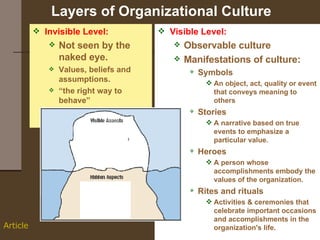
Invisible Level: Not seen by the naked eye. Values, beliefs and assumptions. “ the right way to behave” Layers of Organizational Culture Visible Level: Observable culture Manifestations of culture: Symbols An object, act, quality or event that conveys meaning to others Stories A narrative based on true events to emphasize a particular value. Heroes A person whose accomplishments embody the values of the organization. Rites and rituals Activities & ceremonies that celebrate important occasions and accomplishments in the organization's life.  Article
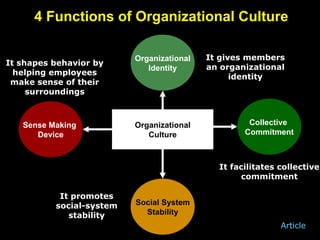
4 Functions of Organizational Culture Sense Making  Device Collective  Commitment Organizational Identity Social System Stability Organizational Culture It gives members an organizational identity It facilitates collective commitment It shapes behavior by helping employees make sense of their surroundings It promotes social-system stability Article
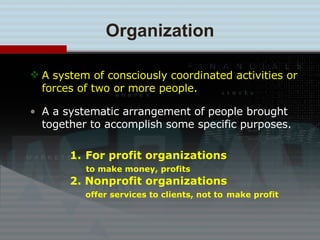
A system of consciously coordinated activities or forces of two or more people. A a systematic arrangement of people brought together to accomplish some specific purposes. Organization For profit organizations to make money, profits 2. Nonprofit organizations   offer services to clients, not to   make profit
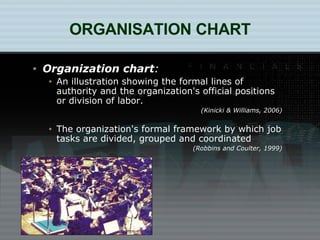
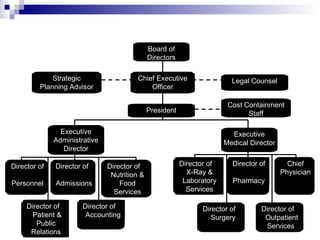
ORGANISATION CHART Organization chart :   An illustration showing the formal lines of authority and the organization's official positions or division of labor. (Kinicki & Williams, 2006) The organization's formal framework by which job tasks are divided, grouped and coordinated  (Robbins and Coulter, 1999)
The Organization Chart Director of  Personnel Director of  Admissions Director of  Nutrition & Food Services Director of  X-Ray & Laboratory Services Chief Physician Director of  Pharmacy Director of  Patient & Public Relations Director of  Accounting Director of  Surgery Director of  Outpatient Services Board of Directors Strategic Planning Advisor Chief Executive Officer Legal Counsel President Cost Containment Staff Executive Administrative Director Executive Medical Director
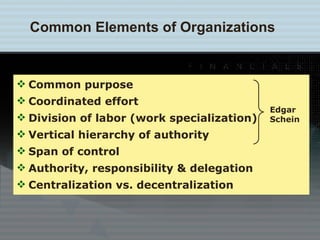
Common purpose Coordinated effort Division of labor (work specialization) Vertical hierarchy of authority  Span of control Authority, responsibility & delegation Centralization vs. decentralization Common Elements of Organizations Edgar Schein
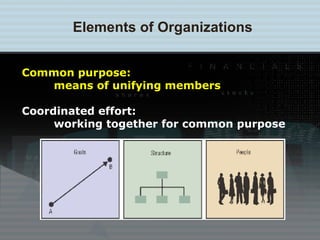
Common purpose:  means of unifying members Coordinated effort:  working together for common purpose Elements of Organizations
Division of labor (work specialization)   - the arrangement of having discreet    parts of a task done by different people. Adam Smith published  Wealth of Nations (1700s) Advocated that jobs should be divided into smaller parts. Each part is completed by a separate individual. Each employee has a set of specific steps to accomplish. Common Elements of Organizations
Think!! Can you think of the disadvantages of work specialization? What are the advantages?
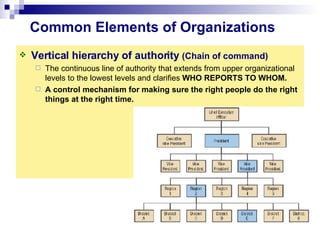
Vertical hierarchy of authority  (Chain of command) The continuous line of authority that extends from upper organizational levels to the lowest levels and clarifies  WHO REPORTS TO WHOM. A control mechanism for making sure the right people do the right things at the right time.  Common Elements of Organizations
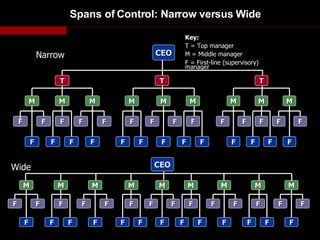
Span of Control Refers to the number of people reporting directly to a given manager. 2 types:  Narrow Wide Common Elements of Organizations
Spans of Control: Narrow versus Wide F CEO Narrow Key: T = Top manager M = Middle manager F = First-line (supervisory) manager T M M M F F F F F F F F F T M F F F M F F F T M M M F F F F F F F F M F F F Wide CEO M F F F M F F F M F F F M F F F M F F F M F F F M F F F M F F F M F F F
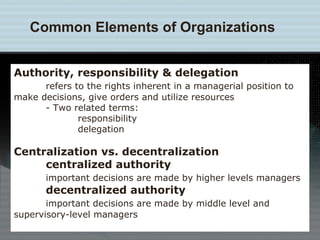
Common Elements of Organizations Authority, responsibility & delegation refers to the rights inherent in a managerial position to  make decisions, give orders and utilize resources - Two related terms:  responsibility delegation Centralization vs. decentralization centralized authority important decisions are made by higher levels managers decentralized authority important decisions are made by middle level and  supervisory-level managers
Think!! Do you prefer to work in a centralized of decentralized organization?  (What.. Again !!!!??) If top management makes the organization's key decisions with little or no input from lower level employees, then the organization adopts centralization / decentralization.
ORGANISATIONAL STRUCTURE
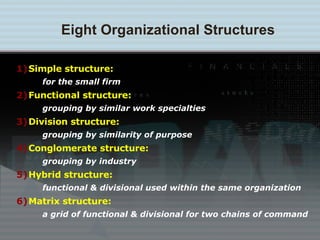
Simple structure:  for the small firm Functional structure:  grouping by similar work specialties Division structure:  grouping by similarity of purpose Conglomerate structure:  grouping by industry Hybrid structure:  functional & divisional used within the same organization Matrix structure:  a grid of functional & divisional for two chains of command Eight Organizational Structures
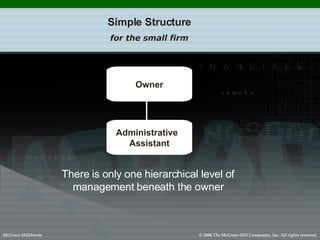
McGraw-Hill/Irwin © 2006 The McGraw-Hill Companies, Inc. All rights reserved. Simple Structure for the small firm There is only one hierarchical level of management beneath the owner Owner Administrative  Assistant
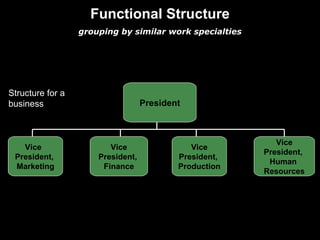
Functional Structure grouping by similar work specialties Structure for a business President Vice  President,  Marketing Vice President,  Finance Vice President,  Production Vice President,  Human  Resources
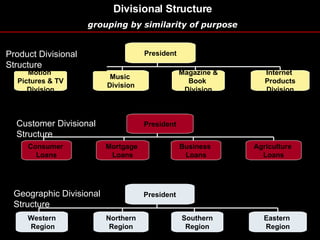
Divisional Structure grouping by similarity of purpose President Motion  Pictures & TV Division Music  Division Magazine & Book  Division Internet  Products Division Product Divisional Structure President Consumer  Loans Mortgage  Loans Business  Loans Agriculture  Loans Customer Divisional Structure President Western Region Northern Region Southern Region Eastern  Region Geographic Divisional Structure
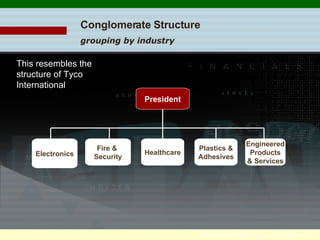
© 2006 The McGraw-Hill Companies, Inc. All rights reserved. Conglomerate Structure grouping by industry President Electronics Fire &  Security Healthcare Plastics & Adhesives Engineered Products & Services This resembles the structure of Tyco International
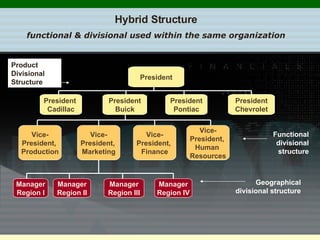
Hybrid Structure functional & divisional used within the same organization Vice- President,  Production Vice- President,  Marketing Vice- President,  Finance Vice- President,  Human  Resources Functional divisional structure President President  Cadillac President Buick President Pontiac President Chevrolet Product Divisional Structure Manager Region I Manager Region II Manager Region III Manager Region IV Geographical divisional structure
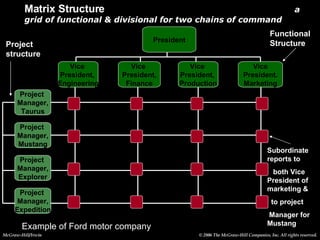
McGraw-Hill/Irwin © 2006 The McGraw-Hill Companies, Inc. All rights reserved. Matrix Structure  a grid of functional & divisional for two chains of command Functional Structure Subordinate reports to  both Vice President of marketing &  to project  Manager for Mustang Project structure Example of Ford motor company President Vice  President,  Engineering Vice  President, Finance Vice  President,  Production Vice President. Marketing Project  Manager, Taurus Project  Manager, Mustang Project  Manager, Explorer Project  Manager, Expedition
 
 
That’s it !
 

Chp8.Oc

  • 1.
    Chapter Eight Organizational Culture, Structure & Design: Building Blocks of the Organization
  • 2.
    Organizational Culture ……is a system of shared beliefs and values that develops within the organization and guides the behavior of its members. What is an Organizational Culture?
  • 3.
    “ Every companyhas their own unique organizational culture. Positive or negative, organizational cultures reflect how things are done within the company.”
  • 4.
    Invisible Level: Notseen by the naked eye. Values, beliefs and assumptions. “ the right way to behave” Layers of Organizational Culture Visible Level: Observable culture Manifestations of culture: Symbols An object, act, quality or event that conveys meaning to others Stories A narrative based on true events to emphasize a particular value. Heroes A person whose accomplishments embody the values of the organization. Rites and rituals Activities & ceremonies that celebrate important occasions and accomplishments in the organization's life. Article
  • 5.
    4 Functions ofOrganizational Culture Sense Making Device Collective Commitment Organizational Identity Social System Stability Organizational Culture It gives members an organizational identity It facilitates collective commitment It shapes behavior by helping employees make sense of their surroundings It promotes social-system stability Article
  • 6.
    A system ofconsciously coordinated activities or forces of two or more people. A a systematic arrangement of people brought together to accomplish some specific purposes. Organization For profit organizations to make money, profits 2. Nonprofit organizations offer services to clients, not to make profit
  • 7.
    ORGANISATION CHART Organizationchart : An illustration showing the formal lines of authority and the organization's official positions or division of labor. (Kinicki & Williams, 2006) The organization's formal framework by which job tasks are divided, grouped and coordinated (Robbins and Coulter, 1999)
  • 8.
    The Organization ChartDirector of Personnel Director of Admissions Director of Nutrition & Food Services Director of X-Ray & Laboratory Services Chief Physician Director of Pharmacy Director of Patient & Public Relations Director of Accounting Director of Surgery Director of Outpatient Services Board of Directors Strategic Planning Advisor Chief Executive Officer Legal Counsel President Cost Containment Staff Executive Administrative Director Executive Medical Director
  • 9.
    Common purpose Coordinatedeffort Division of labor (work specialization) Vertical hierarchy of authority Span of control Authority, responsibility & delegation Centralization vs. decentralization Common Elements of Organizations Edgar Schein
  • 10.
    Common purpose: means of unifying members Coordinated effort: working together for common purpose Elements of Organizations
  • 11.
    Division of labor(work specialization) - the arrangement of having discreet parts of a task done by different people. Adam Smith published Wealth of Nations (1700s) Advocated that jobs should be divided into smaller parts. Each part is completed by a separate individual. Each employee has a set of specific steps to accomplish. Common Elements of Organizations
  • 12.
    Think!! Can youthink of the disadvantages of work specialization? What are the advantages?
  • 13.
    Vertical hierarchy ofauthority (Chain of command) The continuous line of authority that extends from upper organizational levels to the lowest levels and clarifies WHO REPORTS TO WHOM. A control mechanism for making sure the right people do the right things at the right time. Common Elements of Organizations
  • 14.
    Span of ControlRefers to the number of people reporting directly to a given manager. 2 types: Narrow Wide Common Elements of Organizations
  • 15.
    Spans of Control:Narrow versus Wide F CEO Narrow Key: T = Top manager M = Middle manager F = First-line (supervisory) manager T M M M F F F F F F F F F T M F F F M F F F T M M M F F F F F F F F M F F F Wide CEO M F F F M F F F M F F F M F F F M F F F M F F F M F F F M F F F M F F F
  • 16.
    Common Elements ofOrganizations Authority, responsibility & delegation refers to the rights inherent in a managerial position to make decisions, give orders and utilize resources - Two related terms: responsibility delegation Centralization vs. decentralization centralized authority important decisions are made by higher levels managers decentralized authority important decisions are made by middle level and supervisory-level managers
  • 17.
    Think!! Do youprefer to work in a centralized of decentralized organization? (What.. Again !!!!??) If top management makes the organization's key decisions with little or no input from lower level employees, then the organization adopts centralization / decentralization.
  • 18.
  • 19.
    Simple structure: for the small firm Functional structure: grouping by similar work specialties Division structure: grouping by similarity of purpose Conglomerate structure: grouping by industry Hybrid structure: functional & divisional used within the same organization Matrix structure: a grid of functional & divisional for two chains of command Eight Organizational Structures
  • 20.
    McGraw-Hill/Irwin © 2006The McGraw-Hill Companies, Inc. All rights reserved. Simple Structure for the small firm There is only one hierarchical level of management beneath the owner Owner Administrative Assistant
  • 21.
    Functional Structure groupingby similar work specialties Structure for a business President Vice President, Marketing Vice President, Finance Vice President, Production Vice President, Human Resources
  • 22.
    Divisional Structure groupingby similarity of purpose President Motion Pictures & TV Division Music Division Magazine & Book Division Internet Products Division Product Divisional Structure President Consumer Loans Mortgage Loans Business Loans Agriculture Loans Customer Divisional Structure President Western Region Northern Region Southern Region Eastern Region Geographic Divisional Structure
  • 23.
    © 2006 TheMcGraw-Hill Companies, Inc. All rights reserved. Conglomerate Structure grouping by industry President Electronics Fire & Security Healthcare Plastics & Adhesives Engineered Products & Services This resembles the structure of Tyco International
  • 24.
    Hybrid Structure functional& divisional used within the same organization Vice- President, Production Vice- President, Marketing Vice- President, Finance Vice- President, Human Resources Functional divisional structure President President Cadillac President Buick President Pontiac President Chevrolet Product Divisional Structure Manager Region I Manager Region II Manager Region III Manager Region IV Geographical divisional structure
  • 25.
    McGraw-Hill/Irwin © 2006The McGraw-Hill Companies, Inc. All rights reserved. Matrix Structure a grid of functional & divisional for two chains of command Functional Structure Subordinate reports to both Vice President of marketing & to project Manager for Mustang Project structure Example of Ford motor company President Vice President, Engineering Vice President, Finance Vice President, Production Vice President. Marketing Project Manager, Taurus Project Manager, Mustang Project Manager, Explorer Project Manager, Expedition
  • 26.
  • 27.
  • 28.
  • 29.