INVESTIGATIONS

By,
NEHA HUSSAIN
Roll no:30
WHY INVESTIGATE?
• To establish a definitive diagnosis in cases
where clinical examination gives
indistinguishable results.
• To differentiate between malignant and
benign tumors

• Treatment(conservative or surgical line of
management)
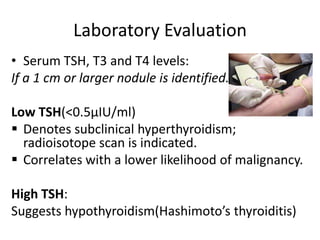
Laboratory Evaluation
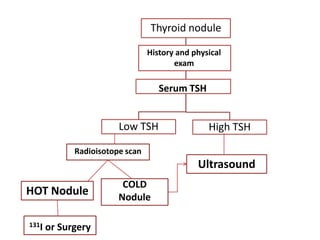
• Serum TSH, T3 and T4 levels:
If a 1 cm or larger nodule is identified.
Low TSH(<0.5µIU/ml)
 Denotes subclinical hyperthyroidism;
radioisotope scan is indicated.
 Correlates with a lower likelihood of malignancy.

High TSH:
Suggests hypothyroidism(Hashimoto’s thyroiditis)
• Serum calcitonin levels: High in Medullary
carcinoma.
 Male: >13.8 ng/L
 Female: >6.4 ng/L

• Detection of Thyroid antibodies in patients
with toxic features(anti-thyroglobulin
antibodies).
Thyroid Imaging
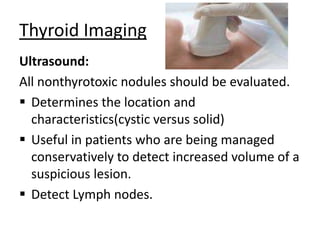
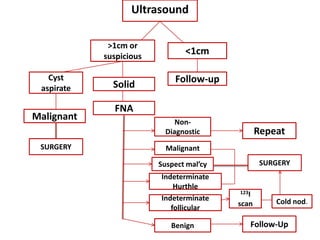
Ultrasound:
All nonthyrotoxic nodules should be evaluated.
 Determines the location and
characteristics(cystic versus solid)
 Useful in patients who are being managed
conservatively to detect increased volume of a
suspicious lesion.
 Detect Lymph nodes.
Disadvantages:
Limited ability to predict the diagnosis of solid
nodules accurately.
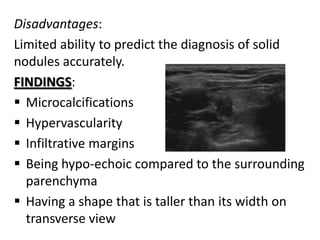
FINDINGS:
 Microcalcifications
 Hypervascularity
 Infiltrative margins
 Being hypo-echoic compared to the surrounding
parenchyma
 Having a shape that is taller than its width on
transverse view
The size of the nodule on ultrasound determines the
need for further evaluation.
A nodule <1 cm in size is not further evaluated unless
it is associated with:

 suspicious characteristics or
 suspicious lymphadenopathy

 Family history of papillary carcinoma of thyroid
 Prior personal history of thyroid cancer
 Radiation exposure
 PET positive lesions
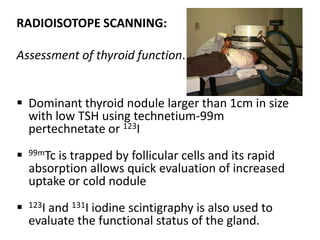
RADIOISOTOPE SCANNING:
Assessment of thyroid function.
 Dominant thyroid nodule larger than 1cm in size
with low TSH using technetium-99m
pertechnetate or 123I


99mTc



123I

is trapped by follicular cells and its rapid
absorption allows quick evaluation of increased
uptake or cold nodule
and 131I iodine scintigraphy is also used to
evaluate the functional status of the gland.


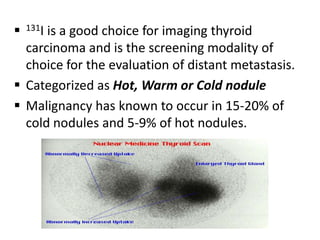
131I

is a good choice for imaging thyroid
carcinoma and is the screening modality of
choice for the evaluation of distant metastasis.
 Categorized as Hot, Warm or Cold nodule
 Malignancy has known to occur in 15-20% of
cold nodules and 5-9% of hot nodules.
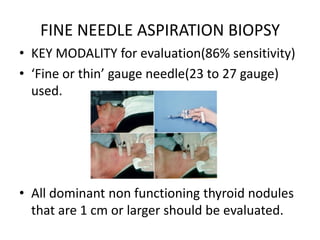
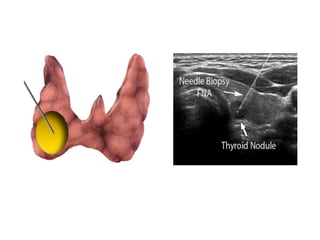
FINE NEEDLE ASPIRATION BIOPSY
• KEY MODALITY for evaluation(86% sensitivity)
• ‘Fine or thin’ gauge needle(23 to 27 gauge)
used.

• All dominant non functioning thyroid nodules
that are 1 cm or larger should be evaluated.
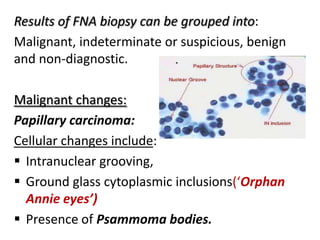
Results of FNA biopsy can be grouped into:
Malignant, indeterminate or suspicious, benign
and non-diagnostic.
Malignant changes:
Papillary carcinoma:
Cellular changes include:
 Intranuclear grooving,
 Ground glass cytoplasmic inclusions(‘Orphan
Annie eyes’)
 Presence of Psammoma bodies.
Medullary carcinoma:
 Typically, aspirates are hypercellular,
 composed of large, poorly cohesive cells,
predominantly spindle-shaped.
 Amyloid is often, but not invariably, present, and
there is no colloid

Follicular carcinoma:
Demonstration of capsular or vascular invasion by
follicular cells not by cellular cytology alone but on
complete histological examination of the resected
specimen.
Indeterminate:
 Repeat aspiration,resection,or close
conservative follow-up of the nodule
Benign Lesions:
 The tissue immediately adjacent to or
contained within another part of the nodule
may harbour malignant cells(false negetive
rate:1-6%)
 Monitor with ultrasound.
 In cases of non-diagnostic cytology, repeat FNA
under ultrasound guidance
 Lesions in which FNA is found to be persistently
non-diagnostic is associated with a high risk of
malignancy and must be followed up closely or
excised.
 FNA can also be done for lesions that appear
cystic on ultrasound: occasionally papillary
carcinoma may manifest as a cyst.
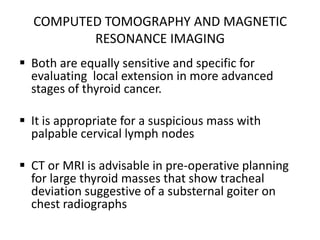
COMPUTED TOMOGRAPHY AND MAGNETIC
RESONANCE IMAGING
 Both are equally sensitive and specific for
evaluating local extension in more advanced
stages of thyroid cancer.
 It is appropriate for a suspicious mass with
palpable cervical lymph nodes
 CT or MRI is advisable in pre-operative planning
for large thyroid masses that show tracheal
deviation suggestive of a substernal goiter on
chest radiographs
Thyroid nodule
History and physical
exam

Serum TSH

Low TSH

High TSH

Radioisotope scan

Ultrasound

HOT Nodule
131I

or Surgery

COLD
Nodule
Ultrasound
>1cm or
suspicious
Cyst
aspirate

Malignant
SURGERY

Solid

<1cm

Follow-up

FNA
NonDiagnostic

Repeat

Malignant
SURGERY

Suspect mal’cy
Indeterminate
Hurthle
Indeterminate
follicular
Benign

123I

scan

Cold nod.

Follow-Up

Investigations thyroid carcinoma

  • 1.
  • 2.
    WHY INVESTIGATE? • Toestablish a definitive diagnosis in cases where clinical examination gives indistinguishable results. • To differentiate between malignant and benign tumors • Treatment(conservative or surgical line of management)
  • 3.
    Laboratory Evaluation • SerumTSH, T3 and T4 levels: If a 1 cm or larger nodule is identified. Low TSH(<0.5µIU/ml)  Denotes subclinical hyperthyroidism; radioisotope scan is indicated.  Correlates with a lower likelihood of malignancy. High TSH: Suggests hypothyroidism(Hashimoto’s thyroiditis)
  • 4.
    • Serum calcitoninlevels: High in Medullary carcinoma.  Male: >13.8 ng/L  Female: >6.4 ng/L • Detection of Thyroid antibodies in patients with toxic features(anti-thyroglobulin antibodies).
  • 5.
    Thyroid Imaging Ultrasound: All nonthyrotoxicnodules should be evaluated.  Determines the location and characteristics(cystic versus solid)  Useful in patients who are being managed conservatively to detect increased volume of a suspicious lesion.  Detect Lymph nodes.
  • 6.
    Disadvantages: Limited ability topredict the diagnosis of solid nodules accurately. FINDINGS:  Microcalcifications  Hypervascularity  Infiltrative margins  Being hypo-echoic compared to the surrounding parenchyma  Having a shape that is taller than its width on transverse view
  • 7.
    The size ofthe nodule on ultrasound determines the need for further evaluation. A nodule <1 cm in size is not further evaluated unless it is associated with:  suspicious characteristics or  suspicious lymphadenopathy  Family history of papillary carcinoma of thyroid  Prior personal history of thyroid cancer  Radiation exposure  PET positive lesions
  • 8.
    RADIOISOTOPE SCANNING: Assessment ofthyroid function.  Dominant thyroid nodule larger than 1cm in size with low TSH using technetium-99m pertechnetate or 123I  99mTc  123I is trapped by follicular cells and its rapid absorption allows quick evaluation of increased uptake or cold nodule and 131I iodine scintigraphy is also used to evaluate the functional status of the gland.
  • 9.
     131I is a goodchoice for imaging thyroid carcinoma and is the screening modality of choice for the evaluation of distant metastasis.  Categorized as Hot, Warm or Cold nodule  Malignancy has known to occur in 15-20% of cold nodules and 5-9% of hot nodules.
  • 10.
    FINE NEEDLE ASPIRATIONBIOPSY • KEY MODALITY for evaluation(86% sensitivity) • ‘Fine or thin’ gauge needle(23 to 27 gauge) used. • All dominant non functioning thyroid nodules that are 1 cm or larger should be evaluated.
  • 11.
    Results of FNAbiopsy can be grouped into: Malignant, indeterminate or suspicious, benign and non-diagnostic. Malignant changes: Papillary carcinoma: Cellular changes include:  Intranuclear grooving,  Ground glass cytoplasmic inclusions(‘Orphan Annie eyes’)  Presence of Psammoma bodies.
  • 12.
    Medullary carcinoma:  Typically,aspirates are hypercellular,  composed of large, poorly cohesive cells, predominantly spindle-shaped.  Amyloid is often, but not invariably, present, and there is no colloid Follicular carcinoma: Demonstration of capsular or vascular invasion by follicular cells not by cellular cytology alone but on complete histological examination of the resected specimen.
  • 13.
    Indeterminate:  Repeat aspiration,resection,orclose conservative follow-up of the nodule Benign Lesions:  The tissue immediately adjacent to or contained within another part of the nodule may harbour malignant cells(false negetive rate:1-6%)  Monitor with ultrasound.
  • 14.
     In casesof non-diagnostic cytology, repeat FNA under ultrasound guidance  Lesions in which FNA is found to be persistently non-diagnostic is associated with a high risk of malignancy and must be followed up closely or excised.  FNA can also be done for lesions that appear cystic on ultrasound: occasionally papillary carcinoma may manifest as a cyst.
  • 16.
    COMPUTED TOMOGRAPHY ANDMAGNETIC RESONANCE IMAGING  Both are equally sensitive and specific for evaluating local extension in more advanced stages of thyroid cancer.  It is appropriate for a suspicious mass with palpable cervical lymph nodes  CT or MRI is advisable in pre-operative planning for large thyroid masses that show tracheal deviation suggestive of a substernal goiter on chest radiographs
  • 17.
    Thyroid nodule History andphysical exam Serum TSH Low TSH High TSH Radioisotope scan Ultrasound HOT Nodule 131I or Surgery COLD Nodule
  • 18.