1
The Z transform (3)
2
Today
• The inverse Z Transform
• Section 3.3 (read class notes first)
• Examples 3.9, 3.11
3
The inverse Z-transform
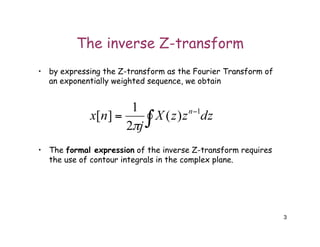
• by expressing the Z-transform as the Fourier Transform of
an exponentially weighted sequence, we obtain
• The formal expression of the inverse Z-transform requires
the use of contour integrals in the complex plane.
Computational methods for the
inverse Z-Transform
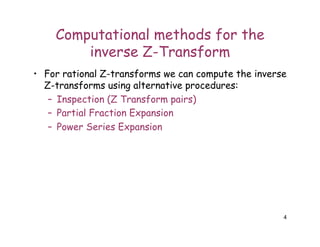
• For rational Z-transforms we can compute the inverse
Z-transforms using alternative procedures:
– Inspection (Z Transform pairs)
– Partial Fraction Expansion
– Power Series Expansion
4
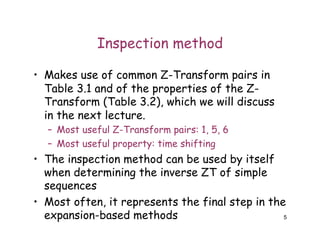
Inspection method
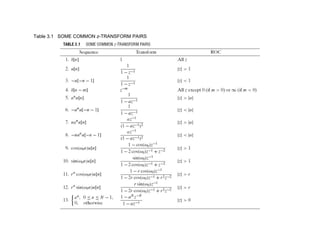
• Makes use of common Z-Transform pairs in
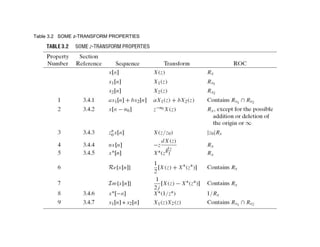
Table 3.1 and of the properties of the Z-
Transform (Table 3.2), which we will discuss
in the next lecture.
– Most useful Z-Transform pairs: 1, 5, 6
– Most useful property: time shifting
• The inspection method can be used by itself
when determining the inverse ZT of simple
sequences
• Most often, it represents the final step in the
expansion-based methods 5
Example for the inspection method
• Consider a causal LTI system specified by its
system function H(z). Compute its unit impulse
response h[n].
6
€
H (z) =
1− z−1
1+
3
4
z−1
Table 3.1 SOME COMMON z-TRANSFORM PAIRS
Table 3.2 SOME z-TRANSFORM PROPERTIES
Inverse ZT via partial fraction
expansion
• We will study only the case of first-order
poles (all poles are distinct) and M<N.
• Equations 3.45, 3.46, 3.47 are not required
• General idea:
• The partial fraction expansion process
computes all coefficients Ak 9
€
X(z) =
bkz−k
k=0
M
∑
akz−k
k=0
N
∑
partial fraction expansion
⎯ →
⎯⎯⎯⎯⎯⎯
⎯ X(z) =
Ak
1− dkz−1
k=1
N
∑
10
Example for partial fraction expansion
• Compute the inverse Z-transform for:
Inverse ZT via power series
expansion
• We start from the definition of X(z)
• We notice that x[n] is the coefficient of n-th power of z-1
• If we have the Z transform expressed as a series of powers
of z-1, then we can retrieve x[n] by direct identification
• Main idea
• For rational ZT: long division
11
€
X(z) = x[n]z−n
n=−∞
+∞
∑
X(z) =
bkz−k
k=0
M
∑
akz−k
k=0
N
∑
power series expansion
⎯ →
⎯⎯⎯⎯⎯⎯ X(z) = x[n]z−n
n=−∞
+∞
∑
Example 1 for power series expansion
• Determine the sequence x[n] corresponding to
the following ZT:
12
€
X(z) = (1+ 2z)(1+ 3z−1
)
Example 2 for power series expansion
• Determine the sequence x[n] that
corresponds to the following Z Transform,
knowing that this sequence is right-sided
13
€
X(z) =
1
1+
1
2
z−1
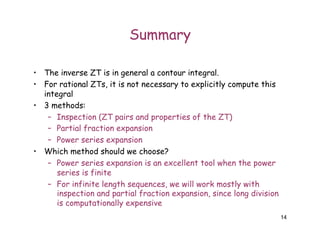
Summary
• The inverse ZT is in general a contour integral.
• For rational ZTs, it is not necessary to explicitly compute this
integral
• 3 methods:
– Inspection (ZT pairs and properties of the ZT)
– Partial fraction expansion
– Power series expansion
• Which method should we choose?
– Power series expansion is an excellent tool when the power
series is finite
– For infinite length sequences, we will work mostly with
inspection and partial fraction expansion, since long division
is computationally expensive
14

The inverse Z-Transform.pdf

  • 1.
  • 2.
    2 Today • The inverseZ Transform • Section 3.3 (read class notes first) • Examples 3.9, 3.11
  • 3.
    3 The inverse Z-transform •by expressing the Z-transform as the Fourier Transform of an exponentially weighted sequence, we obtain • The formal expression of the inverse Z-transform requires the use of contour integrals in the complex plane.
  • 4.
    Computational methods forthe inverse Z-Transform • For rational Z-transforms we can compute the inverse Z-transforms using alternative procedures: – Inspection (Z Transform pairs) – Partial Fraction Expansion – Power Series Expansion 4
  • 5.
    Inspection method • Makesuse of common Z-Transform pairs in Table 3.1 and of the properties of the Z- Transform (Table 3.2), which we will discuss in the next lecture. – Most useful Z-Transform pairs: 1, 5, 6 – Most useful property: time shifting • The inspection method can be used by itself when determining the inverse ZT of simple sequences • Most often, it represents the final step in the expansion-based methods 5
  • 6.
    Example for theinspection method • Consider a causal LTI system specified by its system function H(z). Compute its unit impulse response h[n]. 6 € H (z) = 1− z−1 1+ 3 4 z−1
  • 7.
    Table 3.1 SOMECOMMON z-TRANSFORM PAIRS
  • 8.
    Table 3.2 SOMEz-TRANSFORM PROPERTIES
  • 9.
    Inverse ZT viapartial fraction expansion • We will study only the case of first-order poles (all poles are distinct) and M<N. • Equations 3.45, 3.46, 3.47 are not required • General idea: • The partial fraction expansion process computes all coefficients Ak 9 € X(z) = bkz−k k=0 M ∑ akz−k k=0 N ∑ partial fraction expansion ⎯ → ⎯⎯⎯⎯⎯⎯ ⎯ X(z) = Ak 1− dkz−1 k=1 N ∑
  • 10.
    10 Example for partialfraction expansion • Compute the inverse Z-transform for:
  • 11.
    Inverse ZT viapower series expansion • We start from the definition of X(z) • We notice that x[n] is the coefficient of n-th power of z-1 • If we have the Z transform expressed as a series of powers of z-1, then we can retrieve x[n] by direct identification • Main idea • For rational ZT: long division 11 € X(z) = x[n]z−n n=−∞ +∞ ∑ X(z) = bkz−k k=0 M ∑ akz−k k=0 N ∑ power series expansion ⎯ → ⎯⎯⎯⎯⎯⎯ X(z) = x[n]z−n n=−∞ +∞ ∑
  • 12.
    Example 1 forpower series expansion • Determine the sequence x[n] corresponding to the following ZT: 12 € X(z) = (1+ 2z)(1+ 3z−1 )
  • 13.
    Example 2 forpower series expansion • Determine the sequence x[n] that corresponds to the following Z Transform, knowing that this sequence is right-sided 13 € X(z) = 1 1+ 1 2 z−1
  • 14.
    Summary • The inverseZT is in general a contour integral. • For rational ZTs, it is not necessary to explicitly compute this integral • 3 methods: – Inspection (ZT pairs and properties of the ZT) – Partial fraction expansion – Power series expansion • Which method should we choose? – Power series expansion is an excellent tool when the power series is finite – For infinite length sequences, we will work mostly with inspection and partial fraction expansion, since long division is computationally expensive 14