Prepared by: Dr / Ahmed Nasser
Lecturer at Faculty of Engineering, Suez Canal University
(ahmed.nasser@eng.suez.edu.eg)
DSP
Lecture 4: The Z-Transform
九州大学UIプロジェクト Kyudai Taro,2007
• The z-transform is a very important tool in describing and analyzing digital systems. It also
offers techniques for digital filter design and frequency analysis of digital signals.
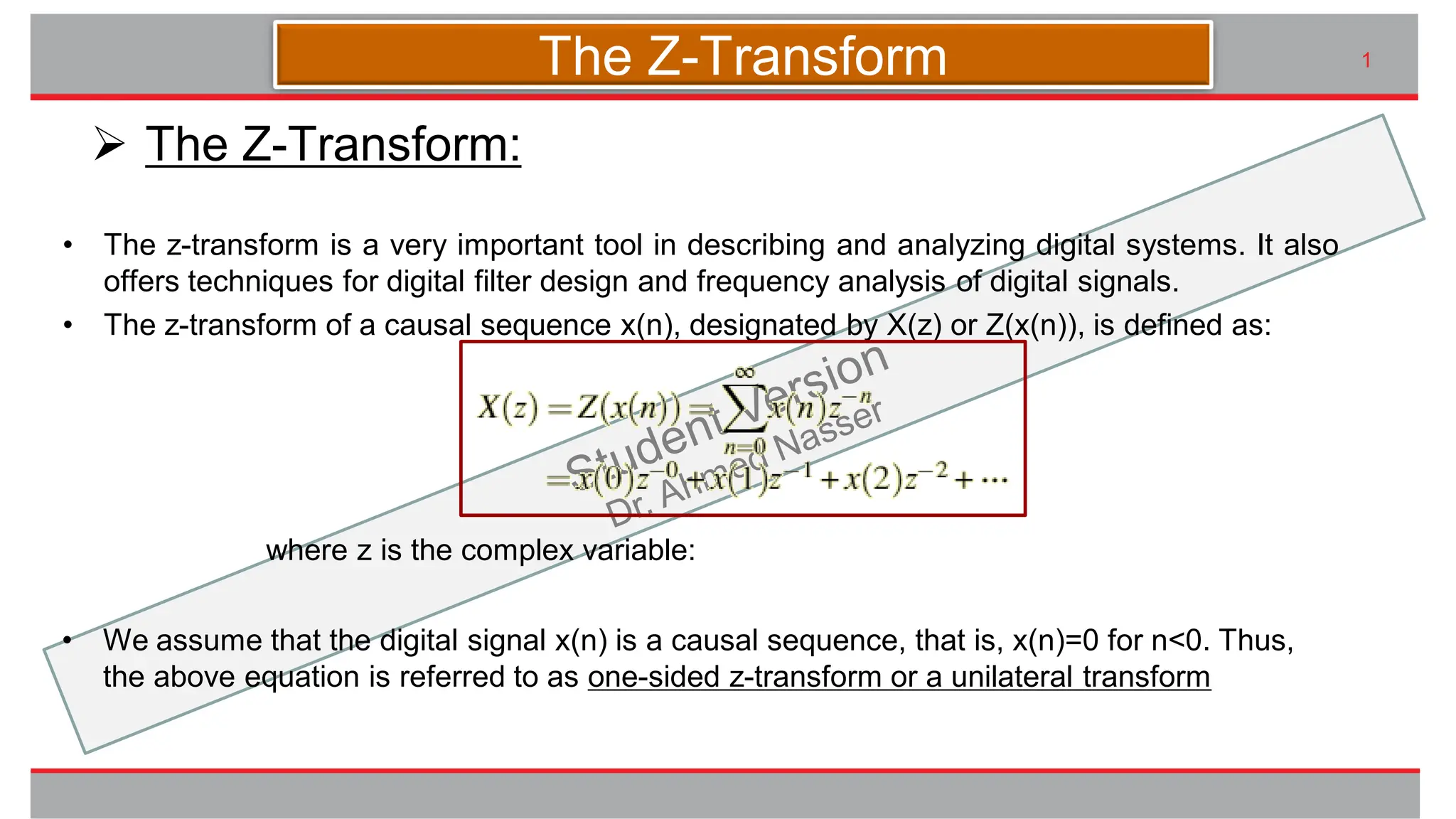
• The z-transform of a causal sequence x(n), designated by X(z) or Z(x(n)), is defined as:
1
➢ The Z-Transform:
The Z-Transform
where z is the complex variable:
• We assume that the digital signal x(n) is a causal sequence, that is, x(n)=0 for n<0. Thus,
the above equation is referred to as one-sided z-transform or a unilateral transform
九州大学UIプロジェクト Kyudai Taro,2007
2
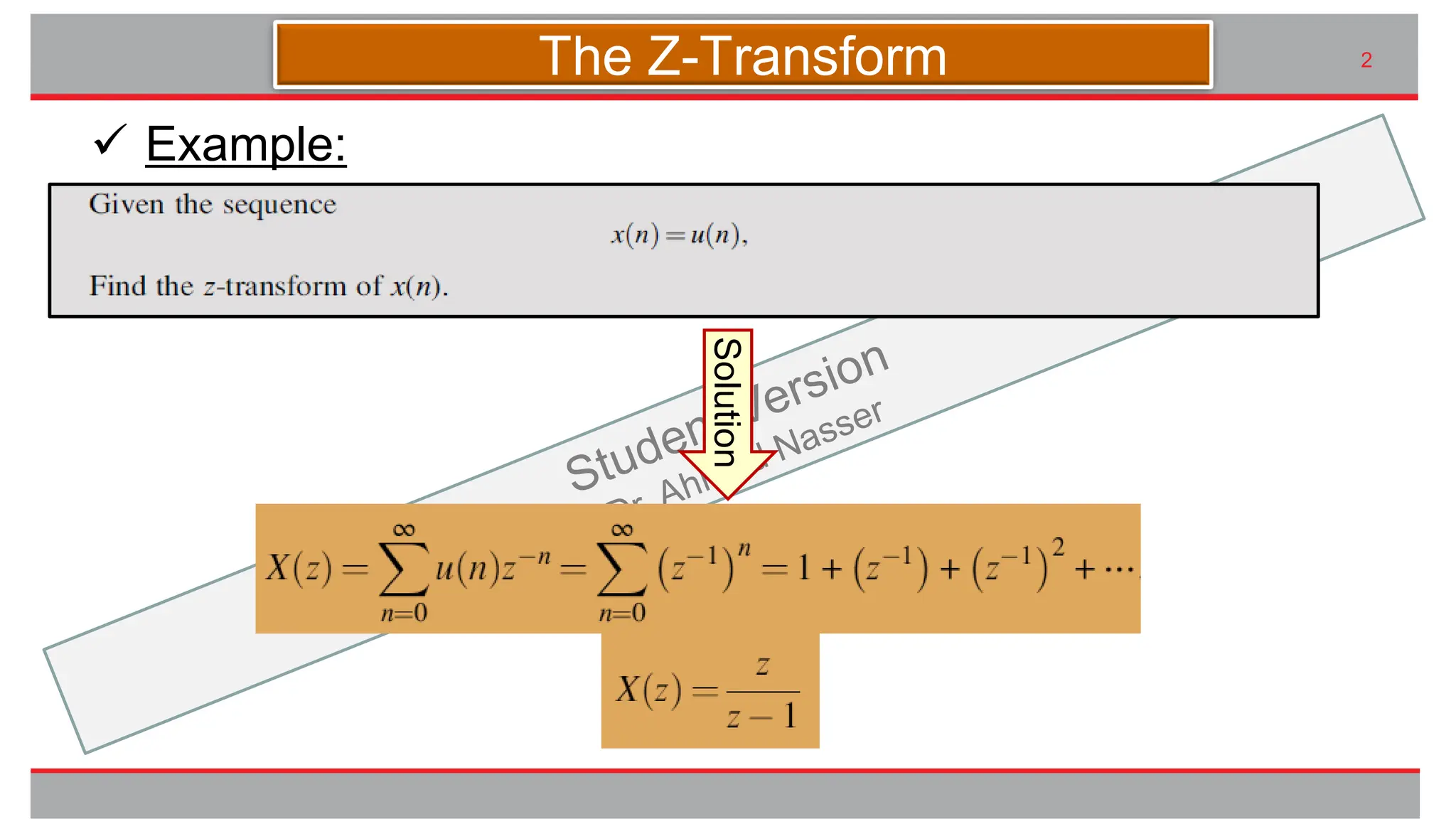
✓ Example:
The Z-Transform
Solution
九州大学UIプロジェクト Kyudai Taro,2007
3
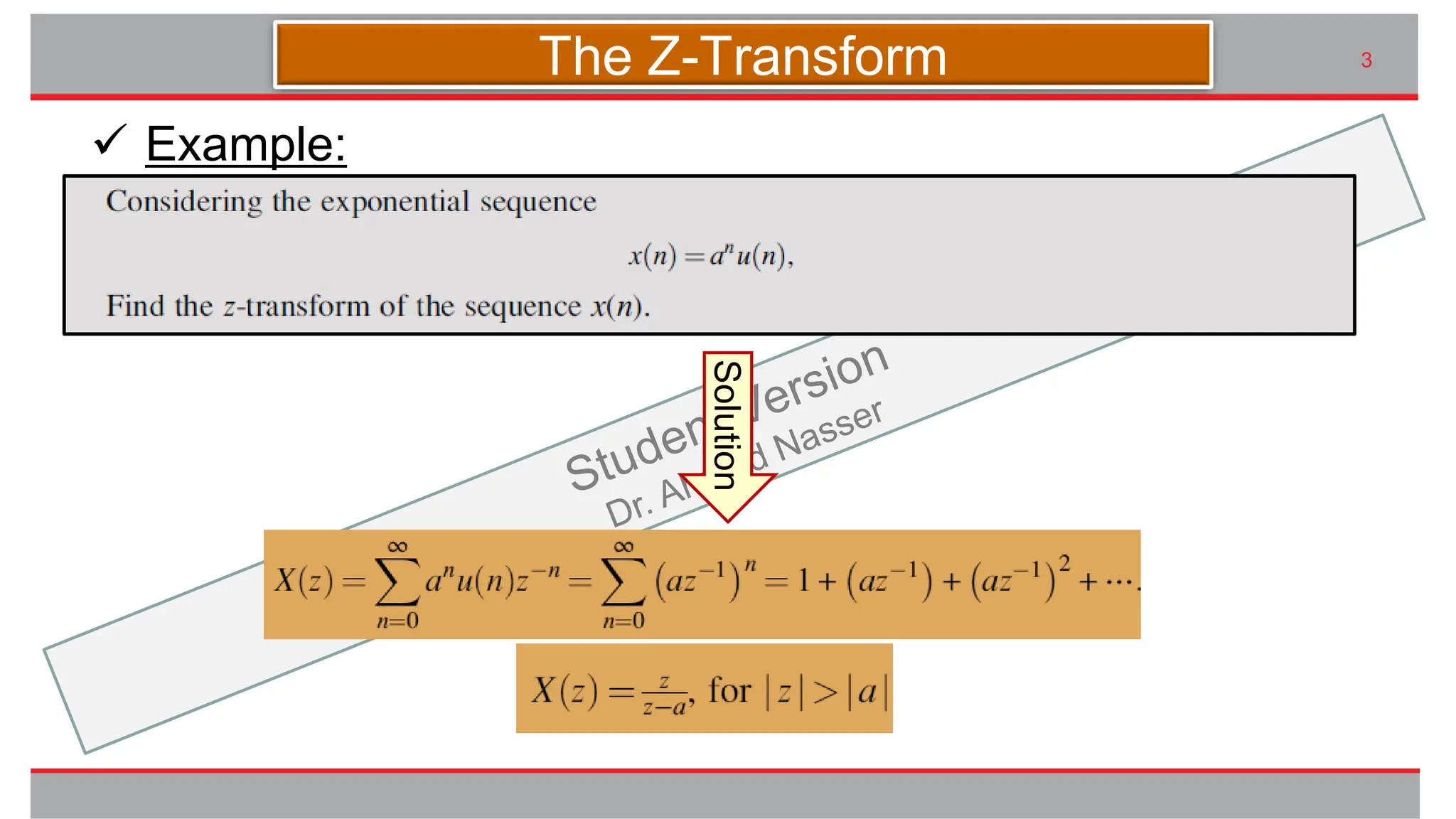
✓ Example:
Solution
The Z-Transform
九州大学UIプロジェクト Kyudai Taro,2007
4
The Z-Transform
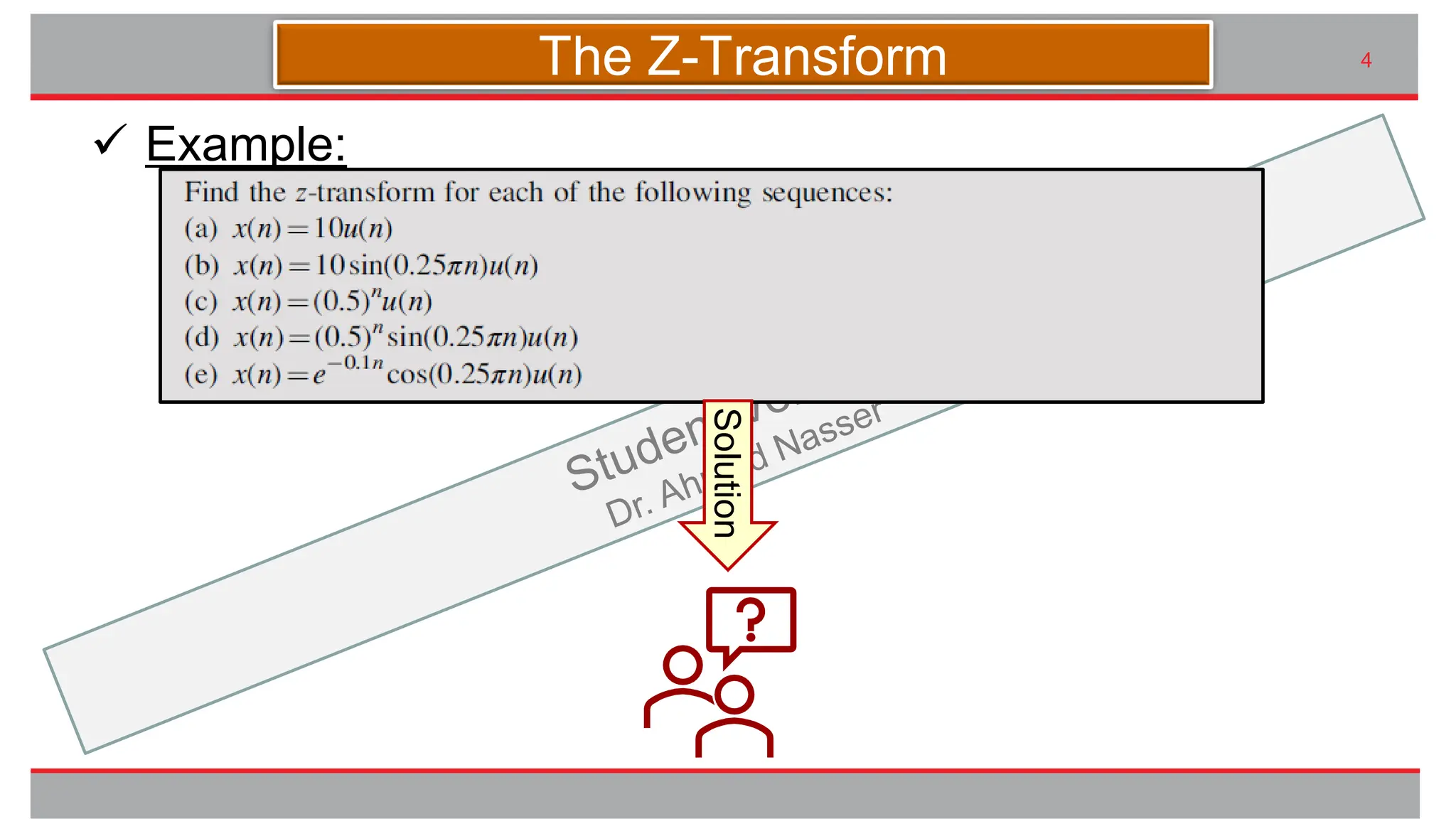
✓ Example:
Solution
九州大学UIプロジェクト Kyudai Taro,2007
5
The Z-Transform
九州大学UIプロジェクト Kyudai Taro,2007
6
The Z-Transform
九州大学UIプロジェクト Kyudai Taro,2007
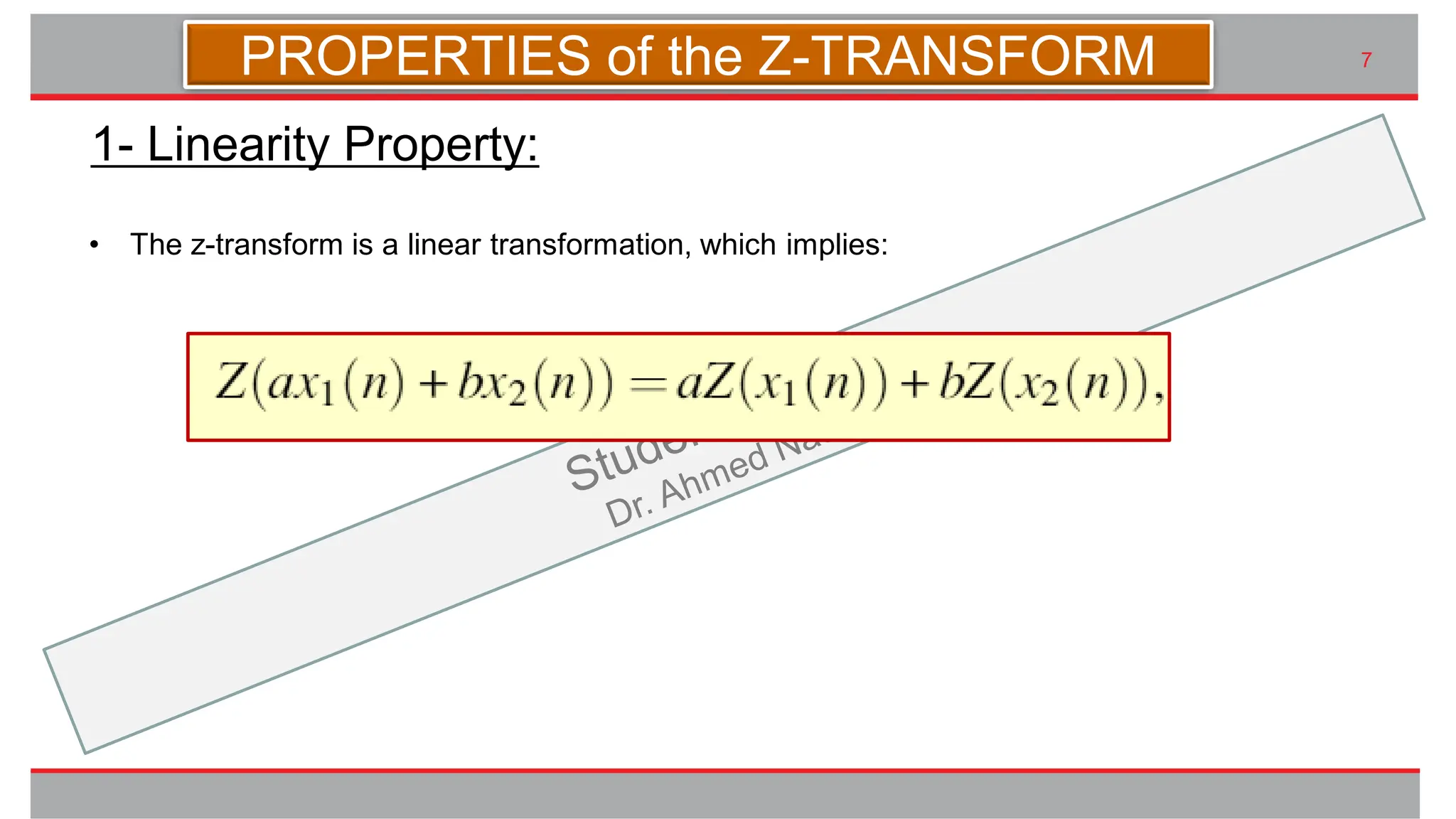
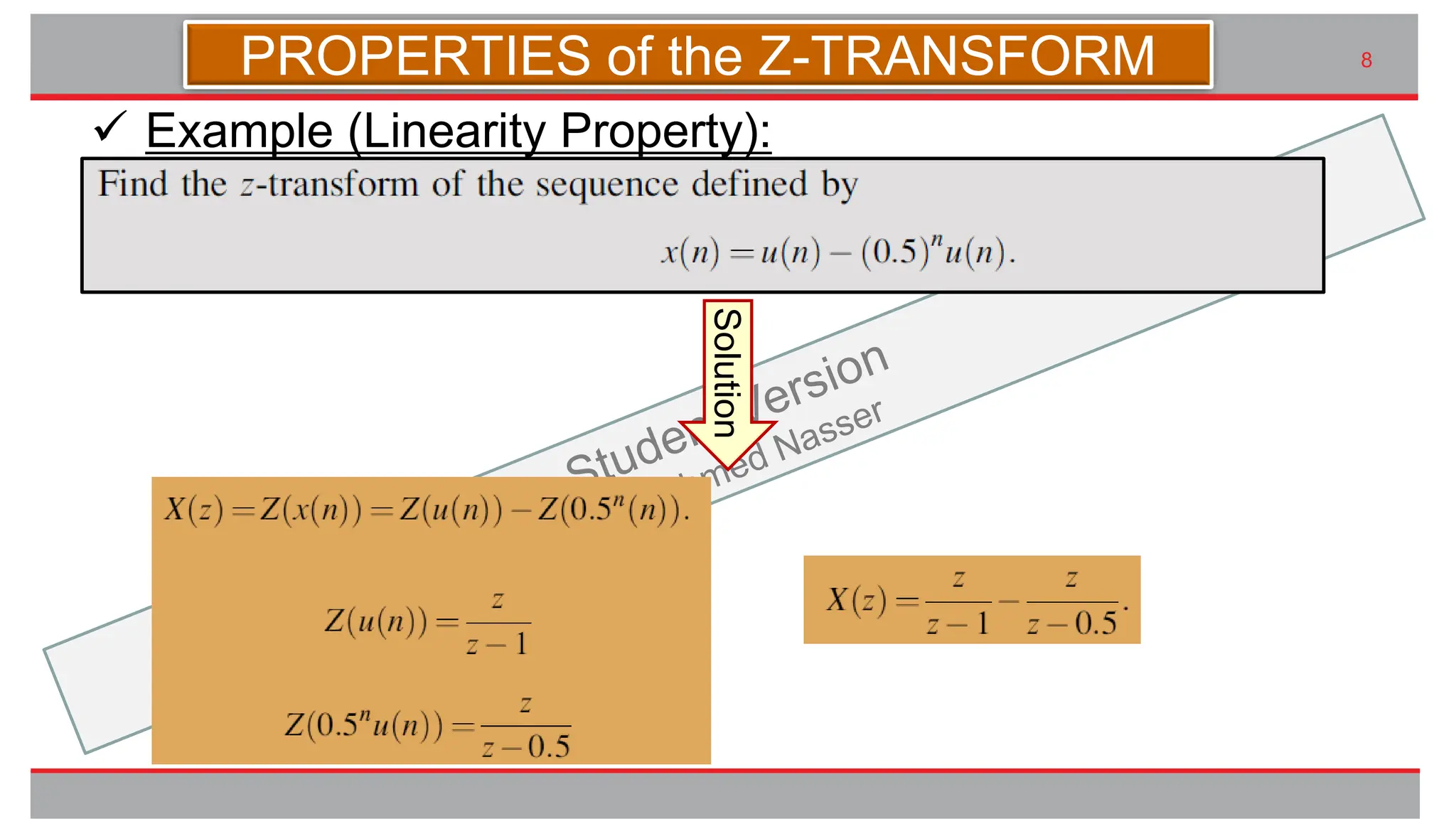
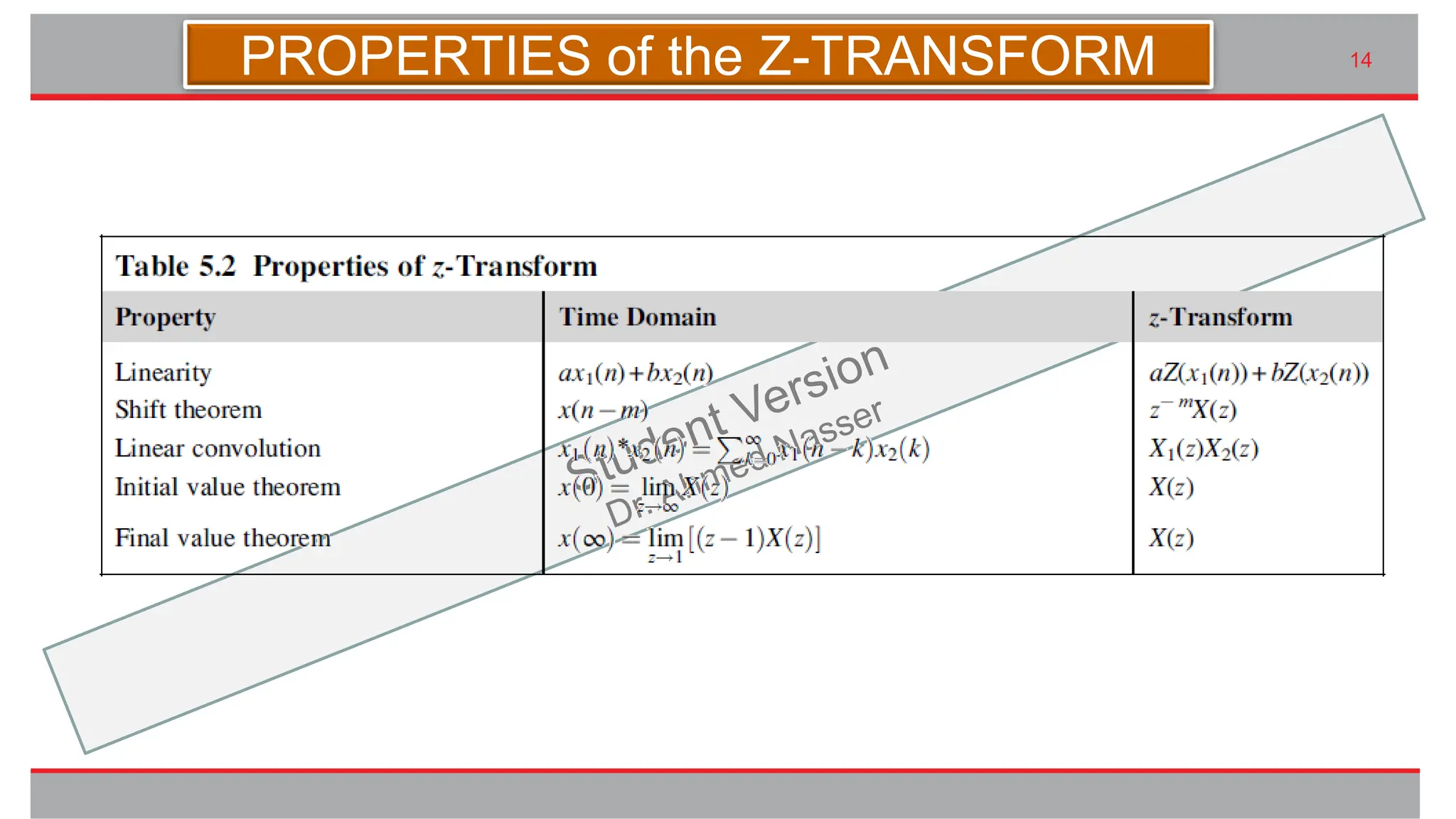
• The z-transform is a linear transformation, which implies:
7
1- Linearity Property:
PROPERTIES of the Z-TRANSFORM
九州大学UIプロジェクト Kyudai Taro,2007
8
Solution
✓ Example (Linearity Property):
PROPERTIES of the Z-TRANSFORM
九州大学UIプロジェクト Kyudai Taro,2007
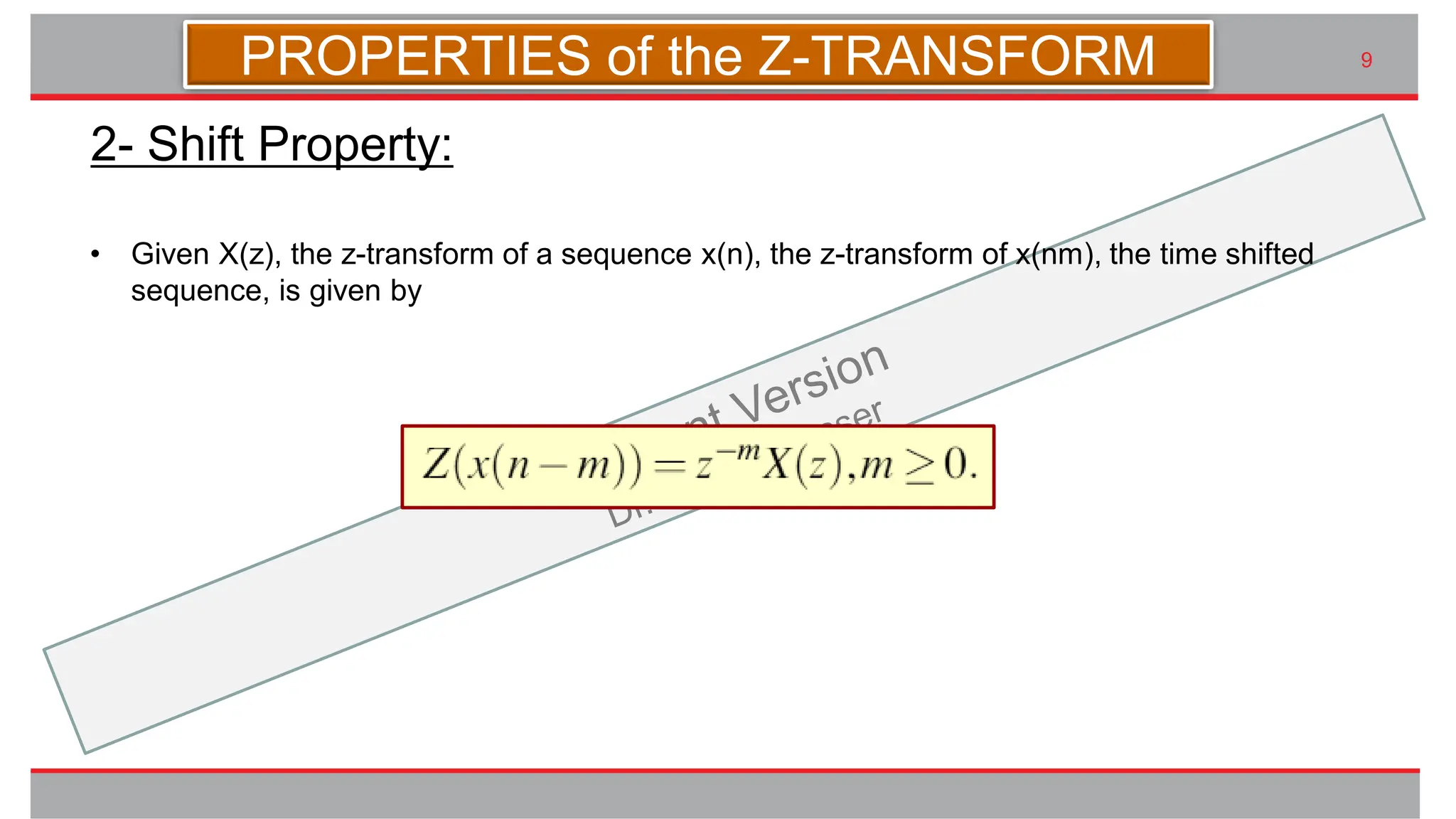
• Given X(z), the z-transform of a sequence x(n), the z-transform of x(nm), the time shifted
sequence, is given by
9
2- Shift Property:
PROPERTIES of the Z-TRANSFORM
九州大学UIプロジェクト Kyudai Taro,2007
10
PROPERTIES of the Z-TRANSFORM
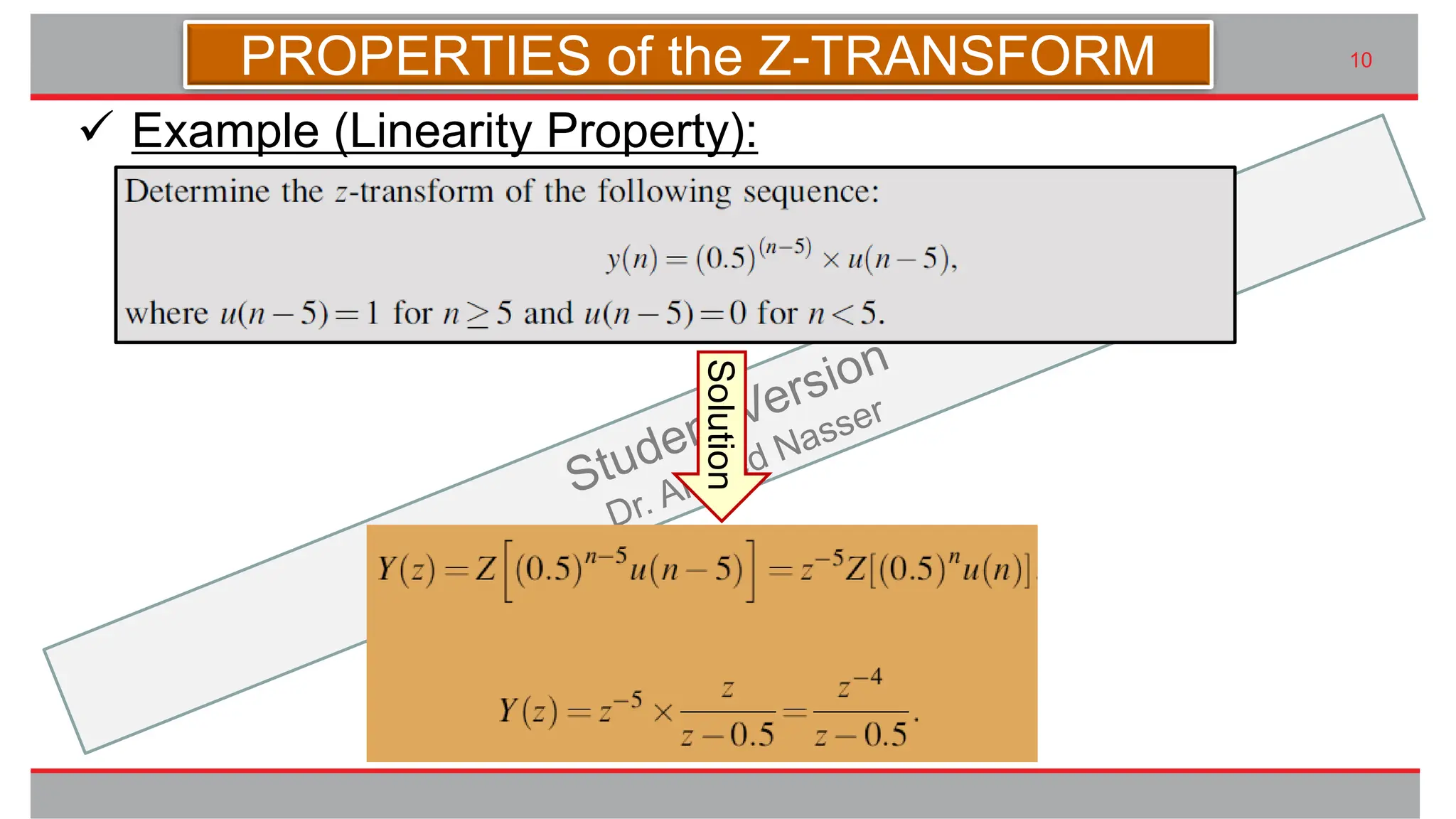
✓ Example (Linearity Property):
Solution
九州大学UIプロジェクト Kyudai Taro,2007
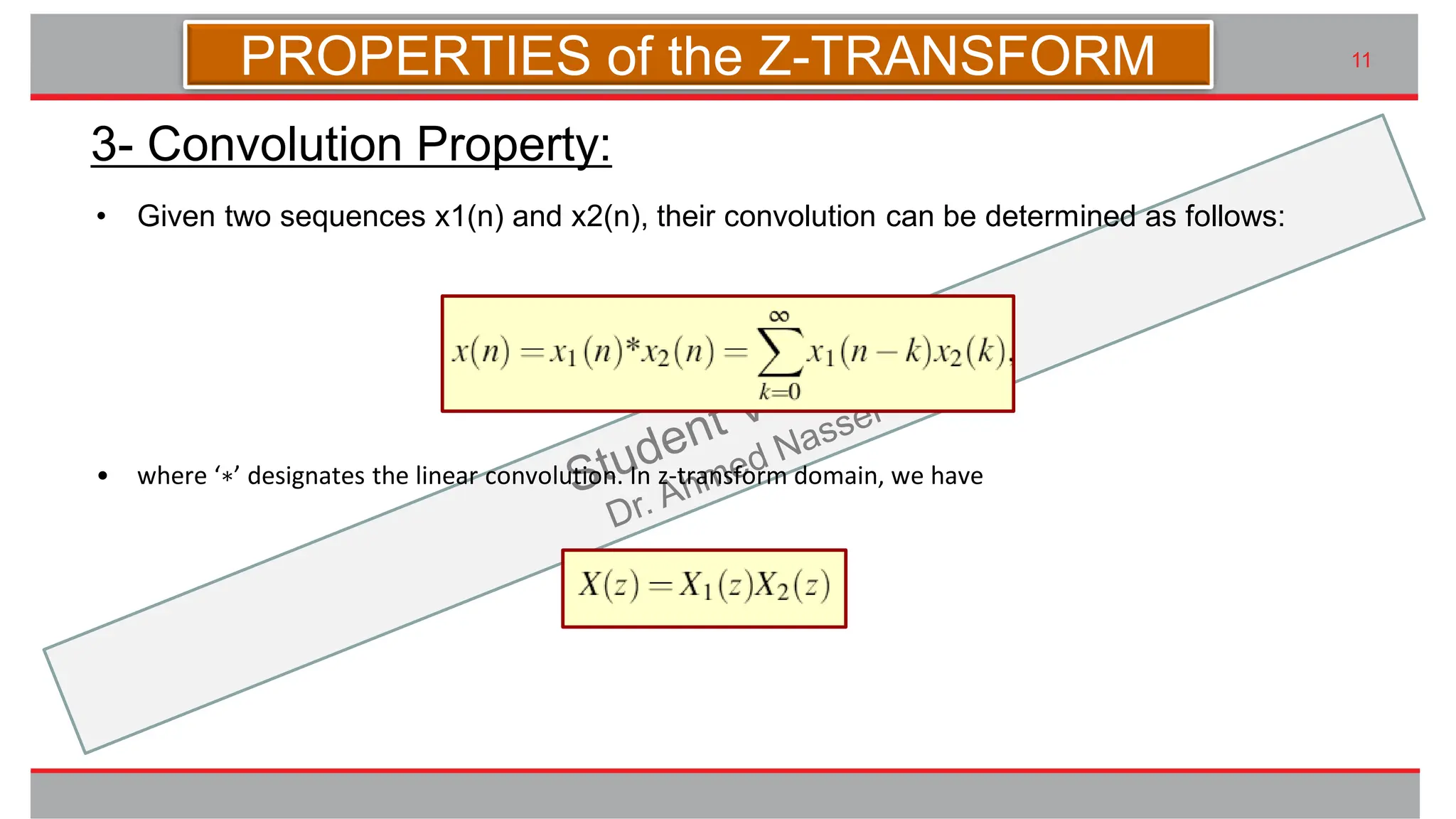
• Given two sequences x1(n) and x2(n), their convolution can be determined as follows:
• where ‘∗’ designates the linear convolution. In z-transform domain, we have
11
3- Convolution Property:
PROPERTIES of the Z-TRANSFORM
九州大学UIプロジェクト Kyudai Taro,2007
12
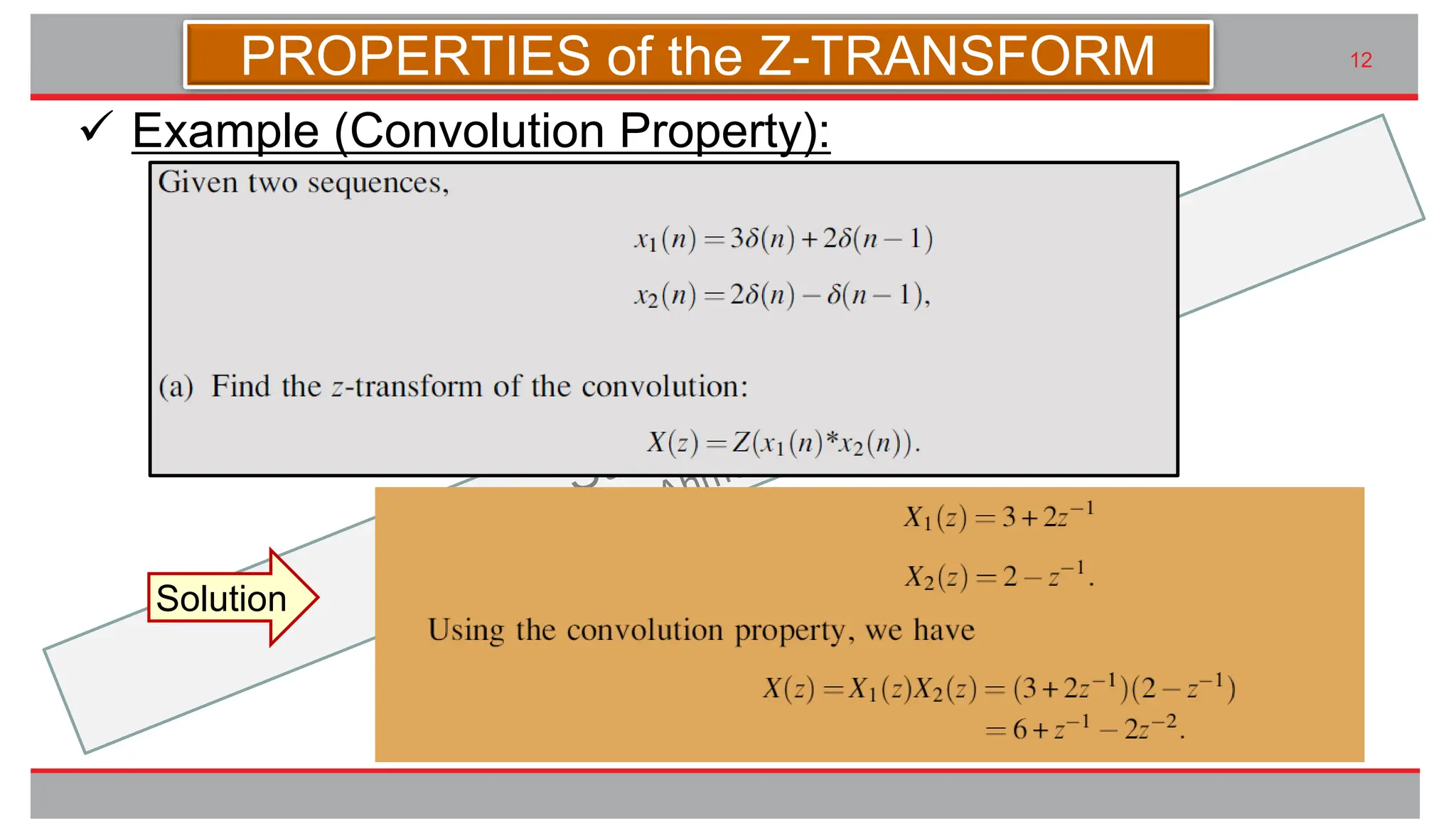
✓ Example (Convolution Property):
PROPERTIES of the Z-TRANSFORM
Solution
九州大学UIプロジェクト Kyudai Taro,2007
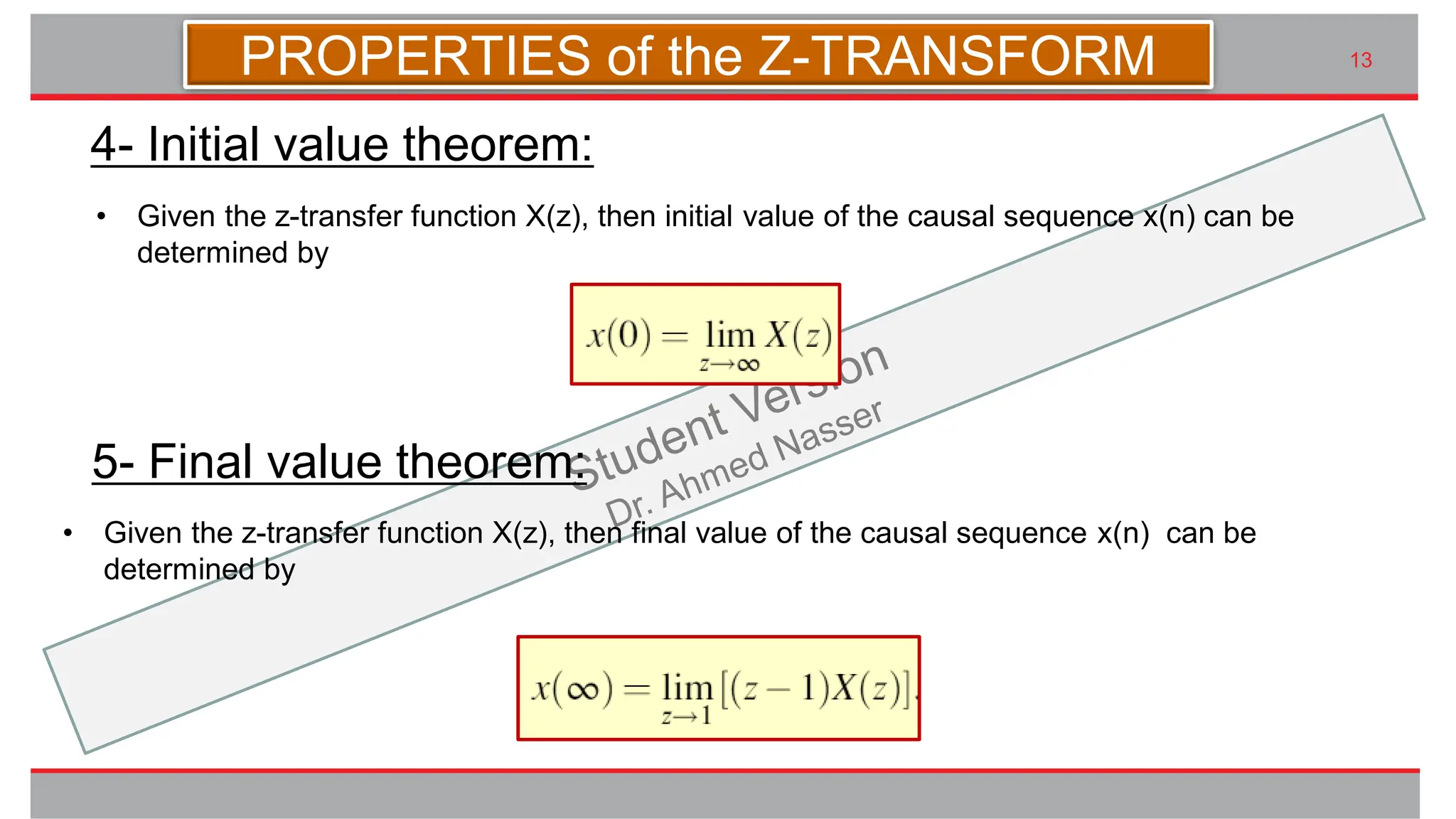
• Given the z-transfer function X(z), then initial value of the causal sequence x(n) can be
determined by
13
4- Initial value theorem:
5- Final value theorem:
• Given the z-transfer function X(z), then final value of the causal sequence x(n) can be
determined by
PROPERTIES of the Z-TRANSFORM
九州大学UIプロジェクト Kyudai Taro,2007
14
PROPERTIES of the Z-TRANSFORM
九州大学UIプロジェクト Kyudai Taro,2007
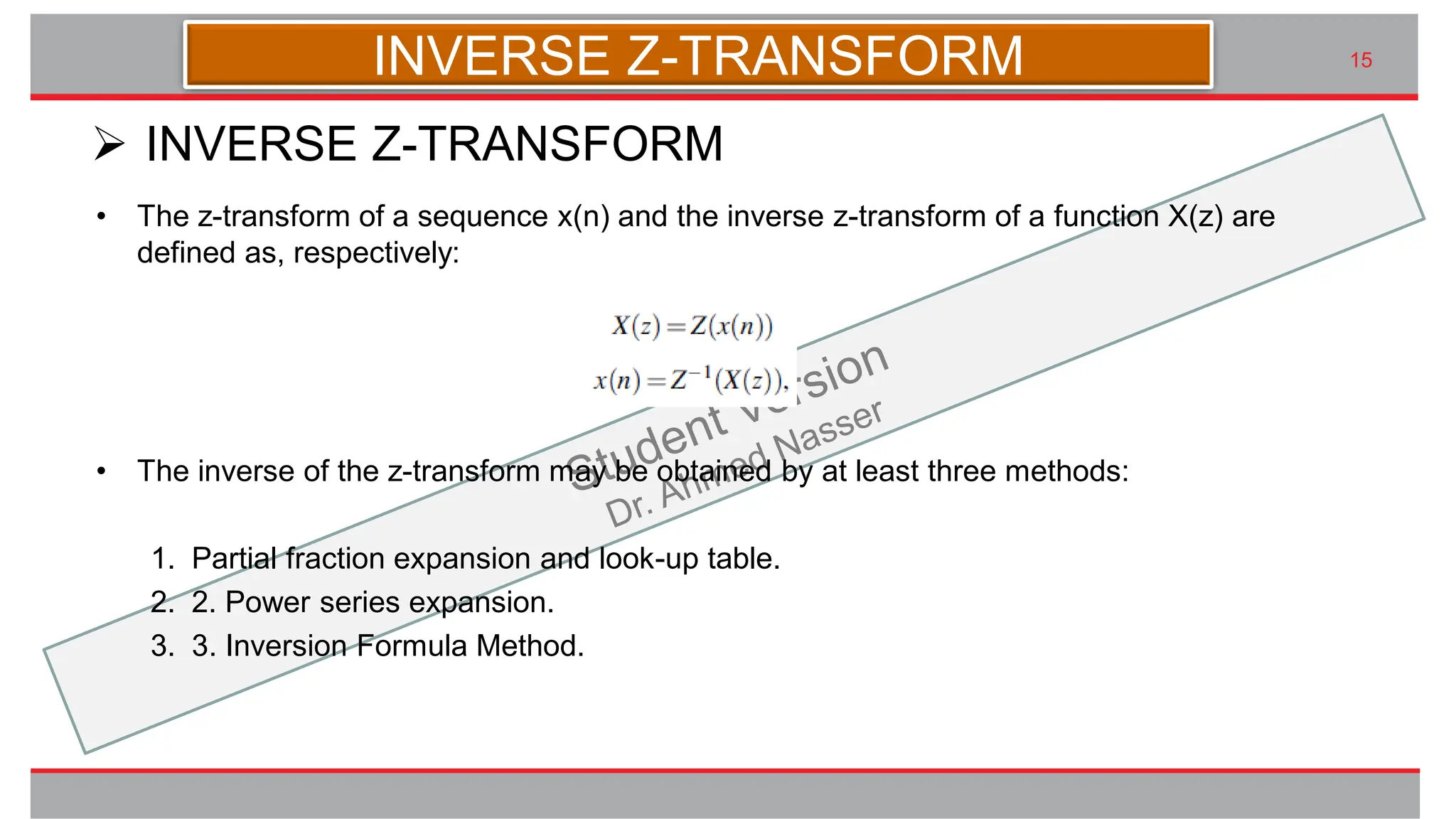
• The z-transform of a sequence x(n) and the inverse z-transform of a function X(z) are
defined as, respectively:
• The inverse of the z-transform may be obtained by at least three methods:
1. Partial fraction expansion and look-up table.
2. 2. Power series expansion.
3. 3. Inversion Formula Method.
15
➢ INVERSE Z-TRANSFORM
INVERSE Z-TRANSFORM
九州大学UIプロジェクト Kyudai Taro,2007
16
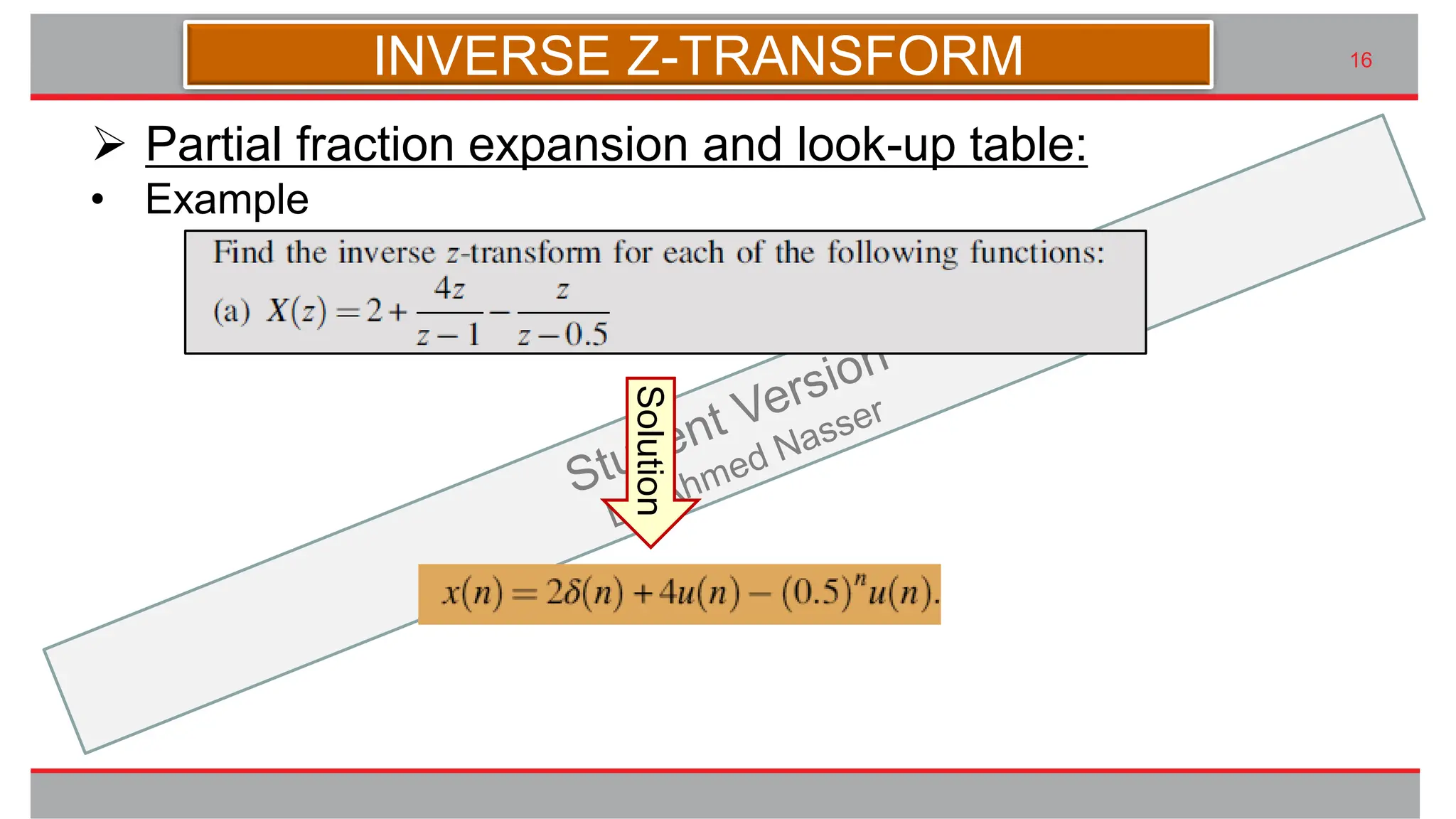
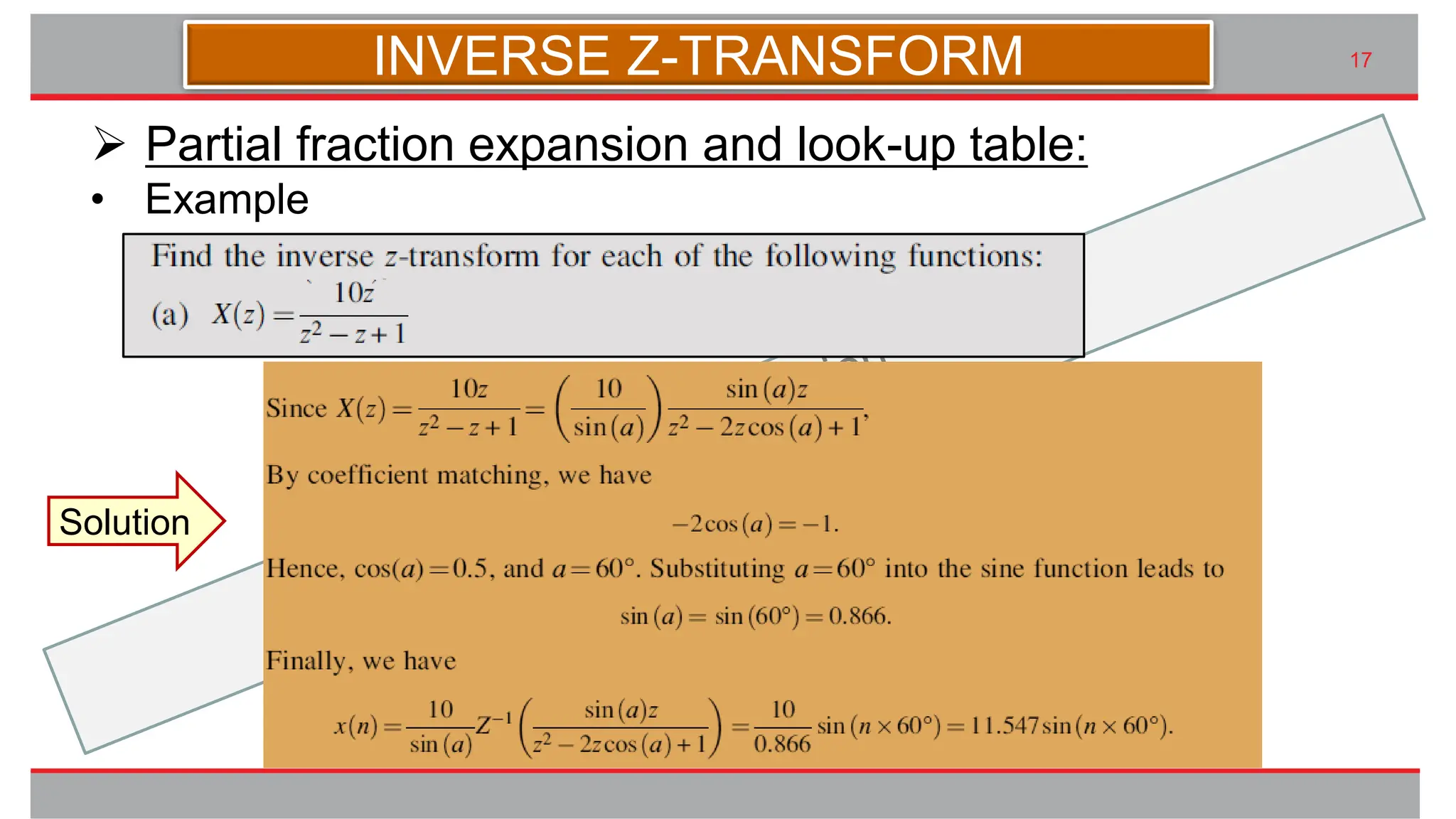
➢ Partial fraction expansion and look-up table:
INVERSE Z-TRANSFORM
• Example
Solution
九州大学UIプロジェクト Kyudai Taro,2007
17
➢ Partial fraction expansion and look-up table:
INVERSE Z-TRANSFORM
• Example
Solution
九州大学UIプロジェクト Kyudai Taro,2007
18
➢ Partial fraction expansion and look-up table:
INVERSE Z-TRANSFORM
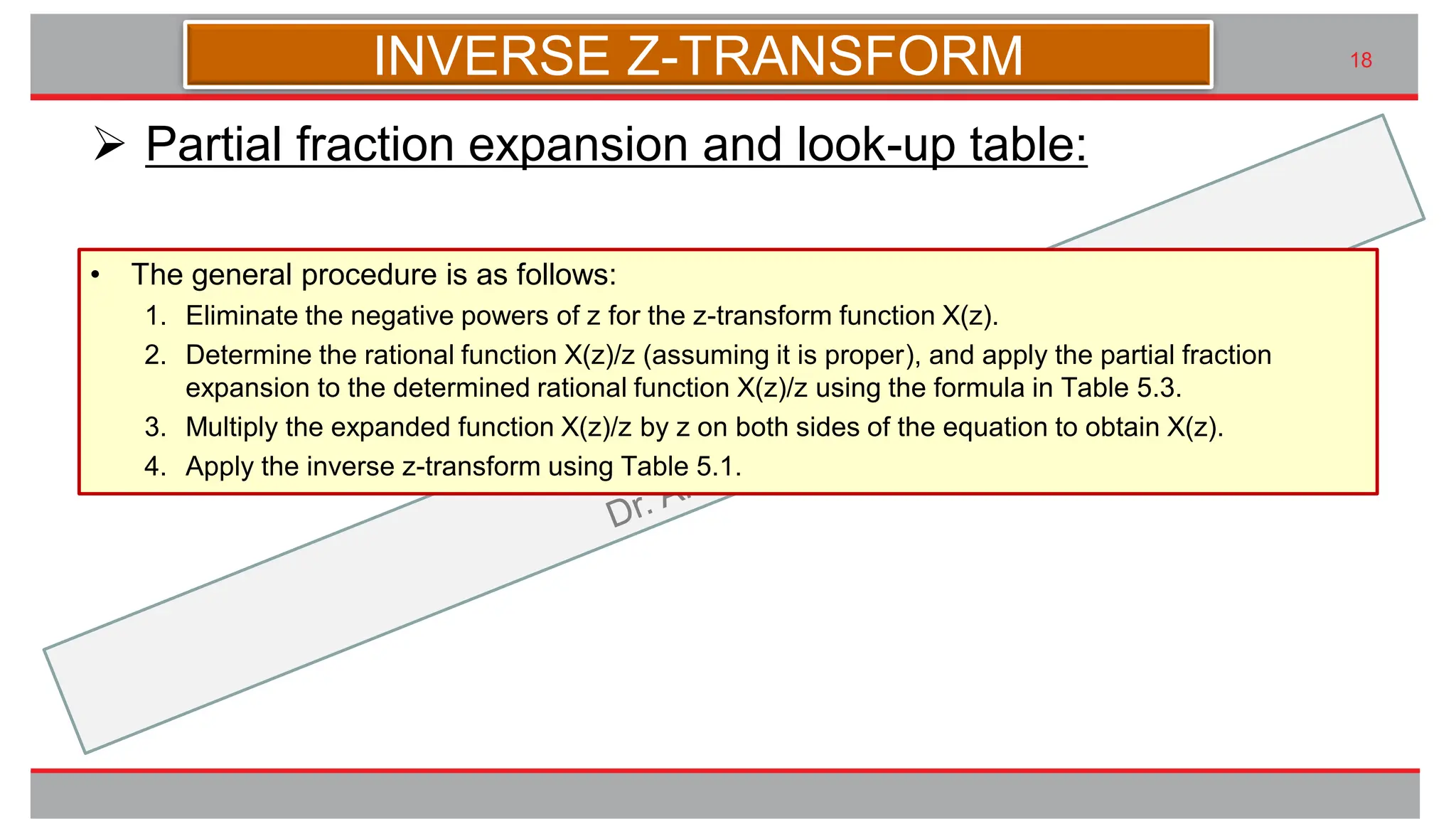
• The general procedure is as follows:
1. Eliminate the negative powers of z for the z-transform function X(z).
2. Determine the rational function X(z)/z (assuming it is proper), and apply the partial fraction
expansion to the determined rational function X(z)/z using the formula in Table 5.3.
3. Multiply the expanded function X(z)/z by z on both sides of the equation to obtain X(z).
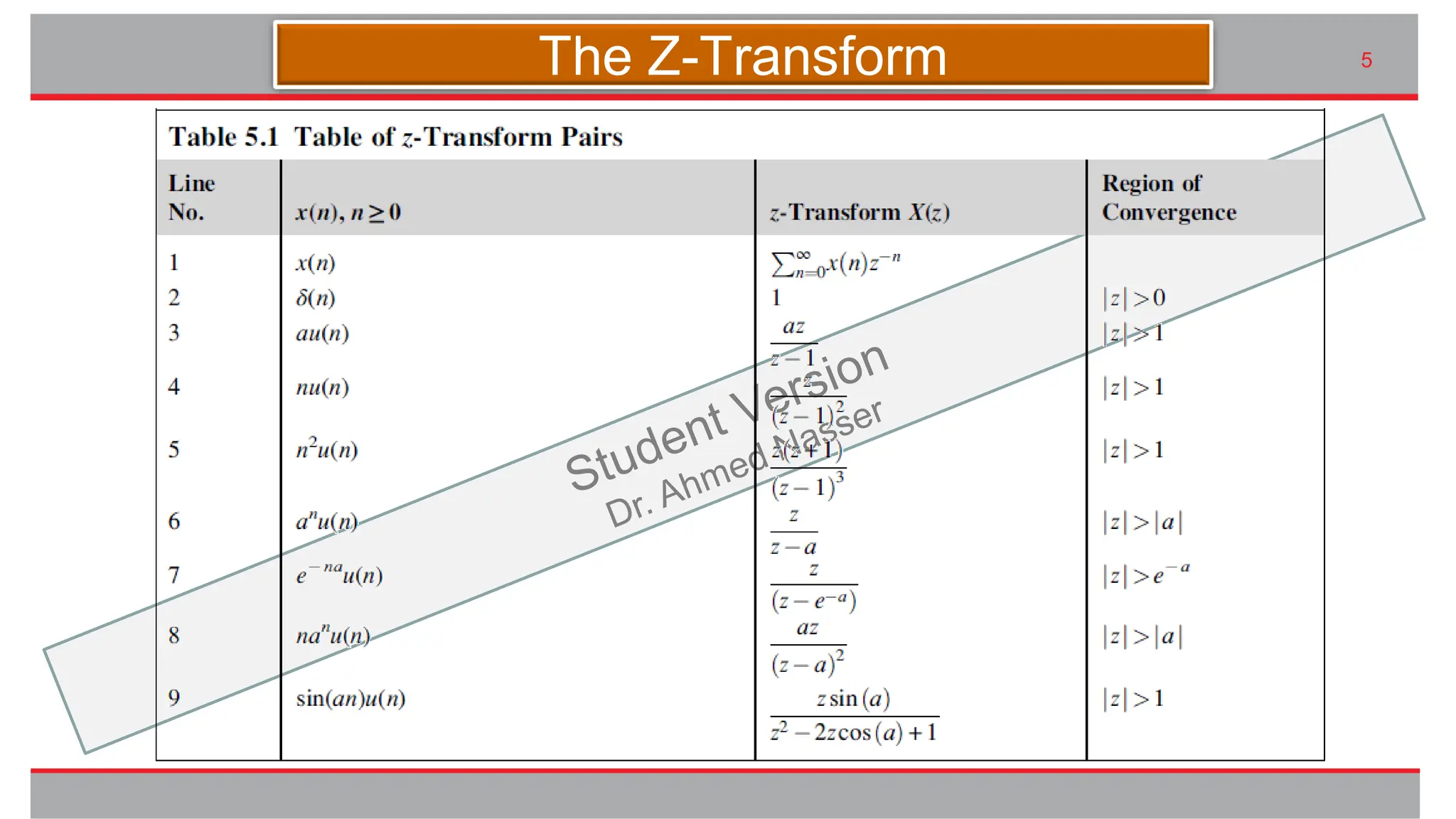
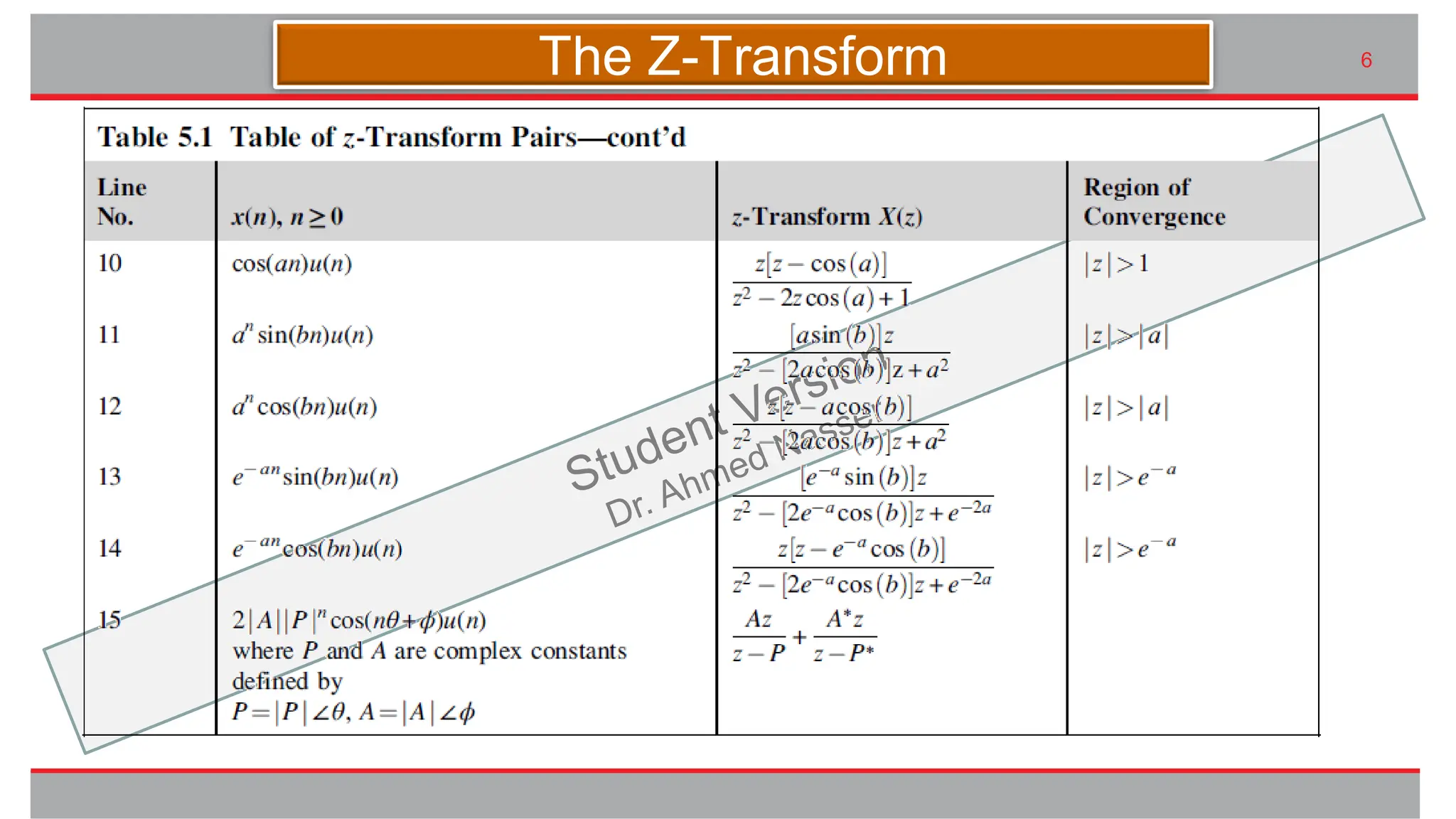
4. Apply the inverse z-transform using Table 5.1.
九州大学UIプロジェクト Kyudai Taro,2007
19
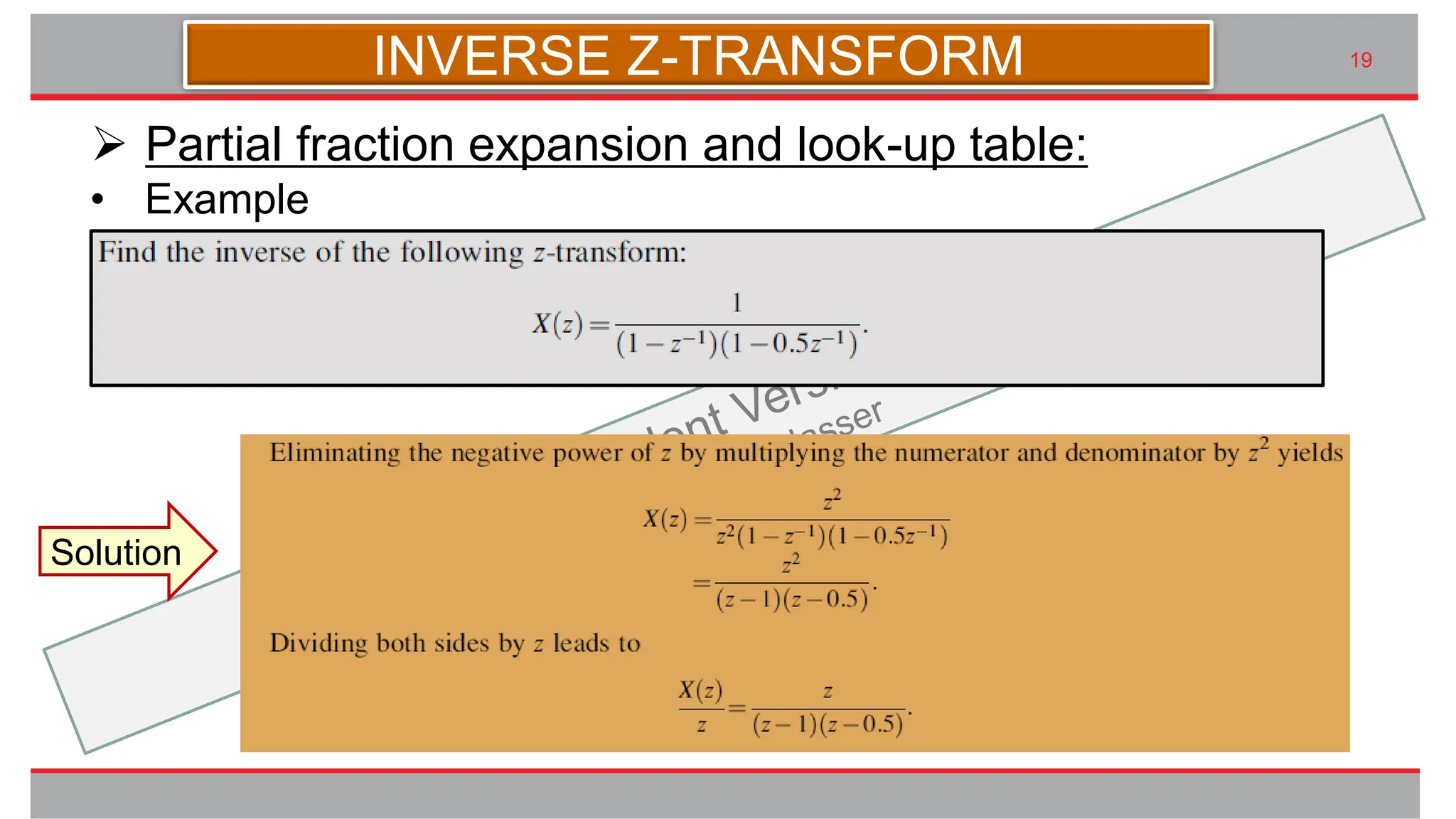
➢ Partial fraction expansion and look-up table:
INVERSE Z-TRANSFORM
• Example
Solution
九州大学UIプロジェクト Kyudai Taro,2007
20
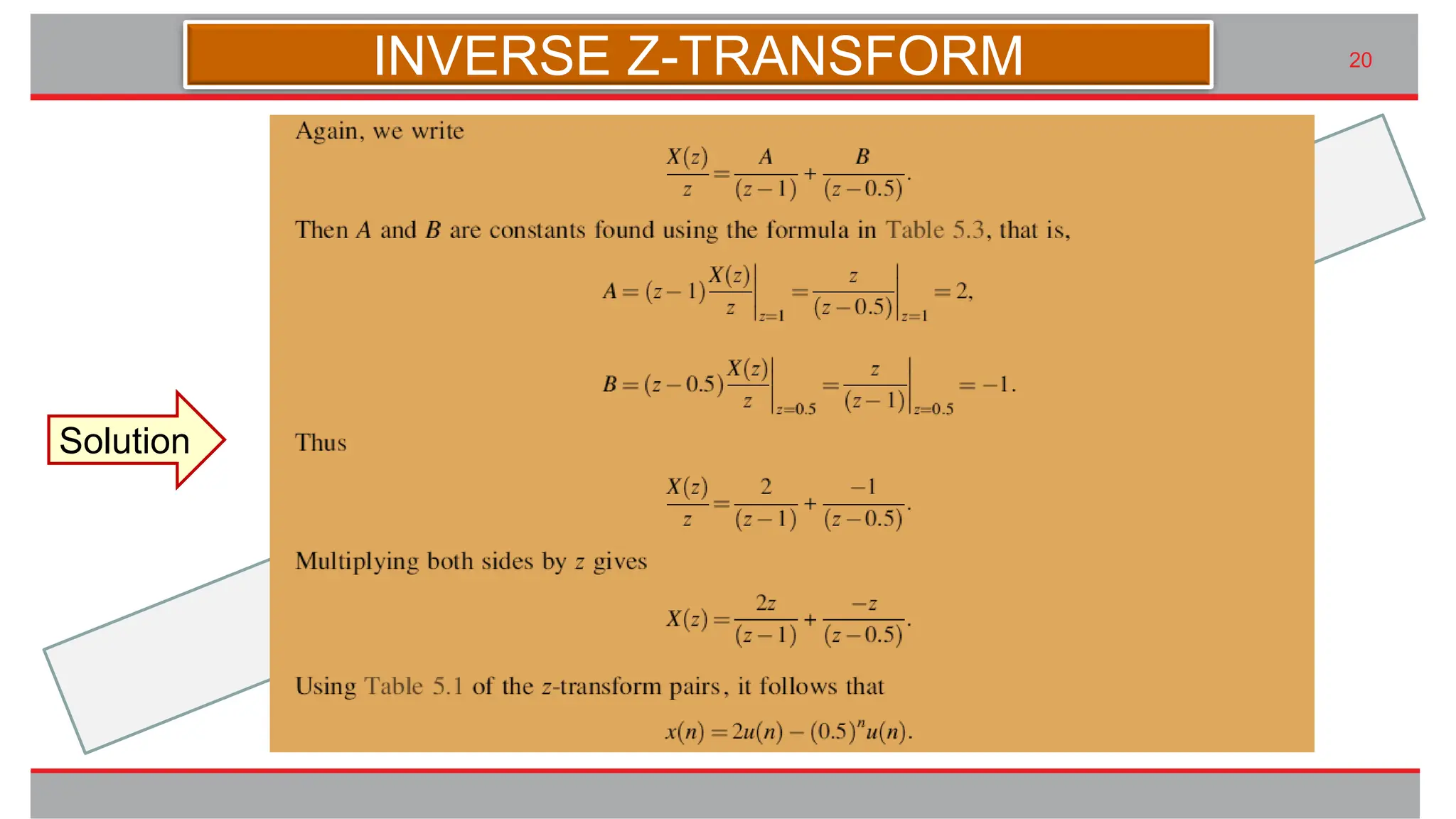
INVERSE Z-TRANSFORM
Solution
Thank You
九州大学UIプロジェクト Kyudai Taro,2007
22

DSP Lect_3_digital_signal_processing.pdf