Inventory Management
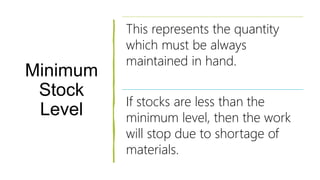
Minimum
Stock
Level
This represents the quantity
which must be always
maintained in hand.
If stocks are less than the
minimum level, then the work
will stop due to shortage of
materials.
Factors
affecting
Minimum
Stock
Level
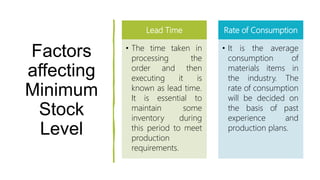
Lead Time
• The time taken in
processing the
order and then
executing it is
known as lead time.
It is essential to
maintain some
inventory during
this period to meet
production
requirements.
Rate of Consumption
• It is the average
consumption of
materials items in
the industry. The
rate of consumption
will be decided on
the basis of past
experience and
production plans.
Factors
affecting
Minimum
Stock
Level
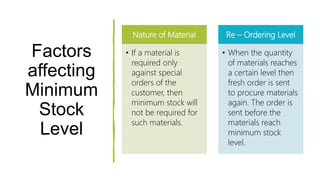
Nature of Material
• If a material is
required only
against special
orders of the
customer, then
minimum stock will
not be required for
such materials.
Re – Ordering Level
• When the quantity
of materials reaches
a certain level then
fresh order is sent
to procure materials
again. The order is
sent before the
materials reach
minimum stock
level.
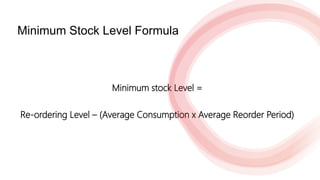
Minimum Stock Level Formula
Minimum stock Level =
Re-ordering Level – (Average Consumption x Average Reorder Period)
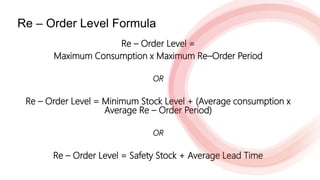
Re – Order Level Formula
Re – Order Level =
Maximum Consumption x Maximum Re–Order Period
OR
Re – Order Level = Minimum Stock Level + (Average consumption x
Average Re – Order Period)
OR
Re – Order Level = Safety Stock + Average Lead Time
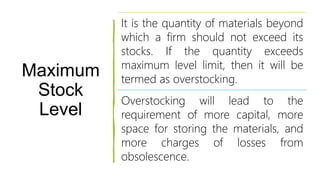
Maximum
Stock
Level
It is the quantity of materials beyond
which a firm should not exceed its
stocks. If the quantity exceeds
maximum level limit, then it will be
termed as overstocking.
Overstocking will lead to the
requirement of more capital, more
space for storing the materials, and
more charges of losses from
obsolescence.
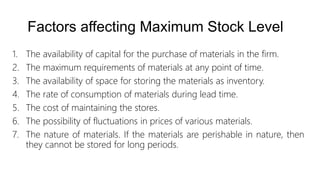
Factors affecting Maximum Stock Level
1. The availability of capital for the purchase of materials in the firm.
2. The maximum requirements of materials at any point of time.
3. The availability of space for storing the materials as inventory.
4. The rate of consumption of materials during lead time.
5. The cost of maintaining the stores.
6. The possibility of fluctuations in prices of various materials.
7. The nature of materials. If the materials are perishable in nature, then
they cannot be stored for long periods.
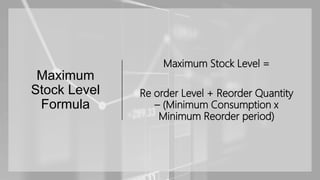
Maximum
Stock Level
Formula
Maximum Stock Level =
Re order Level + Reorder Quantity
– (Minimum Consumption x
Minimum Reorder period)
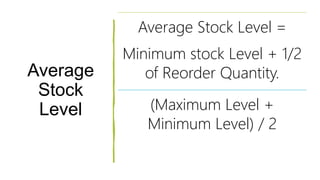
Average
Stock
Level
Average Stock Level =
Minimum stock Level + 1/2
of Reorder Quantity.
(Maximum Level +
Minimum Level) / 2
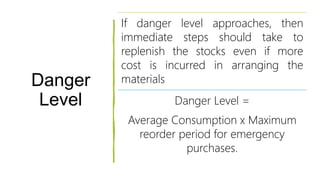
Danger
Level
If danger level approaches, then
immediate steps should take to
replenish the stocks even if more
cost is incurred in arranging the
materials
Danger Level =
Average Consumption x Maximum
reorder period for emergency
purchases.
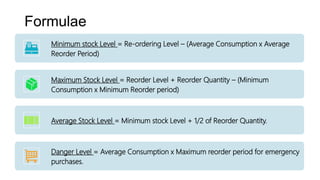
Formulae
Minimum stock Level = Re-ordering Level – (Average Consumption x Average
Reorder Period)
Maximum Stock Level = Reorder Level + Reorder Quantity – (Minimum
Consumption x Minimum Reorder period)
Average Stock Level = Minimum stock Level + 1/2 of Reorder Quantity.
Danger Level = Average Consumption x Maximum reorder period for emergency
purchases.

Inventory Management.pptx

  • 1.
  • 2.
    Minimum Stock Level This represents thequantity which must be always maintained in hand. If stocks are less than the minimum level, then the work will stop due to shortage of materials.
  • 3.
    Factors affecting Minimum Stock Level Lead Time • Thetime taken in processing the order and then executing it is known as lead time. It is essential to maintain some inventory during this period to meet production requirements. Rate of Consumption • It is the average consumption of materials items in the industry. The rate of consumption will be decided on the basis of past experience and production plans.
  • 4.
    Factors affecting Minimum Stock Level Nature of Material •If a material is required only against special orders of the customer, then minimum stock will not be required for such materials. Re – Ordering Level • When the quantity of materials reaches a certain level then fresh order is sent to procure materials again. The order is sent before the materials reach minimum stock level.
  • 5.
    Minimum Stock LevelFormula Minimum stock Level = Re-ordering Level – (Average Consumption x Average Reorder Period)
  • 6.
    Re – OrderLevel Formula Re – Order Level = Maximum Consumption x Maximum Re–Order Period OR Re – Order Level = Minimum Stock Level + (Average consumption x Average Re – Order Period) OR Re – Order Level = Safety Stock + Average Lead Time
  • 7.
    Maximum Stock Level It is thequantity of materials beyond which a firm should not exceed its stocks. If the quantity exceeds maximum level limit, then it will be termed as overstocking. Overstocking will lead to the requirement of more capital, more space for storing the materials, and more charges of losses from obsolescence.
  • 8.
    Factors affecting MaximumStock Level 1. The availability of capital for the purchase of materials in the firm. 2. The maximum requirements of materials at any point of time. 3. The availability of space for storing the materials as inventory. 4. The rate of consumption of materials during lead time. 5. The cost of maintaining the stores. 6. The possibility of fluctuations in prices of various materials. 7. The nature of materials. If the materials are perishable in nature, then they cannot be stored for long periods.
  • 9.
    Maximum Stock Level Formula Maximum StockLevel = Re order Level + Reorder Quantity – (Minimum Consumption x Minimum Reorder period)
  • 10.
    Average Stock Level Average Stock Level= Minimum stock Level + 1/2 of Reorder Quantity. (Maximum Level + Minimum Level) / 2
  • 11.
    Danger Level If danger levelapproaches, then immediate steps should take to replenish the stocks even if more cost is incurred in arranging the materials Danger Level = Average Consumption x Maximum reorder period for emergency purchases.
  • 12.
    Formulae Minimum stock Level= Re-ordering Level – (Average Consumption x Average Reorder Period) Maximum Stock Level = Reorder Level + Reorder Quantity – (Minimum Consumption x Minimum Reorder period) Average Stock Level = Minimum stock Level + 1/2 of Reorder Quantity. Danger Level = Average Consumption x Maximum reorder period for emergency purchases.