Material
Control &
Material
Issues
UNIT II
MEANING OF MATERIAL
Material control is the process of systematically
controlling materials over the stages of procurement,
storage, and usage so as to help maintain the regular
and uninterrupted flow of the materials in the
production pipeline.
No system of costing is complete without an effective
material control system. Material control is a system that
ensures the provision of the required quantity of materials
of the required quality at the required time with the
minimum capital investment.
OBJECTIVES
1. To Avoid Over And Under Stocking Of Materials
2. To Supply Right Quantity Of Materials
3. Wastage Minimization
4. To Increase Profitability
5. Procuring Better Quality Of Materials
6. Protection Of Materials
7. To Provide Data And Information
ESSENTIALS OF MATERIAL CONTROL
Planning Classification & Codification Internal Check
Effective planning and
forecasting of material
requirements is crucial
to ensure the
availability of the right
materials at the right
time.
Classification involves grouping
items based on criteria such as
usage, nature, value, demand
patterns, and criticality.
Codification, on the other hand,
assigns unique codes or
identifiers to each item within
these classified groups. These
codes are structured
hierarchically and provide
detailed information about each
item, including its category,
type, and specific identity.
Internal checks in
material control refer
to the systematic
procedures and
practices implemented
within an organization.
Internal checks in
material control are
essential mechanisms
that ensure the
accuracy, reliability,
and efficiency of
managing materials
within an organization.
TECHNIQUES IN MATERIAL CONTROL
The quantity of a commodity to be
ordered at a time is known as the
EOQ.
determined after considering the
carrying costs and ordering costs.
FORMULA
Total cost of material = Cost of
acquisition + Ordering cost +
Carrying cost
Level setting in material control refers to
establishing and maintaining appropriate
levels of inventory or materials within an
organization to meet operational
requirements effectively.
It includes
a) Re-order level
(b) Minimum Level
(c) Maximum Level
(d) Danger Level and
(e) Average Stock Level
Level setting Economic Order Quantity
JIT, is an inventory management method in
which goods are received from suppliers only
as they are needed. JIT inventory management
ensures that stock arrives as it is needed for
production or to meet consumer demand, but
no sooner.
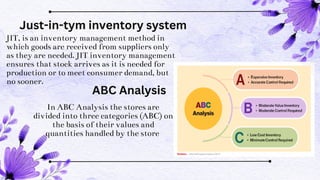
In ABC Analysis the stores are
divided into three categories (ABC) on
the basis of their values and
quantities handled by the store
Just-in-tym inventory system
ABC Analysis
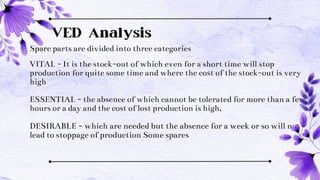
VED Analysis
Spare parts are divided into three categories
VITAL - It is the stock-out of which even for a short time will stop
production for quite some time and where the cost of the stock-out is very
high
ESSENTIAL - the absence of which cannot be tolerated for more than a few
hours or a day and the cost of lost production is high,
DESIRABLE - which are needed but the absence for a week or so will not
lead to stoppage of production Some spares
Double Bin System
Double Bin System is mainly adopted by
small firms. It has 2 categories
first bin contains the active or working
inventory that is currently being used
or processed. It is for Ordinary issues
Once this bin is depleted, the second
bin, which holds a reserve or safety
stock, is then accessed. This is for
emergency purpose
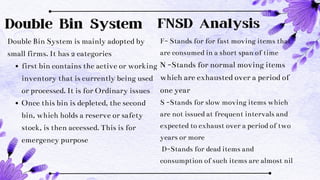
F- Stands for for fast moving items that
are consumed in a short span of time
N -Stands for normal moving items
which are exhausted over a period of
one year
S -Stands for slow moving items which
are not issued at frequent intervals and
expected to exhaust over a period of two
years or more
D-Stands for dead items and
consumption of such items are almost nil
FNSD Analysis
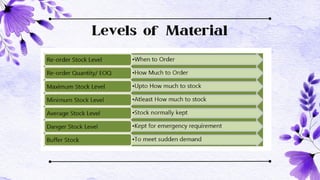
Levels of Material
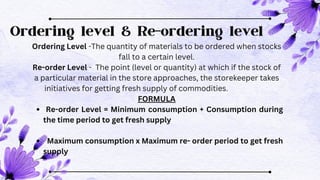
Ordering level & Re-ordering level
Ordering Level -The quantity of materials to be ordered when stocks
fall to a certain level.
Re-order Level - The point (level or quantity) at which if the stock of
a particular material in the store approaches, the storekeeper takes
initiatives for getting fresh supply of commodities.
FORMULA
Re-order Level = Minimum consumption + Consumption during
the time period to get fresh supply
Maximum consumption x Maximum re- order period to get fresh
supply
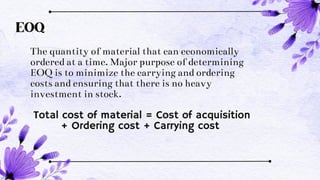
EOQ
The quantity of material that can economically
ordered at a time. Major purpose of determining
EOQ is to minimize the carrying and ordering
costs and ensuring that there is no heavy
investment in stock.
Total cost of material = Cost of acquisition
+ Ordering cost + Carrying cost
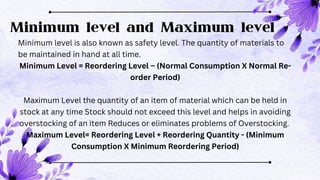
Minimum level and Maximum level
Minimum level is also known as safety level. The quantity of materials to
be maintained in hand at all time.
Minimum Level = Reordering Level – (Normal Consumption X Normal Re-
order Period)
Maximum Level the quantity of an item of material which can be held in
stock at any time Stock should not exceed this level and helps in avoiding
overstocking of an item Reduces or eliminates problems of Overstocking.
Maximum Level= Reordering Level + Reordering Quantity - (Minimum
Consumption X Minimum Reordering Period)
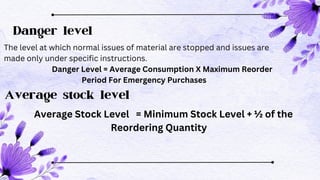
Danger level
The level at which normal issues of material are stopped and issues are
made only under specific instructions.
Danger Level = Average Consumption X Maximum Reorder
Period For Emergency Purchases
Average stock level
Average Stock Level = Minimum Stock Level + ½ of the
Reordering Quantity
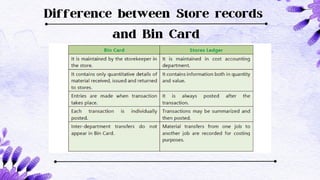
Difference between Store records
and Bin Card
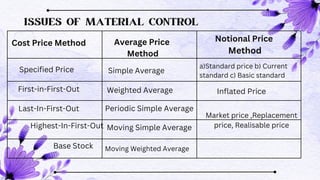
ISSUES OF MATERIAL CONTROL
Cost Price Method Average Price
Method
Notional Price
Method
Specified Price Simple Average
Weighted Average
Periodic Simple Average
Moving Simple Average
Moving Weighted Average
First-in-First-Out
Last-In-First-Out
Highest-In-First-Out
Base Stock
a)Standard price b) Current
standard c) Basic standard
Inflated Price
Market price ,Replacement
price, Realisable price
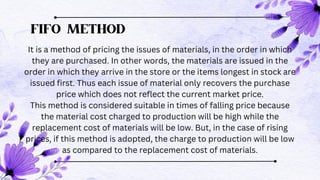
FIFO METHOD
It is a method of pricing the issues of materials, in the order in which
they are purchased. In other words, the materials are issued in the
order in which they arrive in the store or the items longest in stock are
issued first. Thus each issue of material only recovers the purchase
price which does not reflect the current market price.
This method is considered suitable in times of falling price because
the material cost charged to production will be high while the
replacement cost of materials will be low. But, in the case of rising
prices, if this method is adopted, the charge to production will be low
as compared to the replacement cost of materials.
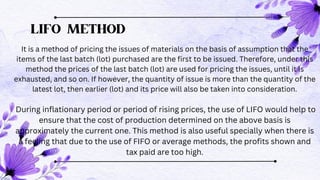
LIFO METHOD
It is a method of pricing the issues of materials on the basis of assumption that the
items of the last batch (lot) purchased are the first to be issued. Therefore, under this
method the prices of the last batch (lot) are used for pricing the issues, until it is
exhausted, and so on. If however, the quantity of issue is more than the quantity of the
latest lot, then earlier (lot) and its price will also be taken into consideration.
During inflationary period or period of rising prices, the use of LIFO would help to
ensure that the cost of production determined on the above basis is
approximately the current one. This method is also useful specially when there is
a feeling that due to the use of FIFO or average methods, the profits shown and
tax paid are too high.
t
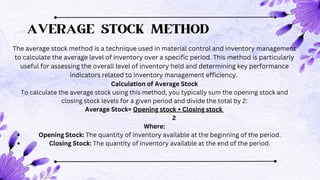
AVERAGE STOCK METHOD
The average stock method is a technique used in material control and inventory management
to calculate the average level of inventory over a specific period. This method is particularly
useful for assessing the overall level of inventory held and determining key performance
indicators related to inventory management efficiency.
Calculation of Average Stock
To calculate the average stock using this method, you typically sum the opening stock and
closing stock levels for a given period and divide the total by 2:
Average Stock= Opening stock + Closing stock
2
Where:
Opening Stock: The quantity of inventory available at the beginning of the period.
Closing Stock: The quantity of inventory available at the end of the period.
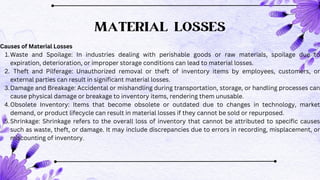
Causes of Material Losses
Waste and Spoilage: In industries dealing with perishable goods or raw materials, spoilage due to
expiration, deterioration, or improper storage conditions can lead to material losses.
1.
Theft and Pilferage: Unauthorized removal or theft of inventory items by employees, customers, or
external parties can result in significant material losses.
2.
Damage and Breakage: Accidental or mishandling during transportation, storage, or handling processes can
cause physical damage or breakage to inventory items, rendering them unusable.
3.
Obsolete Inventory: Items that become obsolete or outdated due to changes in technology, market
demand, or product lifecycle can result in material losses if they cannot be sold or repurposed.
4.
Shrinkage: Shrinkage refers to the overall loss of inventory that cannot be attributed to specific causes
such as waste, theft, or damage. It may include discrepancies due to errors in recording, misplacement, or
miscounting of inventory.
5.
MATERIAL LOSSES
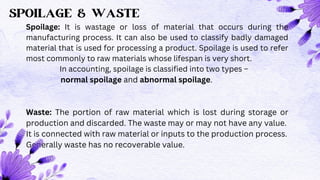
SPOILAGE & WASTE
Spoilage: It is wastage or loss of material that occurs during the
manufacturing process. It can also be used to classify badly damaged
material that is used for processing a product. Spoilage is used to refer
most commonly to raw materials whose lifespan is very short.
In accounting, spoilage is classified into two types –
normal spoilage and abnormal spoilage.
Waste: The portion of raw material which is lost during storage or
production and discarded. The waste may or may not have any value.
It is connected with raw material or inputs to the production process.
Generally waste has no recoverable value.
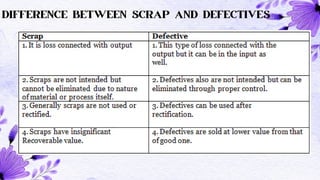
DIFFERENCE BETWEEN SCRAP AND DEFECTIVES
Thank You

Material Control and Material Issues .pdf

  • 1.
  • 2.
    MEANING OF MATERIAL Materialcontrol is the process of systematically controlling materials over the stages of procurement, storage, and usage so as to help maintain the regular and uninterrupted flow of the materials in the production pipeline. No system of costing is complete without an effective material control system. Material control is a system that ensures the provision of the required quantity of materials of the required quality at the required time with the minimum capital investment.
  • 3.
    OBJECTIVES 1. To AvoidOver And Under Stocking Of Materials 2. To Supply Right Quantity Of Materials 3. Wastage Minimization 4. To Increase Profitability 5. Procuring Better Quality Of Materials 6. Protection Of Materials 7. To Provide Data And Information
  • 4.
    ESSENTIALS OF MATERIALCONTROL Planning Classification & Codification Internal Check Effective planning and forecasting of material requirements is crucial to ensure the availability of the right materials at the right time. Classification involves grouping items based on criteria such as usage, nature, value, demand patterns, and criticality. Codification, on the other hand, assigns unique codes or identifiers to each item within these classified groups. These codes are structured hierarchically and provide detailed information about each item, including its category, type, and specific identity. Internal checks in material control refer to the systematic procedures and practices implemented within an organization. Internal checks in material control are essential mechanisms that ensure the accuracy, reliability, and efficiency of managing materials within an organization.
  • 5.
    TECHNIQUES IN MATERIALCONTROL The quantity of a commodity to be ordered at a time is known as the EOQ. determined after considering the carrying costs and ordering costs. FORMULA Total cost of material = Cost of acquisition + Ordering cost + Carrying cost Level setting in material control refers to establishing and maintaining appropriate levels of inventory or materials within an organization to meet operational requirements effectively. It includes a) Re-order level (b) Minimum Level (c) Maximum Level (d) Danger Level and (e) Average Stock Level Level setting Economic Order Quantity
  • 6.
    JIT, is aninventory management method in which goods are received from suppliers only as they are needed. JIT inventory management ensures that stock arrives as it is needed for production or to meet consumer demand, but no sooner. In ABC Analysis the stores are divided into three categories (ABC) on the basis of their values and quantities handled by the store Just-in-tym inventory system ABC Analysis
  • 7.
    VED Analysis Spare partsare divided into three categories VITAL - It is the stock-out of which even for a short time will stop production for quite some time and where the cost of the stock-out is very high ESSENTIAL - the absence of which cannot be tolerated for more than a few hours or a day and the cost of lost production is high, DESIRABLE - which are needed but the absence for a week or so will not lead to stoppage of production Some spares
  • 8.
    Double Bin System DoubleBin System is mainly adopted by small firms. It has 2 categories first bin contains the active or working inventory that is currently being used or processed. It is for Ordinary issues Once this bin is depleted, the second bin, which holds a reserve or safety stock, is then accessed. This is for emergency purpose F- Stands for for fast moving items that are consumed in a short span of time N -Stands for normal moving items which are exhausted over a period of one year S -Stands for slow moving items which are not issued at frequent intervals and expected to exhaust over a period of two years or more D-Stands for dead items and consumption of such items are almost nil FNSD Analysis
  • 9.
  • 10.
    Ordering level &Re-ordering level Ordering Level -The quantity of materials to be ordered when stocks fall to a certain level. Re-order Level - The point (level or quantity) at which if the stock of a particular material in the store approaches, the storekeeper takes initiatives for getting fresh supply of commodities. FORMULA Re-order Level = Minimum consumption + Consumption during the time period to get fresh supply Maximum consumption x Maximum re- order period to get fresh supply
  • 11.
    EOQ The quantity ofmaterial that can economically ordered at a time. Major purpose of determining EOQ is to minimize the carrying and ordering costs and ensuring that there is no heavy investment in stock. Total cost of material = Cost of acquisition + Ordering cost + Carrying cost
  • 12.
    Minimum level andMaximum level Minimum level is also known as safety level. The quantity of materials to be maintained in hand at all time. Minimum Level = Reordering Level – (Normal Consumption X Normal Re- order Period) Maximum Level the quantity of an item of material which can be held in stock at any time Stock should not exceed this level and helps in avoiding overstocking of an item Reduces or eliminates problems of Overstocking. Maximum Level= Reordering Level + Reordering Quantity - (Minimum Consumption X Minimum Reordering Period)
  • 13.
    Danger level The levelat which normal issues of material are stopped and issues are made only under specific instructions. Danger Level = Average Consumption X Maximum Reorder Period For Emergency Purchases Average stock level Average Stock Level = Minimum Stock Level + ½ of the Reordering Quantity
  • 14.
    Difference between Storerecords and Bin Card
  • 15.
    ISSUES OF MATERIALCONTROL Cost Price Method Average Price Method Notional Price Method Specified Price Simple Average Weighted Average Periodic Simple Average Moving Simple Average Moving Weighted Average First-in-First-Out Last-In-First-Out Highest-In-First-Out Base Stock a)Standard price b) Current standard c) Basic standard Inflated Price Market price ,Replacement price, Realisable price
  • 16.
    FIFO METHOD It isa method of pricing the issues of materials, in the order in which they are purchased. In other words, the materials are issued in the order in which they arrive in the store or the items longest in stock are issued first. Thus each issue of material only recovers the purchase price which does not reflect the current market price. This method is considered suitable in times of falling price because the material cost charged to production will be high while the replacement cost of materials will be low. But, in the case of rising prices, if this method is adopted, the charge to production will be low as compared to the replacement cost of materials.
  • 17.
    LIFO METHOD It isa method of pricing the issues of materials on the basis of assumption that the items of the last batch (lot) purchased are the first to be issued. Therefore, under this method the prices of the last batch (lot) are used for pricing the issues, until it is exhausted, and so on. If however, the quantity of issue is more than the quantity of the latest lot, then earlier (lot) and its price will also be taken into consideration. During inflationary period or period of rising prices, the use of LIFO would help to ensure that the cost of production determined on the above basis is approximately the current one. This method is also useful specially when there is a feeling that due to the use of FIFO or average methods, the profits shown and tax paid are too high. t
  • 18.
    AVERAGE STOCK METHOD Theaverage stock method is a technique used in material control and inventory management to calculate the average level of inventory over a specific period. This method is particularly useful for assessing the overall level of inventory held and determining key performance indicators related to inventory management efficiency. Calculation of Average Stock To calculate the average stock using this method, you typically sum the opening stock and closing stock levels for a given period and divide the total by 2: Average Stock= Opening stock + Closing stock 2 Where: Opening Stock: The quantity of inventory available at the beginning of the period. Closing Stock: The quantity of inventory available at the end of the period.
  • 19.
    Causes of MaterialLosses Waste and Spoilage: In industries dealing with perishable goods or raw materials, spoilage due to expiration, deterioration, or improper storage conditions can lead to material losses. 1. Theft and Pilferage: Unauthorized removal or theft of inventory items by employees, customers, or external parties can result in significant material losses. 2. Damage and Breakage: Accidental or mishandling during transportation, storage, or handling processes can cause physical damage or breakage to inventory items, rendering them unusable. 3. Obsolete Inventory: Items that become obsolete or outdated due to changes in technology, market demand, or product lifecycle can result in material losses if they cannot be sold or repurposed. 4. Shrinkage: Shrinkage refers to the overall loss of inventory that cannot be attributed to specific causes such as waste, theft, or damage. It may include discrepancies due to errors in recording, misplacement, or miscounting of inventory. 5. MATERIAL LOSSES
  • 20.
    SPOILAGE & WASTE Spoilage:It is wastage or loss of material that occurs during the manufacturing process. It can also be used to classify badly damaged material that is used for processing a product. Spoilage is used to refer most commonly to raw materials whose lifespan is very short. In accounting, spoilage is classified into two types – normal spoilage and abnormal spoilage. Waste: The portion of raw material which is lost during storage or production and discarded. The waste may or may not have any value. It is connected with raw material or inputs to the production process. Generally waste has no recoverable value.
  • 21.
  • 22.