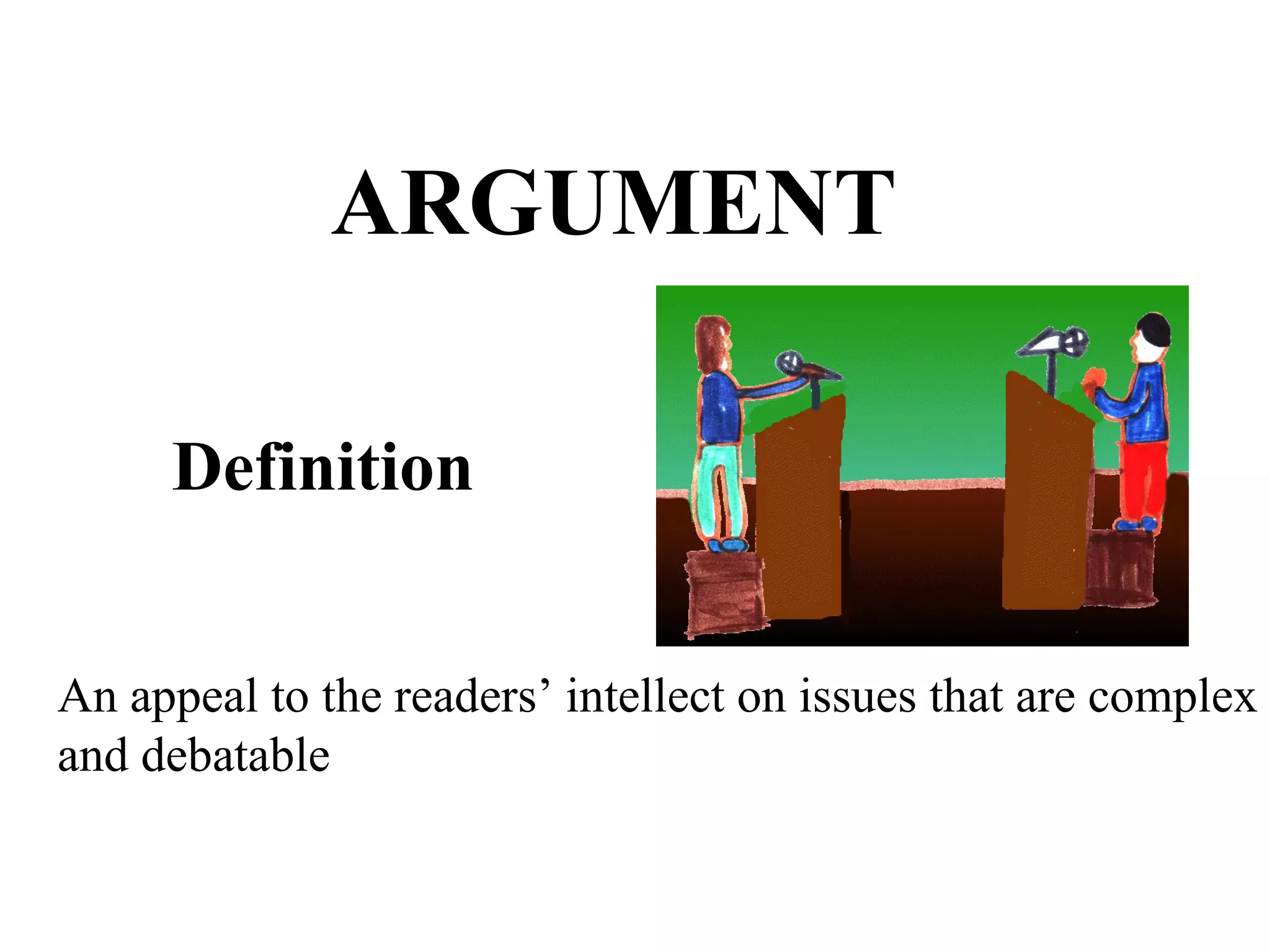
ARGUMENT Definition An appeal to the readers’ intellect on issues that are complex and debatable
PERSUASION Definition To convince readers to think, act, or behave in a certain way
PERSUASION Test for Success Writers have successfully persuaded their readers if those  addressed have  changed  their actions or behavior in favor of the writer.
PERSUASION Obstacles World issues   Personal beliefs
PERSUASION Elements Most Likely To Convince Readers Writer’s credentials, which includes competence.  Quality of the reasoning (sound logic and reasonable  facts) 3. Degree to which writers appeal to our self-interests  (benefit to readers)
ARGUMENT/PERSUASION Important Points to Remember Both argument and persuasion are used, but one is a subdivision of the other. Persuasion is a purpose for writing; argument is an appeal to the readers’ intellect. These are taught together because writers blend these appeals and adjust them to the purpose and audience.
PERSUASION Appeals 1.  Logical 2.  Emotion 3.  Ethics
PERSUASION Examples Appeal to logic  – a lawyer who is arguing a case relies on making claims and using supporting  evidence, such as testimony (statistics and reports), citing authorities, and arguing from precedent.  He/ she uses analogies to make the presentation more concrete, and theorizes about cause and effect.  Even though he/she de-emphasizes personal feelings, they are not totally eliminated.  However, the focus is on facts and research.
PERSUASION Examples Appeal  to emotion –  A writer uses this approach when his/her message appeals to the senses and to personal biases and prejudices.  Connotative language (words that elicit certain feelings when the work is uttered) is used, as is figurative language (similes, metaphors,  colorful phrases that make readers make associations, such as “environmental cancer” or industrial “Goliath” that play on the readers’ emotions.
PERSUASION Definition of Appeals Ethics  – This may be the most powerful tool because it comes from character and reputation, not words.  As a writer, it depends on one’s ability to convince readers he/she is intelligent, committed and knowledgeable about the issues, and cares about others’ welfare.  Writers using this technique must show readers they respect them and that they have done their homework.  The writing cannot be exaggerated or make excessive claims.  If so, a writer will lose his/her credibility.  If the image and presence the writer projects is favorable, the arguments are likely to be well received.
PERSUASION Writing the Essay Begin with an  assertion  or a  proposition , stating your  view on the issue (for or against), which is debatable. 2.  The essay should support the thesis, using a variety of techniques, such as facts, statistics, examples, expert opinions, contrasts, or cause/effect studies.
PERSUASION Writing the Essay A writer should know as much as he/she can about  his//her audience’s opinions, feelings, and  background before writing. The body will consist of all  three  appeals, which  lead to a final conclusion. The closing should clearly bring the argument to an end in a final attempt to move the audience.
PERSUASION Organizing the Essay Organize evidence from  least important to most   important  when the writer is likely to be confronted with a hostile audience so readers will see the reasoning process, step by step. Organize evidence from  most important to least   important  when a writer faces a supportive audience to build its loyalty and enthusiasm.
ARGUMENT Construction of a Logical Argument Inductive reasoning Deductive reasoning
ARGUMENT Inductive Reasoning Moves from specific (examples) to a single generalization Relies on anecdotes, case histories, facts, and statistics for support Used most often by detectives, scientists, and lawyers Helps audience think logically, by moving from an assortment of data to a rational conclusion
ARGUMENT Inductive Reasoning (cont.) Presents more of a challenge for writers and readers Thesis delayed until the end Holds the readers’ attention for a longer period of time Builds suspense
ARGUMENT Deductive Reasoning Moves from a broad generalization to specific examples that support the statement Used in beginning composition classes States a thesis, which is proven by some method Easier and more direct than inductive reasoning Allows audience to see main idea right away
ARGUMENT Syllogism A three-step form of reasoning based on a major premise, a minor premise, and a conclusion
ARGUMENT Example Major premise :  Some people are murderers. Minor premise:   Criminals are murderers. Conclusion:   Therefore, criminals are murderers .
ARGUMENT Important Facts It is only as accurate as its original premise. A writer must be careful with the truth and  validity of his/her argument .
ARGUMENT Purposes To support a cause.  Example:   To urge people to make a donation to a charitable organization. To use people to take action.  Example:   To get people to vote in  the national election in November 2004. To promote change.   Example:   To get higher quality security  cameras in business establishments to allow more precise  identification of robbers and shoplifters. To refute a theory.  Example:   Writing a history paper claiming that antislavery sentiment was not the chief cause of the Civil War.
ARGUMENT Purposes (continued) To arouse sympathy.  Example:   Having more stringent laws against men and women who are abused. To stimulate interest.  Example:   Having more student participation in student government in colleges. To win agreement.  Example:   To get apartment owners to provide an alarm system in apartments. To provoke anger.  Example:   To arouse outrage against a proposed  tax or an increase in an existing tax.
ARGUMENT Definition of a Fallacy Faulty reasoning used to reach a conclusion.
ARGUMENT Avoiding a Fallacy Giving too few examples to support an  assertion Citing examples that misrepresent the  assertion fairly.
ARGUMENT Potential Pitfalls to Avoid  Don’t claim too much .  As a writer, you cannot assert the solution you propose will solve all the problems involved;  for example, implying that legalizing drugs would alleviate all drug-related crimes or that openly paying college football players would eliminate recruitment scandals. State ideas that you believe are worth considering or suggest a new approach.
ARGUMENT Don’t  oversimplify  complex issues .   When an issue is serious but interesting enough to debate, it is complicated, and the issues are difficult.  Trying to make it simpler by  suggesting there is a ”plain” solution threatens your credibility.  Instead, acknowledge the matter is not an easy one to solve, but suggest there are some possible solutions. Potential Pitfalls to Avoid (continued)
ARGUMENT  Potential Pitfalls to Avoid (continued) Support arguments with  concrete  evidence and  specific  proposals, not with generalizations and commonly held beliefs .  Because your argument is likely to be viewed by skeptical readers, they  will expect you to demonstrate your case convincingly.  Moreover, they will not be “swayed” by opinion alone.  You can only expect to hold their attention and respect if you teach them something in your argument and present an old problem in a new way.

Argument[1]

  • 1.
    ARGUMENT Definition Anappeal to the readers’ intellect on issues that are complex and debatable
  • 2.
    PERSUASION Definition Toconvince readers to think, act, or behave in a certain way
  • 3.
    PERSUASION Test forSuccess Writers have successfully persuaded their readers if those addressed have changed their actions or behavior in favor of the writer.
  • 4.
    PERSUASION Obstacles Worldissues Personal beliefs
  • 5.
    PERSUASION Elements MostLikely To Convince Readers Writer’s credentials, which includes competence. Quality of the reasoning (sound logic and reasonable facts) 3. Degree to which writers appeal to our self-interests (benefit to readers)
  • 6.
    ARGUMENT/PERSUASION Important Pointsto Remember Both argument and persuasion are used, but one is a subdivision of the other. Persuasion is a purpose for writing; argument is an appeal to the readers’ intellect. These are taught together because writers blend these appeals and adjust them to the purpose and audience.
  • 7.
    PERSUASION Appeals 1. Logical 2. Emotion 3. Ethics
  • 8.
    PERSUASION Examples Appealto logic – a lawyer who is arguing a case relies on making claims and using supporting evidence, such as testimony (statistics and reports), citing authorities, and arguing from precedent. He/ she uses analogies to make the presentation more concrete, and theorizes about cause and effect. Even though he/she de-emphasizes personal feelings, they are not totally eliminated. However, the focus is on facts and research.
  • 9.
    PERSUASION Examples Appeal to emotion – A writer uses this approach when his/her message appeals to the senses and to personal biases and prejudices. Connotative language (words that elicit certain feelings when the work is uttered) is used, as is figurative language (similes, metaphors, colorful phrases that make readers make associations, such as “environmental cancer” or industrial “Goliath” that play on the readers’ emotions.
  • 10.
    PERSUASION Definition ofAppeals Ethics – This may be the most powerful tool because it comes from character and reputation, not words. As a writer, it depends on one’s ability to convince readers he/she is intelligent, committed and knowledgeable about the issues, and cares about others’ welfare. Writers using this technique must show readers they respect them and that they have done their homework. The writing cannot be exaggerated or make excessive claims. If so, a writer will lose his/her credibility. If the image and presence the writer projects is favorable, the arguments are likely to be well received.
  • 11.
    PERSUASION Writing theEssay Begin with an assertion or a proposition , stating your view on the issue (for or against), which is debatable. 2. The essay should support the thesis, using a variety of techniques, such as facts, statistics, examples, expert opinions, contrasts, or cause/effect studies.
  • 12.
    PERSUASION Writing theEssay A writer should know as much as he/she can about his//her audience’s opinions, feelings, and background before writing. The body will consist of all three appeals, which lead to a final conclusion. The closing should clearly bring the argument to an end in a final attempt to move the audience.
  • 13.
    PERSUASION Organizing theEssay Organize evidence from least important to most important when the writer is likely to be confronted with a hostile audience so readers will see the reasoning process, step by step. Organize evidence from most important to least important when a writer faces a supportive audience to build its loyalty and enthusiasm.
  • 14.
    ARGUMENT Construction ofa Logical Argument Inductive reasoning Deductive reasoning
  • 15.
    ARGUMENT Inductive ReasoningMoves from specific (examples) to a single generalization Relies on anecdotes, case histories, facts, and statistics for support Used most often by detectives, scientists, and lawyers Helps audience think logically, by moving from an assortment of data to a rational conclusion
  • 16.
    ARGUMENT Inductive Reasoning(cont.) Presents more of a challenge for writers and readers Thesis delayed until the end Holds the readers’ attention for a longer period of time Builds suspense
  • 17.
    ARGUMENT Deductive ReasoningMoves from a broad generalization to specific examples that support the statement Used in beginning composition classes States a thesis, which is proven by some method Easier and more direct than inductive reasoning Allows audience to see main idea right away
  • 18.
    ARGUMENT Syllogism Athree-step form of reasoning based on a major premise, a minor premise, and a conclusion
  • 19.
    ARGUMENT Example Majorpremise : Some people are murderers. Minor premise: Criminals are murderers. Conclusion: Therefore, criminals are murderers .
  • 20.
    ARGUMENT Important FactsIt is only as accurate as its original premise. A writer must be careful with the truth and validity of his/her argument .
  • 21.
    ARGUMENT Purposes Tosupport a cause. Example: To urge people to make a donation to a charitable organization. To use people to take action. Example: To get people to vote in the national election in November 2004. To promote change. Example: To get higher quality security cameras in business establishments to allow more precise identification of robbers and shoplifters. To refute a theory. Example: Writing a history paper claiming that antislavery sentiment was not the chief cause of the Civil War.
  • 22.
    ARGUMENT Purposes (continued)To arouse sympathy. Example: Having more stringent laws against men and women who are abused. To stimulate interest. Example: Having more student participation in student government in colleges. To win agreement. Example: To get apartment owners to provide an alarm system in apartments. To provoke anger. Example: To arouse outrage against a proposed tax or an increase in an existing tax.
  • 23.
    ARGUMENT Definition ofa Fallacy Faulty reasoning used to reach a conclusion.
  • 24.
    ARGUMENT Avoiding aFallacy Giving too few examples to support an assertion Citing examples that misrepresent the assertion fairly.
  • 25.
    ARGUMENT Potential Pitfallsto Avoid Don’t claim too much . As a writer, you cannot assert the solution you propose will solve all the problems involved; for example, implying that legalizing drugs would alleviate all drug-related crimes or that openly paying college football players would eliminate recruitment scandals. State ideas that you believe are worth considering or suggest a new approach.
  • 26.
    ARGUMENT Don’t oversimplify complex issues . When an issue is serious but interesting enough to debate, it is complicated, and the issues are difficult. Trying to make it simpler by suggesting there is a ”plain” solution threatens your credibility. Instead, acknowledge the matter is not an easy one to solve, but suggest there are some possible solutions. Potential Pitfalls to Avoid (continued)
  • 27.
    ARGUMENT PotentialPitfalls to Avoid (continued) Support arguments with concrete evidence and specific proposals, not with generalizations and commonly held beliefs . Because your argument is likely to be viewed by skeptical readers, they will expect you to demonstrate your case convincingly. Moreover, they will not be “swayed” by opinion alone. You can only expect to hold their attention and respect if you teach them something in your argument and present an old problem in a new way.

Editor's Notes

  • #9 Less likely in nonsmoking mothers. Alcohol and smoke affect the fetus, which in turn Will affect a newborn’s health. Reason dictates that women want healthy babies.