Invasive Species
that are found in North Carolina
By Kella Randolph M. Ed.
http://www.rowland.harvard.edu/rjf/lewis/herron.php
http://www.chgardens.com/wp-
content/uploads/2014/08/invasive-species-word-cloud1.jpg
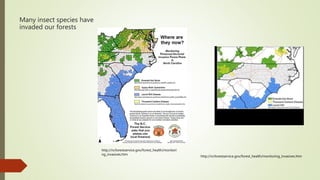
Many insect species have
invaded our forests
http://ncforestservice.gov/forest_health/monitoring_invasives.htm
http://ncforestservice.gov/forest_health/monitori
ng_invasives.htm
The North Carolina Forest
Service monitors invasive forest
pests.
Some invasive species do not come from
across the ocean. They may also come from
other areas of our own lands. New pests can
arrive in North Carolina in a number of ways,
including through infested or infected
nursery plants, wood packaging material, and
even firewood.
Though there are many examples of invasive
forest pests causing damage to trees in North
Carolina, one of most significant pests over
the last century, and one to which most
others are compared, is the Chestnut blight
(Cryphonectria parasitica).
http://ncforestservice.gov/forest_health/moni
toring_invasives.htm
http://ncforestservice.gov/forest_health/moni
toring_invasives.htm
Tiny pests create big problems
 All four native ash species – pumpkin, Carolina, green and white – are susceptible
to attack by the borer. That means an estimated 2.5 million ash trees in the state
are at risk. Damage caused by emerald ash borers may kill trees within three to five
years of initial infestation.
 Adult beetles are metallic green, ½-inch long and 1/8-inch wide, and are active in
North Carolina from late spring through mid-summer. Larvae can be found
underneath the bark throughout the year. The natural flight of the beetles is five to
seven miles per year, but rapid spread has been attributed mostly to the movement
of firewood, Suazo said.
Emerald Ash Borer
 Who would suspect this cute little bug could
destroy millions of acres of North Carolina
forests?
 https://upload.wikimedia.org/wikipedia/com
mons/b/b9/EmeraldAshBorerdorsal.jpghttp://wakeaudubon.org/three-major-invasive-
species-threaten-north-carolina-forests/
Walnut Twig Beetle
Another pest, the walnut twig beetle, carries the
fungus Geosmithia morbida. This fungus causes
thousand cankers disease, which threatens
North Carolina’s native black walnut trees. After
infestation, a tree dies within two to three years.
Walnut twig beetle was first found in the eastern
U.S. in 2010 and was detected in Haywood
County in fall 2012. Black walnut is valued for its
wood, nuts and ornamental features. It is also
important for wildlife, as its nuts provide food
for birds, squirrels and other small mammals.
Authored by Andrea Ashby, Assistant Director,
NCDA&CS http://wakeaudubon.org/three-
major-invasive-species-threaten-north-carolina-
forests/
https://images.app.goo.gl/RjbJj6iPKcXN4p5z7
https://images.app.goo.gl/8DtaBU3LyTkRTyXe6
https://images.app.goo.gl/YFeoY1PiqvHM8fUJ8
Thousand cankers
disease
Photo; https://images.app.goo.gl/u2VmWMvdiKBTHMQa9
Organization: Colorado State University
Map graphic from the Arbor day bloghttp://arbordayftp.org/wp-
content/uploads/2010/11/thousand-cankermap.jpg
Invasive Plant
Species
 Right image:
https://images.app.goo.gl/YNC
AJLTB48C3aMci7
 Far rightimage:
https://images.app.goo.gl/ir7i9e8
PPbXnpCE98
Kudzu smothers other plants
Chinese Wisteria: a
beautiful menace
Chinese wisteria is a deciduous, woody twining vine that
climbs up tree trunks to heights of 60 feet or more. It twines
upwards in a clockwise direction. The stems are stout, gray-
brown and covered with fine white hairs
ECOLOGICAL THREAT
The hard woody vines of Chinese wisteria twine tightly
around host tree trunks and branches and cut through the
host tree bark, eventually girdling and killing it. On the
ground, new vines germinating from seed or sprouting from
rootstocks form dense thickets that smother and shade out
native vegetation and impede natural plant community
development. As girdled trees die, canopy gaps are created
which increase the amount of sunlight reaching the forest
floor. While this may temporarily favor some native species, it
also stimulates vigorous growth and spread of wisteria.
Image:
https://www.almanac.com/sites/default/files/styles/primary_i
mage_in_article/public/image_nodes/wisteria.jpg?itok=Cj9b7
OcV
Girdled trees
Over time, the wisteria vine grows so large and strong that it squeezes through the
bark of the host tree and cuts off the flow of sap. The tree dies due to lack of
nourishment.
https://www.nps.gov/plants/alien/fact/wisi1.htm
 Photos https://images.app.goo.gl/xPdRvk7Qsh6z5X1k8
Image right: https://images.app.goo.gl/YAqukEUGPVYvezmB8
Along the Atlantic intertidal coastline from Maine to North Carolina, this crab is now breeding and increasing rapidly in
number. Because it tolerates a wide range of environmental conditions, it seems all too likely to continue to multiply
and to spread. Because it is not a picky eater, it outcompetes native species such as crabs, fish, and shellfish for food–-
or it eats them, being an opportunistic omnivore that feeds on algae, saltmarsh grass, larval and juvenile fish, and small
invertebrates such as amphipods, gastropods, bivalves, barnacles, and worms. http://eattheinvaders.org/blue-plate-
special-asian-shore-crab/
Asian Shore Crab Invasive range of the Asian shore crab.
Courtesy of USGS.
https://images.app.goo.gl/wpsFsVjzi9XeHrRWA
https://images.app.goo.gl/eKgETM9p8y8K2PmG9
Lionfish:
killing coral reefs
 www.noaanews.noaa.gov 629x477
A new study looking at how to curb the rapid
growth of lionfish, an invasive species not native
to the Atlantic Ocean, suggests that
approximately 27 percent of mature lionfish will
have to be removed monthly for one year to
reduce its population growth rate to zero.
But the good news is that the invasive fish
happens to be delicious—and NOAA is
encouraging chefs to find new ways to introduce
it to U.S. consumers.
Lionfish are native to the western and central
Pacific Ocean, but have established themselves
from North Carolina to South America. They are
a popular aquarium fish that were likely first
released in Florida waters in the mid-1980s. Since
then, the species has spread rapidly. Scientists
and public officials are seriously concerned at
the effect lionfish are having on reef ecosystems,
since this predator is capable of rapid population
growth and outcompeting native fish for food
and territory.
http://www.noaanews.noaa.gov/stories2010/20100806_lionfis
h.html
lionfish
Coypu (Nutria)
(Myocastor Coypus)
This semi-aquatic rodent is
native to southern South
America, but has been
introduced extensively around
the world for the fur industry
and to control water plants.
Nutria began appearing in fur
farms in Louisiana in the 1930’s.
Since then the population has
expanded throughout the
southeastern United States.
Photo https://images.app.goo.gl/ZxRRh6YeRvio2Kuy9
Burmese pythons are sold as pets, but they grow to be very large (up to 200 lbs). A few have killed
household pets and even humans. Some have escaped and others have been set free in the
Everglades. With no natural predators, pythons have become a major threat to all other wildlife there.
https://images.app.goo.gl/3mUtHf2XHi7npsEF8
Invasive Exotic Plants in North Carolina
 Invasive exotic plants disrupt the ecology of natural ecosystems, displace native
plant and animal species, and degrade our biological resources.
 To see a very long list of these, please go to the link below.
 http://www.ncwildflower.org/plant_galleries/invasives_list
North Carolina Wildlife Resources Commission
 To see a list of wild animals that live in North Carolina, go to the link below. There
you will find many animals, some familiar, and some new to you. The North
Carolina Wildlife Resources Commission has photos and descriptions of each as
well as a history of how long each has been here.
 http://www.ncwildlife.org/Learning/Species#7085666-endangered
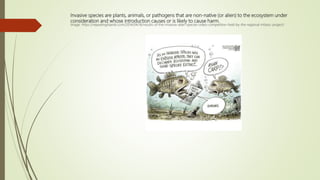
Invasive species are plants, animals, or pathogens that are non-native (or alien) to the ecosystem under
consideration and whose introduction causes or is likely to cause harm.
Image: https://repeatingislands.com/2014/04/16/results-of-the-invasive-alien-species-video-competition-held-by-the-regional-mtiasic-project/
Thank you for viewing.
Humankind has not woven the web of life. We are but
one thread within it. Whatever we do to the web, we do
to ourselves. All things are bound together. All things
connect.
 Chief Seattle, Duwamish (1780-1866)
 https://images.app.goo.gl/trhVszbtXsqe3CWVA

Invaders

  • 1.
    Invasive Species that arefound in North Carolina By Kella Randolph M. Ed.
  • 2.
  • 3.
    Many insect specieshave invaded our forests http://ncforestservice.gov/forest_health/monitoring_invasives.htm http://ncforestservice.gov/forest_health/monitori ng_invasives.htm
  • 4.
    The North CarolinaForest Service monitors invasive forest pests. Some invasive species do not come from across the ocean. They may also come from other areas of our own lands. New pests can arrive in North Carolina in a number of ways, including through infested or infected nursery plants, wood packaging material, and even firewood. Though there are many examples of invasive forest pests causing damage to trees in North Carolina, one of most significant pests over the last century, and one to which most others are compared, is the Chestnut blight (Cryphonectria parasitica). http://ncforestservice.gov/forest_health/moni toring_invasives.htm http://ncforestservice.gov/forest_health/moni toring_invasives.htm
  • 5.
    Tiny pests createbig problems  All four native ash species – pumpkin, Carolina, green and white – are susceptible to attack by the borer. That means an estimated 2.5 million ash trees in the state are at risk. Damage caused by emerald ash borers may kill trees within three to five years of initial infestation.  Adult beetles are metallic green, ½-inch long and 1/8-inch wide, and are active in North Carolina from late spring through mid-summer. Larvae can be found underneath the bark throughout the year. The natural flight of the beetles is five to seven miles per year, but rapid spread has been attributed mostly to the movement of firewood, Suazo said.
  • 6.
    Emerald Ash Borer Who would suspect this cute little bug could destroy millions of acres of North Carolina forests?  https://upload.wikimedia.org/wikipedia/com mons/b/b9/EmeraldAshBorerdorsal.jpghttp://wakeaudubon.org/three-major-invasive- species-threaten-north-carolina-forests/
  • 7.
    Walnut Twig Beetle Anotherpest, the walnut twig beetle, carries the fungus Geosmithia morbida. This fungus causes thousand cankers disease, which threatens North Carolina’s native black walnut trees. After infestation, a tree dies within two to three years. Walnut twig beetle was first found in the eastern U.S. in 2010 and was detected in Haywood County in fall 2012. Black walnut is valued for its wood, nuts and ornamental features. It is also important for wildlife, as its nuts provide food for birds, squirrels and other small mammals. Authored by Andrea Ashby, Assistant Director, NCDA&CS http://wakeaudubon.org/three- major-invasive-species-threaten-north-carolina- forests/ https://images.app.goo.gl/RjbJj6iPKcXN4p5z7 https://images.app.goo.gl/8DtaBU3LyTkRTyXe6 https://images.app.goo.gl/YFeoY1PiqvHM8fUJ8
  • 8.
    Thousand cankers disease Photo; https://images.app.goo.gl/u2VmWMvdiKBTHMQa9 Organization:Colorado State University Map graphic from the Arbor day bloghttp://arbordayftp.org/wp- content/uploads/2010/11/thousand-cankermap.jpg
  • 9.
    Invasive Plant Species  Rightimage: https://images.app.goo.gl/YNC AJLTB48C3aMci7  Far rightimage: https://images.app.goo.gl/ir7i9e8 PPbXnpCE98 Kudzu smothers other plants
  • 10.
    Chinese Wisteria: a beautifulmenace Chinese wisteria is a deciduous, woody twining vine that climbs up tree trunks to heights of 60 feet or more. It twines upwards in a clockwise direction. The stems are stout, gray- brown and covered with fine white hairs ECOLOGICAL THREAT The hard woody vines of Chinese wisteria twine tightly around host tree trunks and branches and cut through the host tree bark, eventually girdling and killing it. On the ground, new vines germinating from seed or sprouting from rootstocks form dense thickets that smother and shade out native vegetation and impede natural plant community development. As girdled trees die, canopy gaps are created which increase the amount of sunlight reaching the forest floor. While this may temporarily favor some native species, it also stimulates vigorous growth and spread of wisteria. Image: https://www.almanac.com/sites/default/files/styles/primary_i mage_in_article/public/image_nodes/wisteria.jpg?itok=Cj9b7 OcV
  • 11.
    Girdled trees Over time,the wisteria vine grows so large and strong that it squeezes through the bark of the host tree and cuts off the flow of sap. The tree dies due to lack of nourishment. https://www.nps.gov/plants/alien/fact/wisi1.htm  Photos https://images.app.goo.gl/xPdRvk7Qsh6z5X1k8 Image right: https://images.app.goo.gl/YAqukEUGPVYvezmB8
  • 12.
    Along the Atlanticintertidal coastline from Maine to North Carolina, this crab is now breeding and increasing rapidly in number. Because it tolerates a wide range of environmental conditions, it seems all too likely to continue to multiply and to spread. Because it is not a picky eater, it outcompetes native species such as crabs, fish, and shellfish for food–- or it eats them, being an opportunistic omnivore that feeds on algae, saltmarsh grass, larval and juvenile fish, and small invertebrates such as amphipods, gastropods, bivalves, barnacles, and worms. http://eattheinvaders.org/blue-plate- special-asian-shore-crab/ Asian Shore Crab Invasive range of the Asian shore crab. Courtesy of USGS. https://images.app.goo.gl/wpsFsVjzi9XeHrRWA https://images.app.goo.gl/eKgETM9p8y8K2PmG9
  • 13.
    Lionfish: killing coral reefs www.noaanews.noaa.gov 629x477 A new study looking at how to curb the rapid growth of lionfish, an invasive species not native to the Atlantic Ocean, suggests that approximately 27 percent of mature lionfish will have to be removed monthly for one year to reduce its population growth rate to zero. But the good news is that the invasive fish happens to be delicious—and NOAA is encouraging chefs to find new ways to introduce it to U.S. consumers. Lionfish are native to the western and central Pacific Ocean, but have established themselves from North Carolina to South America. They are a popular aquarium fish that were likely first released in Florida waters in the mid-1980s. Since then, the species has spread rapidly. Scientists and public officials are seriously concerned at the effect lionfish are having on reef ecosystems, since this predator is capable of rapid population growth and outcompeting native fish for food and territory. http://www.noaanews.noaa.gov/stories2010/20100806_lionfis h.html lionfish
  • 14.
    Coypu (Nutria) (Myocastor Coypus) Thissemi-aquatic rodent is native to southern South America, but has been introduced extensively around the world for the fur industry and to control water plants. Nutria began appearing in fur farms in Louisiana in the 1930’s. Since then the population has expanded throughout the southeastern United States. Photo https://images.app.goo.gl/ZxRRh6YeRvio2Kuy9
  • 15.
    Burmese pythons aresold as pets, but they grow to be very large (up to 200 lbs). A few have killed household pets and even humans. Some have escaped and others have been set free in the Everglades. With no natural predators, pythons have become a major threat to all other wildlife there. https://images.app.goo.gl/3mUtHf2XHi7npsEF8
  • 16.
    Invasive Exotic Plantsin North Carolina  Invasive exotic plants disrupt the ecology of natural ecosystems, displace native plant and animal species, and degrade our biological resources.  To see a very long list of these, please go to the link below.  http://www.ncwildflower.org/plant_galleries/invasives_list
  • 17.
    North Carolina WildlifeResources Commission  To see a list of wild animals that live in North Carolina, go to the link below. There you will find many animals, some familiar, and some new to you. The North Carolina Wildlife Resources Commission has photos and descriptions of each as well as a history of how long each has been here.  http://www.ncwildlife.org/Learning/Species#7085666-endangered
  • 18.
    Invasive species areplants, animals, or pathogens that are non-native (or alien) to the ecosystem under consideration and whose introduction causes or is likely to cause harm. Image: https://repeatingislands.com/2014/04/16/results-of-the-invasive-alien-species-video-competition-held-by-the-regional-mtiasic-project/
  • 19.
    Thank you forviewing. Humankind has not woven the web of life. We are but one thread within it. Whatever we do to the web, we do to ourselves. All things are bound together. All things connect.  Chief Seattle, Duwamish (1780-1866)  https://images.app.goo.gl/trhVszbtXsqe3CWVA