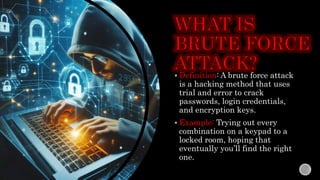
 Definition: A brute force attack
is a hacking method that uses
trial and error to crack
passwords, login credentials,
and encryption keys.
 Example: Trying out every
combination on a keypad to a
locked room, hoping that
eventually you’ll find the right
one.
1.Weak Passwords:
1. Use of easily guessable passwords.
2. Lack of complexity or randomness in password creation.
2.Predictable Passwords:
1. Reliance on common words, phrases, or patterns.
2. Absence of uniqueness in password choices.
3.Lack of Security Measures:
1. No Account Lockout Policies:
1.Failure to limit login attempts.
2.Allows attackers to repeatedly try different passwords without
consequences.
2. No Multifactor Authentication (MFA):
1.Missing an additional layer of security beyond passwords.
2.Increases vulnerability to unauthorized access.
• Simple brute force attacks: The attacker tries to logically guess a password
by using common passwords or personal information
• Dictionary attacks: The attacker tests common words, phrases, or
passwords in exhaustive combinations
• Hybrid brute force attacks: The attacker combines techniques from
dictionary attacks and simple brute force attacks to test combinations
involving both common words and random characters
• Reverse brute force attacks: The attacker starts with a known password and
tests it against a list of possible usernames
• Credential stuffing: The attacker uses credentials that have already been
stolen from another source and tests them against multiple sites
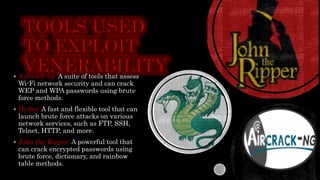
 Aircrack-ng: A suite of tools that assess
Wi-Fi network security and can crack
WEP and WPA passwords using brute
force methods.
 Hydra: A fast and flexible tool that can
launch brute force attacks on various
network services, such as FTP, SSH,
Telnet, HTTP, and more.
 John the Ripper: A powerful tool that
can crack encrypted passwords using
brute force, dictionary, and rainbow
table methods.
• Use strong passwords: Choose passwords
that are long, complex, and unique. Avoid
using common words, phrases, or personal
information. Use a combination of
uppercase and lowercase letters, numbers,
and symbols
• Use multifactor authentication: Add an extra
layer of security by requiring a second factor
of verification, such as a code sent to your
phone or email, a biometric scan, or a
physical token
• Use a password manager: Store and
manage your passwords securely in a
password manager that can generate and
autofill strong passwords for you

Brute Force Attack and Its Prevention.pptx

  • 2.
     Definition: Abrute force attack is a hacking method that uses trial and error to crack passwords, login credentials, and encryption keys.  Example: Trying out every combination on a keypad to a locked room, hoping that eventually you’ll find the right one.
  • 3.
    1.Weak Passwords: 1. Useof easily guessable passwords. 2. Lack of complexity or randomness in password creation. 2.Predictable Passwords: 1. Reliance on common words, phrases, or patterns. 2. Absence of uniqueness in password choices. 3.Lack of Security Measures: 1. No Account Lockout Policies: 1.Failure to limit login attempts. 2.Allows attackers to repeatedly try different passwords without consequences. 2. No Multifactor Authentication (MFA): 1.Missing an additional layer of security beyond passwords. 2.Increases vulnerability to unauthorized access.
  • 4.
    • Simple bruteforce attacks: The attacker tries to logically guess a password by using common passwords or personal information • Dictionary attacks: The attacker tests common words, phrases, or passwords in exhaustive combinations • Hybrid brute force attacks: The attacker combines techniques from dictionary attacks and simple brute force attacks to test combinations involving both common words and random characters • Reverse brute force attacks: The attacker starts with a known password and tests it against a list of possible usernames • Credential stuffing: The attacker uses credentials that have already been stolen from another source and tests them against multiple sites
  • 5.
     Aircrack-ng: Asuite of tools that assess Wi-Fi network security and can crack WEP and WPA passwords using brute force methods.  Hydra: A fast and flexible tool that can launch brute force attacks on various network services, such as FTP, SSH, Telnet, HTTP, and more.  John the Ripper: A powerful tool that can crack encrypted passwords using brute force, dictionary, and rainbow table methods.
  • 6.
    • Use strongpasswords: Choose passwords that are long, complex, and unique. Avoid using common words, phrases, or personal information. Use a combination of uppercase and lowercase letters, numbers, and symbols • Use multifactor authentication: Add an extra layer of security by requiring a second factor of verification, such as a code sent to your phone or email, a biometric scan, or a physical token • Use a password manager: Store and manage your passwords securely in a password manager that can generate and autofill strong passwords for you