1/30
CPDA Lecture 12 Attribute-Based Encryption
曾一凡
林彥賓
2020 年 8 月 12 日
2020 年 8 月 12 日
2/30
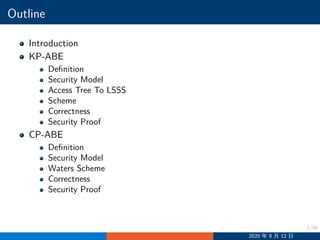
Outline
Introduction
KP-ABE
Definition
Security Model
Access Tree To LSSS
Scheme
Correctness
Security Proof
CP-ABE
Definition
Security Model
Waters Scheme
Correctness
Security Proof
2020 年 8 月 12 日
3/30
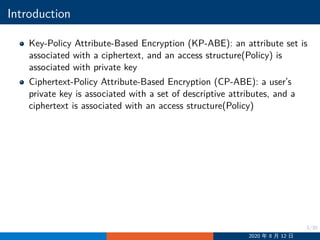
Introduction
Key-Policy Attribute-Based Encryption (KP-ABE): an attribute set is
associated with a ciphertext, and an access structure(Policy) is
associated with private key
Ciphertext-Policy Attribute-Based Encryption (CP-ABE): a user’s
private key is associated with a set of descriptive attributes, and a
ciphertext is associated with an access structure(Policy)
2020 年 8 月 12 日
4/30
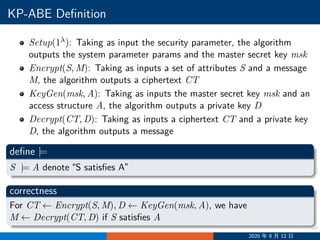
KP-ABE Definition
Setup(1λ): Taking as input the security parameter, the algorithm
outputs the system parameter params and the master secret key msk
Encrypt(S, M): Taking as inputs a set of attributes S and a message
M, the algorithm outputs a ciphertext CT
KeyGen(msk, A): Taking as inputs the master secret key msk and an
access structure A, the algorithm outputs a private key D
Decrypt(CT, D): Taking as inputs a ciphertext CT and a private key
D, the algorithm outputs a message
define |=
S |= A denote “S satisfies A”
correctness
For CT ←− Encrypt(S, M), D ←− KeyGen(msk, A), we have
M ←− Decrypt(CT, D) if S satisfies A
2020 年 8 月 12 日
5/30
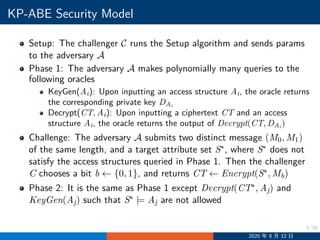
KP-ABE Security Model
Setup: The challenger C runs the Setup algorithm and sends params
to the adversary A
Phase 1: The adversary A makes polynomially many queries to the
following oracles
KeyGen(Ai): Upon inputting an access structure Ai, the oracle returns
the corresponding private key DAi
Decrypt(CT, Ai): Upon inputting a ciphertext CT and an access
structure Ai, the oracle returns the output of Decrypt(CT, DAi
)
Challenge: The adversary A submits two distinct message (M0, M1)
of the same length, and a target attribute set S∗, where S∗ does not
satisfy the access structures queried in Phase 1. Then the challenger
C chooses a bit b ←− {0, 1}, and returns CT ←− Encrypt(S∗, Mb)
Phase 2: It is the same as Phase 1 except Decrypt(CT∗, Aj) and
KeyGen(Aj) such that S∗ |= Aj are not allowed
2020 年 8 月 12 日
6/30
KP-ABE Security Model
Guess: The adversary A outputs a bit b, and wins the game if b = b.
The advantage of the adversary A in winning the game is defined as
Adv(A) = Pr[b = b]−1/2
We say that an ABE scheme is CCA secure if for all PPT adversary
A, Adv(A) is negligible
2020 年 8 月 12 日
7/30
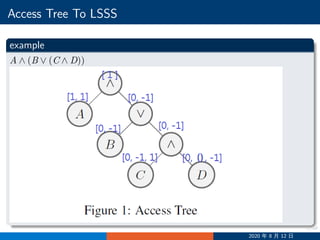
Access Tree To LSSS
1 label the root with [1] and label each node from the root to leaves
2 If an internal node is “∧”labelled with a vector v, then we label its left
son with [v, 1], and the right son with [0, ..., 0, −1]. The sum of left
and right should be [v, 0]
3 If an internal node is “∨”then we label the two sons with the same
vector as their parent
4 pad 0 to the shorter vectors to make all the vectors the same length
2020 年 8 月 12 日
8/30
Access Tree To LSSS
example
A ∧ (B ∨ (C ∧ D))
2020 年 8 月 12 日
9/30
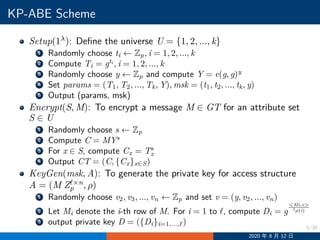
KP-ABE Scheme
Setup(1λ): Define the universe U = {1, 2, ..., k}
1 Randomly choose ti ←− Zp, i = 1, 2, ..., k
2 Compute Ti = gti
, i = 1, 2, ..., k
3 Randomly choose y ←− Zp and compute Y = e(g, g)y
4 Set params = (T1, T2, ..., Tk, Y), msk = (t1, t2, ..., tk, y)
5 Output (params, msk)
Encrypt(S, M): To encrypt a message M ∈ GT for an attribute set
S ∈ U
1 Randomly choose s ←− Zp
2 Compute C = MYs
3 For x ∈ S, compute Cx = Ts
x
4 Output CT = (C, {Cx}x∈S)
KeyGen(msk, A): To generate the private key for access structure
A = (MZℓ×n
p , ρ)
1 Randomly choose v2, v3, ..., vn ←− Zp and set v = (y, v2, ..., vn)
2 Let Mi denote the i-th row of M. For i = 1 to ℓ, compute Di = g
Mi,v
tρ(i)
3 output private key D = ({Di}i=1,...,ℓ)
2020 年 8 月 12 日
10/30
KP-ABE Scheme
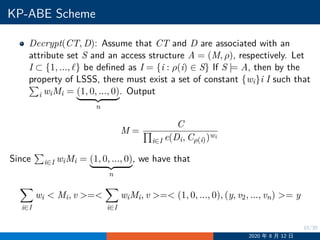
Decrypt(CT, D): Assume that CT and D are associated with an
attribute set S and an access structure A = (M, ρ), respectively. Let
I ⊂ {1, ..., ℓ} be defined as I = {i : ρ(i) ∈ S} If S |= A, then by the
property of LSSS, there must exist a set of constant {wi}iI such that
i wiMi = (1, 0, ..., 0)
n
. Output
M =
C
i∈I e(Di, Cρ(i))wi
Since i∈I wiMi = (1, 0, ..., 0)
n
, we have that
i∈I
wi  Mi, v =
i∈I
wiMi, v = (1, 0, ..., 0), (y, v2, ..., vn) = y
2020 年 8 月 12 日
11/30
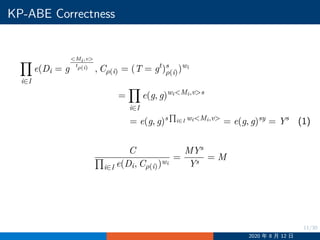
KP-ABE Correctness
i∈I
e(Di = g
Mi,v
tρ(i) , Cρ(i) = (T = gt
)s
ρ(i))wi
=
i∈I
e(g, g)wiMi,vs
= e(g, g)s
∏
i∈I wiMi,v
= e(g, g)sy
= Ys
(1)
C
i∈I e(Di, Cρ(i))wi
=
MYs
Ys
= M
2020 年 8 月 12 日
12/30
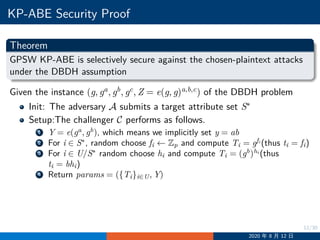
KP-ABE Security Proof
Theorem
GPSW KP-ABE is selectively secure against the chosen-plaintext attacks
under the DBDH assumption
Given the instance (g, ga, gb, gc, Z = e(g, g)a,b,c) of the DBDH problem
Init: The adversary A submits a target attribute set S∗
Setup:The challenger C performs as follows.
1 Y = e(ga
, gb
), which means we implicitly set y = ab
2 For i ∈ S∗
, random choose fi ←− Zp and compute Ti = gfi
(thus ti = fi)
3 For i ∈ U/S∗
random choose hi and compute Ti = (gb
)hi
(thus
ti = bhi)
4 Return params = ({Ti}i∈U, Y)
2020 年 8 月 12 日
13/30
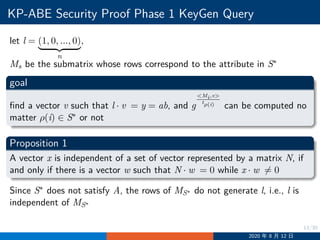
KP-ABE Security Proof Phase 1 KeyGen Query
let l = (1, 0, ..., 0)
n
,
Ms be the submatrix whose rows correspond to the attribute in S∗
goal
find a vector v such that l · v = y = ab, and g
Mi,v
tρ(i) can be computed no
matter ρ(i) ∈ S∗ or not
Proposition 1
A vector x is independent of a set of vector represented by a matrix N, if
and only if there is a vector w such that N · w = 0 while x · w ̸= 0
Since S∗ does not satisfy A, the rows of MS∗ do not generate l, i.e., l is
independent of MS∗
2020 年 8 月 12 日
14/30
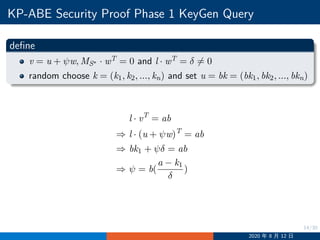
KP-ABE Security Proof Phase 1 KeyGen Query
define
v = u + ψw, MS∗ · wT = 0 and l · wT = δ ̸= 0
random choose k = (k1, k2, ..., kn) and set u = bk = (bk1, bk2, ..., bkn)
l · vT
= ab
⇒ l · (u + ψw)T
= ab
⇒ bk1 + ψδ = ab
⇒ ψ = b(
a − k1
δ
)
2020 年 8 月 12 日
15/30
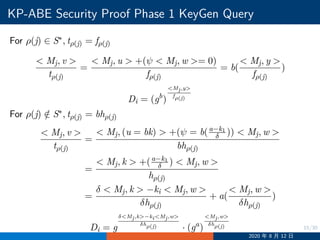
KP-ABE Security Proof Phase 1 KeyGen Query
For ρ(j) ∈ S∗, tρ(j) = fρ(j)
 Mj, v 
tρ(j)
=
 Mj, u  +(ψ  Mj, w = 0)
fρ(j)
= b(
 Mj, y 
fρ(j)
)
Di = (gb
)
Mj,y
fρ(j)
For ρ(j) /∈ S∗, tρ(j) = bhρ(j)
 Mj, v 
tρ(j)
=
 Mj, (u = bk)  +(ψ = b(a−k1
δ ))  Mj, w 
bhρ(j)
=
 Mj, k  +(a−k1
δ )  Mj, w 
hρ(j)
=
δ  Mj, k  −ki  Mj, w 
δhρ(j)
+ a(
 Mj, w 
δhρ(j)
)
Di = g
δMj,k−kiMj,w
δhρ(j) · (ga
)
Mj,w
δhρ(j)
2020 年 8 月 12 日
16/30
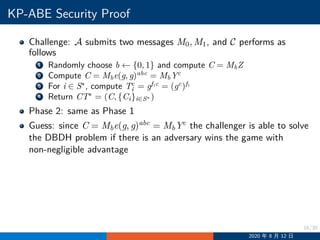
KP-ABE Security Proof
Challenge: A submits two messages M0, M1, and C performs as
follows
1 Randomly choose b ←− {0, 1} and compute C = MbZ
2 Compute C = Mbe(g, g)abc
= MbYc
3 For i ∈ S∗
, compute Tc
i = gfic
= (gc
)fi
4 Return CT∗
= (C, {Ci}i∈S∗ )
Phase 2: same as Phase 1
Guess: since C = Mbe(g, g)abc = MbYc the challenger is able to solve
the DBDH problem if there is an adversary wins the game with
non-negligible advantage
2020 年 8 月 12 日
17/30
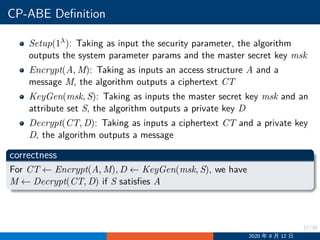
CP-ABE Definition
Setup(1λ): Taking as input the security parameter, the algorithm
outputs the system parameter params and the master secret key msk
Encrypt(A, M): Taking as inputs an access structure A and a
message M, the algorithm outputs a ciphertext CT
KeyGen(msk, S): Taking as inputs the master secret key msk and an
attribute set S, the algorithm outputs a private key D
Decrypt(CT, D): Taking as inputs a ciphertext CT and a private key
D, the algorithm outputs a message
correctness
For CT ←− Encrypt(A, M), D ←− KeyGen(msk, S), we have
M ←− Decrypt(CT, D) if S satisfies A
2020 年 8 月 12 日
18/30
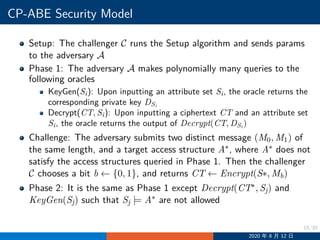
CP-ABE Security Model
Setup: The challenger C runs the Setup algorithm and sends params
to the adversary A
Phase 1: The adversary A makes polynomially many queries to the
following oracles
KeyGen(Si): Upon inputting an attribute set Si, the oracle returns the
corresponding private key DSi
Decrypt(CT, Si): Upon inputting a ciphertext CT and an attribute set
Si, the oracle returns the output of Decrypt(CT, DSi
)
Challenge: The adversary submits two distinct message (M0, M1) of
the same length, and a target access structure A∗, where A∗ does not
satisfy the access structures queried in Phase 1. Then the challenger
C chooses a bit b ←− {0, 1}, and returns CT ←− Encrypt(S∗, Mb)
Phase 2: It is the same as Phase 1 except Decrypt(CT∗, Sj) and
KeyGen(Sj) such that Sj |= A∗ are not allowed
2020 年 8 月 12 日
19/30
CP-ABE Security Model
Guess: The adversary A outputs a bit b, and wins the game if b = b.
The advantage of the adversary A in winning the game is defined as
Adv(A) = Pr[b = b]−1/2
We say that an ABE scheme is CCA secure if for all PPT adversary
A, Adv(A) is negligible
2020 年 8 月 12 日
20/30
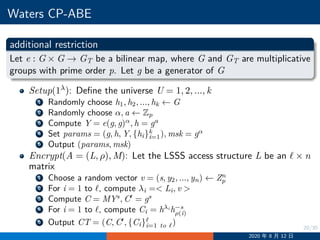
Waters CP-ABE
additional restriction
Let e : G × G −→ GT be a bilinear map, where G and GT are multiplicative
groups with prime order p. Let g be a generator of G
Setup(1λ): Define the universe U = 1, 2, ..., k
1 Randomly choose h1, h2, ..., hk ←− G
2 Randomly choose α, a ←− Zp
3 Compute Y = e(g, g)α
, h = ga
4 Set params = (g, h, Y, {hi}k
i=1), msk = gα
5 Output (params, msk)
Encrypt(A = (L, ρ), M): Let the LSSS access structure L be an ℓ × n
matrix
1 Choose a random vector v = (s, y2, ..., yn) ←− Zn
p
2 For i = 1 to ℓ, compute λi = Li, v 
3 Compute C = MYs
, C′
= gs
4 For i = 1 to ℓ, compute Ci = hλi
h−s
ρ(i)
5 Output CT = (C, C′
, {Ci}ℓ
i=1 to ℓ)
2020 年 8 月 12 日
21/30
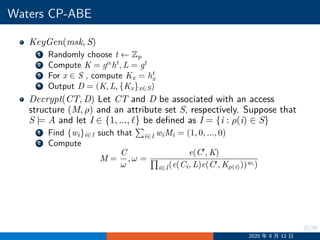
Waters CP-ABE
KeyGen(msk, S)
1 Randomly choose t ←− Zp
2 Compute K = gα
ht
, L = gt
3 For x ∈ S , compute Kx = ht
x
4 Output D = (K, L, {Kx}x∈S)
Decrypt(CT, D) Let CT and D be associated with an access
structure (M, ρ) and an attribute set S, respectively. Suppose that
S |= A and let I ∈ {1, ..., ℓ} be defined as I = {i : ρ(i) ∈ S}
1 Find {wi}i∈I such that i∈I wiMi = (1, 0, ..., 0)
2 Compute
M =
C
ω
, ω =
e(C′
, K)
i∈I(e(Ci, L)e(C′, Kρ(i)))wi )
2020 年 8 月 12 日
22/30
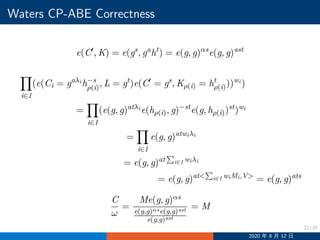
Waters CP-ABE Correctness
e(C′
, K) = e(gs
, ga
ht
) = e(g, g)αs
e(g, g)ast
i∈I
(e(Ci = gaλi
h−s
ρ(i), L = gt
)e(C′
= gs
, Kρ(i) = ht
ρ(i)))wi
)
=
i∈I
(e(g, g)atλi
e(hρ(i), g)−st
e(g, hρ(i))st
)wi
=
i∈I
e(g, g)atwiλi
= e(g, g)at
∑
i∈I wiλi
= e(g, g)at
∑
i∈I wiMi,V
= e(g, g)ats
C
ω
=
Me(g, g)αs
e(g,g)αse(g,g)ast
e(g,g)ast
= M
2020 年 8 月 12 日
23/30
Waters CP-ABE Security Proof
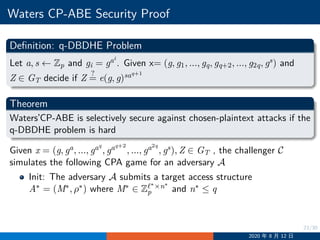
Definition: q-DBDHE Problem
Let a, s ←− Zp and gi = gai
. Given x= (g, g1, ..., gq, gq+2, ..., g2q, gs) and
Z ∈ GT decide if Z
?
= e(g, g)saq+1
Theorem
Waters’CP-ABE is selectively secure against chosen-plaintext attacks if the
q-DBDHE problem is hard
Given x = (g, ga, ..., gaq
, gaq+2
, ..., ga2q
, gs), Z ∈ GT , the challenger C
simulates the following CPA game for an adversary A
Init: The adversary A submits a target access structure
A∗ = (M∗, ρ∗) where M∗ ∈ Zℓ∗×n∗
p and n∗ ≤ q
2020 年 8 月 12 日
24/30
Waters CP-ABE Security Proof
Setup:
1 Randomly choose α′
and set Y = e(ga
, gaq
)e(g, g)α′
, which means
α = αq+1
+ α′
2 Set h = ga
3 For x ∈ U choose randomly zx ←− Zp
4 For x /∈ U, if there is an i such that ρ∗
(i) = x, set
hx = gzx
gaMi[1]
ga2
Mi[2]
, ..., gan∗
Mi[n∗
]
where Mi[j] denotes the j-th entry of Mi; otherwise set hx = gzx
5 Return params = (g, h, Y, {hx}x∈U)
2020 年 8 月 12 日
25/30
Waters CP-ABE Security Proof Phase 1 KeyGen Query
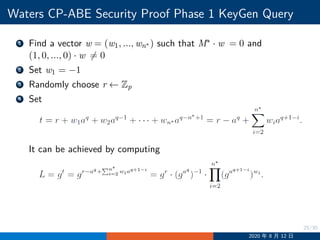
1 Find a vector w = (w1, ..., wn∗ ) such that M∗ · w = 0 and
(1, 0, ..., 0) · w ̸= 0
2 Set w1 = −1
3 Randomly choose r ←− Zp
4 Set
It can be achieved by computing
2020 年 8 月 12 日
26/30
Waters CP-ABE Security Proof Phase 1 KeyGen Query
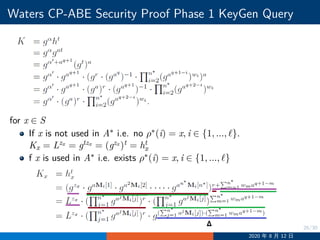
for x ∈ S
If x is not used in A∗ i.e. no ρ∗(i) = x, i ∈ {1, ..., ℓ}.
Kx = Lzx = gtzx = (gzx )t = ht
x
f x is used in A∗ i.e. exists ρ∗(i) = x, i ∈ {1, ..., ℓ}
2020 年 8 月 12 日
27/30
Waters CP-ABE Security Proof Phase 1 KeyGen Query
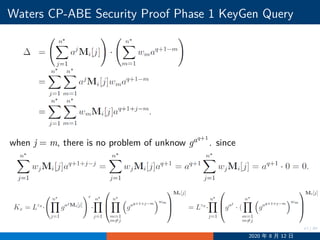
when j = m, there is no problem of unknow gaq+1
. since
2020 年 8 月 12 日
28/30
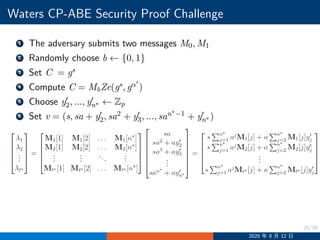
Waters CP-ABE Security Proof Challenge
1 The adversary submits two messages M0, M1
2 Randomly choose b ←− {0, 1}
3 Set C = gs
4 Compute C = MbZe(gs, gα′
)
5 Choose y′
2, ..., y′
n∗ ←− Zp
6 Set v = (s, sa + y′
2, sa2 + y′
3, ..., san∗−1 + y′
n∗ )
2020 年 8 月 12 日
29/30
Waters CP-ABE Security Proof Challenge
Ci = gaλi
h−s
ρ∗(i), hρ∗(i) = gzρ∗(i)+
∑n∗
j=1 ajMi[j]
2020 年 8 月 12 日
30/30
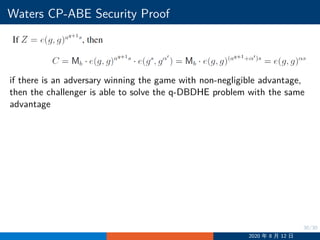
Waters CP-ABE Security Proof
if there is an adversary winning the game with non-negligible advantage,
then the challenger is able to solve the q-DBDHE problem with the same
advantage
2020 年 8 月 12 日

NCCU CPDA Lecture 12 Attribute Based Encryption

  • 1.
    1/30 CPDA Lecture 12Attribute-Based Encryption 曾一凡 林彥賓 2020 年 8 月 12 日 2020 年 8 月 12 日
  • 2.
    2/30 Outline Introduction KP-ABE Definition Security Model Access TreeTo LSSS Scheme Correctness Security Proof CP-ABE Definition Security Model Waters Scheme Correctness Security Proof 2020 年 8 月 12 日
  • 3.
    3/30 Introduction Key-Policy Attribute-Based Encryption(KP-ABE): an attribute set is associated with a ciphertext, and an access structure(Policy) is associated with private key Ciphertext-Policy Attribute-Based Encryption (CP-ABE): a user’s private key is associated with a set of descriptive attributes, and a ciphertext is associated with an access structure(Policy) 2020 年 8 月 12 日
  • 4.
    4/30 KP-ABE Definition Setup(1λ): Takingas input the security parameter, the algorithm outputs the system parameter params and the master secret key msk Encrypt(S, M): Taking as inputs a set of attributes S and a message M, the algorithm outputs a ciphertext CT KeyGen(msk, A): Taking as inputs the master secret key msk and an access structure A, the algorithm outputs a private key D Decrypt(CT, D): Taking as inputs a ciphertext CT and a private key D, the algorithm outputs a message define |= S |= A denote “S satisfies A” correctness For CT ←− Encrypt(S, M), D ←− KeyGen(msk, A), we have M ←− Decrypt(CT, D) if S satisfies A 2020 年 8 月 12 日
  • 5.
    5/30 KP-ABE Security Model Setup:The challenger C runs the Setup algorithm and sends params to the adversary A Phase 1: The adversary A makes polynomially many queries to the following oracles KeyGen(Ai): Upon inputting an access structure Ai, the oracle returns the corresponding private key DAi Decrypt(CT, Ai): Upon inputting a ciphertext CT and an access structure Ai, the oracle returns the output of Decrypt(CT, DAi ) Challenge: The adversary A submits two distinct message (M0, M1) of the same length, and a target attribute set S∗, where S∗ does not satisfy the access structures queried in Phase 1. Then the challenger C chooses a bit b ←− {0, 1}, and returns CT ←− Encrypt(S∗, Mb) Phase 2: It is the same as Phase 1 except Decrypt(CT∗, Aj) and KeyGen(Aj) such that S∗ |= Aj are not allowed 2020 年 8 月 12 日
  • 6.
    6/30 KP-ABE Security Model Guess:The adversary A outputs a bit b, and wins the game if b = b. The advantage of the adversary A in winning the game is defined as Adv(A) = Pr[b = b]−1/2 We say that an ABE scheme is CCA secure if for all PPT adversary A, Adv(A) is negligible 2020 年 8 月 12 日
  • 7.
    7/30 Access Tree ToLSSS 1 label the root with [1] and label each node from the root to leaves 2 If an internal node is “∧”labelled with a vector v, then we label its left son with [v, 1], and the right son with [0, ..., 0, −1]. The sum of left and right should be [v, 0] 3 If an internal node is “∨”then we label the two sons with the same vector as their parent 4 pad 0 to the shorter vectors to make all the vectors the same length 2020 年 8 月 12 日
  • 8.
    8/30 Access Tree ToLSSS example A ∧ (B ∨ (C ∧ D)) 2020 年 8 月 12 日
  • 9.
    9/30 KP-ABE Scheme Setup(1λ): Definethe universe U = {1, 2, ..., k} 1 Randomly choose ti ←− Zp, i = 1, 2, ..., k 2 Compute Ti = gti , i = 1, 2, ..., k 3 Randomly choose y ←− Zp and compute Y = e(g, g)y 4 Set params = (T1, T2, ..., Tk, Y), msk = (t1, t2, ..., tk, y) 5 Output (params, msk) Encrypt(S, M): To encrypt a message M ∈ GT for an attribute set S ∈ U 1 Randomly choose s ←− Zp 2 Compute C = MYs 3 For x ∈ S, compute Cx = Ts x 4 Output CT = (C, {Cx}x∈S) KeyGen(msk, A): To generate the private key for access structure A = (MZℓ×n p , ρ) 1 Randomly choose v2, v3, ..., vn ←− Zp and set v = (y, v2, ..., vn) 2 Let Mi denote the i-th row of M. For i = 1 to ℓ, compute Di = g Mi,v tρ(i) 3 output private key D = ({Di}i=1,...,ℓ) 2020 年 8 月 12 日
  • 10.
    10/30 KP-ABE Scheme Decrypt(CT, D):Assume that CT and D are associated with an attribute set S and an access structure A = (M, ρ), respectively. Let I ⊂ {1, ..., ℓ} be defined as I = {i : ρ(i) ∈ S} If S |= A, then by the property of LSSS, there must exist a set of constant {wi}iI such that i wiMi = (1, 0, ..., 0) n . Output M = C i∈I e(Di, Cρ(i))wi Since i∈I wiMi = (1, 0, ..., 0) n , we have that i∈I wi Mi, v = i∈I wiMi, v = (1, 0, ..., 0), (y, v2, ..., vn) = y 2020 年 8 月 12 日
  • 11.
    11/30 KP-ABE Correctness i∈I e(Di =g Mi,v tρ(i) , Cρ(i) = (T = gt )s ρ(i))wi = i∈I e(g, g)wiMi,vs = e(g, g)s ∏ i∈I wiMi,v = e(g, g)sy = Ys (1) C i∈I e(Di, Cρ(i))wi = MYs Ys = M 2020 年 8 月 12 日
  • 12.
    12/30 KP-ABE Security Proof Theorem GPSWKP-ABE is selectively secure against the chosen-plaintext attacks under the DBDH assumption Given the instance (g, ga, gb, gc, Z = e(g, g)a,b,c) of the DBDH problem Init: The adversary A submits a target attribute set S∗ Setup:The challenger C performs as follows. 1 Y = e(ga , gb ), which means we implicitly set y = ab 2 For i ∈ S∗ , random choose fi ←− Zp and compute Ti = gfi (thus ti = fi) 3 For i ∈ U/S∗ random choose hi and compute Ti = (gb )hi (thus ti = bhi) 4 Return params = ({Ti}i∈U, Y) 2020 年 8 月 12 日
  • 13.
    13/30 KP-ABE Security ProofPhase 1 KeyGen Query let l = (1, 0, ..., 0) n , Ms be the submatrix whose rows correspond to the attribute in S∗ goal find a vector v such that l · v = y = ab, and g Mi,v tρ(i) can be computed no matter ρ(i) ∈ S∗ or not Proposition 1 A vector x is independent of a set of vector represented by a matrix N, if and only if there is a vector w such that N · w = 0 while x · w ̸= 0 Since S∗ does not satisfy A, the rows of MS∗ do not generate l, i.e., l is independent of MS∗ 2020 年 8 月 12 日
  • 14.
    14/30 KP-ABE Security ProofPhase 1 KeyGen Query define v = u + ψw, MS∗ · wT = 0 and l · wT = δ ̸= 0 random choose k = (k1, k2, ..., kn) and set u = bk = (bk1, bk2, ..., bkn) l · vT = ab ⇒ l · (u + ψw)T = ab ⇒ bk1 + ψδ = ab ⇒ ψ = b( a − k1 δ ) 2020 年 8 月 12 日
  • 15.
    15/30 KP-ABE Security ProofPhase 1 KeyGen Query For ρ(j) ∈ S∗, tρ(j) = fρ(j) Mj, v tρ(j) = Mj, u +(ψ Mj, w = 0) fρ(j) = b( Mj, y fρ(j) ) Di = (gb ) Mj,y fρ(j) For ρ(j) /∈ S∗, tρ(j) = bhρ(j) Mj, v tρ(j) = Mj, (u = bk) +(ψ = b(a−k1 δ )) Mj, w bhρ(j) = Mj, k +(a−k1 δ ) Mj, w hρ(j) = δ Mj, k −ki Mj, w δhρ(j) + a( Mj, w δhρ(j) ) Di = g δMj,k−kiMj,w δhρ(j) · (ga ) Mj,w δhρ(j) 2020 年 8 月 12 日
  • 16.
    16/30 KP-ABE Security Proof Challenge:A submits two messages M0, M1, and C performs as follows 1 Randomly choose b ←− {0, 1} and compute C = MbZ 2 Compute C = Mbe(g, g)abc = MbYc 3 For i ∈ S∗ , compute Tc i = gfic = (gc )fi 4 Return CT∗ = (C, {Ci}i∈S∗ ) Phase 2: same as Phase 1 Guess: since C = Mbe(g, g)abc = MbYc the challenger is able to solve the DBDH problem if there is an adversary wins the game with non-negligible advantage 2020 年 8 月 12 日
  • 17.
    17/30 CP-ABE Definition Setup(1λ): Takingas input the security parameter, the algorithm outputs the system parameter params and the master secret key msk Encrypt(A, M): Taking as inputs an access structure A and a message M, the algorithm outputs a ciphertext CT KeyGen(msk, S): Taking as inputs the master secret key msk and an attribute set S, the algorithm outputs a private key D Decrypt(CT, D): Taking as inputs a ciphertext CT and a private key D, the algorithm outputs a message correctness For CT ←− Encrypt(A, M), D ←− KeyGen(msk, S), we have M ←− Decrypt(CT, D) if S satisfies A 2020 年 8 月 12 日
  • 18.
    18/30 CP-ABE Security Model Setup:The challenger C runs the Setup algorithm and sends params to the adversary A Phase 1: The adversary A makes polynomially many queries to the following oracles KeyGen(Si): Upon inputting an attribute set Si, the oracle returns the corresponding private key DSi Decrypt(CT, Si): Upon inputting a ciphertext CT and an attribute set Si, the oracle returns the output of Decrypt(CT, DSi ) Challenge: The adversary submits two distinct message (M0, M1) of the same length, and a target access structure A∗, where A∗ does not satisfy the access structures queried in Phase 1. Then the challenger C chooses a bit b ←− {0, 1}, and returns CT ←− Encrypt(S∗, Mb) Phase 2: It is the same as Phase 1 except Decrypt(CT∗, Sj) and KeyGen(Sj) such that Sj |= A∗ are not allowed 2020 年 8 月 12 日
  • 19.
    19/30 CP-ABE Security Model Guess:The adversary A outputs a bit b, and wins the game if b = b. The advantage of the adversary A in winning the game is defined as Adv(A) = Pr[b = b]−1/2 We say that an ABE scheme is CCA secure if for all PPT adversary A, Adv(A) is negligible 2020 年 8 月 12 日
  • 20.
    20/30 Waters CP-ABE additional restriction Lete : G × G −→ GT be a bilinear map, where G and GT are multiplicative groups with prime order p. Let g be a generator of G Setup(1λ): Define the universe U = 1, 2, ..., k 1 Randomly choose h1, h2, ..., hk ←− G 2 Randomly choose α, a ←− Zp 3 Compute Y = e(g, g)α , h = ga 4 Set params = (g, h, Y, {hi}k i=1), msk = gα 5 Output (params, msk) Encrypt(A = (L, ρ), M): Let the LSSS access structure L be an ℓ × n matrix 1 Choose a random vector v = (s, y2, ..., yn) ←− Zn p 2 For i = 1 to ℓ, compute λi = Li, v 3 Compute C = MYs , C′ = gs 4 For i = 1 to ℓ, compute Ci = hλi h−s ρ(i) 5 Output CT = (C, C′ , {Ci}ℓ i=1 to ℓ) 2020 年 8 月 12 日
  • 21.
    21/30 Waters CP-ABE KeyGen(msk, S) 1Randomly choose t ←− Zp 2 Compute K = gα ht , L = gt 3 For x ∈ S , compute Kx = ht x 4 Output D = (K, L, {Kx}x∈S) Decrypt(CT, D) Let CT and D be associated with an access structure (M, ρ) and an attribute set S, respectively. Suppose that S |= A and let I ∈ {1, ..., ℓ} be defined as I = {i : ρ(i) ∈ S} 1 Find {wi}i∈I such that i∈I wiMi = (1, 0, ..., 0) 2 Compute M = C ω , ω = e(C′ , K) i∈I(e(Ci, L)e(C′, Kρ(i)))wi ) 2020 年 8 月 12 日
  • 22.
    22/30 Waters CP-ABE Correctness e(C′ ,K) = e(gs , ga ht ) = e(g, g)αs e(g, g)ast i∈I (e(Ci = gaλi h−s ρ(i), L = gt )e(C′ = gs , Kρ(i) = ht ρ(i)))wi ) = i∈I (e(g, g)atλi e(hρ(i), g)−st e(g, hρ(i))st )wi = i∈I e(g, g)atwiλi = e(g, g)at ∑ i∈I wiλi = e(g, g)at ∑ i∈I wiMi,V = e(g, g)ats C ω = Me(g, g)αs e(g,g)αse(g,g)ast e(g,g)ast = M 2020 年 8 月 12 日
  • 23.
    23/30 Waters CP-ABE SecurityProof Definition: q-DBDHE Problem Let a, s ←− Zp and gi = gai . Given x= (g, g1, ..., gq, gq+2, ..., g2q, gs) and Z ∈ GT decide if Z ? = e(g, g)saq+1 Theorem Waters’CP-ABE is selectively secure against chosen-plaintext attacks if the q-DBDHE problem is hard Given x = (g, ga, ..., gaq , gaq+2 , ..., ga2q , gs), Z ∈ GT , the challenger C simulates the following CPA game for an adversary A Init: The adversary A submits a target access structure A∗ = (M∗, ρ∗) where M∗ ∈ Zℓ∗×n∗ p and n∗ ≤ q 2020 年 8 月 12 日
  • 24.
    24/30 Waters CP-ABE SecurityProof Setup: 1 Randomly choose α′ and set Y = e(ga , gaq )e(g, g)α′ , which means α = αq+1 + α′ 2 Set h = ga 3 For x ∈ U choose randomly zx ←− Zp 4 For x /∈ U, if there is an i such that ρ∗ (i) = x, set hx = gzx gaMi[1] ga2 Mi[2] , ..., gan∗ Mi[n∗ ] where Mi[j] denotes the j-th entry of Mi; otherwise set hx = gzx 5 Return params = (g, h, Y, {hx}x∈U) 2020 年 8 月 12 日
  • 25.
    25/30 Waters CP-ABE SecurityProof Phase 1 KeyGen Query 1 Find a vector w = (w1, ..., wn∗ ) such that M∗ · w = 0 and (1, 0, ..., 0) · w ̸= 0 2 Set w1 = −1 3 Randomly choose r ←− Zp 4 Set It can be achieved by computing 2020 年 8 月 12 日
  • 26.
    26/30 Waters CP-ABE SecurityProof Phase 1 KeyGen Query for x ∈ S If x is not used in A∗ i.e. no ρ∗(i) = x, i ∈ {1, ..., ℓ}. Kx = Lzx = gtzx = (gzx )t = ht x f x is used in A∗ i.e. exists ρ∗(i) = x, i ∈ {1, ..., ℓ} 2020 年 8 月 12 日
  • 27.
    27/30 Waters CP-ABE SecurityProof Phase 1 KeyGen Query when j = m, there is no problem of unknow gaq+1 . since 2020 年 8 月 12 日
  • 28.
    28/30 Waters CP-ABE SecurityProof Challenge 1 The adversary submits two messages M0, M1 2 Randomly choose b ←− {0, 1} 3 Set C = gs 4 Compute C = MbZe(gs, gα′ ) 5 Choose y′ 2, ..., y′ n∗ ←− Zp 6 Set v = (s, sa + y′ 2, sa2 + y′ 3, ..., san∗−1 + y′ n∗ ) 2020 年 8 月 12 日
  • 29.
    29/30 Waters CP-ABE SecurityProof Challenge Ci = gaλi h−s ρ∗(i), hρ∗(i) = gzρ∗(i)+ ∑n∗ j=1 ajMi[j] 2020 年 8 月 12 日
  • 30.
    30/30 Waters CP-ABE SecurityProof if there is an adversary winning the game with non-negligible advantage, then the challenger is able to solve the q-DBDHE problem with the same advantage 2020 年 8 月 12 日