Classification: CONFIDENTIAL
Introduction to
Pharmacology
Presented By :
Rupa Devilal Singh
Assistant Professor (Pharmacology)
Classification: CONFIDENTIAL
Learning Objectives
 Defination of Pharmacology and various others terms.
 History, Scope of pharmacology, Nature and Source of drugs and
Essential drugs concept
 List the various routes of administration of drugs.
 What is pharmacokinetics.
Classification: CONFIDENTIAL
Pharmacology
 Pharmacon means “drug or medicine” and logy means
“to study”.
 It deals with interaction of exogeneously administered
chemical molecule with living system or any single
chemical substance which can produce a biological
response.
 the two main division of pharmacology are
 1)pharmacodynamics
 2)pharmacokinetics
 It is all about the study of drugs and effect of drug on
body and body’s response towards the drug.
Classification: CONFIDENTIAL
History
 Since the beginning people search to treat illness and cure disease
the oldest known prescription found on a clay( 5000 years ago).
 Primitive man gather the knowledge of healing and medicines by
observing the nature, noticing the animals while ill and personal
experience after consuming plants and herbs as remedies.
 They discovered that extract from plants,animals and minerals had
medicinal effects on body tissue.
Classification: CONFIDENTIAL
Landmarks
1) Hippocrates- A Greek physician consider as ”Father of
Medicine”
 He was the first person who recognize disease as
abnormal reaction of body.
 He introduce the use of metallic salts for the treatment
of disease.(iron sulfate,copper chloride,calcium lactate)
2) Paracelsus –”Grandfather of Pharmacology”.
-He introduces the use of chemicals for treatment of
diseases.
3) Oswald schmeideberg- “Father of pharmacology”
-He established pharmacology as an independent discipline.
-Estimation of chloroform in blood
Classification: CONFIDENTIAL
Landmarks
4) Jhon Jacob (1857-1938)
- Isolation of histamine from pituitary gland.
5) Alfred joseph- (1885-1968)
- General mechanism of drug action with receptors
6) Ram nath chopra- “Father of Indian pharmacology”.
-Systemic study of Indian medicinal plant
Classification: CONFIDENTIAL
Terminology
Pharmacology: is a science that studies the effect of the drugs on the
body.
Pharmacopoeias: A book containing directions for the identification
of compound medicines and published by the authority of a
government or a medical or pharmaceutical society.
E.g. IP, BP,USP
 Medication: is a substance administered for diagnosis, cure,
treatment or prevention.
Prescription: an instruction to a pharmacist written by a doctor to
dispense a stated quantity of particular drug in a specified dose.
Classification: CONFIDENTIAL
Terminology Cont …..
 The therapeutic effect: is the primary effect
intended for which the drug is prescribed such as
paracetamol as antipyretics.
 Side effect: secondary effect of the drug is one that
undesired, side effects are usually predictable and
may be either harmless
Classification: CONFIDENTIAL
Terminology Cont …..
 Drug toxicity: harmful effect of the
drug on an organism or tissue, result
from overdose or inappropriate use.
 Drug allergy: is immunological
reaction to a drug.
Classification: CONFIDENTIAL
Terminology Cont …..
 Drug interaction: A change in the way
a drugs acts in the body when taken with
certain other drugs, herbal or food or
when taken in certain medical condition.
 Drug misuse: Is the improper use of
common drugs in way that lead to acute
and chronic toxicity for example
laxative, antacid and vitamins.
Classification: CONFIDENTIAL
Terminology Cont …..
 Drug abuse: the illegal use of drugs, or the
prescription or over the counter of drugs or
excessive amount of drugs for the purposes
for which they are not meant to be used.
 Drug dependence: is a person's reliance on
or need to take drug or substance
 It occurs due to excessive consumption of
psychoactive substances
 there are two type of dependence:
Classification: CONFIDENTIAL
Terminology Cont …..
 Physiological dependence: is due to
biochemical changes in the body tissue
these tissue come to require substance
for normal function.
 Psychological dependence: is
emotional reliance on a drug to maintain
a since of wellbeing accompanied
feeling of need.
Classification: CONFIDENTIAL
Terminology Cont …..
Drug habituation: it is a condition
resulting from the repeated consumption of
drugs because of over powering desire,
which denotes a mild form of
psychological dependence.
Illicit drug: an illicit drug is one that is
illegal to have . E.g. Cannabis, Heroin,
cocaine and non-medically use of drugs
that are legally available.
Classification: CONFIDENTIAL
Terminology Cont …..
Dose :an amount of medicine that patient take at one time.
The aim to give patient a dose of the drug that achieves the
desired effect with out causing with harmful side effect.
Therapeutic index: is a quantitative measurement of the
relative safety of drug.
A ratio that compares the blood concentration at which a
drug becomes toxic and the concentration at which the drug
is effective.
Therapeutic index= LD50/ED50
LD= Median lethal dose (the dose at which a drug kills
50% of test group of animal)
ED= Median effective dose ( the dose at which the desired
effect is produced in 50% of test group)
Classification: CONFIDENTIAL
Terminology Cont …..
 Bioavailability: is defined as athe rate
and extent to which the active
constituent of drug is absorbed from a
drug product and reaches to the systemic
circulation.
 Tolerance: It is the diminished
effect(response) of any drug give
repeatedly for the long duration in the
same dose
 Toxicology: It includes the study of
adverse effects of drugs, since the same
substance can be a drug or a poison,
depending on the dose.
Classification: CONFIDENTIAL
Terminology
 Drug (French: Drogue—a dry herb) :It is the single
active chemical entity present in a medicine that is
used for diagnosis, prevention, treatment/ cure of a
disease.
 Clinical pharmacology It is the scientific study
of drugs in human.
 Chemotherapy: It is the treatment of systemic
infection/malignancy with specific drugs that have
selective toxicity for the infecting organism/ malignant
cell with no/minimal effects on the host cells.
 Pharmacy : It is the art and science of compounding
and dispensing drugs or preparing suitable dosage forms
for administration of drugs to human or animals.
Classification: CONFIDENTIAL
basic concepts of Pharmacology
 Pharmacokinetics: it is branch of pharmacology concerned with the
movement of drugs and alteration of the drugs by the body.(what body does
to the drug)
 It includes absorption, distribution binding/localization storage,
biotransformation/metabolism and excretion of the drug
 Pharmacodynamics: what the drug does to the body, this includes
physiological and biochemical effects of drugs and their mechanism of action
at organ system
 Pharmacotherapeutics: is the application of pharmacological information
together with knowledge of the disease for its cure and prevention.
 Pharmacognosy: The study of natural (plant ) drug sources.
Classification: CONFIDENTIAL
]]]]]]]]]]]]]]]]]]]]]]]]]]]]]]]]]]]]]]]]]]]]]]]]]]
]]]]]]]]]]]]]]]]]]]]]]]]]]]]]]]]]]]]]]]]]]]]]]]]]]
]]]]]]]]]]]]]]]]]]]]]]]]]]]]]]]]]]]]]]]]]]]]]]]]]]
]
Science
of Pharma-
cology
Pharmacognosy
Pharmacokinetics
Pharmacodynamic
Pharmacotherapeutics
Toxicology
Classification: CONFIDENTIAL
Drug Nomenclature
 The chemical name: the name of chemical compound that
shows the names of each of its elements or sub compound.
 E.g: N-Acetyl-para-aminophenol = paracetamol
 The generic name: is the chemical name of a medicine. E.g
paracetamol
 The trade mark or brand name (proprietary name) : is name
given by the drug manufacture
 Example: Paracetamol/Acetaminophen (generic name).
 Calpol/Metacin/Meftal (brand name)
Classification: CONFIDENTIAL
SCOPE OF PHARMACOLOGY
 To Study about drugs and their action.
 To study about disease or disorder which is comes under
pathophysiology.
 To study about pharmacodynamics-what is the effects
of drug to the body in which study about both desirable
and undesirable effects of drugs.
 To study about pharmacokinetics- what body give
response towards drugs(A,D,M,E)
 In present times there are many other scopes in
pharmacology such as Research, Industries and
Academics etc..
Classification: CONFIDENTIAL
SCOPE OF PHARMACOLOGY
 To study in Clinical pharmacology, in which we can
study about contraindication of drugs, their
bioavailability and also about posology( doses of drugs).
 To study of Toxicology(toxic substances their antidote
and prevention)
 Study of Forensic science.(investigation)
 There are also great scope of pharmacology in research
such as Drug Discovery, Drug Development and Clinical
Trials.
Classification: CONFIDENTIAL
Nature of drugs
 Drug: it is a single active chemical entity present in medicine
that is used for diagnosis, prevention ,treatment/cure of any
disease.
 Nature of drugs are of two types:
1)classification based on chemical nature
2)classification based on physical nature
1) Classification based on chemical nature.
a) Inorganic drugs: includes ferrous sulphate, zinc sulphate,
magnesium sulphate.
b) Organic drugs: majority of drugs are organic compounds,
It may be , 1) weakly acidic=aspirin,penicillin
2) weakly basic=morphine
3) non electrolyte= alcohol
Classification: CONFIDENTIAL
Nature of drugs
 2) classification based on physical nature
a) solid: tablet, capsule
b) Liquid: syrup, elixir
c) Semi-solid: suppositories, ointment.
Classification: CONFIDENTIAL
1. Plants: many plants contain biologically
active substance and are the oldest source of
drugs.. E.g- Tulsi (used for cough and
cold),alkaloids: morphine, quinine.
Glycosides: digoxin, digitoxin. Oil: Essential
oils, Mineral oils
2. Animals: Though animals parts have been
used as cured since early times. such as
insulin from pancreas and thyroxine from
ship’s thyroid and heparin from pig’s
intestine.
Source of drugs
Classification: CONFIDENTIAL
Cont..
3) Micro organism- Most antibiotics are obtained from
fungi bacteria etc. E.g : Penicillin, streptomycin,
erythromycin.
4) Minerals: There are many more minerals which is used
as a medicinal substance. E.g: Iron (Anemia), Zinc (wound
healing),iodine (antiseptic), silver (immunity booster)
5) Synthetic: It is the largest source of medicine.
- It has the advantage of purity and uniformity of the
product, they can be manufactured as per need. E.g:
fluoroquinolones, bismuth iodine etc.
6) Biotechnology: in which, combined biological organism
with technology and generate new drugs… E.g peptides
and proteins are now produced by recombined DNA
technology used as Human Growth Hormone and Human
Insulin
Classification: CONFIDENTIAL
ESSENTIAL DRUGS CONCEPT
 WHO( World health organisation) introduce the concept of
essential medicines in 1977.
 Definition : these are those drugs which satisfy the priority
health care needs of the population.
 They are selected with due regard to public health relevance,
evidence on efficacy and safety, and comparative cost
effectiveness.
 Essential medicines are intended to be available within the
context of functioning health systems at all times and in
adequate amounts, in appropriate dosage forms, with assured
quality and adequate information, and at a price the individual
and the community can afford.
 For optimum utilization of resources, governments (especially in
developing countries) should concentrate on these medicines by
identifying them as Essential medicines
Classification: CONFIDENTIAL
Cont..
 the WHO brought out its first Model List of Essential Drugs
along with their dosage forms and strengths in 1977 which
could be adopted after suitable modifications according to
local needs.
 This has been revised from time to time.
 India produced its “National Essential drugs” list in 1996 and
has revised it in 2011 with the title “National List of
Essential Medicines”.
 This includes 348 medicines which are considered to be
adequate to meet the priority healthcare needs of the
general population of the country.
 Adoption of the essential medicines list for procurement and
supply of medicines, especially in the public sector
healthcare system, has resulted in improved availability of
medicines, cost saving and more rational use of drugs
Classification: CONFIDENTIAL
Prescription and non-
prescription drugs
 As per drug rules, majority of drugs including all antibiotics
must be sold in retail only against a prescription issued to a
patient by a registered medical practitioner. These are called
‘Prescription Drugs’
 Few drugs like simple analgesics (paracetamol aspirin),
antacids, laxatives (senna, lactulose), vitamins, ferrous salts,
etc. are considered relatively harmless, and can be procured
without a prescription. These are ‘Non-Prescription’ or ‘Over
The-Counter’ (OTC) drugs.
 Orphan drugs: These are drugs or biological products for
diagnoses/ treatment/prevention of rare disease for which
there is no reasonable expectation that cost of developing and
marketing it will be recovered from sales of that drug.
Classification: CONFIDENTIAL
 Most drugs can be administered by a variety of
routes.
 The choice of appropriate route in a given situation
depends both on drug as well as patient related
factors.
Routes can be broadly divided into
(a) Local action
(b) Systemic action
Route of administration:
Classification: CONFIDENTIAL
Local Routes
The local routes are:
1. Topical
2. Deeper tissue
3. Arterial supply
Classification: CONFIDENTIAL
Topical
 This refers to external application of the drug to the surface of
skin for localized action.
 Drugs can be efficiently delivered to the localized
lesions on skin, oropharyngeal/ nasal mucosa, eyes, ear
canal, anal canal or vagina in the form of lotion,
ointment, cream, powder, rinse, paints, drops, spray,
lozengens, suppositories or pesseries.
 Nonabsorbable drugs given orally for action on g.i.
mucosa (sucralfate, vancomycin), inhalation of drugs
for action on bronchi (salbutamol, cromolyn sodium)
and irrigating solutions/jellys (povidone iodine,
lidocaine) applied to urethra are other forms of topical
medication
Classification: CONFIDENTIAL
Cont..
Advantage:
 apply for local action
 More convenient for patients to apply by there own.
 Painless, safe and cheap.
Disadvantage
 Slow action
 Some drugs cause irritation.
Classification: CONFIDENTIAL
Deeper tissues
 Certain deep areas can be approached by using a
syringe and needle, but the drug should be in such
a form that systemic absorption is slow
 e.g. intra-articular injection (hydrocortisone
acetate in knee joint), infiltration around a nerve
or intrathecal injection (lidocaine), retrobulbar
injection (hydrocortisone acetate behind the
eyeball).
Classification: CONFIDENTIAL
ARTERIAL SUPPLY
 Close intra-arterial injection is used for contrast media
in angiography; anticancer drugs can be infused in
femoral or brachial artery to localise the effect for limb
malignancies
Classification: CONFIDENTIAL
Systemic Routes
 The drug administered through systemic
routes is intended to be absorbed into the
blood stream and distributed all over
including the site of action, through
circulation.
 Systemic routes include:
1. Enteral
2. Parenteral
Classification: CONFIDENTIAL
Enteral route
 It means drugs pass through GIT and reach into the
blood to show systemic effect.
 It includes first pass metabolism.
 FIRST PASS METABOLISM
 The degree of metabolic breakdown of an orally
administered drug that occurs in the intestine or liver
before it reaches the systemic circulation.
 It is also known as the first pass effect and results in a
reduction in the concentration of the drug.
Classification: CONFIDENTIAL
Enteral route
Oral route:
Oral ingestion is the oldest and commonest mode of drug
administration ,in which drugs is directly swallow through
mouth and it reach in blood by passing through GIT.
 Both solid dosage form(powders, tablet, capsule) and
liquid dosage form (elixir, syrups, emulsion) can be
given orally.
 Advantage:
1. Safe, more convenient, does not need assistance.
2. painless, cheap and cost effective.
3. Variety of dosage form available: fast release, slow
release, layered tablet.
Classification: CONFIDENTIAL
Cont..
 Disadvantage:
1. Slow responses due to first pass metabolism.
2. Not suitable for emergencies.
3. Cannot be used for unconscious patients.
4. Inappropriate for client nausea and vomiting.
Classification: CONFIDENTIAL
Enteral route
2. Sublingual or Buccal
 The tablet or pellet containing the drug is placed under
the tongue or crushed in the mouth and spread over the
buccal mucosa.
 Only lipid soluble and non-irritating drugs can be so
administered. Absorption is relatively rapid—action can
be produced in minutes.
Classification: CONFIDENTIAL
Cont..
Advantage
 Rapid action
 It follow bypass metabolism( in which drug directly
reaches into blood then reach at site of action through
circulation without passing intestine and liver.
Disadvantage
 It is somewhat inconvenient, one can spit the drug after
the desired effect has been obtained.
 If swallowed drug may be inactive.
Classification: CONFIDENTIAL
Enteral route
3. Rectal
 Certain irritant and unpleasant drugs can be put into
rectum as suppositories or retention enema for systemic
effect.
 This route can also be used when the patient is having
recurrent vomiting or is unconscious.
 Absorption is slower, irregular and often unpredictable,
though paracetamol suppository are rapidly absorbed
from the rectum in children.
Classification: CONFIDENTIAL
Cont..
Advantage
 Given to children and unconscious patient.
 Can be given in vomiting condition.
Disadvantage
 Rectal inflammation can result from irritant drugs.
 Drug absorption is slow.
Classification: CONFIDENTIAL
Enteral route
4. Cutaneous
 Highly lipid soluble drugs can be applied over the skin
for slow and prolonged absorption.
 The liver is also bypassed. The drug can be incorporated
in an ointment and applied over specified area of skin.
 Absorption of the drug can be enhanced by rubbing the
preparation, by using an oily base and by an occlusive
dressing.
Classification: CONFIDENTIAL
Cont..
Transdermal therapeutic systems (TTS)
 These are devices in the form of adhesive patches of
various shapes and sizes (5–20 cm2 ) which deliver the
contained drug at a constant rate into systemic
circulation.
 The drug (in solution or bound to a polymer) is held in a
reservoir between an occlusive backing film and a rate
controlling micropore membrane, the under surface of
which is smeared with an adhesive impregnated with
priming dose of the drug.
Classification: CONFIDENTIAL
cont,..
5.Inhalation
 Volatile liquids and gases are given by inhalation for
systemic action, e.g. general anaesthetics. Absorption
takes place from the vast surface of alveoli—action is
very rapid.
 When administration is discontinued the drug diffuses
back and is rapidly eliminated in expired air.
Classification: CONFIDENTIAL
Parentral.
 Parenteral refers to administration by injection which takes
the drug directly into the tissue fluid or blood without having
to cross the enteral mucosa.
 Drug action is faster and surer .
 Parenteral routes can be employed even in unconscious,
uncooperative or vomiting patient.
 There are no chances of interference by food or digestive
juices. Liver is bypassed.
Classification: CONFIDENTIAL
Parentral.
a) Subcutaneous (s.c.) The drug is deposited in the loose
subcutaneous tissue which is richly supplied by nerves (thigh,
abdomen, arms)
Advantage:
 Self-injection is possible because deep penetration is not needed
 action of drug are sustained and uniform.
 Drug can be given in case of vomiting and diarrhoea.
 Can be given to unconscious patients.
Disadvantage.
 Avoided in shock patient.
 Absorption is slower than intramuscular inj.
 Expensive
 Large volume of drug cannot be given .
Classification: CONFIDENTIAL
Parenteral.
 (b) Intramuscular (i.m.) The drug is injected in one of the large
skeletal muscles—deltoid, triceps, gluteus maximus, rectus femoris,
etc. and reach into blood circulation.
 Injection inject at a angle of 90 degree.
 Advantage:
 Bypass metabolism (rapid action)
 Can be given to unconscious patient.
 Disadvantage :
 Small qty of drug can be injected at a time(10 ml)
 Need phycisian for administration of drug.
 Local pain
 Expensive.
Classification: CONFIDENTIAL
parenteral
 D) intra dermal: The drug is injected into the skin raising a
bleb (e.g. BCG vaccine, sensitivity testing)
 Injected into epidermis.
 This route is employed for specific purposes only.
e) Intra cardiac: drug is directly injected into muscles of
heart.
 This method is only used in emergency situation
 Need an expert for this.
f) Intra arterial:
 Drug administered into artery(blood vessels that carries
blood from heart to organ and tissue)
Classification: CONFIDENTIAL
Parenteral
C) Intravenous (i.v)- In this drug is directly injected into veins
through injection which absorb directly into blood stream.
Advantage:
 By pass metabolism.(rapid action)
 100% bioavailability
 Large volume of drug can be administered.
 Can be given to unconscious patients.
Disadvantage:
 Local pain and irritation after administration of drug.
 Cannot be self administered.
Classification: CONFIDENTIAL
Receptors.
 Receptors are binding site located on the surface of cell that
recognize the drug and initiate action Or give pharmacological action.
 It is based on lock- key mechanism.
1. Agonist:
 These are those substance or drug which binds to the receptor and
activates the receptor to produce p’cological action.
 Efficacy: ability of drug to bind.
 Potency: action or response of drug.
 It can be : 1. full agonist: high afficacy full response
 2. partial agonist; lower efficacy, less response
 3. inverse agonist: opposite response
Classification: CONFIDENTIAL
2. Antagonist.
 These are those drugs which has similar structure like
agonist, bind with the receptors but do not give any
p’cological action, instead they block the receptor and
inhibit the agonist or natural substance to bind with
receptor.
 It is of two types:
 1) Competitive
 2) Non competitive
A)Competitive antagonist: these are the drugs which
have similar structure like agonist, bind with the receptor
to inhibit the full response of agonist.
Eg: morphine- naloxone
Classification: CONFIDENTIAL
Receptors.
B) Non competitive: these are the antagonist which
binds to the non agonist site or allosteric site on the
receptor to prevent activation of the receptor.
 They have different structures than agonist
 Eg: Diazepam- Bicuculline
3) Spare receptors.
 These are those receptors which are not occupied by
the drug molecules to produce p’cological action or
response.
 They are same as normal receptors
 They are not hidden.
Classification: CONFIDENTIAL
Receptors.
4) Addiction:
 It is a psychological and physical inability to stop
consuming drug even drug causing harm.
 Eg: heroine, cocaine,alcohol.
5) Tachyphylaxis:
 Rapid decrease in response of drug upon repeated
administration of same dose in short intervals.
 Also known as acute tolerance.
Classification: CONFIDENTIAL
Receptors.
6) Idiosyncrasy
 It is a condition in which a side effect of any drug is
seen only in very less population. this effect is known as
idiosyncratic effect.
 Eg: barbiturates it cause some side effect such as
mental confusion and excitement in some people.
7) Allergy:
 Some drugs cause the unwanted side effect or adverse
effect to our body.
 Eg : rashes, itching.
Classification: CONFIDENTIAL
PHARMACOKINETICS.
 Pharmacokinetic is the study of drug movement in,
through and out of the body.
 It is the study of how drugs get absorbed, distributed
,metabolise and excreted from the body.
 A –(Absorption) = drug enter into the blood stream.
 D-(Distribution)= distribution of drug in body tissue.
 M-(Metabolism/ biotransformation)= metabolism occur.
 E-(Excretion) = removing of drug from the body..
Classification: CONFIDENTIAL
Drug transport across
biological cell membrane
Membrane:
it is a biological membrane , which made up of phospholipids
and cholesterol and other groups(bilayer)
 Lipophilic drug easily cross cell membrane.( faster rate of
drug absorption)
 Hydrophilic or hydrophobic drug cannot cross cell
membrane easily they need protein channel to cross the
membrane( lower rate of absorption of drug)
Classification: CONFIDENTIAL
Membrane transport
Drug reaches into systemic circulation through membrane
transport, which are as follows
1. Passive Transport and Filtration.
2. Carrier Mediated Transport
3. Endocytosis/ pinocytosis.
CONCENTRATION GRADIENT:
When drug move from high conc. To lower conc..
Classification: CONFIDENTIAL
Passive transport
 Passive transport is also known as passive diffusion.
 In this transport, drug move across the concentration(
high to low)
 Most of the drugs are absorb by passive diffusion.
 The speed of diffusion depends upon Conc. Gradient
and lipid solubility of drug.
Diagram: refer k.d Tripathy pg no. 11
Classification: CONFIDENTIAL
Filtration( aqueous diffusion)
 Filtration is a passage for drugs through aqueous pores to
cross cell membrane.
 Lipid-insoluble drugs cross biological membranes by
filtration if their molecular size is smaller than the
diameter of the pores
 Diagram : refer k.d Tripathy page no 11
Classification: CONFIDENTIAL
Carrier Mediated Transport
 Those drug does not move across the cell membrane by passive
transport they cross by carrier mediated transport.
 Depending on requirement of energy, carrier transport is of two
types:
a. Facilitated diffusion
b. Active transport
a) Facilitated diffusion:
 In this transport, drug molecules move across the conc. Gradient,
but the help of any carrier bodies.
 Some large molecules or poorly diffusible substance does not passes
through passive transport, so they required help of any carrier body
to cross the membrane.
 Carrier such as SLC (Solute carrier transporter)
 Diagram. K.d Tripathy pg no. 13
Classification: CONFIDENTIAL
Carrier mediated transport
B. Active transport
 In this transport, drug molecules move against the conc.
Gradient (low to high)
 It required energy due to movement of drugs against
the conc. Gradient.
 ATP is used.
 Active transport can be primary or secondary depending
on the source of the driving force
1. Primary active transport
2. Secondary active transport
 Diagram : k.d Tripathy page no: 13
Classification: CONFIDENTIAL
Endocytosis/ pinocytosis.
 In this transport drugs of very large size get transport via
engulment by cell membrane and make pocket like
structure then move across the cell membrane.
 Diagram: refer from notes.
Classification: CONFIDENTIAL
Absorption
 It is defined as the movement of drug molecules from its
site of administration to the systemic circulation.
 when we take any drug through oral route it goes into
stomach in which disintegrate and dissolution takes place.
 After dissolution of drug ,it reach into intestine and
absorb into blood stream through membrane.
 Absorption has various process depending on
various factors:
1. Physio chemical properties
2. Biological factor
3. Routes of administration
Classification: CONFIDENTIAL
Factors affecting drug
absorption
 Physio-chemical properties:
1.Particle size (drug molecule): it is inversely proportional to the
absorption.
The smaller is the particle size, the greater will be its absorption.
2.Formulation: rate of absorption is greater in parenteral > liquid
dosage form> solid dosage form.
3. PH: acidic drug are absorbed in stomach (aspirin)
Basic drug gets absorbed in intestine.( morphine)
4. Lipid solubility:
Lipophilic nature drugs has higher absorption rate then hydrophilic,
because in membrane transport lipid soluble drug cross membrane
easily as its made up of bilayer phospholipid.
Concentration: as passive transport follow Conc. Gradient, so
higher the conc of drugs, greater will be its absorption.
Classification: CONFIDENTIAL
Factors affecting drug
absorption
Biological factor
1. Surface area: it is directly proportional to absorption.
So , larger is the surface area faster is the absorption .
2. Membrane transport: most of the drugs absorb
through passive transport, as it does not require any
energy and also follow conc.gradient.
Passive transport > fasciliated transport > active
transport.
3. Gastric emptying time: this is the time where food
gets empty from stomach and enters into the intestine.
Fast gastric emptying time = faster absorption of drugs.
Vise versa
Classification: CONFIDENTIAL
Factors affecting drug
absorption
4. Blood flow: it is directly proportional to absorption of
drugs. On absorption site, inc. in blood flow = higher in
drug absorption. Vise versa.
5. Food: it wiil also affect the drug absorption. As the
food is present inside the stomach then it will dilute the
drug and absorption will be decrease.
Classification: CONFIDENTIAL
Factors affecting drug
absorption
Routes of administration:
Its affects the bioavailability of drugs.
1. Bioavailability: it is the actual amt of drug which reach
into the circulation.
Parenteral route has maximum bioavailability.
 In I.V --- drug directly goes in to the blood = 100%
bioavailability and absorption
 In subcutaneous/ I.M -- drug injected near the
capillaries/ tissue / muscles = inc. in bioavailability and
absorption
 Enteral ( oral route) - it follows first pass metabolism =
decrease in bioavailability and drug absorption.
Classification: CONFIDENTIAL
Distribution
 Once a drug absorbed in systemic circulation, it can be
carried throughout the body. This process is called
distribution.
 When drug is absorbed in blood it bound with plasma protein
which is present in blood it results in slow distribution and
some of the drugs will not bound with plasma protein will
have fast distribution.
 The movement of drug from systemic circulation to
interstitial fluid( extra cellular & intracellular fluid)and
other parts of the body.
 Diagram: refer from notes
Classification: CONFIDENTIAL
Factors affecting drug
distribution
 Distribution is very important step of p’kinetics, because in
which drug reach to site of action then bind with receptor and
give p’cological action.
 It is depend on many factors:
1. Blood flow
2. Lipophilicity
3. Capillary permeability
4. Plasma protein binding
5. Some other factors.
1. Blood flow: if there will be more blood flow , will have rapid
drug distribution ( brain, heart, kidney).and those region have
low blood flow will have less drug distribution.( skeletal
muscle, adipose tissue).
Classification: CONFIDENTIAL
Factors affecting drug
distribution
2. lipophilicity: Greater the lipid solubility of the drug, faster
the drug distribution, because membrane is lipophilic, so drug can
easily cross cell membrane.
3. Capillary permeability: Higher the permeability of capillary
greater will be drug distribution.
It depends upon barriers which are as follows:
a. BBB ( Blood Brain Barrier)
b. BCSFB (Blood CSF Barrier)
c. BPB (Blood Placenta Barrier)
A. BBB : The capillary endothelial cells in brain have tight
junctions and lack large paracellular spaces. Further, an
investment of neural tissue covers the capillaries.
This barrier are lipoidal so only lipophilic drug gets distributed.
e.g: liver (capillary size is high and less junction)- faster drug
distribution.
Classification: CONFIDENTIAL
Factors affecting drug
distribution
Brain (capillary size is small and more junction)- slow drug
distribution.
Diagram : k.d Tripathy pg no: 18
b. BCSFB (Blood Cerebrospinal fluid Barrier) : same as BBB.
c. BPB : it is seen in pregnancy which protect foetus. It is also
lipoidal so drug distribution is higher but gives teratogenic effect
only prescribe under doctor guidance.
4. Plasma protein binding: when drug reach into systemic
circulation, then there are two forms of drug
a. Free drug
b. Bound drug (those drug which are bind with plasma protein)
Example of plasma proteins are : albumin, lipo protein, alpha 1
acid glycoprotein.
Classification: CONFIDENTIAL
Factors affecting drug
distribution.
 Acidic drug bind with albumin
 Basic drug bind with alpha 1 acid glycoprotein
 In lipoprotein, lipid soluble drug will bind depending on
their lipid content.
 Plasma protein bound drug will have less drug
distribution because their size gets increases, so they
cannot cross cell membrane easily.
 Free drug has good drug distribution.
 Diagram: refer from notes
Classification: CONFIDENTIAL
Factors affecting drug
distribution
5. Others
1. Age: also affects distribution process due to difference in
total body weight, fat content etc.
2. Obesity: high adipose tissue can take up large fraction of
lipophilic drugs.
3. Redistribution: distributed drug again distribute. e.g drug
distributed to brain kidney lungs later more bulky tissue (
muscle , fat) will take up the drug.
 Volume of distribution:
 V = amt of drug in body/plasma concentration
 It help to know the drug distribution in body fluid
throughout the body.
Classification: CONFIDENTIAL
Metabolism
 Biotransformation means chemical alteration of the drug in the
body.
 It is need to convert nonpolar (lipid-soluble) compounds to
polar (lipid insoluble) so that they are not reabsorbed in the
renal tubules and are excreted.
 Most hydrophilic drugs, e.g. streptomycin, neostigmine,
pancuronium, etc. are little biotransformed and are largely
excreted unchanged.
 The primary site for drug metabolism is liver; others are—
kidney, intestine, lungs and plasma.
 Biotransformation reactions can be classified into:
(a) Nonsynthetic/Phase I/Functionalization reaction.
(b) Synthetic/Conjugation/ Phase II reactions.
Classification: CONFIDENTIAL
Metabolism
1. Phase 1: in this drugs can be metabolised by oxidation
reduction, hydrolysis and increase in polarity of drugs. Sp
drug can easily excrete from kidney.
a) Oxidation: Oxidation This reaction involves addition of
oxygen/negatively charged radical or removal of
hydrogen/positively charged radical.
 Oxidations are the most important drug metabolizing
reactions.
 Various oxidation reactions are: hydroxylation;
oxygenation at C, N or S atoms; N or O-dealkylation,
oxidative deamination, etc.
b) Reduction :This reaction is the converse of oxidation and
involves cytochrome P-450 enzymes working in the opposite
direction. Alcohols, aldehydes, quinones are reduced.
Classification: CONFIDENTIAL
Metabolism
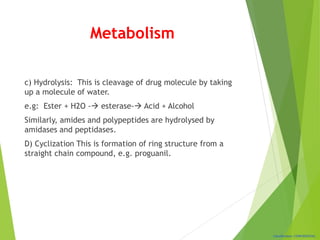
c) Hydrolysis: This is cleavage of drug molecule by taking
up a molecule of water.
e.g: Ester + H2O - esterase- Acid + Alcohol
Similarly, amides and polypeptides are hydrolysed by
amidases and peptidases.
D) Cyclization This is formation of ring structure from a
straight chain compound, e.g. proguanil.
Classification: CONFIDENTIAL
METABOLISM
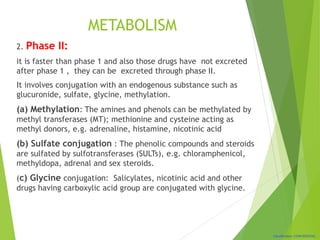
2. Phase II:
it is faster than phase 1 and also those drugs have not excreted
after phase 1 , they can be excreted through phase II.
It involves conjugation with an endogenous substance such as
glucuronide, sulfate, glycine, methylation.
(a) Methylation: The amines and phenols can be methylated by
methyl transferases (MT); methionine and cysteine acting as
methyl donors, e.g. adrenaline, histamine, nicotinic acid
(b) Sulfate conjugation : The phenolic compounds and steroids
are sulfated by sulfotransferases (SULTs), e.g. chloramphenicol,
methyldopa, adrenal and sex steroids.
(c) Glycine conjugation: Salicylates, nicotinic acid and other
drugs having carboxylic acid group are conjugated with glycine.
Classification: CONFIDENTIAL
Factors affecting drug
metabolism.
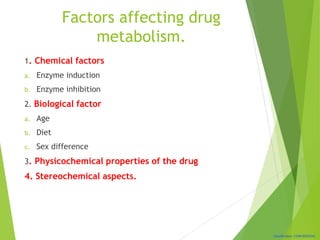
1. Chemical factors
a. Enzyme induction
b. Enzyme inhibition
2. Biological factor
a. Age
b. Diet
c. Sex difference
3. Physicochemical properties of the drug
4. Stereochemical aspects.
Classification: CONFIDENTIAL
Factors affecting drug
metabolism
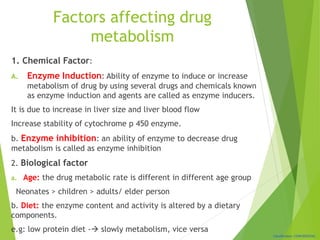
1. Chemical Factor:
A. Enzyme Induction: Ability of enzyme to induce or increase
metabolism of drug by using several drugs and chemicals known
as enzyme induction and agents are called as enzyme inducers.
It is due to increase in liver size and liver blood flow
Increase stability of cytochrome p 450 enzyme.
b. Enzyme inhibition: an ability of enzyme to decrease drug
metabolism is called as enzyme inhibition
2. Biological factor
a. Age: the drug metabolic rate is different in different age group
Neonates > children > adults/ elder person
b. Diet: the enzyme content and activity is altered by a dietary
components.
e.g: low protein diet - slowly metabolism, vice versa
Classification: CONFIDENTIAL
Factors affecting drug
metabolism
 Because protein diet increases enzyme synthesis.
C. sex difference: e.g benzodiazepine - metabolize
slowly in women than men.
 There are also some other factors which affect
metabolism such as pregnancy, disease condition and
hormonal imbalance
 3. physiochemical properties: pka, solubility,
polarity size, shape etc may also affect the drug
metabolism by interaction with the active sites of
enzymes.
 4. stereochemical aspect drug metabolism: it
affects drug metabolism because some metabolizing
enzyme often display a preference for one enantiomer
of drug over the other.. It is due to differ in their
action. E.g: D glucose easily metabolised than L glucose.
Classification: CONFIDENTIAL
Elimination
 It is removal of systemically absorbed drug from the body.
 Routes of elimination:
1.Urine: most of the drug are excreted through kidney by the
process of urination.
2. Faeces: some of the drug is absorbed in liver ( bile is secreted in
liver) which further excreted through faeces.
 Mostly lipid soluble drug is excreted through this.
3. Lungs (exhaled air): some drugs in form of gaseous and volatile
liquid is excreted through exhalation by lungs. E.g: general
anaesthetics, alcohol.
4. Sweat and Saliva: some of drugs is excreted in form of sweat
from skin and some are excreted from sputum which is mix with
saliva.
Classification: CONFIDENTIAL
Kinetics of Elimination
Clearance (CL) :
The clearance of a drug is the theoretical volume of plasma from
which the drug is completely removed in unit time.
It can be calculated as :
CL = Rate of elimination/plasma concentration.
First order kinetics :
The rate of elimination is directly proportional to the drug
concentration.
Most of the drug eliminated through first order kinetics.
e.g: 1000mg -750 mg - 562 mg drug ( in this drug eliminated at
constant rate of 15% but the amt of drug is change)
diagram: k.d Tripathy page no: 31
Classification: CONFIDENTIAL
Kinetics of Elimination
Zero order kinetics:
 The rate of elimination remains constant irrespective of drug
concentration, CL decreases with increase in concentration; or
a constant amount of the drug is eliminated in unit time, e.g.
ethyl alcohol.
 Rate of elimination = constant.
 This is also called capacity limited elimination or Michaelis-
Menten elimination.
 E.g: 1000mg drug - 900 mg - 800 mg
 Diagram : k.d tripathy pg no: 32
Plasma half-life :
 The Plasma half-life (t½) of a drug is the time taken for its
plasma concentration to be reduced to half of its original
value
 Diagram : notes

introduction_to_pharmacology (unit 1).ppt

  • 1.
    Classification: CONFIDENTIAL Introduction to Pharmacology PresentedBy : Rupa Devilal Singh Assistant Professor (Pharmacology)
  • 2.
    Classification: CONFIDENTIAL Learning Objectives Defination of Pharmacology and various others terms.  History, Scope of pharmacology, Nature and Source of drugs and Essential drugs concept  List the various routes of administration of drugs.  What is pharmacokinetics.
  • 3.
    Classification: CONFIDENTIAL Pharmacology  Pharmaconmeans “drug or medicine” and logy means “to study”.  It deals with interaction of exogeneously administered chemical molecule with living system or any single chemical substance which can produce a biological response.  the two main division of pharmacology are  1)pharmacodynamics  2)pharmacokinetics  It is all about the study of drugs and effect of drug on body and body’s response towards the drug.
  • 4.
    Classification: CONFIDENTIAL History  Sincethe beginning people search to treat illness and cure disease the oldest known prescription found on a clay( 5000 years ago).  Primitive man gather the knowledge of healing and medicines by observing the nature, noticing the animals while ill and personal experience after consuming plants and herbs as remedies.  They discovered that extract from plants,animals and minerals had medicinal effects on body tissue.
  • 5.
    Classification: CONFIDENTIAL Landmarks 1) Hippocrates-A Greek physician consider as ”Father of Medicine”  He was the first person who recognize disease as abnormal reaction of body.  He introduce the use of metallic salts for the treatment of disease.(iron sulfate,copper chloride,calcium lactate) 2) Paracelsus –”Grandfather of Pharmacology”. -He introduces the use of chemicals for treatment of diseases. 3) Oswald schmeideberg- “Father of pharmacology” -He established pharmacology as an independent discipline. -Estimation of chloroform in blood
  • 6.
    Classification: CONFIDENTIAL Landmarks 4) JhonJacob (1857-1938) - Isolation of histamine from pituitary gland. 5) Alfred joseph- (1885-1968) - General mechanism of drug action with receptors 6) Ram nath chopra- “Father of Indian pharmacology”. -Systemic study of Indian medicinal plant
  • 7.
  • 8.
    Classification: CONFIDENTIAL Terminology Pharmacology: isa science that studies the effect of the drugs on the body. Pharmacopoeias: A book containing directions for the identification of compound medicines and published by the authority of a government or a medical or pharmaceutical society. E.g. IP, BP,USP  Medication: is a substance administered for diagnosis, cure, treatment or prevention. Prescription: an instruction to a pharmacist written by a doctor to dispense a stated quantity of particular drug in a specified dose.
  • 9.
    Classification: CONFIDENTIAL Terminology Cont…..  The therapeutic effect: is the primary effect intended for which the drug is prescribed such as paracetamol as antipyretics.  Side effect: secondary effect of the drug is one that undesired, side effects are usually predictable and may be either harmless
  • 10.
    Classification: CONFIDENTIAL Terminology Cont…..  Drug toxicity: harmful effect of the drug on an organism or tissue, result from overdose or inappropriate use.  Drug allergy: is immunological reaction to a drug.
  • 11.
    Classification: CONFIDENTIAL Terminology Cont…..  Drug interaction: A change in the way a drugs acts in the body when taken with certain other drugs, herbal or food or when taken in certain medical condition.  Drug misuse: Is the improper use of common drugs in way that lead to acute and chronic toxicity for example laxative, antacid and vitamins.
  • 12.
    Classification: CONFIDENTIAL Terminology Cont…..  Drug abuse: the illegal use of drugs, or the prescription or over the counter of drugs or excessive amount of drugs for the purposes for which they are not meant to be used.  Drug dependence: is a person's reliance on or need to take drug or substance  It occurs due to excessive consumption of psychoactive substances  there are two type of dependence:
  • 13.
    Classification: CONFIDENTIAL Terminology Cont…..  Physiological dependence: is due to biochemical changes in the body tissue these tissue come to require substance for normal function.  Psychological dependence: is emotional reliance on a drug to maintain a since of wellbeing accompanied feeling of need.
  • 14.
    Classification: CONFIDENTIAL Terminology Cont….. Drug habituation: it is a condition resulting from the repeated consumption of drugs because of over powering desire, which denotes a mild form of psychological dependence. Illicit drug: an illicit drug is one that is illegal to have . E.g. Cannabis, Heroin, cocaine and non-medically use of drugs that are legally available.
  • 15.
    Classification: CONFIDENTIAL Terminology Cont….. Dose :an amount of medicine that patient take at one time. The aim to give patient a dose of the drug that achieves the desired effect with out causing with harmful side effect. Therapeutic index: is a quantitative measurement of the relative safety of drug. A ratio that compares the blood concentration at which a drug becomes toxic and the concentration at which the drug is effective. Therapeutic index= LD50/ED50 LD= Median lethal dose (the dose at which a drug kills 50% of test group of animal) ED= Median effective dose ( the dose at which the desired effect is produced in 50% of test group)
  • 16.
    Classification: CONFIDENTIAL Terminology Cont…..  Bioavailability: is defined as athe rate and extent to which the active constituent of drug is absorbed from a drug product and reaches to the systemic circulation.  Tolerance: It is the diminished effect(response) of any drug give repeatedly for the long duration in the same dose  Toxicology: It includes the study of adverse effects of drugs, since the same substance can be a drug or a poison, depending on the dose.
  • 17.
    Classification: CONFIDENTIAL Terminology  Drug(French: Drogue—a dry herb) :It is the single active chemical entity present in a medicine that is used for diagnosis, prevention, treatment/ cure of a disease.  Clinical pharmacology It is the scientific study of drugs in human.  Chemotherapy: It is the treatment of systemic infection/malignancy with specific drugs that have selective toxicity for the infecting organism/ malignant cell with no/minimal effects on the host cells.  Pharmacy : It is the art and science of compounding and dispensing drugs or preparing suitable dosage forms for administration of drugs to human or animals.
  • 18.
    Classification: CONFIDENTIAL basic conceptsof Pharmacology  Pharmacokinetics: it is branch of pharmacology concerned with the movement of drugs and alteration of the drugs by the body.(what body does to the drug)  It includes absorption, distribution binding/localization storage, biotransformation/metabolism and excretion of the drug  Pharmacodynamics: what the drug does to the body, this includes physiological and biochemical effects of drugs and their mechanism of action at organ system  Pharmacotherapeutics: is the application of pharmacological information together with knowledge of the disease for its cure and prevention.  Pharmacognosy: The study of natural (plant ) drug sources.
  • 19.
  • 20.
    Classification: CONFIDENTIAL Drug Nomenclature The chemical name: the name of chemical compound that shows the names of each of its elements or sub compound.  E.g: N-Acetyl-para-aminophenol = paracetamol  The generic name: is the chemical name of a medicine. E.g paracetamol  The trade mark or brand name (proprietary name) : is name given by the drug manufacture  Example: Paracetamol/Acetaminophen (generic name).  Calpol/Metacin/Meftal (brand name)
  • 21.
    Classification: CONFIDENTIAL SCOPE OFPHARMACOLOGY  To Study about drugs and their action.  To study about disease or disorder which is comes under pathophysiology.  To study about pharmacodynamics-what is the effects of drug to the body in which study about both desirable and undesirable effects of drugs.  To study about pharmacokinetics- what body give response towards drugs(A,D,M,E)  In present times there are many other scopes in pharmacology such as Research, Industries and Academics etc..
  • 22.
    Classification: CONFIDENTIAL SCOPE OFPHARMACOLOGY  To study in Clinical pharmacology, in which we can study about contraindication of drugs, their bioavailability and also about posology( doses of drugs).  To study of Toxicology(toxic substances their antidote and prevention)  Study of Forensic science.(investigation)  There are also great scope of pharmacology in research such as Drug Discovery, Drug Development and Clinical Trials.
  • 23.
    Classification: CONFIDENTIAL Nature ofdrugs  Drug: it is a single active chemical entity present in medicine that is used for diagnosis, prevention ,treatment/cure of any disease.  Nature of drugs are of two types: 1)classification based on chemical nature 2)classification based on physical nature 1) Classification based on chemical nature. a) Inorganic drugs: includes ferrous sulphate, zinc sulphate, magnesium sulphate. b) Organic drugs: majority of drugs are organic compounds, It may be , 1) weakly acidic=aspirin,penicillin 2) weakly basic=morphine 3) non electrolyte= alcohol
  • 24.
    Classification: CONFIDENTIAL Nature ofdrugs  2) classification based on physical nature a) solid: tablet, capsule b) Liquid: syrup, elixir c) Semi-solid: suppositories, ointment.
  • 25.
    Classification: CONFIDENTIAL 1. Plants:many plants contain biologically active substance and are the oldest source of drugs.. E.g- Tulsi (used for cough and cold),alkaloids: morphine, quinine. Glycosides: digoxin, digitoxin. Oil: Essential oils, Mineral oils 2. Animals: Though animals parts have been used as cured since early times. such as insulin from pancreas and thyroxine from ship’s thyroid and heparin from pig’s intestine. Source of drugs
  • 26.
    Classification: CONFIDENTIAL Cont.. 3) Microorganism- Most antibiotics are obtained from fungi bacteria etc. E.g : Penicillin, streptomycin, erythromycin. 4) Minerals: There are many more minerals which is used as a medicinal substance. E.g: Iron (Anemia), Zinc (wound healing),iodine (antiseptic), silver (immunity booster) 5) Synthetic: It is the largest source of medicine. - It has the advantage of purity and uniformity of the product, they can be manufactured as per need. E.g: fluoroquinolones, bismuth iodine etc. 6) Biotechnology: in which, combined biological organism with technology and generate new drugs… E.g peptides and proteins are now produced by recombined DNA technology used as Human Growth Hormone and Human Insulin
  • 27.
    Classification: CONFIDENTIAL ESSENTIAL DRUGSCONCEPT  WHO( World health organisation) introduce the concept of essential medicines in 1977.  Definition : these are those drugs which satisfy the priority health care needs of the population.  They are selected with due regard to public health relevance, evidence on efficacy and safety, and comparative cost effectiveness.  Essential medicines are intended to be available within the context of functioning health systems at all times and in adequate amounts, in appropriate dosage forms, with assured quality and adequate information, and at a price the individual and the community can afford.  For optimum utilization of resources, governments (especially in developing countries) should concentrate on these medicines by identifying them as Essential medicines
  • 28.
    Classification: CONFIDENTIAL Cont..  theWHO brought out its first Model List of Essential Drugs along with their dosage forms and strengths in 1977 which could be adopted after suitable modifications according to local needs.  This has been revised from time to time.  India produced its “National Essential drugs” list in 1996 and has revised it in 2011 with the title “National List of Essential Medicines”.  This includes 348 medicines which are considered to be adequate to meet the priority healthcare needs of the general population of the country.  Adoption of the essential medicines list for procurement and supply of medicines, especially in the public sector healthcare system, has resulted in improved availability of medicines, cost saving and more rational use of drugs
  • 29.
    Classification: CONFIDENTIAL Prescription andnon- prescription drugs  As per drug rules, majority of drugs including all antibiotics must be sold in retail only against a prescription issued to a patient by a registered medical practitioner. These are called ‘Prescription Drugs’  Few drugs like simple analgesics (paracetamol aspirin), antacids, laxatives (senna, lactulose), vitamins, ferrous salts, etc. are considered relatively harmless, and can be procured without a prescription. These are ‘Non-Prescription’ or ‘Over The-Counter’ (OTC) drugs.  Orphan drugs: These are drugs or biological products for diagnoses/ treatment/prevention of rare disease for which there is no reasonable expectation that cost of developing and marketing it will be recovered from sales of that drug.
  • 30.
    Classification: CONFIDENTIAL  Mostdrugs can be administered by a variety of routes.  The choice of appropriate route in a given situation depends both on drug as well as patient related factors. Routes can be broadly divided into (a) Local action (b) Systemic action Route of administration:
  • 31.
    Classification: CONFIDENTIAL Local Routes Thelocal routes are: 1. Topical 2. Deeper tissue 3. Arterial supply
  • 32.
    Classification: CONFIDENTIAL Topical  Thisrefers to external application of the drug to the surface of skin for localized action.  Drugs can be efficiently delivered to the localized lesions on skin, oropharyngeal/ nasal mucosa, eyes, ear canal, anal canal or vagina in the form of lotion, ointment, cream, powder, rinse, paints, drops, spray, lozengens, suppositories or pesseries.  Nonabsorbable drugs given orally for action on g.i. mucosa (sucralfate, vancomycin), inhalation of drugs for action on bronchi (salbutamol, cromolyn sodium) and irrigating solutions/jellys (povidone iodine, lidocaine) applied to urethra are other forms of topical medication
  • 33.
    Classification: CONFIDENTIAL Cont.. Advantage:  applyfor local action  More convenient for patients to apply by there own.  Painless, safe and cheap. Disadvantage  Slow action  Some drugs cause irritation.
  • 34.
    Classification: CONFIDENTIAL Deeper tissues Certain deep areas can be approached by using a syringe and needle, but the drug should be in such a form that systemic absorption is slow  e.g. intra-articular injection (hydrocortisone acetate in knee joint), infiltration around a nerve or intrathecal injection (lidocaine), retrobulbar injection (hydrocortisone acetate behind the eyeball).
  • 35.
    Classification: CONFIDENTIAL ARTERIAL SUPPLY Close intra-arterial injection is used for contrast media in angiography; anticancer drugs can be infused in femoral or brachial artery to localise the effect for limb malignancies
  • 36.
    Classification: CONFIDENTIAL Systemic Routes The drug administered through systemic routes is intended to be absorbed into the blood stream and distributed all over including the site of action, through circulation.  Systemic routes include: 1. Enteral 2. Parenteral
  • 37.
    Classification: CONFIDENTIAL Enteral route It means drugs pass through GIT and reach into the blood to show systemic effect.  It includes first pass metabolism.  FIRST PASS METABOLISM  The degree of metabolic breakdown of an orally administered drug that occurs in the intestine or liver before it reaches the systemic circulation.  It is also known as the first pass effect and results in a reduction in the concentration of the drug.
  • 38.
    Classification: CONFIDENTIAL Enteral route Oralroute: Oral ingestion is the oldest and commonest mode of drug administration ,in which drugs is directly swallow through mouth and it reach in blood by passing through GIT.  Both solid dosage form(powders, tablet, capsule) and liquid dosage form (elixir, syrups, emulsion) can be given orally.  Advantage: 1. Safe, more convenient, does not need assistance. 2. painless, cheap and cost effective. 3. Variety of dosage form available: fast release, slow release, layered tablet.
  • 39.
    Classification: CONFIDENTIAL Cont..  Disadvantage: 1.Slow responses due to first pass metabolism. 2. Not suitable for emergencies. 3. Cannot be used for unconscious patients. 4. Inappropriate for client nausea and vomiting.
  • 40.
    Classification: CONFIDENTIAL Enteral route 2.Sublingual or Buccal  The tablet or pellet containing the drug is placed under the tongue or crushed in the mouth and spread over the buccal mucosa.  Only lipid soluble and non-irritating drugs can be so administered. Absorption is relatively rapid—action can be produced in minutes.
  • 41.
    Classification: CONFIDENTIAL Cont.. Advantage  Rapidaction  It follow bypass metabolism( in which drug directly reaches into blood then reach at site of action through circulation without passing intestine and liver. Disadvantage  It is somewhat inconvenient, one can spit the drug after the desired effect has been obtained.  If swallowed drug may be inactive.
  • 42.
    Classification: CONFIDENTIAL Enteral route 3.Rectal  Certain irritant and unpleasant drugs can be put into rectum as suppositories or retention enema for systemic effect.  This route can also be used when the patient is having recurrent vomiting or is unconscious.  Absorption is slower, irregular and often unpredictable, though paracetamol suppository are rapidly absorbed from the rectum in children.
  • 43.
    Classification: CONFIDENTIAL Cont.. Advantage  Givento children and unconscious patient.  Can be given in vomiting condition. Disadvantage  Rectal inflammation can result from irritant drugs.  Drug absorption is slow.
  • 44.
    Classification: CONFIDENTIAL Enteral route 4.Cutaneous  Highly lipid soluble drugs can be applied over the skin for slow and prolonged absorption.  The liver is also bypassed. The drug can be incorporated in an ointment and applied over specified area of skin.  Absorption of the drug can be enhanced by rubbing the preparation, by using an oily base and by an occlusive dressing.
  • 45.
    Classification: CONFIDENTIAL Cont.. Transdermal therapeuticsystems (TTS)  These are devices in the form of adhesive patches of various shapes and sizes (5–20 cm2 ) which deliver the contained drug at a constant rate into systemic circulation.  The drug (in solution or bound to a polymer) is held in a reservoir between an occlusive backing film and a rate controlling micropore membrane, the under surface of which is smeared with an adhesive impregnated with priming dose of the drug.
  • 46.
    Classification: CONFIDENTIAL cont,.. 5.Inhalation  Volatileliquids and gases are given by inhalation for systemic action, e.g. general anaesthetics. Absorption takes place from the vast surface of alveoli—action is very rapid.  When administration is discontinued the drug diffuses back and is rapidly eliminated in expired air.
  • 47.
    Classification: CONFIDENTIAL Parentral.  Parenteralrefers to administration by injection which takes the drug directly into the tissue fluid or blood without having to cross the enteral mucosa.  Drug action is faster and surer .  Parenteral routes can be employed even in unconscious, uncooperative or vomiting patient.  There are no chances of interference by food or digestive juices. Liver is bypassed.
  • 48.
    Classification: CONFIDENTIAL Parentral. a) Subcutaneous(s.c.) The drug is deposited in the loose subcutaneous tissue which is richly supplied by nerves (thigh, abdomen, arms) Advantage:  Self-injection is possible because deep penetration is not needed  action of drug are sustained and uniform.  Drug can be given in case of vomiting and diarrhoea.  Can be given to unconscious patients. Disadvantage.  Avoided in shock patient.  Absorption is slower than intramuscular inj.  Expensive  Large volume of drug cannot be given .
  • 49.
    Classification: CONFIDENTIAL Parenteral.  (b)Intramuscular (i.m.) The drug is injected in one of the large skeletal muscles—deltoid, triceps, gluteus maximus, rectus femoris, etc. and reach into blood circulation.  Injection inject at a angle of 90 degree.  Advantage:  Bypass metabolism (rapid action)  Can be given to unconscious patient.  Disadvantage :  Small qty of drug can be injected at a time(10 ml)  Need phycisian for administration of drug.  Local pain  Expensive.
  • 50.
    Classification: CONFIDENTIAL parenteral  D)intra dermal: The drug is injected into the skin raising a bleb (e.g. BCG vaccine, sensitivity testing)  Injected into epidermis.  This route is employed for specific purposes only. e) Intra cardiac: drug is directly injected into muscles of heart.  This method is only used in emergency situation  Need an expert for this. f) Intra arterial:  Drug administered into artery(blood vessels that carries blood from heart to organ and tissue)
  • 51.
    Classification: CONFIDENTIAL Parenteral C) Intravenous(i.v)- In this drug is directly injected into veins through injection which absorb directly into blood stream. Advantage:  By pass metabolism.(rapid action)  100% bioavailability  Large volume of drug can be administered.  Can be given to unconscious patients. Disadvantage:  Local pain and irritation after administration of drug.  Cannot be self administered.
  • 52.
    Classification: CONFIDENTIAL Receptors.  Receptorsare binding site located on the surface of cell that recognize the drug and initiate action Or give pharmacological action.  It is based on lock- key mechanism. 1. Agonist:  These are those substance or drug which binds to the receptor and activates the receptor to produce p’cological action.  Efficacy: ability of drug to bind.  Potency: action or response of drug.  It can be : 1. full agonist: high afficacy full response  2. partial agonist; lower efficacy, less response  3. inverse agonist: opposite response
  • 53.
    Classification: CONFIDENTIAL 2. Antagonist. These are those drugs which has similar structure like agonist, bind with the receptors but do not give any p’cological action, instead they block the receptor and inhibit the agonist or natural substance to bind with receptor.  It is of two types:  1) Competitive  2) Non competitive A)Competitive antagonist: these are the drugs which have similar structure like agonist, bind with the receptor to inhibit the full response of agonist. Eg: morphine- naloxone
  • 54.
    Classification: CONFIDENTIAL Receptors. B) Noncompetitive: these are the antagonist which binds to the non agonist site or allosteric site on the receptor to prevent activation of the receptor.  They have different structures than agonist  Eg: Diazepam- Bicuculline 3) Spare receptors.  These are those receptors which are not occupied by the drug molecules to produce p’cological action or response.  They are same as normal receptors  They are not hidden.
  • 55.
    Classification: CONFIDENTIAL Receptors. 4) Addiction: It is a psychological and physical inability to stop consuming drug even drug causing harm.  Eg: heroine, cocaine,alcohol. 5) Tachyphylaxis:  Rapid decrease in response of drug upon repeated administration of same dose in short intervals.  Also known as acute tolerance.
  • 56.
    Classification: CONFIDENTIAL Receptors. 6) Idiosyncrasy It is a condition in which a side effect of any drug is seen only in very less population. this effect is known as idiosyncratic effect.  Eg: barbiturates it cause some side effect such as mental confusion and excitement in some people. 7) Allergy:  Some drugs cause the unwanted side effect or adverse effect to our body.  Eg : rashes, itching.
  • 57.
    Classification: CONFIDENTIAL PHARMACOKINETICS.  Pharmacokineticis the study of drug movement in, through and out of the body.  It is the study of how drugs get absorbed, distributed ,metabolise and excreted from the body.  A –(Absorption) = drug enter into the blood stream.  D-(Distribution)= distribution of drug in body tissue.  M-(Metabolism/ biotransformation)= metabolism occur.  E-(Excretion) = removing of drug from the body..
  • 58.
    Classification: CONFIDENTIAL Drug transportacross biological cell membrane Membrane: it is a biological membrane , which made up of phospholipids and cholesterol and other groups(bilayer)  Lipophilic drug easily cross cell membrane.( faster rate of drug absorption)  Hydrophilic or hydrophobic drug cannot cross cell membrane easily they need protein channel to cross the membrane( lower rate of absorption of drug)
  • 59.
    Classification: CONFIDENTIAL Membrane transport Drugreaches into systemic circulation through membrane transport, which are as follows 1. Passive Transport and Filtration. 2. Carrier Mediated Transport 3. Endocytosis/ pinocytosis. CONCENTRATION GRADIENT: When drug move from high conc. To lower conc..
  • 60.
    Classification: CONFIDENTIAL Passive transport Passive transport is also known as passive diffusion.  In this transport, drug move across the concentration( high to low)  Most of the drugs are absorb by passive diffusion.  The speed of diffusion depends upon Conc. Gradient and lipid solubility of drug. Diagram: refer k.d Tripathy pg no. 11
  • 61.
    Classification: CONFIDENTIAL Filtration( aqueousdiffusion)  Filtration is a passage for drugs through aqueous pores to cross cell membrane.  Lipid-insoluble drugs cross biological membranes by filtration if their molecular size is smaller than the diameter of the pores  Diagram : refer k.d Tripathy page no 11
  • 62.
    Classification: CONFIDENTIAL Carrier MediatedTransport  Those drug does not move across the cell membrane by passive transport they cross by carrier mediated transport.  Depending on requirement of energy, carrier transport is of two types: a. Facilitated diffusion b. Active transport a) Facilitated diffusion:  In this transport, drug molecules move across the conc. Gradient, but the help of any carrier bodies.  Some large molecules or poorly diffusible substance does not passes through passive transport, so they required help of any carrier body to cross the membrane.  Carrier such as SLC (Solute carrier transporter)  Diagram. K.d Tripathy pg no. 13
  • 63.
    Classification: CONFIDENTIAL Carrier mediatedtransport B. Active transport  In this transport, drug molecules move against the conc. Gradient (low to high)  It required energy due to movement of drugs against the conc. Gradient.  ATP is used.  Active transport can be primary or secondary depending on the source of the driving force 1. Primary active transport 2. Secondary active transport  Diagram : k.d Tripathy page no: 13
  • 64.
    Classification: CONFIDENTIAL Endocytosis/ pinocytosis. In this transport drugs of very large size get transport via engulment by cell membrane and make pocket like structure then move across the cell membrane.  Diagram: refer from notes.
  • 65.
    Classification: CONFIDENTIAL Absorption  Itis defined as the movement of drug molecules from its site of administration to the systemic circulation.  when we take any drug through oral route it goes into stomach in which disintegrate and dissolution takes place.  After dissolution of drug ,it reach into intestine and absorb into blood stream through membrane.  Absorption has various process depending on various factors: 1. Physio chemical properties 2. Biological factor 3. Routes of administration
  • 66.
    Classification: CONFIDENTIAL Factors affectingdrug absorption  Physio-chemical properties: 1.Particle size (drug molecule): it is inversely proportional to the absorption. The smaller is the particle size, the greater will be its absorption. 2.Formulation: rate of absorption is greater in parenteral > liquid dosage form> solid dosage form. 3. PH: acidic drug are absorbed in stomach (aspirin) Basic drug gets absorbed in intestine.( morphine) 4. Lipid solubility: Lipophilic nature drugs has higher absorption rate then hydrophilic, because in membrane transport lipid soluble drug cross membrane easily as its made up of bilayer phospholipid. Concentration: as passive transport follow Conc. Gradient, so higher the conc of drugs, greater will be its absorption.
  • 67.
    Classification: CONFIDENTIAL Factors affectingdrug absorption Biological factor 1. Surface area: it is directly proportional to absorption. So , larger is the surface area faster is the absorption . 2. Membrane transport: most of the drugs absorb through passive transport, as it does not require any energy and also follow conc.gradient. Passive transport > fasciliated transport > active transport. 3. Gastric emptying time: this is the time where food gets empty from stomach and enters into the intestine. Fast gastric emptying time = faster absorption of drugs. Vise versa
  • 68.
    Classification: CONFIDENTIAL Factors affectingdrug absorption 4. Blood flow: it is directly proportional to absorption of drugs. On absorption site, inc. in blood flow = higher in drug absorption. Vise versa. 5. Food: it wiil also affect the drug absorption. As the food is present inside the stomach then it will dilute the drug and absorption will be decrease.
  • 69.
    Classification: CONFIDENTIAL Factors affectingdrug absorption Routes of administration: Its affects the bioavailability of drugs. 1. Bioavailability: it is the actual amt of drug which reach into the circulation. Parenteral route has maximum bioavailability.  In I.V --- drug directly goes in to the blood = 100% bioavailability and absorption  In subcutaneous/ I.M -- drug injected near the capillaries/ tissue / muscles = inc. in bioavailability and absorption  Enteral ( oral route) - it follows first pass metabolism = decrease in bioavailability and drug absorption.
  • 70.
    Classification: CONFIDENTIAL Distribution  Oncea drug absorbed in systemic circulation, it can be carried throughout the body. This process is called distribution.  When drug is absorbed in blood it bound with plasma protein which is present in blood it results in slow distribution and some of the drugs will not bound with plasma protein will have fast distribution.  The movement of drug from systemic circulation to interstitial fluid( extra cellular & intracellular fluid)and other parts of the body.  Diagram: refer from notes
  • 71.
    Classification: CONFIDENTIAL Factors affectingdrug distribution  Distribution is very important step of p’kinetics, because in which drug reach to site of action then bind with receptor and give p’cological action.  It is depend on many factors: 1. Blood flow 2. Lipophilicity 3. Capillary permeability 4. Plasma protein binding 5. Some other factors. 1. Blood flow: if there will be more blood flow , will have rapid drug distribution ( brain, heart, kidney).and those region have low blood flow will have less drug distribution.( skeletal muscle, adipose tissue).
  • 72.
    Classification: CONFIDENTIAL Factors affectingdrug distribution 2. lipophilicity: Greater the lipid solubility of the drug, faster the drug distribution, because membrane is lipophilic, so drug can easily cross cell membrane. 3. Capillary permeability: Higher the permeability of capillary greater will be drug distribution. It depends upon barriers which are as follows: a. BBB ( Blood Brain Barrier) b. BCSFB (Blood CSF Barrier) c. BPB (Blood Placenta Barrier) A. BBB : The capillary endothelial cells in brain have tight junctions and lack large paracellular spaces. Further, an investment of neural tissue covers the capillaries. This barrier are lipoidal so only lipophilic drug gets distributed. e.g: liver (capillary size is high and less junction)- faster drug distribution.
  • 73.
    Classification: CONFIDENTIAL Factors affectingdrug distribution Brain (capillary size is small and more junction)- slow drug distribution. Diagram : k.d Tripathy pg no: 18 b. BCSFB (Blood Cerebrospinal fluid Barrier) : same as BBB. c. BPB : it is seen in pregnancy which protect foetus. It is also lipoidal so drug distribution is higher but gives teratogenic effect only prescribe under doctor guidance. 4. Plasma protein binding: when drug reach into systemic circulation, then there are two forms of drug a. Free drug b. Bound drug (those drug which are bind with plasma protein) Example of plasma proteins are : albumin, lipo protein, alpha 1 acid glycoprotein.
  • 74.
    Classification: CONFIDENTIAL Factors affectingdrug distribution.  Acidic drug bind with albumin  Basic drug bind with alpha 1 acid glycoprotein  In lipoprotein, lipid soluble drug will bind depending on their lipid content.  Plasma protein bound drug will have less drug distribution because their size gets increases, so they cannot cross cell membrane easily.  Free drug has good drug distribution.  Diagram: refer from notes
  • 75.
    Classification: CONFIDENTIAL Factors affectingdrug distribution 5. Others 1. Age: also affects distribution process due to difference in total body weight, fat content etc. 2. Obesity: high adipose tissue can take up large fraction of lipophilic drugs. 3. Redistribution: distributed drug again distribute. e.g drug distributed to brain kidney lungs later more bulky tissue ( muscle , fat) will take up the drug.  Volume of distribution:  V = amt of drug in body/plasma concentration  It help to know the drug distribution in body fluid throughout the body.
  • 76.
    Classification: CONFIDENTIAL Metabolism  Biotransformationmeans chemical alteration of the drug in the body.  It is need to convert nonpolar (lipid-soluble) compounds to polar (lipid insoluble) so that they are not reabsorbed in the renal tubules and are excreted.  Most hydrophilic drugs, e.g. streptomycin, neostigmine, pancuronium, etc. are little biotransformed and are largely excreted unchanged.  The primary site for drug metabolism is liver; others are— kidney, intestine, lungs and plasma.  Biotransformation reactions can be classified into: (a) Nonsynthetic/Phase I/Functionalization reaction. (b) Synthetic/Conjugation/ Phase II reactions.
  • 77.
    Classification: CONFIDENTIAL Metabolism 1. Phase1: in this drugs can be metabolised by oxidation reduction, hydrolysis and increase in polarity of drugs. Sp drug can easily excrete from kidney. a) Oxidation: Oxidation This reaction involves addition of oxygen/negatively charged radical or removal of hydrogen/positively charged radical.  Oxidations are the most important drug metabolizing reactions.  Various oxidation reactions are: hydroxylation; oxygenation at C, N or S atoms; N or O-dealkylation, oxidative deamination, etc. b) Reduction :This reaction is the converse of oxidation and involves cytochrome P-450 enzymes working in the opposite direction. Alcohols, aldehydes, quinones are reduced.
  • 78.
    Classification: CONFIDENTIAL Metabolism c) Hydrolysis:This is cleavage of drug molecule by taking up a molecule of water. e.g: Ester + H2O - esterase- Acid + Alcohol Similarly, amides and polypeptides are hydrolysed by amidases and peptidases. D) Cyclization This is formation of ring structure from a straight chain compound, e.g. proguanil.
  • 79.
    Classification: CONFIDENTIAL METABOLISM 2. PhaseII: it is faster than phase 1 and also those drugs have not excreted after phase 1 , they can be excreted through phase II. It involves conjugation with an endogenous substance such as glucuronide, sulfate, glycine, methylation. (a) Methylation: The amines and phenols can be methylated by methyl transferases (MT); methionine and cysteine acting as methyl donors, e.g. adrenaline, histamine, nicotinic acid (b) Sulfate conjugation : The phenolic compounds and steroids are sulfated by sulfotransferases (SULTs), e.g. chloramphenicol, methyldopa, adrenal and sex steroids. (c) Glycine conjugation: Salicylates, nicotinic acid and other drugs having carboxylic acid group are conjugated with glycine.
  • 80.
    Classification: CONFIDENTIAL Factors affectingdrug metabolism. 1. Chemical factors a. Enzyme induction b. Enzyme inhibition 2. Biological factor a. Age b. Diet c. Sex difference 3. Physicochemical properties of the drug 4. Stereochemical aspects.
  • 81.
    Classification: CONFIDENTIAL Factors affectingdrug metabolism 1. Chemical Factor: A. Enzyme Induction: Ability of enzyme to induce or increase metabolism of drug by using several drugs and chemicals known as enzyme induction and agents are called as enzyme inducers. It is due to increase in liver size and liver blood flow Increase stability of cytochrome p 450 enzyme. b. Enzyme inhibition: an ability of enzyme to decrease drug metabolism is called as enzyme inhibition 2. Biological factor a. Age: the drug metabolic rate is different in different age group Neonates > children > adults/ elder person b. Diet: the enzyme content and activity is altered by a dietary components. e.g: low protein diet - slowly metabolism, vice versa
  • 82.
    Classification: CONFIDENTIAL Factors affectingdrug metabolism  Because protein diet increases enzyme synthesis. C. sex difference: e.g benzodiazepine - metabolize slowly in women than men.  There are also some other factors which affect metabolism such as pregnancy, disease condition and hormonal imbalance  3. physiochemical properties: pka, solubility, polarity size, shape etc may also affect the drug metabolism by interaction with the active sites of enzymes.  4. stereochemical aspect drug metabolism: it affects drug metabolism because some metabolizing enzyme often display a preference for one enantiomer of drug over the other.. It is due to differ in their action. E.g: D glucose easily metabolised than L glucose.
  • 83.
    Classification: CONFIDENTIAL Elimination  Itis removal of systemically absorbed drug from the body.  Routes of elimination: 1.Urine: most of the drug are excreted through kidney by the process of urination. 2. Faeces: some of the drug is absorbed in liver ( bile is secreted in liver) which further excreted through faeces.  Mostly lipid soluble drug is excreted through this. 3. Lungs (exhaled air): some drugs in form of gaseous and volatile liquid is excreted through exhalation by lungs. E.g: general anaesthetics, alcohol. 4. Sweat and Saliva: some of drugs is excreted in form of sweat from skin and some are excreted from sputum which is mix with saliva.
  • 84.
    Classification: CONFIDENTIAL Kinetics ofElimination Clearance (CL) : The clearance of a drug is the theoretical volume of plasma from which the drug is completely removed in unit time. It can be calculated as : CL = Rate of elimination/plasma concentration. First order kinetics : The rate of elimination is directly proportional to the drug concentration. Most of the drug eliminated through first order kinetics. e.g: 1000mg -750 mg - 562 mg drug ( in this drug eliminated at constant rate of 15% but the amt of drug is change) diagram: k.d Tripathy page no: 31
  • 85.
    Classification: CONFIDENTIAL Kinetics ofElimination Zero order kinetics:  The rate of elimination remains constant irrespective of drug concentration, CL decreases with increase in concentration; or a constant amount of the drug is eliminated in unit time, e.g. ethyl alcohol.  Rate of elimination = constant.  This is also called capacity limited elimination or Michaelis- Menten elimination.  E.g: 1000mg drug - 900 mg - 800 mg  Diagram : k.d tripathy pg no: 32 Plasma half-life :  The Plasma half-life (t½) of a drug is the time taken for its plasma concentration to be reduced to half of its original value  Diagram : notes