what is Trading account In accounting
The account prepared by the trader to get the information about the gross profit or gross loss
from the business within a certain period (such as one year or six months) is called ‘trade
account’. In fact, the meaning of trading account is such an account from which gross profit
or loss is known through the purchase and sale of goods.
Acording to J.R. Batliboi — The Trading Account shows the results of buying and selling of
goods. In preparing this account, the general establishment change are ignored and only the
transaction in good anr included.
This explains the meaning of trading account.
According to this definition, trading account can also be called Goods Account, because only
transactions related to goods are accounted for in it, such as- (i) opening stock, (ii) purchase
of goods, (iii) Purchase returns, (iv) Sales of goods, (v) Sales returns, (vi) Closing stock, (vii)
Cost of manufacturing the goods, (viii) Cost of purchasing the goods and bringing them to
the place of business.
Purpose or Object of trading Account
The main purpose of preparing a trading account is to find out the gross profit or gross loss
of the enterprise in a particular period.
Gross Profit or Gross Loss – Gross profit or gross loss is the difference between actual sales
receipts and cost of goods sold.
• If the net amount of sale is more than the goods purchased by the trader and the expenses
incurred on it, then the difference is called Gross Profit.
Gross profit = Sale proceeds – Cost of Goods Sold
• If the amount of sale is less than the amount of purchase and expenses incurred on it, then
the difference is called gross loss.
Gross Loss = Cost of Good Sold – Sale proceeds
Features of Trading Account
1. It is a nominal account and forms part of the Profit and Loss Account.
2. This is the first step in the preparation of final accounts of the business concern.
3. In this the direct costs of goods sold and sales are accounted for.
4. The balance of this account represents ‘Gross Profit’ or ‘Gross Loss’.
5. The balance of this account i.e. gross profit or gross loss is transferred to the profit and
loss account.
6. It is prepared for a particular accounting period and usually at the end of that period.
Need and Importance ( Advantages ) of Trading Account
Following are the importance or benefits of creating a trading account :
(1) It provides information on gross profit or gross loss.
(2) The trading account provides information on net purchases and balances.
(3) It helps in determining the ratio of direct expenses to gross profit.
(4) The relationship between purchases and direct expenses can be determined from the
trading account.
(5) The cost of goods sold can be calculated from the trading account.
(6) Gross profit ratio can be calculated from trading account and with the help of gross profit
ratio, the performance of the business can be assessed. Efficiency can be assessed.
(7) The efficiency of the sales department can be assessed on the basis of the sales trend
over several years.
(8) It helps in analysing the condition of the occupants.
(9) The percentage of gross profit helps in the evaluation and comparative study of the
success of business operations.
Preparation of Trading Account
• A Trade Account is a Nominal Account.
• Opening Stock is shown on the debit side of the Trading Account.
• All those expenses which are related to the purchase or manufacture of goods are shown
on the ‘debit’ (or ‘creditor’) side of the trading account.
• Sales (both cash and credit) and ‘closing stock’ are shown on the credit (or ‘deposit’ or
‘rich’) side of the trading account. Remember here ‘sale’ means sale of goods. The amount
received from the sale of assets is not included in this. If there is ‘Sales Returns’, it will be
deducted from sales and credited to trading account from net sales.
• If the sum of the credit side of the trading account is greater than the sum of the debit side,
then there will be ‘gross profit’ and if the sum of the debit side is greater than the sum of the
credit side then it will be called ‘gross loss’.
• To create a trading account or trading account, first enter the title of the trading account and
below that mention the year for which the trading account is being created.
Heading of Trading A/c
(1)Trading A/c of ……(Name of the Form or name of the trade ) For the year ending …..(
The date on which accounting year closes )
Important Not ::
As on 31st December or As at……. should never be written under the heading in Trading A/c
and Profit & Loss A/c. It is in correct
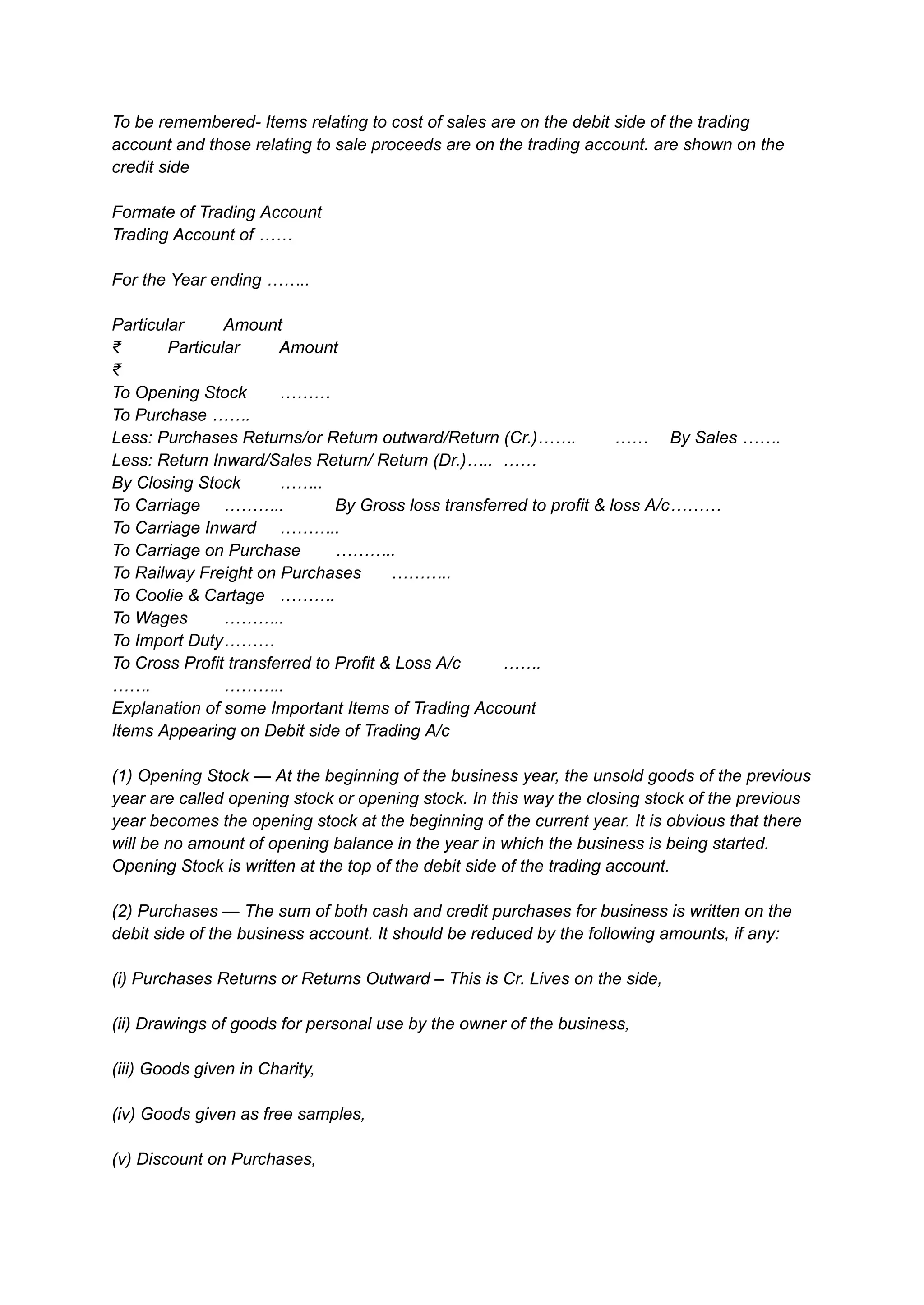
To be remembered- Items relating to cost of sales are on the debit side of the trading
account and those relating to sale proceeds are on the trading account. are shown on the
credit side
Format of Trading Account
Trading Account of ……
For the Year ending ……..
Particular Amount. ₹ Particular Amount. ₹
To Opening Stock
To Purchase …….
Less: Purchases
Returns/or Return
outward/Return (Cr.)……. ……….
By Sales …….
Less: Return Inward/Sales
Return/ Return (Dr.)….. ………..
By Closing Stock ……….
To Carriage ……… By Gross loss transferred to
profit & loss A/c ……….
To Carriage Inward ………
To Carriage on Purchase ………
To Railway Freight on
Purchases ………
To Coolie & Cartage ………
To Wages ……….
To Import Duty ……….
To Cross Profit transferred
to Profit & Loss A/c ……….
………. ……….
Explanation of some Important Items of Trading Account
Items Appearing on Debit side of Trading A/c
(1) Opening Stock — At the beginning of the business year, the unsold goods of the
previous year are called opening stock or opening stock. In this way the closing stock of the
previous year becomes the opening stock at the beginning of the current year. It is obvious
that there will be no amount of opening balance in the year in which the business is being
started. Opening Stock is written at the top of the debit side of the trading account.
(2) Purchases — The sum of both cash and credit purchases for business is written on the
debit side of the business account. It should be reduced by the following amounts, if any:
(i) Purchases Returns or Returns Outward – This is Cr. Lives on the side,
(ii) Drawings of goods for personal use by the owner of the business,
(iii) Goods given in Charity,
(iv) Goods given as free samples,
(v) Discount on Purchases,
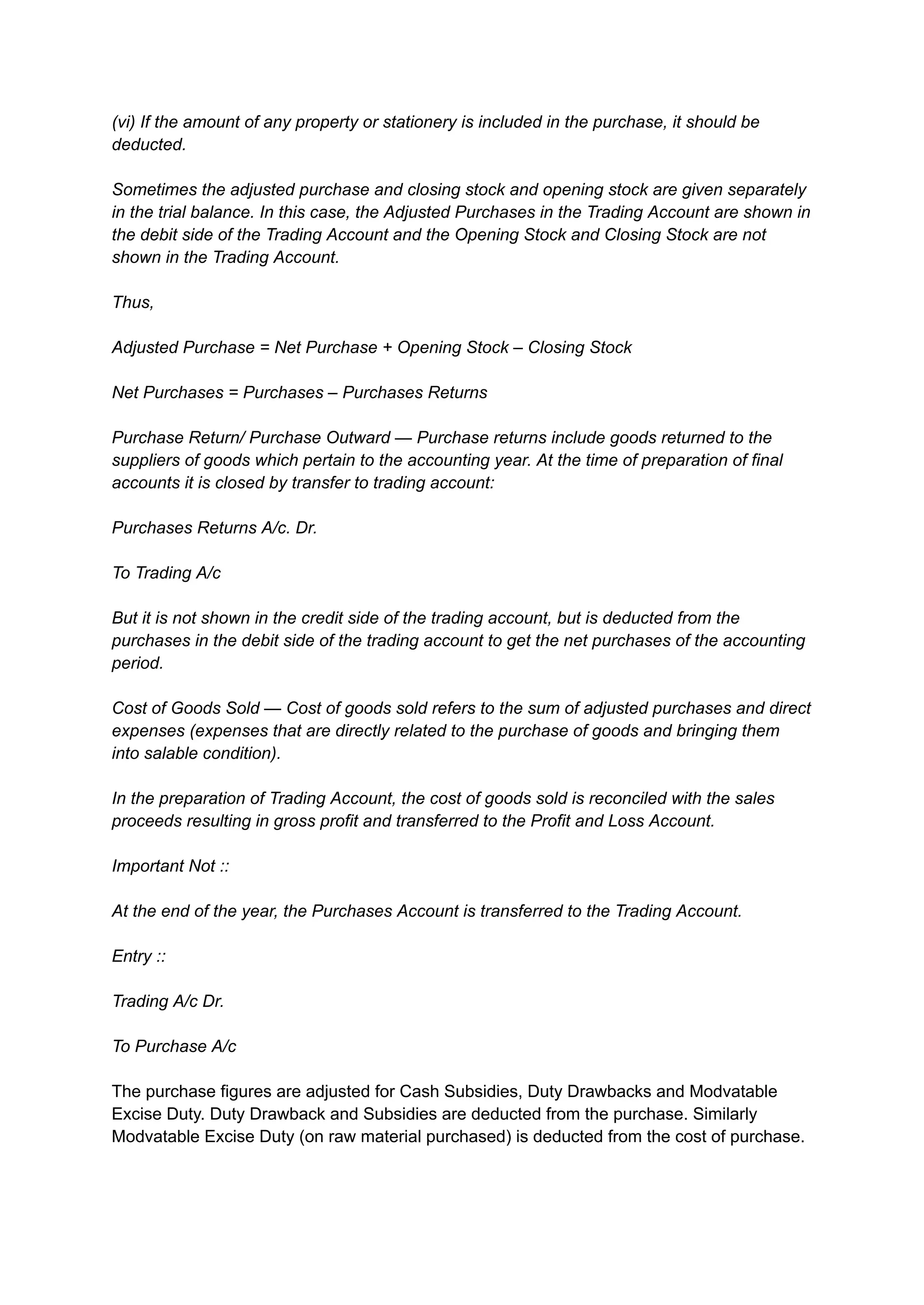
(vi) If the amount of any property or stationery is included in the purchase, it should be
deducted.
Sometimes the adjusted purchase and closing stock and opening stock are given separately
in the trial balance. In this case, the Adjusted Purchases in the Trading Account are shown in
the debit side of the Trading Account and the Opening Stock and Closing Stock are not
shown in the Trading Account.
Thus,
Adjusted Purchase = Net Purchase + Opening Stock – Closing Stock
Net Purchases = Purchases – Purchases Returns
Purchase Return/ Purchase Outward —
Purchase returns include goods returned to the suppliers of goods which pertain to the
accounting year. At the time of preparation of final accounts it is closed by transfer to trading
account:
Purchases Returns A/c. Dr.
To Trading A/c
But it is not shown in the credit side of the trading account, but is deducted from the
purchases in the debit side of the trading account to get the net purchases of the accounting
period.
Cost of Goods Sold — Cost of goods sold refers to the sum of adjusted purchases and
direct expenses (expenses that are directly related to the purchase of goods and bringing
them into salable condition).
In the preparation of Trading Account, the cost of goods sold is reconciled with the sales
proceeds resulting in gross profit and transferred to the Profit and Loss Account.
Important Not ::
At the end of the year, the Purchases Account is transferred to the Trading Account.
Entry ::
Trading A/c Dr.
To Purchase A/c
Commerce
Customize
3636 Comments in moderation
New
Edit Post
Rank Math SEO
Search
Howdy, admin
Log OutSkip to content
Commerce
Commerce
Search
what is Trading account In accounting
Leave a Comment / Uncategorized / By admin
what is Trading account In accounting
The account prepared by the trader to get the information about the gross profit or gross loss
from the business within a certain period (such as one year or six months) is called ‘trade
account’. In fact, the meaning of trading account is such an account from which gross profit
or loss is known through the purchase and sale of goods.
Acording to J.R. Batliboi — The Trading Account shows the results of buying and selling of
goods. In preparing this account, the general establishment change are ignored and only the
transaction in good anr included.
This explains the meaning of trading account.
According to this definition, trading account can also be called Goods Account, because only
transactions related to goods are accounted for in it, such as- (i) opening stock, (ii) purchase
of goods, (iii) Purchase returns, (iv) Sales of goods, (v) Sales returns, (vi) Closing stock, (vii)
Cost of manufacturing the goods, (viii) Cost of purchasing the goods and bringing them to
the place of business.
Table of Contents
Purpose or Object of trading Account
Features of Trading Account
Need and Importance ( Advantages ) of Trading Account
Preparation of Trading Account
Heading of Trading A/c
Formate of Trading Account
Explanation of some Important Items of Trading Account
Items on Credit Side of Trading A/c
Balancing of Trading Account
Types of opening and closing stock
Stock includes the following:
Cost of Good Sold (COGS) or Cost of Sales
What is trading account in accounting with example
Frequently Asked Questions
Purpose or Object of trading Account
The main purpose of preparing trading account is to find out the gross profit or gross loss of
the enterprise in a particular period.
Gross Profit or Gross Loss – Gross profit or gross loss is the difference between actual sales
receipts and cost of goods sold.
• If the net amount of sale is more than the goods purchased by the trader and the expenses
incurred on it, then the difference is called Gross Profit.
Gross profit = Sale proceeds – Cost of Goods Sold
• If the amount of sale is less than the amount of purchase and expenses incurred on it, then
the difference is called gross loss.
Gross Loss = Cost of Good Sold – Sale proceeds
Features of Trading Account
what is Trading account In accounting
1. It is a nominal account and forms part of the Profit and Loss Account.
2. This is the first step in the preparation of final accounts of the business concern.
3. In this the direct costs of goods sold and sales are accounted for.
4. The balance of this account represents ‘Gross Profit’ or ‘Gross Loss’.
5. The balance of this account i.e. gross profit or gross loss is transferred to the profit and
loss account.
6. It is prepared for a particular accounting period and usually at the end of that period.
Need and Importance ( Advantages ) of Trading Account
Following are the importance or benefits of creating a trading account :
(1) It provides information on gross profit or gross loss.
(2) The trading account provides information on net purchases and balances.
(3) It helps in determining the ratio of direct expenses to gross profit.
(4) The relationship between purchases and direct expenses can be determined from the
trading account.
(5) The cost of goods sold can be calculated from the trading account.
(6) Gross profit ratio can be calculated from trading account and with the help of gross profit
ratio, the performance of the business can be assessed. Efficiency can be assessed.
(7) The efficiency of the sales department can be assessed on the basis of the sales trend
over several years.
(8) It helps in analysing the condition of the occupants.
(9) The percentage of gross profit helps in the evaluation and comparative study of the
success of business operations.
Preparation of Trading Account
• Trade Account is a Nominal Account.
• Opening Stock is shown on the debit side of the Trading Account.
• All those expenses which are related to the purchase or manufacture of goods are shown
on the ‘debit’ (or ‘creditor’) side of the trading account.
• Sales (both cash and credit) and ‘closing stock’ are shown on the credit (or ‘deposit’ or
‘rich’) side of the trading account. Remember here ‘sale’ means sale of goods. The amount
received from the sale of assets is not included in this. If there is ‘Sales Returns’, it will be
deducted from sales and credited to trading account from net sales.
• If the sum of the credit side of the trading account is greater than the sum of the debit side,
then there will be ‘gross profit’ and if the sum of the debit side is greater than the sum of the
credit side then it will be called ‘gross loss’.
• To create a trading account or trading account, first enter the title of the trading account
and below that mention the year for which the trading account is being created.
Heading of Trading A/c
(1)Trading A/c of ……(Name of the Form or name of the trade ) For the year ending …..( The
date on which accounting year closes )
Important Not ::
As on 31st December or As at……. should never be written under the heading in Trading A/c
and Profit & Loss A/c. It is in currect
To be remembered- Items relating to cost of sales are on the debit side of the trading
account and those relating to sale proceeds are on the trading account. are shown on the
credit side
Formate of Trading Account
Trading Account of ……
For the Year ending ……..
Particular Amount
₹ Particular Amount
₹
To Opening Stock ………
To Purchase …….
Less: Purchases Returns/or Return outward/Return (Cr.)……. …… By Sales …….
Less: Return Inward/Sales Return/ Return (Dr.)….. ……
By Closing Stock ……..
To Carriage ……….. By Gross loss transferred to profit & loss A/c………
To Carriage Inward ………..
To Carriage on Purchase ………..
To Railway Freight on Purchases ………..
To Coolie & Cartage ……….
To Wages ………..
To Import Duty………
To Cross Profit transferred to Profit & Loss A/c …….
……. ………..
Explanation of some Important Items of Trading Account
Items Appearing on Debit side of Trading A/c
(1) Opening Stock — At the beginning of the business year, the unsold goods of the previous
year are called opening stock or opening stock. In this way the closing stock of the previous
year becomes the opening stock at the beginning of the current year. It is obvious that there
will be no amount of opening balance in the year in which the business is being started.
Opening Stock is written at the top of the debit side of the trading account.
(2) Purchases — The sum of both cash and credit purchases for business is written on the
debit side of the business account. It should be reduced by the following amounts, if any:
(i) Purchases Returns or Returns Outward – This is Cr. Lives on the side,
(ii) Drawings of goods for personal use by the owner of the business,
(iii) Goods given in Charity,
(iv) Goods given as free samples,
(v) Discount on Purchases,
(vi) If the amount of any property or stationery is included in the purchase, it should be
deducted.
Sometimes the adjusted purchase and closing stock and opening stock are given separately
in the trial balance. In this case, the Adjusted Purchases in the Trading Account are shown in
the debit side of the Trading Account and the Opening Stock and Closing Stock are not
shown in the Trading Account.
Thus,
Adjusted Purchase = Net Purchase + Opening Stock – Closing Stock
Net Purchases = Purchases – Purchases Returns
Purchase Return/ Purchase Outward — Purchase returns include goods returned to the
suppliers of goods which pertain to the accounting year. At the time of preparation of final
accounts it is closed by transfer to trading account:
Purchases Returns A/c. Dr.
To Trading A/c
But it is not shown in the credit side of the trading account, but is deducted from the
purchases in the debit side of the trading account to get the net purchases of the accounting
period.
Cost of Goods Sold — Cost of goods sold refers to the sum of adjusted purchases and direct
expenses (expenses that are directly related to the purchase of goods and bringing them
into salable condition).
In the preparation of Trading Account, the cost of goods sold is reconciled with the sales
proceeds resulting in gross profit and transferred to the Profit and Loss Account.
Important Not ::
At the end of the year, the Purchases Account is transferred to the Trading Account.
Entry ::
Trading A/c Dr.
To Purchase A/c
The purchase figures are adjusted for Cash Subsidies, Duty Drawbacks and Modvatable
Excise Duty. Duty Drawback and Subsidies are deducted from the purchase. Similarly
Modvatable Excise Duty (on raw material purchased) is deducted from the cost of purchase.
Direct Expenses — Direct expenses are expenses that are made from the phase of
purchasing goods to the goods and making them sellable. All direct expenditures are shown
in the debit side of the business account. The expenditure related to the purchase
purchases expenses — The expenditure related to the purchase is related to purchasing
and bringing it to goods. The expenditure related to the purchase consists of direct
expenses. These expenses are shown in the debit side of the business account. Examples
of expenditure related to purchasing are as follows:
(i) Freight and Freight (Input) – The freight expenses incurred or freight (external
expenditure) paid in bringing the purchased goods are kept in this category, such as:
(a) Railway Freight on Purchases,
(b) Freight,
(c) Carriage & Freight,
(d) Carriage Inward,
(e) Carriage,
(f) Collie & Cartage.
Note- Carriage Outward is shown on the debit side of Profit & Loss A/c and not in the
Trading Account.
Similarly, Carriage on Purchases is shown in Trading A/c and Carriage on Sales is shown in
debit side of Profit & Loss A/c. Rent on fixed asset is debited to the asset account.
(ii) Octroi, Import Duty, Custom Duty, Excise Duty, etc..
( a) Octroi – The fee levied by the municipality or municipal corporation at the time of
bringing the purchased goods to its place is called Octroi.
(b) Import tax – Import tax is levied on goods imported from other countries.
(c) Excise tax – Taxes levied at the origin are excise taxes.
(d) Customs Duty and Dock Tax- When goods purchased from other countries enter the
border of their country, duty has to be paid for it. Dock dues are collected for unloading the
goods from the ship and keeping them on the dock.
(iii) Wages – The wages paid for bringing the purchased goods and manufacturing the
goods are written in the debit side of the trading account. It may have the following names:
Wages, Productive wages, factory wages, wages and Salary, labour cost, Direct Labour,
etc….
Remember ::
(a) In case of Salary and Wages it will be shown in Debit Side of Profit & Loss A/c, but in
case of Wages and Salaries it will be shown in Trading Account
(b) If wages are paid for the installation or installation of any machinery, the same shall not
be debited to the trading account, but shall be added to the cost of the machinery. Will be
shown in the letter.
(iv) Insurance — Insurance premium, Factory Insurance or Premium on Factory Insurance,
of goods imported from abroad is shown on the debit side of the Trading Account.
(Vi) Factory Experience — Factory Rent, Rates & Taxes, Factory Lighting, Factory Repairs
and Other Factory Expenses.
(Vii)Manufacturing Experience — All the expenses related to the manufacture of goods are
shown on the debit side of the trading account. These expenses are incurred by the
manufacturing organisation. Some examples of construction expenses are as follows:
(a) Gas, Fuel, Light, Power.
(b) Water, Oil, Grease.
(c) Coal, Chemicals, Colour.
Other Expenses.
Royalty based on Production — The consideration given for the exercise of a particular
type of right is called ‘rights fee’. It is a kind of rent, like the publisher of a book pays royalty
to its authors and the lessee pays royalty to his landlord.
The royalty on production is written in the trading account but the royalty on sale is written in
the profit and loss account.
Stores Consumed — Stores refer to those items which are purchased for use in the factory.
Under ‘Stores’, fuel, coal, chemical substances, paint, different parts of machines, etc. are
included. These goods are used in the manufacture of other goods. These are not bought for
sale. Hence stores should not be included in the stock. Stores Consumed is shown on the
debit side of the trading account.
Stores Used = (Opening Stock of Stores + Purchases of Stores – Closing Stock of
Stores )
Items on Credit Side of Trading A/c
1. Sales — All sales (cash + credit) for the year (or the period for which the trading account
is being prepared) are entered on the credit side of the trading account. From this the
amount of Discount on Sales and Sales Returns or Returns Inward should be deducted.
2. Goods on Sales or Return Basis — It should not be included in sales but should be
shown separately on the credit side of the trading account and written on the assets side of
the balance sheet (B/S).
3. Goods Sent on Consignment — If the consignor sends some goods on consignment
(i.e. invoice of goods) it should be shown on the credit side of the trading account; But it will
be shown at cost price only.
4. Closing Stock — At the end of the year the value of the closing stock is calculated. The
unsold stock at the end of the year is called closing stock. Closing stock is valued at cost or
market value, whichever is less. (Closing stock is valued at cost or market price, whichever
is lower.) The closing stock is usually given outside the trial balance (at the beginning of the
question or at the end of the question). It is shown on the credit side of trading account and
on the asset side of the balance sheet. Thus it is accounted for in two places.
Important Not ::
(1) If the stock is in trial balance, it will not be accounted for in the trading account but will be
shown only on the assets side of the balance sheet.
(2) If closing stock i.e. closing stock is adjusted from ‘Purchases’ then it will not be credited
to Trading A/c
Balancing of Trading Account
The balance of the trading account is taken out from the related items of the trading account
so that ‘Gross Profit’ or ‘Gross Loss’ can be known.
• Gross Profit – If the sum of the credit side of the business account is greater than the sum
of the debit side, then the difference between the two sides will be called gross profit. It is
shown on the debit side of the trading account.
• Gross Loss – When the sum of the debit side of the trading account is more than the sum
of the credit side, then the amount of difference is called gross loss. It is shown on the credit
side of the trading account.
Note- Gross profit and gross loss are transferred to profit and loss account. Gross profit is
shown on the credit side of the profit and loss account and gross loss is shown on the debit
side of the profit and loss account.
Types of opening and closing stock
Stock includes the following:
(1) Raw Material Stock
(2) Semi – Finished Goods
(3) Work – in – Progress
(4) Finished Goods
Cost of Good Sold (COGS) or Cost of Sales
Cost of goods sold or cost of sales is the amount that represents the cost of supplying goods
or providing services by the organisation, excluding administrative and other general
overheads.
In a business concern, it is equal to opening stock at the beginning of the accounting year +
‘purchases’ for the period + direct expenditure – closing stock at the end of the accounting
period. Thus
COGS = Opening Stock + Net Purchases + Direct Expenses – Closing Stock
• In a manufacturing organisation, the ‘Production cost of finished goods’ will be taken into
account in place of ‘Purchases’ for the period.
• In a service providing organisation, the cost of sales will be calculated as a direct cost,
which will be adjusted by the values ​
​
of the beginning and ending unfinished goods
(Word-in-progress).
• To calculate the Gross Profit, the cost of goods sold (COGS) will be subtracted from the
Sales Revenue ie Sales Proceeds.
• If gross profit and sales are given in the question, then cost of goods sold will be worked
out as follows-
Cost Of Goods Sold = (Net) Sales – Gross Profit .
Whereas,
Net Sales = Sales – Sales Returns or Returns Inward
What is trading account in accounting with example
Qs 1. Prepare Trading Account of Mr. Satish Sah for the year ending 31 March, 2017 :
Stock (1.1.2016) 10,000.
Purchases 50,000.
Purchases Return 2,000
Sales 75,000
Sales Returns 3,000
Wages 1,500
Machinery 10,000
Furniture 1,000
Railway Freight 1,000
carriage Inward 100
Factory Expenses 600
Manufacturing Expenses 1,300
Octroi 100
Closing Stock (31.3.2017) ₹ 10,000
Solution ::
Trading Account of Mr. Satish Sah
Particular Amount. ₹ Particular Amount. ₹
To Stock (1.4.2016)
To Purchases 50,000
10,000 By Sales 75,000
Less: Sales Returns
Less: Returns 2,000 48,0000 3,000 72,000
To Wages .1,500 By Closing Stock 10,000
To Railway freight 1,000
To Carriage Inward 100
To Factory Expenses 600
To Manufacturing
Expenses
1,300
To Octroi 100
To Gross Profit transferred
to Profit & Loss A/c
.19,400
82,000 82,000
Frequently Asked Questions
Qs 1. What are the two main types of trading?
Ans. The 2 main type of trading is Short -term and Long -term
Qs 2. What is meant by trading account?
Ans. An Investment Account.
Qs 3. Is a trading account a real account?
Ans. Trading account is a Nominal Account
• Read more : Theory base of accounting class 11 notes
• Read more : Financial statements class 11
• Read more : Triple / Three Column Cash Book
Read more : Mixcelebrity.xyz
what is Trading account In accounting

what is Trading account In accounting

  • 1.
    what is Tradingaccount In accounting what is Trading account In accounting The account prepared by the trader to get the information about the gross profit or gross loss from the business within a certain period (such as one year or six months) is called ‘trade account’. In fact, the meaning of trading account is such an account from which gross profit or loss is known through the purchase and sale of goods. Acording to J.R. Batliboi — The Trading Account shows the results of buying and selling of goods. In preparing this account, the general establishment change are ignored and only the transaction in good anr included. This explains the meaning of trading account. According to this definition, trading account can also be called Goods Account, because only transactions related to goods are accounted for in it, such as- (i) opening stock, (ii) purchase of goods, (iii) Purchase returns, (iv) Sales of goods, (v) Sales returns, (vi) Closing stock, (vii) Cost of manufacturing the goods, (viii) Cost of purchasing the goods and bringing them to the place of business. Purpose or Object of trading Account The main purpose of preparing a trading account is to find out the gross profit or gross loss of the enterprise in a particular period. Gross Profit or Gross Loss – Gross profit or gross loss is the difference between actual sales receipts and cost of goods sold. • If the net amount of sale is more than the goods purchased by the trader and the expenses incurred on it, then the difference is called Gross Profit. Gross profit = Sale proceeds – Cost of Goods Sold • If the amount of sale is less than the amount of purchase and expenses incurred on it, then the difference is called gross loss.
  • 2.
    Gross Loss =Cost of Good Sold – Sale proceeds Features of Trading Account 1. It is a nominal account and forms part of the Profit and Loss Account. 2. This is the first step in the preparation of final accounts of the business concern. 3. In this the direct costs of goods sold and sales are accounted for. 4. The balance of this account represents ‘Gross Profit’ or ‘Gross Loss’. 5. The balance of this account i.e. gross profit or gross loss is transferred to the profit and loss account. 6. It is prepared for a particular accounting period and usually at the end of that period. Need and Importance ( Advantages ) of Trading Account Following are the importance or benefits of creating a trading account : (1) It provides information on gross profit or gross loss. (2) The trading account provides information on net purchases and balances. (3) It helps in determining the ratio of direct expenses to gross profit. (4) The relationship between purchases and direct expenses can be determined from the trading account. (5) The cost of goods sold can be calculated from the trading account.
  • 3.
    (6) Gross profitratio can be calculated from trading account and with the help of gross profit ratio, the performance of the business can be assessed. Efficiency can be assessed. (7) The efficiency of the sales department can be assessed on the basis of the sales trend over several years. (8) It helps in analysing the condition of the occupants. (9) The percentage of gross profit helps in the evaluation and comparative study of the success of business operations. Preparation of Trading Account • A Trade Account is a Nominal Account. • Opening Stock is shown on the debit side of the Trading Account. • All those expenses which are related to the purchase or manufacture of goods are shown on the ‘debit’ (or ‘creditor’) side of the trading account. • Sales (both cash and credit) and ‘closing stock’ are shown on the credit (or ‘deposit’ or ‘rich’) side of the trading account. Remember here ‘sale’ means sale of goods. The amount received from the sale of assets is not included in this. If there is ‘Sales Returns’, it will be deducted from sales and credited to trading account from net sales. • If the sum of the credit side of the trading account is greater than the sum of the debit side, then there will be ‘gross profit’ and if the sum of the debit side is greater than the sum of the credit side then it will be called ‘gross loss’. • To create a trading account or trading account, first enter the title of the trading account and below that mention the year for which the trading account is being created. Heading of Trading A/c (1)Trading A/c of ……(Name of the Form or name of the trade ) For the year ending …..( The date on which accounting year closes ) Important Not :: As on 31st December or As at……. should never be written under the heading in Trading A/c and Profit & Loss A/c. It is in correct To be remembered- Items relating to cost of sales are on the debit side of the trading account and those relating to sale proceeds are on the trading account. are shown on the credit side Format of Trading Account
  • 4.
    Trading Account of…… For the Year ending …….. Particular Amount. ₹ Particular Amount. ₹ To Opening Stock To Purchase ……. Less: Purchases Returns/or Return outward/Return (Cr.)……. ………. By Sales ……. Less: Return Inward/Sales Return/ Return (Dr.)….. ……….. By Closing Stock ………. To Carriage ……… By Gross loss transferred to profit & loss A/c ………. To Carriage Inward ……… To Carriage on Purchase ……… To Railway Freight on Purchases ……… To Coolie & Cartage ……… To Wages ………. To Import Duty ………. To Cross Profit transferred to Profit & Loss A/c ………. ………. ………. Explanation of some Important Items of Trading Account Items Appearing on Debit side of Trading A/c (1) Opening Stock — At the beginning of the business year, the unsold goods of the previous year are called opening stock or opening stock. In this way the closing stock of the previous year becomes the opening stock at the beginning of the current year. It is obvious that there will be no amount of opening balance in the year in which the business is being started. Opening Stock is written at the top of the debit side of the trading account. (2) Purchases — The sum of both cash and credit purchases for business is written on the debit side of the business account. It should be reduced by the following amounts, if any: (i) Purchases Returns or Returns Outward – This is Cr. Lives on the side, (ii) Drawings of goods for personal use by the owner of the business,
  • 5.
    (iii) Goods givenin Charity, (iv) Goods given as free samples, (v) Discount on Purchases, (vi) If the amount of any property or stationery is included in the purchase, it should be deducted. Sometimes the adjusted purchase and closing stock and opening stock are given separately in the trial balance. In this case, the Adjusted Purchases in the Trading Account are shown in the debit side of the Trading Account and the Opening Stock and Closing Stock are not shown in the Trading Account. Thus, Adjusted Purchase = Net Purchase + Opening Stock – Closing Stock Net Purchases = Purchases – Purchases Returns Purchase Return/ Purchase Outward — Purchase returns include goods returned to the suppliers of goods which pertain to the accounting year. At the time of preparation of final accounts it is closed by transfer to trading account: Purchases Returns A/c. Dr. To Trading A/c But it is not shown in the credit side of the trading account, but is deducted from the purchases in the debit side of the trading account to get the net purchases of the accounting period. Cost of Goods Sold — Cost of goods sold refers to the sum of adjusted purchases and direct expenses (expenses that are directly related to the purchase of goods and bringing them into salable condition). In the preparation of Trading Account, the cost of goods sold is reconciled with the sales proceeds resulting in gross profit and transferred to the Profit and Loss Account. Important Not :: At the end of the year, the Purchases Account is transferred to the Trading Account.
  • 6.
    Entry :: Trading A/cDr. To Purchase A/c Commerce Customize 3636 Comments in moderation New Edit Post Rank Math SEO Search Howdy, admin Log OutSkip to content Commerce Commerce Search what is Trading account In accounting Leave a Comment / Uncategorized / By admin what is Trading account In accounting what is Trading account In accounting what is Trading account In accounting The account prepared by the trader to get the information about the gross profit or gross loss from the business within a certain period (such as one year or six months) is called ‘trade account’. In fact, the meaning of trading account is such an account from which gross profit or loss is known through the purchase and sale of goods. Acording to J.R. Batliboi — The Trading Account shows the results of buying and selling of goods. In preparing this account, the general establishment change are ignored and only the transaction in good anr included. This explains the meaning of trading account. According to this definition, trading account can also be called Goods Account, because only transactions related to goods are accounted for in it, such as- (i) opening stock, (ii) purchase of goods, (iii) Purchase returns, (iv) Sales of goods, (v) Sales returns, (vi) Closing stock, (vii) Cost of manufacturing the goods, (viii) Cost of purchasing the goods and bringing them to the place of business. Table of Contents Purpose or Object of trading Account Purpose or Object of trading Account Features of Trading Account Need and Importance ( Advantages ) of Trading Account Preparation of Trading Account Heading of Trading A/c Formate of Trading Account Explanation of some Important Items of Trading Account
  • 7.
    Items on CreditSide of Trading A/c Balancing of Trading Account Types of opening and closing stock Stock includes the following: Cost of Good Sold (COGS) or Cost of Sales What is trading account in accounting with example Frequently Asked Questions Purpose or Object of trading Account The main purpose of preparing trading account is to find out the gross profit or gross loss of the enterprise in a particular period. Gross Profit or Gross Loss – Gross profit or gross loss is the difference between actual sales receipts and cost of goods sold. • If the net amount of sale is more than the goods purchased by the trader and the expenses incurred on it, then the difference is called Gross Profit. Gross profit = Sale proceeds – Cost of Goods Sold • If the amount of sale is less than the amount of purchase and expenses incurred on it, then the difference is called gross loss. Gross Loss = Cost of Good Sold – Sale proceeds Features of Trading Account what is Trading account In accounting what is Trading account In accounting 1. It is a nominal account and forms part of the Profit and Loss Account. 2. This is the first step in the preparation of final accounts of the business concern. 3. In this the direct costs of goods sold and sales are accounted for. 4. The balance of this account represents ‘Gross Profit’ or ‘Gross Loss’. 5. The balance of this account i.e. gross profit or gross loss is transferred to the profit and loss account. 6. It is prepared for a particular accounting period and usually at the end of that period. Need and Importance ( Advantages ) of Trading Account Following are the importance or benefits of creating a trading account : (1) It provides information on gross profit or gross loss. (2) The trading account provides information on net purchases and balances. (3) It helps in determining the ratio of direct expenses to gross profit.
  • 8.
    (4) The relationshipbetween purchases and direct expenses can be determined from the trading account. (5) The cost of goods sold can be calculated from the trading account. (6) Gross profit ratio can be calculated from trading account and with the help of gross profit ratio, the performance of the business can be assessed. Efficiency can be assessed. (7) The efficiency of the sales department can be assessed on the basis of the sales trend over several years. (8) It helps in analysing the condition of the occupants. (9) The percentage of gross profit helps in the evaluation and comparative study of the success of business operations. Preparation of Trading Account • Trade Account is a Nominal Account. • Opening Stock is shown on the debit side of the Trading Account. • All those expenses which are related to the purchase or manufacture of goods are shown on the ‘debit’ (or ‘creditor’) side of the trading account. • Sales (both cash and credit) and ‘closing stock’ are shown on the credit (or ‘deposit’ or ‘rich’) side of the trading account. Remember here ‘sale’ means sale of goods. The amount received from the sale of assets is not included in this. If there is ‘Sales Returns’, it will be deducted from sales and credited to trading account from net sales. • If the sum of the credit side of the trading account is greater than the sum of the debit side, then there will be ‘gross profit’ and if the sum of the debit side is greater than the sum of the credit side then it will be called ‘gross loss’. • To create a trading account or trading account, first enter the title of the trading account and below that mention the year for which the trading account is being created. Heading of Trading A/c (1)Trading A/c of ……(Name of the Form or name of the trade ) For the year ending …..( The date on which accounting year closes ) Important Not :: As on 31st December or As at……. should never be written under the heading in Trading A/c and Profit & Loss A/c. It is in currect
  • 9.
    To be remembered-Items relating to cost of sales are on the debit side of the trading account and those relating to sale proceeds are on the trading account. are shown on the credit side Formate of Trading Account Trading Account of …… For the Year ending …….. Particular Amount ₹ Particular Amount ₹ To Opening Stock ……… To Purchase ……. Less: Purchases Returns/or Return outward/Return (Cr.)……. …… By Sales ……. Less: Return Inward/Sales Return/ Return (Dr.)….. …… By Closing Stock …….. To Carriage ……….. By Gross loss transferred to profit & loss A/c……… To Carriage Inward ……….. To Carriage on Purchase ……….. To Railway Freight on Purchases ……….. To Coolie & Cartage ………. To Wages ……….. To Import Duty……… To Cross Profit transferred to Profit & Loss A/c ……. ……. ……….. Explanation of some Important Items of Trading Account Items Appearing on Debit side of Trading A/c (1) Opening Stock — At the beginning of the business year, the unsold goods of the previous year are called opening stock or opening stock. In this way the closing stock of the previous year becomes the opening stock at the beginning of the current year. It is obvious that there will be no amount of opening balance in the year in which the business is being started. Opening Stock is written at the top of the debit side of the trading account. (2) Purchases — The sum of both cash and credit purchases for business is written on the debit side of the business account. It should be reduced by the following amounts, if any: (i) Purchases Returns or Returns Outward – This is Cr. Lives on the side, (ii) Drawings of goods for personal use by the owner of the business, (iii) Goods given in Charity, (iv) Goods given as free samples, (v) Discount on Purchases,
  • 10.
    (vi) If theamount of any property or stationery is included in the purchase, it should be deducted. Sometimes the adjusted purchase and closing stock and opening stock are given separately in the trial balance. In this case, the Adjusted Purchases in the Trading Account are shown in the debit side of the Trading Account and the Opening Stock and Closing Stock are not shown in the Trading Account. Thus, Adjusted Purchase = Net Purchase + Opening Stock – Closing Stock Net Purchases = Purchases – Purchases Returns Purchase Return/ Purchase Outward — Purchase returns include goods returned to the suppliers of goods which pertain to the accounting year. At the time of preparation of final accounts it is closed by transfer to trading account: Purchases Returns A/c. Dr. To Trading A/c But it is not shown in the credit side of the trading account, but is deducted from the purchases in the debit side of the trading account to get the net purchases of the accounting period. Cost of Goods Sold — Cost of goods sold refers to the sum of adjusted purchases and direct expenses (expenses that are directly related to the purchase of goods and bringing them into salable condition). In the preparation of Trading Account, the cost of goods sold is reconciled with the sales proceeds resulting in gross profit and transferred to the Profit and Loss Account. Important Not :: At the end of the year, the Purchases Account is transferred to the Trading Account. Entry :: Trading A/c Dr. To Purchase A/c The purchase figures are adjusted for Cash Subsidies, Duty Drawbacks and Modvatable Excise Duty. Duty Drawback and Subsidies are deducted from the purchase. Similarly Modvatable Excise Duty (on raw material purchased) is deducted from the cost of purchase.
  • 11.
    Direct Expenses —Direct expenses are expenses that are made from the phase of purchasing goods to the goods and making them sellable. All direct expenditures are shown in the debit side of the business account. The expenditure related to the purchase purchases expenses — The expenditure related to the purchase is related to purchasing and bringing it to goods. The expenditure related to the purchase consists of direct expenses. These expenses are shown in the debit side of the business account. Examples of expenditure related to purchasing are as follows: (i) Freight and Freight (Input) – The freight expenses incurred or freight (external expenditure) paid in bringing the purchased goods are kept in this category, such as: (a) Railway Freight on Purchases, (b) Freight, (c) Carriage & Freight, (d) Carriage Inward, (e) Carriage, (f) Collie & Cartage. Note- Carriage Outward is shown on the debit side of Profit & Loss A/c and not in the Trading Account. Similarly, Carriage on Purchases is shown in Trading A/c and Carriage on Sales is shown in debit side of Profit & Loss A/c. Rent on fixed asset is debited to the asset account. (ii) Octroi, Import Duty, Custom Duty, Excise Duty, etc.. ( a) Octroi – The fee levied by the municipality or municipal corporation at the time of bringing the purchased goods to its place is called Octroi. (b) Import tax – Import tax is levied on goods imported from other countries. (c) Excise tax – Taxes levied at the origin are excise taxes. (d) Customs Duty and Dock Tax- When goods purchased from other countries enter the border of their country, duty has to be paid for it. Dock dues are collected for unloading the goods from the ship and keeping them on the dock. (iii) Wages – The wages paid for bringing the purchased goods and manufacturing the goods are written in the debit side of the trading account. It may have the following names: Wages, Productive wages, factory wages, wages and Salary, labour cost, Direct Labour, etc….
  • 12.
    Remember :: (a) Incase of Salary and Wages it will be shown in Debit Side of Profit & Loss A/c, but in case of Wages and Salaries it will be shown in Trading Account (b) If wages are paid for the installation or installation of any machinery, the same shall not be debited to the trading account, but shall be added to the cost of the machinery. Will be shown in the letter. (iv) Insurance — Insurance premium, Factory Insurance or Premium on Factory Insurance, of goods imported from abroad is shown on the debit side of the Trading Account. (Vi) Factory Experience — Factory Rent, Rates & Taxes, Factory Lighting, Factory Repairs and Other Factory Expenses. (Vii)Manufacturing Experience — All the expenses related to the manufacture of goods are shown on the debit side of the trading account. These expenses are incurred by the manufacturing organisation. Some examples of construction expenses are as follows: (a) Gas, Fuel, Light, Power. (b) Water, Oil, Grease. (c) Coal, Chemicals, Colour. Other Expenses. Royalty based on Production — The consideration given for the exercise of a particular type of right is called ‘rights fee’. It is a kind of rent, like the publisher of a book pays royalty to its authors and the lessee pays royalty to his landlord. The royalty on production is written in the trading account but the royalty on sale is written in the profit and loss account. Stores Consumed — Stores refer to those items which are purchased for use in the factory. Under ‘Stores’, fuel, coal, chemical substances, paint, different parts of machines, etc. are included. These goods are used in the manufacture of other goods. These are not bought for sale. Hence stores should not be included in the stock. Stores Consumed is shown on the debit side of the trading account. Stores Used = (Opening Stock of Stores + Purchases of Stores – Closing Stock of Stores ) Items on Credit Side of Trading A/c
  • 13.
    1. Sales —All sales (cash + credit) for the year (or the period for which the trading account is being prepared) are entered on the credit side of the trading account. From this the amount of Discount on Sales and Sales Returns or Returns Inward should be deducted. 2. Goods on Sales or Return Basis — It should not be included in sales but should be shown separately on the credit side of the trading account and written on the assets side of the balance sheet (B/S). 3. Goods Sent on Consignment — If the consignor sends some goods on consignment (i.e. invoice of goods) it should be shown on the credit side of the trading account; But it will be shown at cost price only. 4. Closing Stock — At the end of the year the value of the closing stock is calculated. The unsold stock at the end of the year is called closing stock. Closing stock is valued at cost or market value, whichever is less. (Closing stock is valued at cost or market price, whichever is lower.) The closing stock is usually given outside the trial balance (at the beginning of the question or at the end of the question). It is shown on the credit side of trading account and on the asset side of the balance sheet. Thus it is accounted for in two places. Important Not :: (1) If the stock is in trial balance, it will not be accounted for in the trading account but will be shown only on the assets side of the balance sheet. (2) If closing stock i.e. closing stock is adjusted from ‘Purchases’ then it will not be credited to Trading A/c Balancing of Trading Account The balance of the trading account is taken out from the related items of the trading account so that ‘Gross Profit’ or ‘Gross Loss’ can be known. • Gross Profit – If the sum of the credit side of the business account is greater than the sum of the debit side, then the difference between the two sides will be called gross profit. It is shown on the debit side of the trading account. • Gross Loss – When the sum of the debit side of the trading account is more than the sum of the credit side, then the amount of difference is called gross loss. It is shown on the credit side of the trading account. Note- Gross profit and gross loss are transferred to profit and loss account. Gross profit is shown on the credit side of the profit and loss account and gross loss is shown on the debit side of the profit and loss account. Types of opening and closing stock
  • 14.
    Stock includes thefollowing: (1) Raw Material Stock (2) Semi – Finished Goods (3) Work – in – Progress (4) Finished Goods Cost of Good Sold (COGS) or Cost of Sales Cost of goods sold or cost of sales is the amount that represents the cost of supplying goods or providing services by the organisation, excluding administrative and other general overheads. In a business concern, it is equal to opening stock at the beginning of the accounting year + ‘purchases’ for the period + direct expenditure – closing stock at the end of the accounting period. Thus COGS = Opening Stock + Net Purchases + Direct Expenses – Closing Stock • In a manufacturing organisation, the ‘Production cost of finished goods’ will be taken into account in place of ‘Purchases’ for the period. • In a service providing organisation, the cost of sales will be calculated as a direct cost, which will be adjusted by the values ​ ​ of the beginning and ending unfinished goods (Word-in-progress). • To calculate the Gross Profit, the cost of goods sold (COGS) will be subtracted from the Sales Revenue ie Sales Proceeds. • If gross profit and sales are given in the question, then cost of goods sold will be worked out as follows-
  • 15.
    Cost Of GoodsSold = (Net) Sales – Gross Profit . Whereas, Net Sales = Sales – Sales Returns or Returns Inward What is trading account in accounting with example Qs 1. Prepare Trading Account of Mr. Satish Sah for the year ending 31 March, 2017 : Stock (1.1.2016) 10,000. Purchases 50,000. Purchases Return 2,000 Sales 75,000 Sales Returns 3,000 Wages 1,500 Machinery 10,000 Furniture 1,000 Railway Freight 1,000 carriage Inward 100 Factory Expenses 600 Manufacturing Expenses 1,300 Octroi 100 Closing Stock (31.3.2017) ₹ 10,000 Solution :: Trading Account of Mr. Satish Sah Particular Amount. ₹ Particular Amount. ₹ To Stock (1.4.2016) To Purchases 50,000 10,000 By Sales 75,000 Less: Sales Returns
  • 16.
    Less: Returns 2,00048,0000 3,000 72,000 To Wages .1,500 By Closing Stock 10,000 To Railway freight 1,000 To Carriage Inward 100 To Factory Expenses 600 To Manufacturing Expenses 1,300 To Octroi 100 To Gross Profit transferred to Profit & Loss A/c .19,400 82,000 82,000 Frequently Asked Questions Qs 1. What are the two main types of trading? Ans. The 2 main type of trading is Short -term and Long -term Qs 2. What is meant by trading account? Ans. An Investment Account. Qs 3. Is a trading account a real account? Ans. Trading account is a Nominal Account • Read more : Theory base of accounting class 11 notes • Read more : Financial statements class 11 • Read more : Triple / Three Column Cash Book Read more : Mixcelebrity.xyz