Chapter 2 Tourism Concepts 
& Tourism System
Learning Objectives 
 To identify important terminologies. 
 To explain why economists don’t think of 
tourism as being an industry. 
 To explain the reasons for using a systems 
approach for tourism. 
 To describe the parts of The Tourism 
System & the Tourism System model.
Contents 
 Some fundamental concepts 
 Tourism 
 Tourism Industry 
 Visitor, tourist, excursionist 
 Why use a system approach 
 The parts of Tourism System Model
FUNDAMENTAL CONCEPTS 
What is Tourism 
 There is no single definition of tourism that is universally 
accepted. 
 WTO , Madrid, Spain, is a specialized agency of the United 
Nations. 
 The World Tourism Organization defines tourism as 
“Activities of persons traveling to and staying in places 
outside their usual environment for not more than one 
consecutive year for leisure, business and other purposes 
not related to the exercise of an activity remunerated from 
within the place visited.”
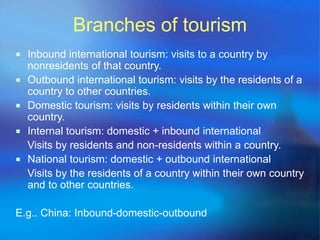
Branches of tourism 
 Inbound international tourism: visits to a country by 
nonresidents of that country. 
 Outbound international tourism: visits by the residents of a 
country to other countries. 
 Domestic tourism: visits by residents within their own 
country. 
 Internal tourism: domestic + inbound international 
Visits by residents and non-residents within a country. 
 National tourism: domestic + outbound international 
Visits by the residents of a country within their own country 
and to other countries. 
E.g.. China: Inbound-domestic-outbound
AIEST definition 
 AIEST stands for International Association of Scientific 
Experts in Tourism. 
 Hunziker and Krapf, in 1942, defined tourism as "the 
totality of the relationship and phenomenon arising from 
the travel and stay of strangers, provided that the stay does 
not imply the establishment of a permanent residence and 
is not connected with a remunerative activities". 
 Above definition was then accepted by AIEST as below: 
Tourism is the sum of phenomena and relationships arising 
from travel and stay of non residents in so far as they do 
not lead to permanent residence and are not connected 
with any earning activity. 
 This definition is widely accepted in China.
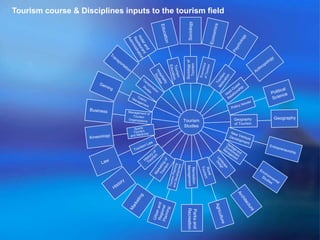
Tourism course & Disciplines inputs to the tourism field 
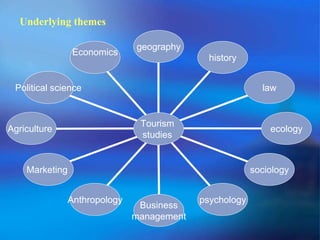
Sociology 
Sociology of 
Tourism 
Tourism 
Studies 
Parks and 
Recreation
Economics 
Political science 
Agriculture 
Marketing 
Anthropology 
Business 
management 
psychology 
law 
ecology 
sociology 
history 
geography 
Tourism 
studies 
Underlying themes
What is an Industry 
 Well (1989) defines an industry as 
“a number of firms that produce similar 
goods and services and therefore are in 
competition with one another”. 
For instance, the steel industry is defined by 
the steel products they produce.
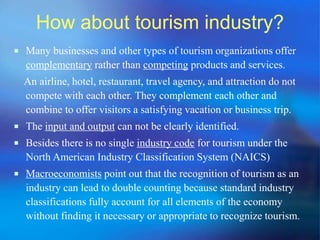
How about tourism industry? 
 Many businesses and other types of tourism organizations offer 
complementary rather than competing products and services. 
An airline, hotel, restaurant, travel agency, and attraction do not 
compete with each other. They complement each other and 
combine to offer visitors a satisfying vacation or business trip. 
 The input and output can not be clearly identified. 
 Besides there is no single industry code for tourism under the 
North American Industry Classification System (NAICS) 
 Macroeconomists point out that the recognition of tourism as an 
industry can lead to double counting because standard industry 
classifications fully account for all elements of the economy 
without finding it necessary or appropriate to recognize tourism.
Tourism industry 
 Unlike other industries that are defined by the 
products and services they produce (the supply 
side), the tourism industry is defined from a 
demand side perspective. 
A tourism industry supplies products and services 
to tourists. 
 The Tourism Industry is defined as individuals, 
businesses & organizations that are working to 
provide product & services (including information) 
to tourists. 
They include those that work in transportation, 
lodging, entertainment and food & beverage.
China tourism industry 
 Since 1986 tourism in China has been regarded as a 
significant industry for the national economy. 
 In the year 1986, China placed the tourist industry into 
the national plan for social and economic development 
for the first time. 
 There is growing acceptance of travel and tourism as an 
industry or sector of economy which includes 
accommodation, travel agents and tour operators (the 
travel trade), intercity passenger transport enterprises, 
government agencies responsible for tourism programs 
and tourism facilities, and major elements of other 
businesses in the food service, entertainment, and 
recreational fields.
Visitor 
Visitor 
 Tourist 
 Excursionist 
A visitor is defined as 'any person traveling to a place 
other than that of his/her usual environment for less 
than twelve months and whose main purpose of trip is 
other than the exercise of an activity remunerated from 
within the place visited'.
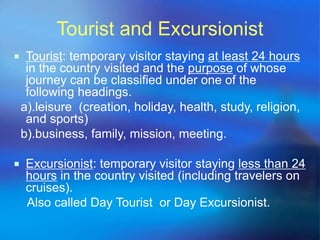
Tourist and Excursionist 
 Tourist: temporary visitor staying at least 24 hours 
in the country visited and the purpose of whose 
journey can be classified under one of the 
following headings. 
a).leisure (creation, holiday, health, study, religion, 
and sports) 
b).business, family, mission, meeting. 
 Excursionist: temporary visitor staying less than 24 
hours in the country visited (including travelers on 
cruises). 
Also called Day Tourist or Day Excursionist.
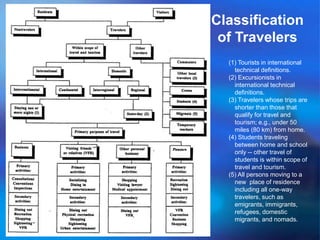
Classification 
of Travelers 
(1) Tourists in international 
technical definitions. 
(2) Excursionists in 
international technical 
definitions. 
(3) Travelers whose trips are 
shorter than those that 
qualify for travel and 
tourism; e.g., under 50 
miles (80 km) from home. 
(4) Students traveling 
between home and school 
only -- other travel of 
students is within scope of 
travel and tourism. 
(5) All persons moving to a 
new place of residence 
including all one-way 
travelers, such as 
emigrants, immigrants, 
refugees, domestic 
migrants, and nomads.
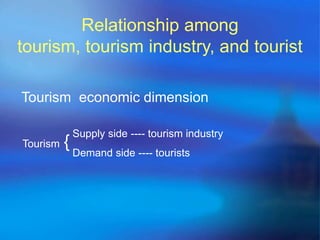
Relationship among 
tourism, tourism industry, and tourist 
Tourism economic dimension 
Tourism { 
Supply side ---- tourism industry 
Demand side ---- tourists
SYSTEM APPROACH 
 General system theory was defined by a 
biologist, Ludwig von Bertalanffy, as: 
A set of elements standing in interrelation 
among themselves and with the 
environments. 
 Tourism system consists of several 
interrelated parts working together to 
achieve common purposes.
The reasons for using a systems 
approach for study of tourism 
 To emphasize the interdependency in 
tourism; the tourism system is like a spider’s 
web – touch one part are felt throughout the 
system. 
For a student beginning to study tourism, it is 
important to get “the bigger picture” right 
away. The tourism system model framework 
provides a more comprehensive view of 
tourism: it captures “the big picture”.
The reasons for using a systems 
approach 
 The second reason is because of the open system 
nature of tourism. 
Tourism system is dynamic and constantly 
changing. New concepts are always arriving in 
tourism, such as ecotourism, TSA. 
 The third reason is the complexity and variety in all 
aspect of tourism. 
For example, there are thousands of specialized 
tours and packages available for travelers today.
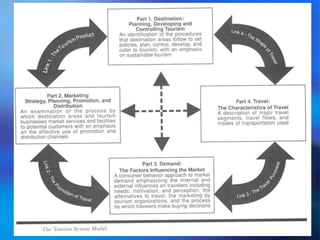
The Tourism System Model 
 Part I: Destination: Planning, developing, and 
controlling tourism 
 Link 1: The tourism product 
 Part II: Marketing: Strategy, planning, promotion, 
and distribution 
 Link 2: The promotion of travel 
 Part III: Demand: The factors influencing the 
market 
 Link 3: The travel purchase 
 Part IV: Travel: The characteristics of travel 
 Link 4: The shape of travel
Travel and tourism systems 
 Tourism process developed by Chau (1977). 
He described the tourist as the demand, the travel industry 
as the supply, and attractions as the tourist product and 
summarized the interrelate process as the subject, means, 
and objective of tourism. 
 Gunn in his book, tourism planning (1979), referred to a 
“tourism fundamental system” involving five components: 
tourist, transportation, attractions, services-facilities, and 
information-direction. 
 Leiper(1979) involved five basic elements in his system: 
tourists, generating regions, transit routes, destination 
regions, and a tourist industry operating within physical, 
cultural, social, economic, political, and technological 
environments.
The end! 
Questions?

Chapter 2 fundamental concepts & tourism system

  • 1.
    Chapter 2 TourismConcepts & Tourism System
  • 2.
    Learning Objectives To identify important terminologies.  To explain why economists don’t think of tourism as being an industry.  To explain the reasons for using a systems approach for tourism.  To describe the parts of The Tourism System & the Tourism System model.
  • 3.
    Contents  Somefundamental concepts  Tourism  Tourism Industry  Visitor, tourist, excursionist  Why use a system approach  The parts of Tourism System Model
  • 4.
    FUNDAMENTAL CONCEPTS Whatis Tourism  There is no single definition of tourism that is universally accepted.  WTO , Madrid, Spain, is a specialized agency of the United Nations.  The World Tourism Organization defines tourism as “Activities of persons traveling to and staying in places outside their usual environment for not more than one consecutive year for leisure, business and other purposes not related to the exercise of an activity remunerated from within the place visited.”
  • 5.
    Branches of tourism  Inbound international tourism: visits to a country by nonresidents of that country.  Outbound international tourism: visits by the residents of a country to other countries.  Domestic tourism: visits by residents within their own country.  Internal tourism: domestic + inbound international Visits by residents and non-residents within a country.  National tourism: domestic + outbound international Visits by the residents of a country within their own country and to other countries. E.g.. China: Inbound-domestic-outbound
  • 6.
    AIEST definition AIEST stands for International Association of Scientific Experts in Tourism.  Hunziker and Krapf, in 1942, defined tourism as "the totality of the relationship and phenomenon arising from the travel and stay of strangers, provided that the stay does not imply the establishment of a permanent residence and is not connected with a remunerative activities".  Above definition was then accepted by AIEST as below: Tourism is the sum of phenomena and relationships arising from travel and stay of non residents in so far as they do not lead to permanent residence and are not connected with any earning activity.  This definition is widely accepted in China.
  • 7.
    Tourism course &Disciplines inputs to the tourism field Sociology Sociology of Tourism Tourism Studies Parks and Recreation
  • 8.
    Economics Political science Agriculture Marketing Anthropology Business management psychology law ecology sociology history geography Tourism studies Underlying themes
  • 9.
    What is anIndustry  Well (1989) defines an industry as “a number of firms that produce similar goods and services and therefore are in competition with one another”. For instance, the steel industry is defined by the steel products they produce.
  • 10.
    How about tourismindustry?  Many businesses and other types of tourism organizations offer complementary rather than competing products and services. An airline, hotel, restaurant, travel agency, and attraction do not compete with each other. They complement each other and combine to offer visitors a satisfying vacation or business trip.  The input and output can not be clearly identified.  Besides there is no single industry code for tourism under the North American Industry Classification System (NAICS)  Macroeconomists point out that the recognition of tourism as an industry can lead to double counting because standard industry classifications fully account for all elements of the economy without finding it necessary or appropriate to recognize tourism.
  • 11.
    Tourism industry Unlike other industries that are defined by the products and services they produce (the supply side), the tourism industry is defined from a demand side perspective. A tourism industry supplies products and services to tourists.  The Tourism Industry is defined as individuals, businesses & organizations that are working to provide product & services (including information) to tourists. They include those that work in transportation, lodging, entertainment and food & beverage.
  • 12.
    China tourism industry  Since 1986 tourism in China has been regarded as a significant industry for the national economy.  In the year 1986, China placed the tourist industry into the national plan for social and economic development for the first time.  There is growing acceptance of travel and tourism as an industry or sector of economy which includes accommodation, travel agents and tour operators (the travel trade), intercity passenger transport enterprises, government agencies responsible for tourism programs and tourism facilities, and major elements of other businesses in the food service, entertainment, and recreational fields.
  • 13.
    Visitor Visitor Tourist  Excursionist A visitor is defined as 'any person traveling to a place other than that of his/her usual environment for less than twelve months and whose main purpose of trip is other than the exercise of an activity remunerated from within the place visited'.
  • 14.
    Tourist and Excursionist  Tourist: temporary visitor staying at least 24 hours in the country visited and the purpose of whose journey can be classified under one of the following headings. a).leisure (creation, holiday, health, study, religion, and sports) b).business, family, mission, meeting.  Excursionist: temporary visitor staying less than 24 hours in the country visited (including travelers on cruises). Also called Day Tourist or Day Excursionist.
  • 15.
    Classification of Travelers (1) Tourists in international technical definitions. (2) Excursionists in international technical definitions. (3) Travelers whose trips are shorter than those that qualify for travel and tourism; e.g., under 50 miles (80 km) from home. (4) Students traveling between home and school only -- other travel of students is within scope of travel and tourism. (5) All persons moving to a new place of residence including all one-way travelers, such as emigrants, immigrants, refugees, domestic migrants, and nomads.
  • 16.
    Relationship among tourism,tourism industry, and tourist Tourism economic dimension Tourism { Supply side ---- tourism industry Demand side ---- tourists
  • 17.
    SYSTEM APPROACH General system theory was defined by a biologist, Ludwig von Bertalanffy, as: A set of elements standing in interrelation among themselves and with the environments.  Tourism system consists of several interrelated parts working together to achieve common purposes.
  • 18.
    The reasons forusing a systems approach for study of tourism  To emphasize the interdependency in tourism; the tourism system is like a spider’s web – touch one part are felt throughout the system. For a student beginning to study tourism, it is important to get “the bigger picture” right away. The tourism system model framework provides a more comprehensive view of tourism: it captures “the big picture”.
  • 19.
    The reasons forusing a systems approach  The second reason is because of the open system nature of tourism. Tourism system is dynamic and constantly changing. New concepts are always arriving in tourism, such as ecotourism, TSA.  The third reason is the complexity and variety in all aspect of tourism. For example, there are thousands of specialized tours and packages available for travelers today.
  • 21.
    The Tourism SystemModel  Part I: Destination: Planning, developing, and controlling tourism  Link 1: The tourism product  Part II: Marketing: Strategy, planning, promotion, and distribution  Link 2: The promotion of travel  Part III: Demand: The factors influencing the market  Link 3: The travel purchase  Part IV: Travel: The characteristics of travel  Link 4: The shape of travel
  • 22.
    Travel and tourismsystems  Tourism process developed by Chau (1977). He described the tourist as the demand, the travel industry as the supply, and attractions as the tourist product and summarized the interrelate process as the subject, means, and objective of tourism.  Gunn in his book, tourism planning (1979), referred to a “tourism fundamental system” involving five components: tourist, transportation, attractions, services-facilities, and information-direction.  Leiper(1979) involved five basic elements in his system: tourists, generating regions, transit routes, destination regions, and a tourist industry operating within physical, cultural, social, economic, political, and technological environments.
  • 23.