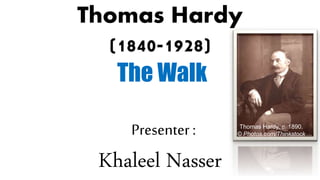
Thomas Hardy
(1840-1928)
The Walk
Presenter :
Khaleel Nasser
Thomas Hardy, c. 1890.
© Photos.com/Thinkstock
Outline
Birth
Education
Poetic Forms
The poem
Birth
Thomas Hardy (1840-1928) was born in Higher
Brockhampton, Dorset, near the town of Dorchester.
His father was a builder, and played violin in the local
church and for local dances. His mother, though she
had been brought up in poverty and had only a basic
education, read widely, and encouraged Hardy to do
the same.
Education
He attended the village school in Stinsford for a year
(1848), then the British School in Dorchester.
After one year there he moved to a commercial
academy run by Isaac Last, where he was able to study
Latin. He left school in 1856 and was articled to the
architect John Hicks in Dorchester. Here he began to
teach himself Greek, with encouragement from the
dialect poet and philologist William Barnes.
Horace Moule
At the same time, he met and was
befriended by Horace Moule, in Dorchester,
who had been educated at Cambridge, and
who now helped him with his studies, and
encouraged him to write poetry.
Poetic Forms
•Lyrics
•Ballads
•Dramatic Monologue
Witnesses a public execution
Public executions were still carried out in
Dorchester, and he witnessed there the
hanging of a woman, an event which haunted
him for the rest of his life, and which he re-
enacted in his novel Tess of the d'Urbervilles
forty years later.
London
In 1862 he moved to London, where he found
employment in the office of the architect Arthur
Bloomfield. He attended the opera, joined a choir
and put himself through a course on the English
poets.
First writings
He wrote, mainly poetry, but failed to get
anything published apart from a small satirical
sketch, How I Built Myself a House, which was
published by Chambers’ Journal.
The Walk
(1912)
You did not walk with me
Of late to the hill-top tree
By the gated ways,
As in earlier days;
You were weak and lame,
So you never came,
And I went alone ,and I did not mind
Not thinking of you as left behind.
I walked up there to-day
Just in the former way;
Surveyed around
The familiar ground
By myself again:
What difference, then?
Only that underlying sense
Of the look of a room on returning
thence.
References
https://www.britannica.com/biography/Thomas-Hardy
http://www.poemhunter.com/poem/the-walk-30/
The walk by thomas Hardy

The walk by thomas Hardy

  • 1.
    Thomas Hardy (1840-1928) The Walk Presenter: Khaleel Nasser Thomas Hardy, c. 1890. © Photos.com/Thinkstock
  • 2.
  • 3.
    Birth Thomas Hardy (1840-1928)was born in Higher Brockhampton, Dorset, near the town of Dorchester. His father was a builder, and played violin in the local church and for local dances. His mother, though she had been brought up in poverty and had only a basic education, read widely, and encouraged Hardy to do the same.
  • 4.
    Education He attended thevillage school in Stinsford for a year (1848), then the British School in Dorchester. After one year there he moved to a commercial academy run by Isaac Last, where he was able to study Latin. He left school in 1856 and was articled to the architect John Hicks in Dorchester. Here he began to teach himself Greek, with encouragement from the dialect poet and philologist William Barnes.
  • 5.
    Horace Moule At thesame time, he met and was befriended by Horace Moule, in Dorchester, who had been educated at Cambridge, and who now helped him with his studies, and encouraged him to write poetry.
  • 6.
  • 7.
    Witnesses a publicexecution Public executions were still carried out in Dorchester, and he witnessed there the hanging of a woman, an event which haunted him for the rest of his life, and which he re- enacted in his novel Tess of the d'Urbervilles forty years later.
  • 8.
    London In 1862 hemoved to London, where he found employment in the office of the architect Arthur Bloomfield. He attended the opera, joined a choir and put himself through a course on the English poets.
  • 9.
    First writings He wrote,mainly poetry, but failed to get anything published apart from a small satirical sketch, How I Built Myself a House, which was published by Chambers’ Journal.
  • 10.
    The Walk (1912) You didnot walk with me Of late to the hill-top tree By the gated ways, As in earlier days; You were weak and lame, So you never came,
  • 11.
    And I wentalone ,and I did not mind Not thinking of you as left behind. I walked up there to-day Just in the former way; Surveyed around The familiar ground By myself again: What difference, then? Only that underlying sense Of the look of a room on returning thence.
  • 12.