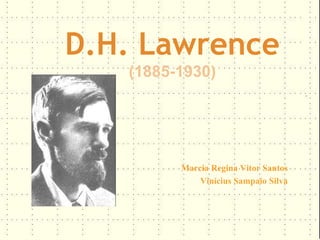
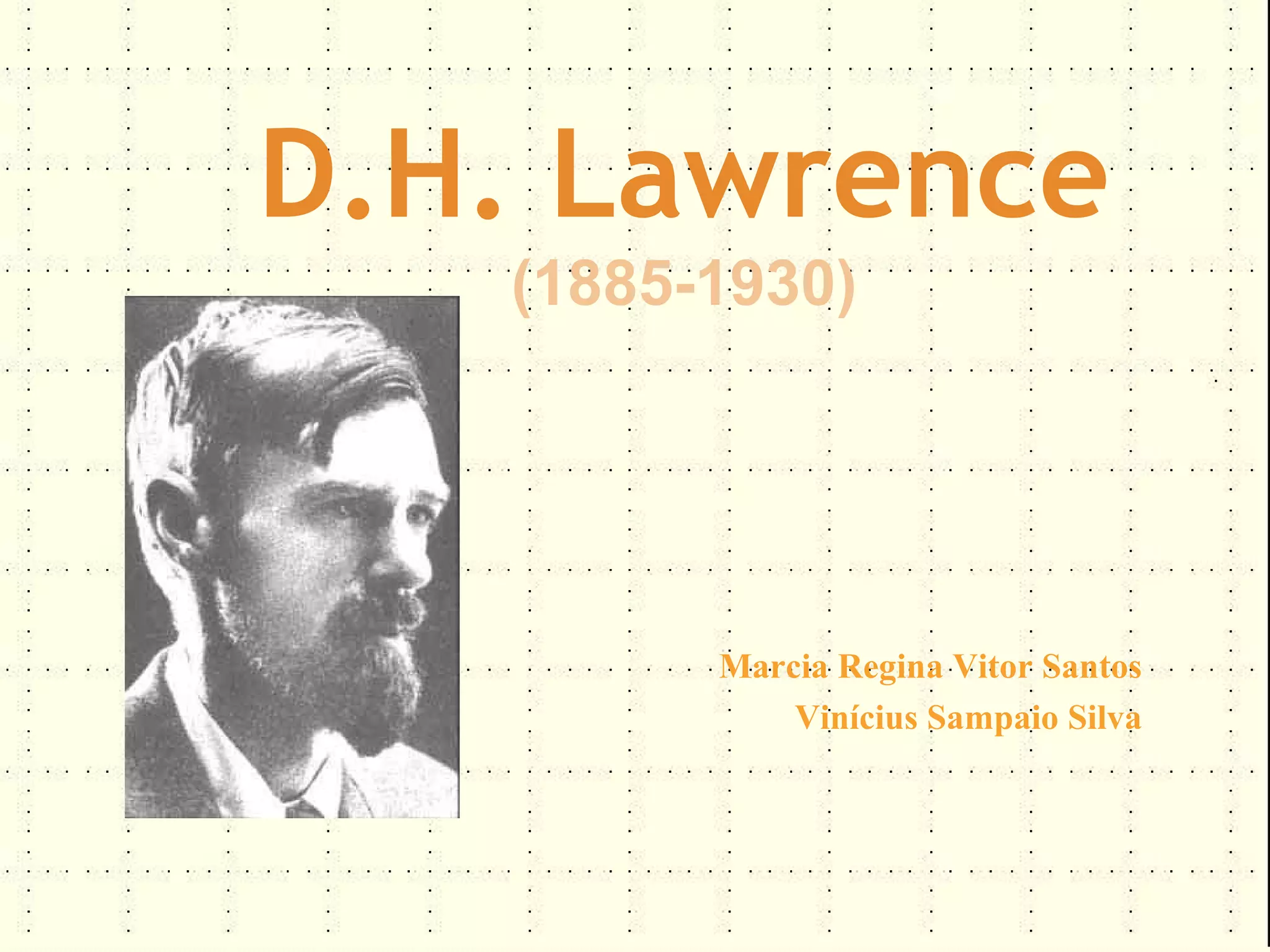
D.H. Lawrence
   (1885-1930)


         Marcia Regina Vitor Santos
             Vinícius Sampaio Silva
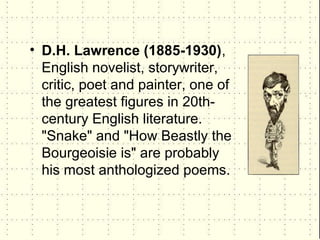
• D.H. Lawrence (1885-1930),
  English novelist, storywriter,
  critic, poet and painter, one of
  the greatest figures in 20th-
  century English literature.
  "Snake" and "How Beastly the
  Bourgeoisie is" are probably
  his most anthologized poems.
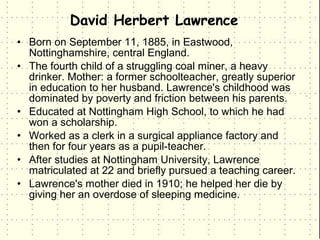
David Herbert Lawrence
• Born on September 11, 1885, in Eastwood,
  Nottinghamshire, central England.
• The fourth child of a struggling coal miner, a heavy
  drinker. Mother: a former schoolteacher, greatly superior
  in education to her husband. Lawrence's childhood was
  dominated by poverty and friction between his parents.
• Educated at Nottingham High School, to which he had
  won a scholarship.
• Worked as a clerk in a surgical appliance factory and
  then for four years as a pupil-teacher.
• After studies at Nottingham University, Lawrence
  matriculated at 22 and briefly pursued a teaching career.
• Lawrence's mother died in 1910; he helped her die by
  giving her an overdose of sleeping medicine.
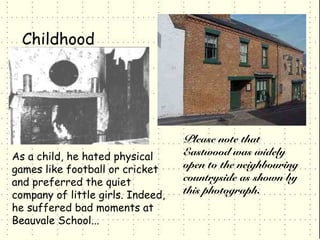
Childhood


                                   Please note that
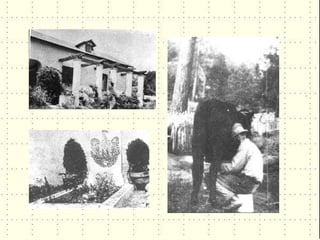
As a child, he hated physical      Eastwood was widely
games like football or cricket     open to the neighbouring
and preferred the quiet            countryside as shown by
company of little girls. Indeed,   this photograph.
he suffered bad moments at
Beauvale School...
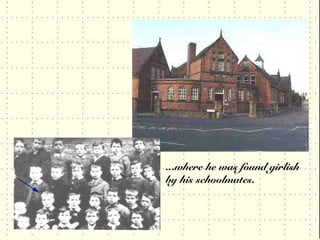
...where he was found girlish
by his schoolmates.
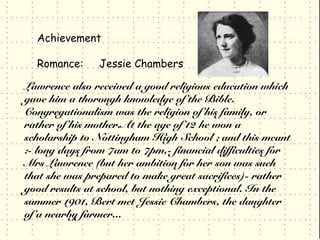
Achievement

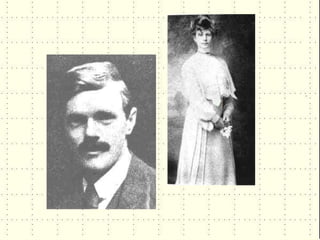
  Romance:      Jessie Chambers

Lawrence also received a good religious education which
gave him a thorough knowledge of the Bible.
Congregationalism was the religion of his family, or
rather of his mother.At the age of 12 he won a
scholarship to Nottingham High School ; and this meant
:- long days from 7am to 7pm,- financial difficulties for
Mrs Lawrence (but her ambition for her son was such
that she was prepared to make great sacrifices)- rather
good results at school, but nothing exceptional. In the
summer 1901, Bert met Jessie Chambers, the daughter
of a nearby farmer...
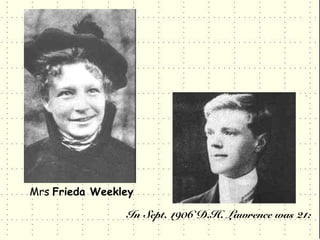
Mrs Frieda Weekley

                In Sept. 1906 D.H. Lawrence was 21:
“Odour of Chrysanthemums”


One of D. H. Lawrence’s most accomplished stories,
written in 1909.

-- A dramatic moment in the life of Mrs.
   Elizabeth Bates and the death of her
   husband, Walter Bates.

-- Lawrence presents his parents’
   marriage in the story
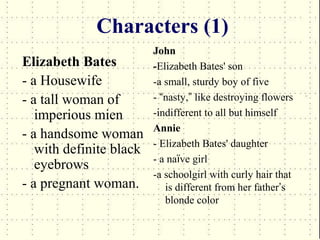
Characters (1)
                         John
Elizabeth Bates          -Elizabeth Bates' son
- a Housewife            -a small, sturdy boy of five
- a tall woman of        - “nasty,” like destroying flowers
   imperious mien        -indifferent to all but himself
                         Annie
- a handsome woman
                         - Elizabeth Bates' daughter
   with definite black
                         - a naïve girl
   eyebrows
                         -a schoolgirl with curly hair that
- a pregnant woman.         is different from her father’s
                            blonde color
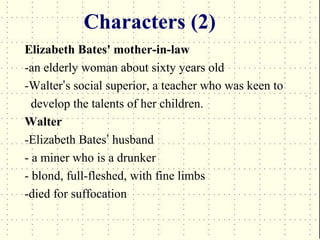
Characters (2)
Elizabeth Bates' mother-in-law
-an elderly woman about sixty years old
-Walter’s social superior, a teacher who was keen to
  develop the talents of her children.
Walter
-Elizabeth Bates’ husband
- a miner who is a drunker
- blond, full-fleshed, with fine limbs
-died for suffocation
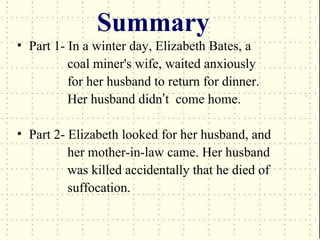
Summary
• Part 1- In a winter day, Elizabeth Bates, a
          coal miner's wife, waited anxiously
          for her husband to return for dinner.
          Her husband didn’t come home.

• Part 2- Elizabeth looked for her husband, and
          her mother-in-law came. Her husband
          was killed accidentally that he died of
          suffocation.
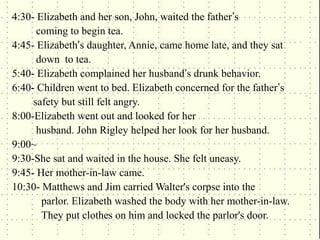
4:30- Elizabeth and her son, John, waited the father’s
      coming to begin tea.
4:45- Elizabeth’s daughter, Annie, came home late, and they sat
      down to tea.
5:40- Elizabeth complained her husband’s drunk behavior.
6:40- Children went to bed. Elizabeth concerned for the father’s
     safety but still felt angry.
8:00-Elizabeth went out and looked for her
      husband. John Rigley helped her look for her husband.
9:00~
9:30-She sat and waited in the house. She felt uneasy.
9:45- Her mother-in-law came.
10:30- Matthews and Jim carried Walter's corpse into the
       parlor. Elizabeth washed the body with her mother-in-law.
       They put clothes on him and locked the parlor's door.
Some Symbols
Reading the text, it’s possible to identify some symbols
   that represents the main ideas around Elizabeth:

Chrysanthemums: representing the sweet beginning of
    Elizabeth’s marriage as well as the pale colour in
    which her marriage had become;
Darkness: the word darkness in some parts of the
    writing brings the idea of disappointment and
    loneliness to which Elizabeth was subjected. She
    had an unhappy life beside her drunk husband,
    who’s suffocated to die;
The broken vase: represents the end of the marriage.
Theme
A. Industrial Revolution
 -Industrial blight against nature beauty

B. Life and death
 -The chrysanthemums, which bloom a little while in the
  fall and then die, are symbolic of the fragility of the inner
  lives.

C. Marriage.
  -Their marriage had been dead before her
   husband lost his life that night in the mine.
  -Elizabeth never appreciated what she could have had
    with Walter.

Dh lawrence presentation

  • 1.
    D.H. Lawrence (1885-1930) Marcia Regina Vitor Santos Vinícius Sampaio Silva
  • 2.
    • D.H. Lawrence(1885-1930), English novelist, storywriter, critic, poet and painter, one of the greatest figures in 20th- century English literature. "Snake" and "How Beastly the Bourgeoisie is" are probably his most anthologized poems.
  • 3.
    David Herbert Lawrence •Born on September 11, 1885, in Eastwood, Nottinghamshire, central England. • The fourth child of a struggling coal miner, a heavy drinker. Mother: a former schoolteacher, greatly superior in education to her husband. Lawrence's childhood was dominated by poverty and friction between his parents. • Educated at Nottingham High School, to which he had won a scholarship. • Worked as a clerk in a surgical appliance factory and then for four years as a pupil-teacher. • After studies at Nottingham University, Lawrence matriculated at 22 and briefly pursued a teaching career. • Lawrence's mother died in 1910; he helped her die by giving her an overdose of sleeping medicine.
  • 4.
    Childhood Please note that As a child, he hated physical Eastwood was widely games like football or cricket open to the neighbouring and preferred the quiet countryside as shown by company of little girls. Indeed, this photograph. he suffered bad moments at Beauvale School...
  • 5.
    ...where he wasfound girlish by his schoolmates.
  • 6.
    Achievement Romance: Jessie Chambers Lawrence also received a good religious education which gave him a thorough knowledge of the Bible. Congregationalism was the religion of his family, or rather of his mother.At the age of 12 he won a scholarship to Nottingham High School ; and this meant :- long days from 7am to 7pm,- financial difficulties for Mrs Lawrence (but her ambition for her son was such that she was prepared to make great sacrifices)- rather good results at school, but nothing exceptional. In the summer 1901, Bert met Jessie Chambers, the daughter of a nearby farmer...
  • 7.
    Mrs Frieda Weekley In Sept. 1906 D.H. Lawrence was 21:
  • 11.
    “Odour of Chrysanthemums” Oneof D. H. Lawrence’s most accomplished stories, written in 1909. -- A dramatic moment in the life of Mrs. Elizabeth Bates and the death of her husband, Walter Bates. -- Lawrence presents his parents’ marriage in the story
  • 12.
    Characters (1) John Elizabeth Bates -Elizabeth Bates' son - a Housewife -a small, sturdy boy of five - a tall woman of - “nasty,” like destroying flowers imperious mien -indifferent to all but himself Annie - a handsome woman - Elizabeth Bates' daughter with definite black - a naïve girl eyebrows -a schoolgirl with curly hair that - a pregnant woman. is different from her father’s blonde color
  • 13.
    Characters (2) Elizabeth Bates'mother-in-law -an elderly woman about sixty years old -Walter’s social superior, a teacher who was keen to develop the talents of her children. Walter -Elizabeth Bates’ husband - a miner who is a drunker - blond, full-fleshed, with fine limbs -died for suffocation
  • 14.
    Summary • Part 1-In a winter day, Elizabeth Bates, a coal miner's wife, waited anxiously for her husband to return for dinner. Her husband didn’t come home. • Part 2- Elizabeth looked for her husband, and her mother-in-law came. Her husband was killed accidentally that he died of suffocation.
  • 15.
    4:30- Elizabeth andher son, John, waited the father’s coming to begin tea. 4:45- Elizabeth’s daughter, Annie, came home late, and they sat down to tea. 5:40- Elizabeth complained her husband’s drunk behavior. 6:40- Children went to bed. Elizabeth concerned for the father’s safety but still felt angry. 8:00-Elizabeth went out and looked for her husband. John Rigley helped her look for her husband. 9:00~ 9:30-She sat and waited in the house. She felt uneasy. 9:45- Her mother-in-law came. 10:30- Matthews and Jim carried Walter's corpse into the parlor. Elizabeth washed the body with her mother-in-law. They put clothes on him and locked the parlor's door.
  • 16.
    Some Symbols Reading thetext, it’s possible to identify some symbols that represents the main ideas around Elizabeth: Chrysanthemums: representing the sweet beginning of Elizabeth’s marriage as well as the pale colour in which her marriage had become; Darkness: the word darkness in some parts of the writing brings the idea of disappointment and loneliness to which Elizabeth was subjected. She had an unhappy life beside her drunk husband, who’s suffocated to die; The broken vase: represents the end of the marriage.
  • 17.
    Theme A. Industrial Revolution -Industrial blight against nature beauty B. Life and death -The chrysanthemums, which bloom a little while in the fall and then die, are symbolic of the fragility of the inner lives. C. Marriage. -Their marriage had been dead before her husband lost his life that night in the mine. -Elizabeth never appreciated what she could have had with Walter.