Social Control
Lecture 11
Social Control
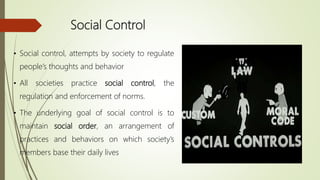
• Social control, attempts by society to regulate
people’s thoughts and behavior
• All societies practice social control, the
regulation and enforcement of norms.
• The underlying goal of social control is to
maintain social order, an arrangement of
practices and behaviors on which society’s
members base their daily lives
Sanctions
 The means of enforcing rules are known as sanctions.
 Sanctions can be positive as well as negative.
 Positive sanctions are rewards given for conforming to norms. A promotion at work is a positive
sanction for working hard.
 Negative sanctions are punishments for violating norms. Being arrested is a punishment for
shoplifting. Both types of sanctions play a role in social control.
Sociologists also classify sanctions
as formal or informal.
 Informal sanctions.
 Informal sanctions emerge in face-to-
face social interactions
 For example, may draw disapproving
looks or even verbal warnings
 Formal sanctions, on the other hand,
are ways to officially recognize and
enforce norm violations.
 If a student violates her college’s code of
conduct, for example, she might be
expelled.
Criminal justice system
 The criminal justice system is a society’s formal system of social control.
 The key elements of the U.S. criminal justice system:
 police,
 courts,
 and the system of punishment and corrections.
Police
 Police are a civil force in charge of enforcing laws and public order at a federal, state, or
community level.
 The police generally serve as the primary point of contact between a society’s population
and the criminal justice system.
 In principle, the police maintain public order by enforcing the law.
 A county police officer may spend time responding to emergency calls, working at the
local jail, or patrolling areas as needed, whereas a federal officer would be provide security
for government officers.
 State police have the authority to enforce statewide laws, including regulating traffic on
highways.
 Local or county police, on the other hand, have a limited jurisdiction with authority only in
the town or county in which they serve.
Courts
 Once a crime has been committed and a violator is identified by the police, the case goes to
the court.
 A court is a system that has the authority to make decisions based on law
 Plea bargaining, a legal conciliation in which a prosecutor reduces a charge in
exchange for a defendant’s guilty.
 Plea bargaining is widespread because it saves the time and expense of trials.
Due Process
Due process is a simple but very important idea: The criminal justice system must
operate according to law.
 the concept of due process means that anyone charged with a crime must receive
 (1) fair notice of legal proceedings,
 (2) the opportunity to present a defense during a hearing on the charges, which
must be conducted according to law, and
 (3) a judge or jury that weighs evidence impartially (Inciardi, 2000).
Correction And Punishment
 The corrections system, more commonly known as the prison system, is
tasked with supervising individuals who have been arrested, convicted,
and sentenced for a criminal.
 community-based corrections, correctional programs operating within
society at large rather than behind prison walls. Community-based
corrections have three main advantages:
 They reduce costs,
 Reduce overcrowding in prisons,
 and allow for supervision of convicts while eliminating the hardships of
prison life and the stigma that go with going to jail.
 In a society gain through the punishment of wrongdoers? Scholars answer with
four basic reasons:
 retribution,
 deterrence,
 rehabilitation,
 and societal protection.
Retribution
 Retribution, an act of moral revenge by which society makes the
offender(criminal) suffer as much as the suffering caused by the crime.
 Retribution rests on a view of society as a moral balance.
 When criminality upsets this balance, punishment in equal measure restores the
moral order, as suggested in the ancient code calling for
 “an eye for an eye, a tooth for a tooth.”
Deterrence
 A second justification for punishment is deterrence, the attempt to discourage
criminality through the use of punishment.
 Deterrence is based on the eighteenth-century Enlightenment idea that humans, as
calculating and rational creatures, will not break the law if they think that the pain of
punishment will outweigh the pleasure of the crime.
 Punishment can discourage crime in two ways. Specific deterrence is used to convince
an individual offender that crime does not pay.
 Through general deterrence, the punishment of one person serves as an example to
others.
Rehabilitation
 The third justification for punishment is rehabilitation, a program for reforming
the criminal to prevent later crimes.
 Rehabilitation arose along with the social sciences in the nineteenth century.
Since then, sociologists have claimed that crime and other deviance spring from
a social environment marked by poverty or a lack of parental supervision.
 Logically, then, if offenders learn to be deviant, they can also earn to obey the
rules; the key is controlling their environment.
Societal Protection
 A final justification for punishment is societal protection, rendering the criminal
unable of further crimes temporarily through imprisonment or permanently by
execution.
 Like deterrence, societal protection is a rational approach to punishment
intended to protect society from crime.
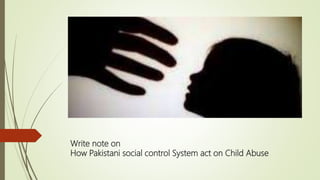
Write note on
How Pakistani social control System act on Child Abuse

Social control

  • 1.
  • 2.
    Social Control • Socialcontrol, attempts by society to regulate people’s thoughts and behavior • All societies practice social control, the regulation and enforcement of norms. • The underlying goal of social control is to maintain social order, an arrangement of practices and behaviors on which society’s members base their daily lives
  • 3.
    Sanctions  The meansof enforcing rules are known as sanctions.  Sanctions can be positive as well as negative.  Positive sanctions are rewards given for conforming to norms. A promotion at work is a positive sanction for working hard.  Negative sanctions are punishments for violating norms. Being arrested is a punishment for shoplifting. Both types of sanctions play a role in social control.
  • 4.
    Sociologists also classifysanctions as formal or informal.  Informal sanctions.  Informal sanctions emerge in face-to- face social interactions  For example, may draw disapproving looks or even verbal warnings  Formal sanctions, on the other hand, are ways to officially recognize and enforce norm violations.  If a student violates her college’s code of conduct, for example, she might be expelled.
  • 5.
    Criminal justice system The criminal justice system is a society’s formal system of social control.  The key elements of the U.S. criminal justice system:  police,  courts,  and the system of punishment and corrections.
  • 6.
    Police  Police area civil force in charge of enforcing laws and public order at a federal, state, or community level.  The police generally serve as the primary point of contact between a society’s population and the criminal justice system.  In principle, the police maintain public order by enforcing the law.  A county police officer may spend time responding to emergency calls, working at the local jail, or patrolling areas as needed, whereas a federal officer would be provide security for government officers.  State police have the authority to enforce statewide laws, including regulating traffic on highways.  Local or county police, on the other hand, have a limited jurisdiction with authority only in the town or county in which they serve.
  • 7.
    Courts  Once acrime has been committed and a violator is identified by the police, the case goes to the court.  A court is a system that has the authority to make decisions based on law  Plea bargaining, a legal conciliation in which a prosecutor reduces a charge in exchange for a defendant’s guilty.  Plea bargaining is widespread because it saves the time and expense of trials.
  • 8.
    Due Process Due processis a simple but very important idea: The criminal justice system must operate according to law.  the concept of due process means that anyone charged with a crime must receive  (1) fair notice of legal proceedings,  (2) the opportunity to present a defense during a hearing on the charges, which must be conducted according to law, and  (3) a judge or jury that weighs evidence impartially (Inciardi, 2000).
  • 9.
    Correction And Punishment The corrections system, more commonly known as the prison system, is tasked with supervising individuals who have been arrested, convicted, and sentenced for a criminal.  community-based corrections, correctional programs operating within society at large rather than behind prison walls. Community-based corrections have three main advantages:  They reduce costs,  Reduce overcrowding in prisons,  and allow for supervision of convicts while eliminating the hardships of prison life and the stigma that go with going to jail.
  • 10.
     In asociety gain through the punishment of wrongdoers? Scholars answer with four basic reasons:  retribution,  deterrence,  rehabilitation,  and societal protection.
  • 11.
    Retribution  Retribution, anact of moral revenge by which society makes the offender(criminal) suffer as much as the suffering caused by the crime.  Retribution rests on a view of society as a moral balance.  When criminality upsets this balance, punishment in equal measure restores the moral order, as suggested in the ancient code calling for  “an eye for an eye, a tooth for a tooth.”
  • 12.
    Deterrence  A secondjustification for punishment is deterrence, the attempt to discourage criminality through the use of punishment.  Deterrence is based on the eighteenth-century Enlightenment idea that humans, as calculating and rational creatures, will not break the law if they think that the pain of punishment will outweigh the pleasure of the crime.  Punishment can discourage crime in two ways. Specific deterrence is used to convince an individual offender that crime does not pay.  Through general deterrence, the punishment of one person serves as an example to others.
  • 13.
    Rehabilitation  The thirdjustification for punishment is rehabilitation, a program for reforming the criminal to prevent later crimes.  Rehabilitation arose along with the social sciences in the nineteenth century. Since then, sociologists have claimed that crime and other deviance spring from a social environment marked by poverty or a lack of parental supervision.  Logically, then, if offenders learn to be deviant, they can also earn to obey the rules; the key is controlling their environment.
  • 14.
    Societal Protection  Afinal justification for punishment is societal protection, rendering the criminal unable of further crimes temporarily through imprisonment or permanently by execution.  Like deterrence, societal protection is a rational approach to punishment intended to protect society from crime.
  • 17.
    Write note on HowPakistani social control System act on Child Abuse