Vikas Dongre
Introduction
 Human Race is socialistic in nature

 Early Civilizations started in settlements

 Man learnt Business to make his/her life comfortable

 Need arose for a uniform code of conduct


      Class Notes - Business Law     Presented by: Vikas Dongre   2
Meaning
Law is a rulebook, containing a list of
  Code/Rules/Procedures, which tells us what should be
  done and what should not be done.
Law is a system of rules, usually enforced through a set
  of institutions
Law is a force. It consists of rules and regulations to
  provide firmness to mutual relations.

      Class Notes - Business Law       Presented by: Vikas Dongre   3
Definition
“Law is a body of Principles recognized and applied by
 the state in the administration of justice” - Salmond


“Law is a rule of civil conduct, prescribed by the supreme
 power of a state, commanding what is right and
 prohibiting what is wrong” - Blackstone


      Class Notes - Business Law     Presented by: Vikas Dongre   4
Branches
 Growth of Civilization led to development in diverse fields
 As result a Uniform Code of Conduct did not make sense
Hence,
i. Civil Law
ii. Criminal Law
iii. Constitutional Law
iv. International Law
v. Industrial Law
vi. Mercantile Law (Business law)-Part of Civil Law(India)


      Class Notes - Business Law       Presented by: Vikas Dongre   5
Meaning of Business
   All those activities which are aimed at transfer of
    goods & services from the production centre to
 consumption centre carried out by an entrepreneur by
   optimally utilizing resources at his command i.e.
    money, man, material & machine with a view to
                                 maximize profit.


    Class Notes - Business Law                 Presented by: Vikas Dongre   6
Meaning of Business Law

   Laws relating to business, commercial
       activity, trade or commerce.


   Class Notes - Business Law   Presented by: Vikas Dongre   7
Objectives of Business Law
 Complex Business environment has given rise to the need
    for a code of conduct
   IGNORANTIA JURIS NON EXCUSAT
    ---ignorance of Law is no excuse.
   Develop an understanding of the legal framework
   Understand the purpose and logic of Law-Meaningful
    when understood
   Preventive Law
   The Success of lawyer depend upon the well informed
    client
   Build a better society

        Class Notes - Business Law    Presented by: Vikas Dongre   8
Sources of Business Law (Origin
and Development)
 Customs of Trade (History)
 English Common Law
 Principles of Equity
 Law Merchant
 British Statute Law
 Precedents (Past Judicial Decisions)
 Indian Statute Law (Acts of the Indian Legislature)


      Class Notes - Business Law    Presented by: Vikas Dongre   9
Customs of Trade (History)
 customs and traditions, laid the first foundation to the
  Law
 which are reasonable in nature to the entire society
  and which are time tested


      Class Notes - Business Law       Presented by: Vikas
      Dongre                                                 10
English Common Law
 Considering the customs and usages as the raw
  material, the judges made up their judgments. These
  important contributions of the judges are found in
  what is known as English Common Law
 Decisions made by judges based on English customs
  and traditins


      Class Notes - Business Law    Presented by: Vikas
      Dongre                                              11
Principles of Equity
 law based on principles of justice and good conscience
 unwritten law
 cases where the common law courts could not give
  relief to the aggrieved, the party had to petition to the
  king
 courts were called courts of equity
 relief was granted to the aggrieved on the basis of
  justice, good conscience and equity


      Class Notes - Business Law        Presented by: Vikas
      Dongre                                                  12
Law Merchant
 Law based on customs and traditions which were
  practiced by the traders- not recognized initially but
  later made an impact
 Initially English Law courts were not aware of the
  trades and practices - many times futile in giving
  judgments in case of conflicts
 As trade grew - traders set up tribunals mostly
  consisting of traders to judge the cases
 This gave birth to Law Merchants (Lex Mercatoria).

      Class Notes - Business Law      Presented by: Vikas
      Dongre                                                13
British Statute Law
 Law which is based upon Acts passed by the
 Legislature (Parliament). It is the Written Law. This
 Law is superior and can override the effect of other
 laws


     Class Notes - Business Law       Presented by: Vikas
     Dongre                                                 14
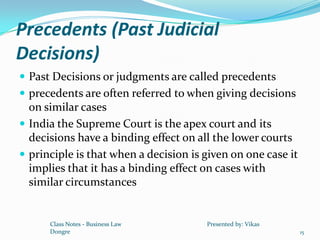
Precedents (Past Judicial
Decisions)
 Past Decisions or judgments are called precedents
 precedents are often referred to when giving decisions
  on similar cases
 India the Supreme Court is the apex court and its
  decisions have a binding effect on all the lower courts
 principle is that when a decision is given on one case it
  implies that it has a binding effect on cases with
  similar circumstances


      Class Notes - Business Law       Presented by: Vikas
      Dongre                                                  15
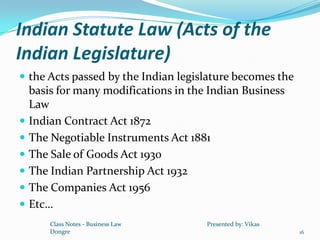
Indian Statute Law (Acts of the
Indian Legislature)
 the Acts passed by the Indian legislature becomes the
    basis for many modifications in the Indian Business
    Law
   Indian Contract Act 1872
   The Negotiable Instruments Act 1881
   The Sale of Goods Act 1930
   The Indian Partnership Act 1932
   The Companies Act 1956
   Etc…
        Class Notes - Business Law     Presented by: Vikas
        Dongre                                               16
End of General Introduction

                                 Questions…
                            Clarifications…
                             Suggestions…


                       Email: vikasdongre@gmail.com


   Class Notes - Business Law                  Presented by: Vikas Dongre   17

1 business law intro

  • 1.
  • 2.
    Introduction  Human Raceis socialistic in nature  Early Civilizations started in settlements  Man learnt Business to make his/her life comfortable  Need arose for a uniform code of conduct Class Notes - Business Law Presented by: Vikas Dongre 2
  • 3.
    Meaning Law is arulebook, containing a list of Code/Rules/Procedures, which tells us what should be done and what should not be done. Law is a system of rules, usually enforced through a set of institutions Law is a force. It consists of rules and regulations to provide firmness to mutual relations. Class Notes - Business Law Presented by: Vikas Dongre 3
  • 4.
    Definition “Law is abody of Principles recognized and applied by the state in the administration of justice” - Salmond “Law is a rule of civil conduct, prescribed by the supreme power of a state, commanding what is right and prohibiting what is wrong” - Blackstone Class Notes - Business Law Presented by: Vikas Dongre 4
  • 5.
    Branches  Growth ofCivilization led to development in diverse fields  As result a Uniform Code of Conduct did not make sense Hence, i. Civil Law ii. Criminal Law iii. Constitutional Law iv. International Law v. Industrial Law vi. Mercantile Law (Business law)-Part of Civil Law(India) Class Notes - Business Law Presented by: Vikas Dongre 5
  • 6.
    Meaning of Business All those activities which are aimed at transfer of goods & services from the production centre to consumption centre carried out by an entrepreneur by optimally utilizing resources at his command i.e. money, man, material & machine with a view to maximize profit. Class Notes - Business Law Presented by: Vikas Dongre 6
  • 7.
    Meaning of BusinessLaw Laws relating to business, commercial activity, trade or commerce. Class Notes - Business Law Presented by: Vikas Dongre 7
  • 8.
    Objectives of BusinessLaw  Complex Business environment has given rise to the need for a code of conduct  IGNORANTIA JURIS NON EXCUSAT ---ignorance of Law is no excuse.  Develop an understanding of the legal framework  Understand the purpose and logic of Law-Meaningful when understood  Preventive Law  The Success of lawyer depend upon the well informed client  Build a better society Class Notes - Business Law Presented by: Vikas Dongre 8
  • 9.
    Sources of BusinessLaw (Origin and Development)  Customs of Trade (History)  English Common Law  Principles of Equity  Law Merchant  British Statute Law  Precedents (Past Judicial Decisions)  Indian Statute Law (Acts of the Indian Legislature) Class Notes - Business Law Presented by: Vikas Dongre 9
  • 10.
    Customs of Trade(History)  customs and traditions, laid the first foundation to the Law  which are reasonable in nature to the entire society and which are time tested Class Notes - Business Law Presented by: Vikas Dongre 10
  • 11.
    English Common Law Considering the customs and usages as the raw material, the judges made up their judgments. These important contributions of the judges are found in what is known as English Common Law  Decisions made by judges based on English customs and traditins Class Notes - Business Law Presented by: Vikas Dongre 11
  • 12.
    Principles of Equity law based on principles of justice and good conscience  unwritten law  cases where the common law courts could not give relief to the aggrieved, the party had to petition to the king  courts were called courts of equity  relief was granted to the aggrieved on the basis of justice, good conscience and equity Class Notes - Business Law Presented by: Vikas Dongre 12
  • 13.
    Law Merchant  Lawbased on customs and traditions which were practiced by the traders- not recognized initially but later made an impact  Initially English Law courts were not aware of the trades and practices - many times futile in giving judgments in case of conflicts  As trade grew - traders set up tribunals mostly consisting of traders to judge the cases  This gave birth to Law Merchants (Lex Mercatoria). Class Notes - Business Law Presented by: Vikas Dongre 13
  • 14.
    British Statute Law Law which is based upon Acts passed by the Legislature (Parliament). It is the Written Law. This Law is superior and can override the effect of other laws Class Notes - Business Law Presented by: Vikas Dongre 14
  • 15.
    Precedents (Past Judicial Decisions) Past Decisions or judgments are called precedents  precedents are often referred to when giving decisions on similar cases  India the Supreme Court is the apex court and its decisions have a binding effect on all the lower courts  principle is that when a decision is given on one case it implies that it has a binding effect on cases with similar circumstances Class Notes - Business Law Presented by: Vikas Dongre 15
  • 16.
    Indian Statute Law(Acts of the Indian Legislature)  the Acts passed by the Indian legislature becomes the basis for many modifications in the Indian Business Law  Indian Contract Act 1872  The Negotiable Instruments Act 1881  The Sale of Goods Act 1930  The Indian Partnership Act 1932  The Companies Act 1956  Etc… Class Notes - Business Law Presented by: Vikas Dongre 16
  • 17.
    End of GeneralIntroduction  Questions…  Clarifications…  Suggestions… Email: vikasdongre@gmail.com Class Notes - Business Law Presented by: Vikas Dongre 17