TOEFL TRAINING
TOFEL EXAM PATTERN
AND SYLLABUS
Table of
contents
01
What is TOEFL
02
TOEFL Pattern
03
Listening
04
Speaking
05
Writing
What is TOEFL ?
01
What is TOEFL ?
● Full form of TOEFL is Test of English as a Foreign Language
● To assess the English language proficiency of non-native English speakers.
● The test comes in two formats: computer-based test (iBT) and paper-based test (PBT)
● The Internet-based test is available in most countries.
● The TOEFL iBT test is scored on a scale of 0 to 120 points.
● Each of the four sections (Reading, Listening, Speaking, and Writing) receives a scaled
score from 0 to 30. The scaled scores from the four sections are added together to
determine the total score.
● The reading and listening sections are tested first, followed by a ten-minute break. The
speaking and writing sections are then completed following the break. A maximum
amount of 203 minutes is allowed to complete the whole exam process.
What is TOEFL ?
● Each speaking question is initially given a raw score of 0 to 4, with 1-point increment, and
each writing question is initially given a raw score of 0.0 to 5.0, with 0.5-point increment.
These scores are converted to scaled scores of 0 to 30.
● TOEFL Score is valid for 2 years
● The registration fee for TOEFL in India is US$180
TOEFL Pattern
02
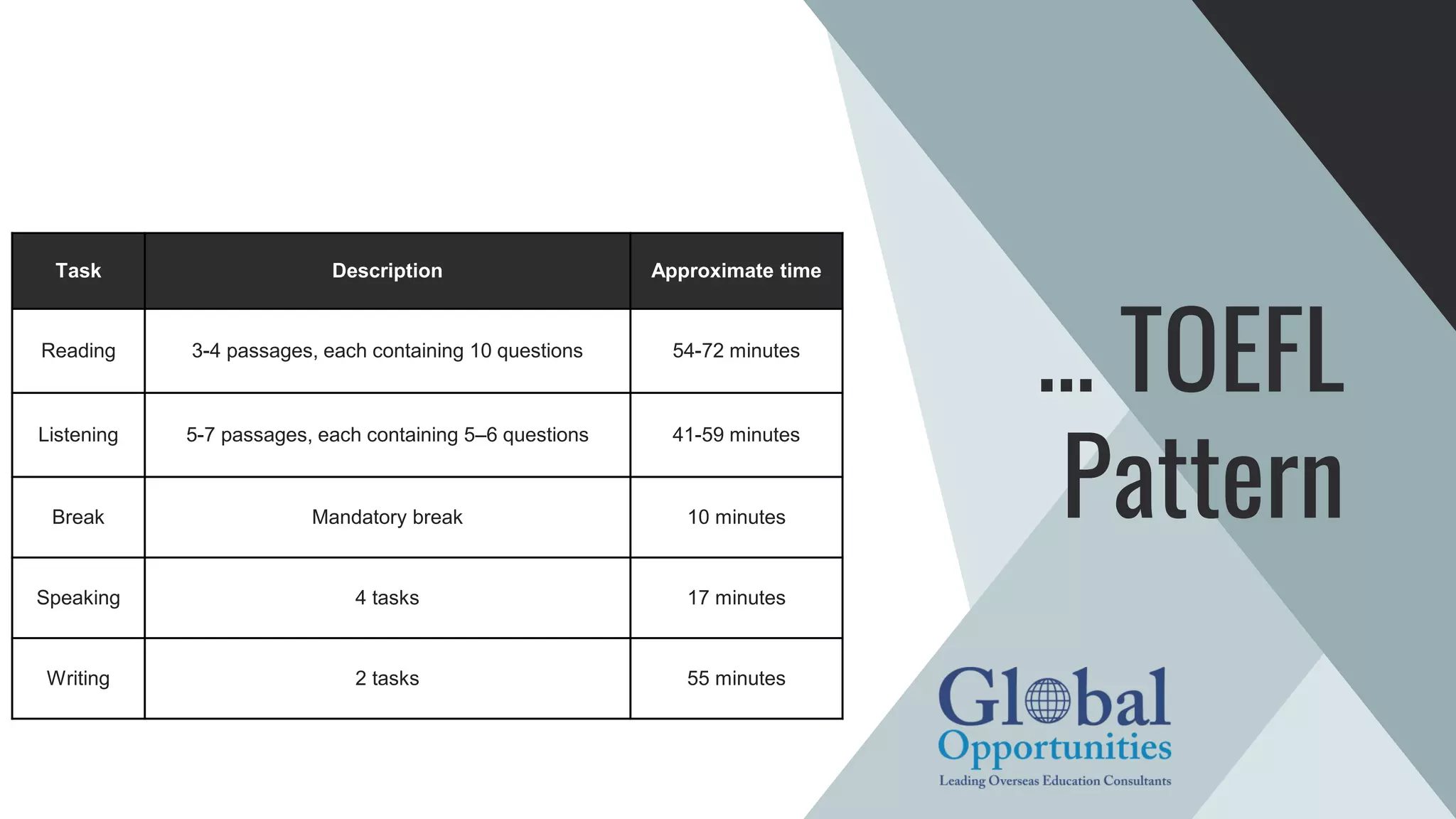
Task Description Approximate time
Reading 3-4 passages, each containing 10 questions 54-72 minutes
Listening 5-7 passages, each containing 5–6 questions 41-59 minutes
Break Mandatory break 10 minutes
Speaking 4 tasks 17 minutes
Writing 2 tasks 55 minutes
… TOEFL
Pattern
Listening
03
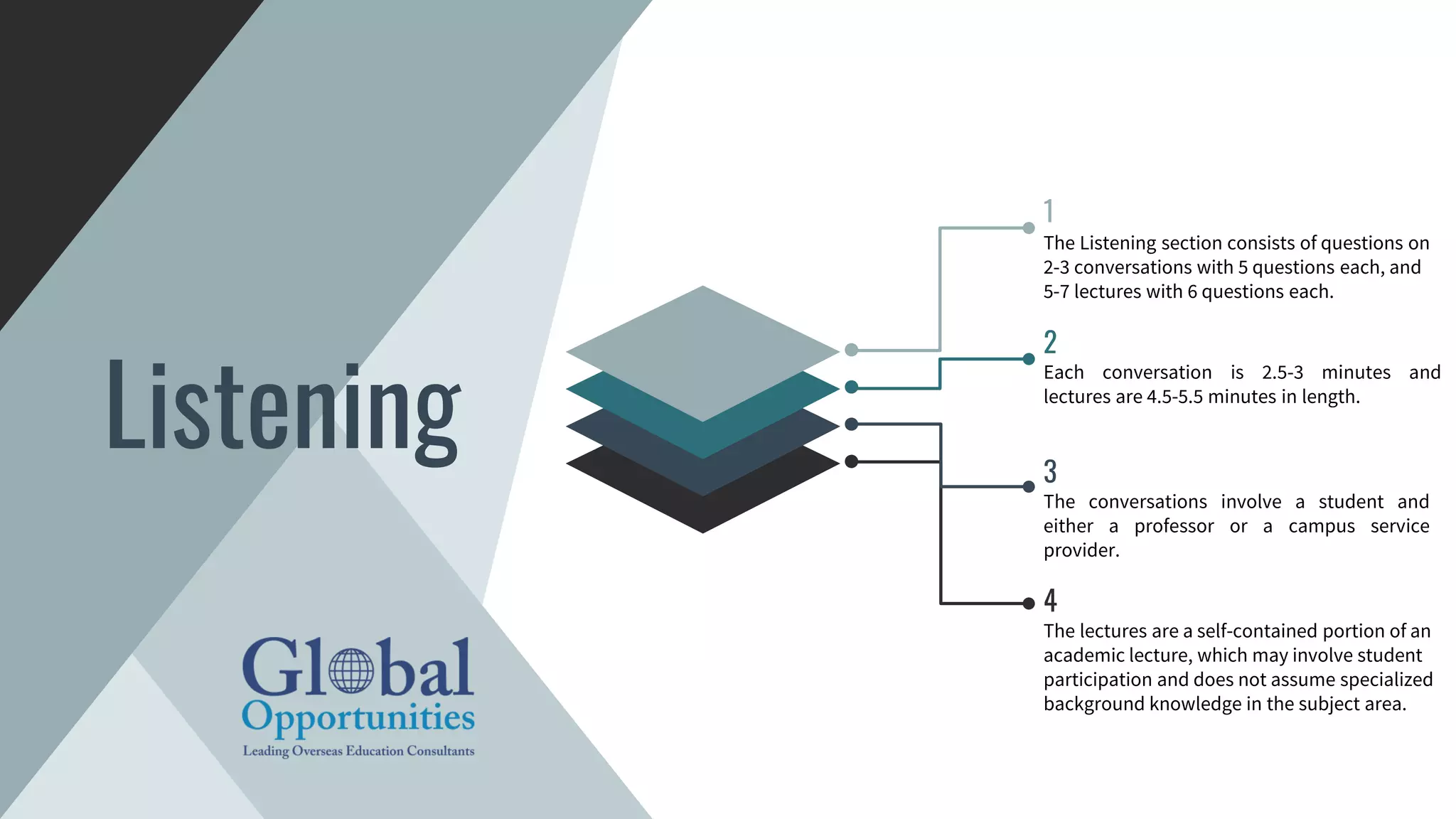
2
Each conversation is 2.5-3 minutes and
lectures are 4.5-5.5 minutes in length.
3
The conversations involve a student and
either a professor or a campus service
provider.
1
The Listening section consists of questions on
2-3 conversations with 5 questions each, and
5-7 lectures with 6 questions each.
Listening
4
The lectures are a self-contained portion of an
academic lecture, which may involve student
participation and does not assume specialized
background knowledge in the subject area.
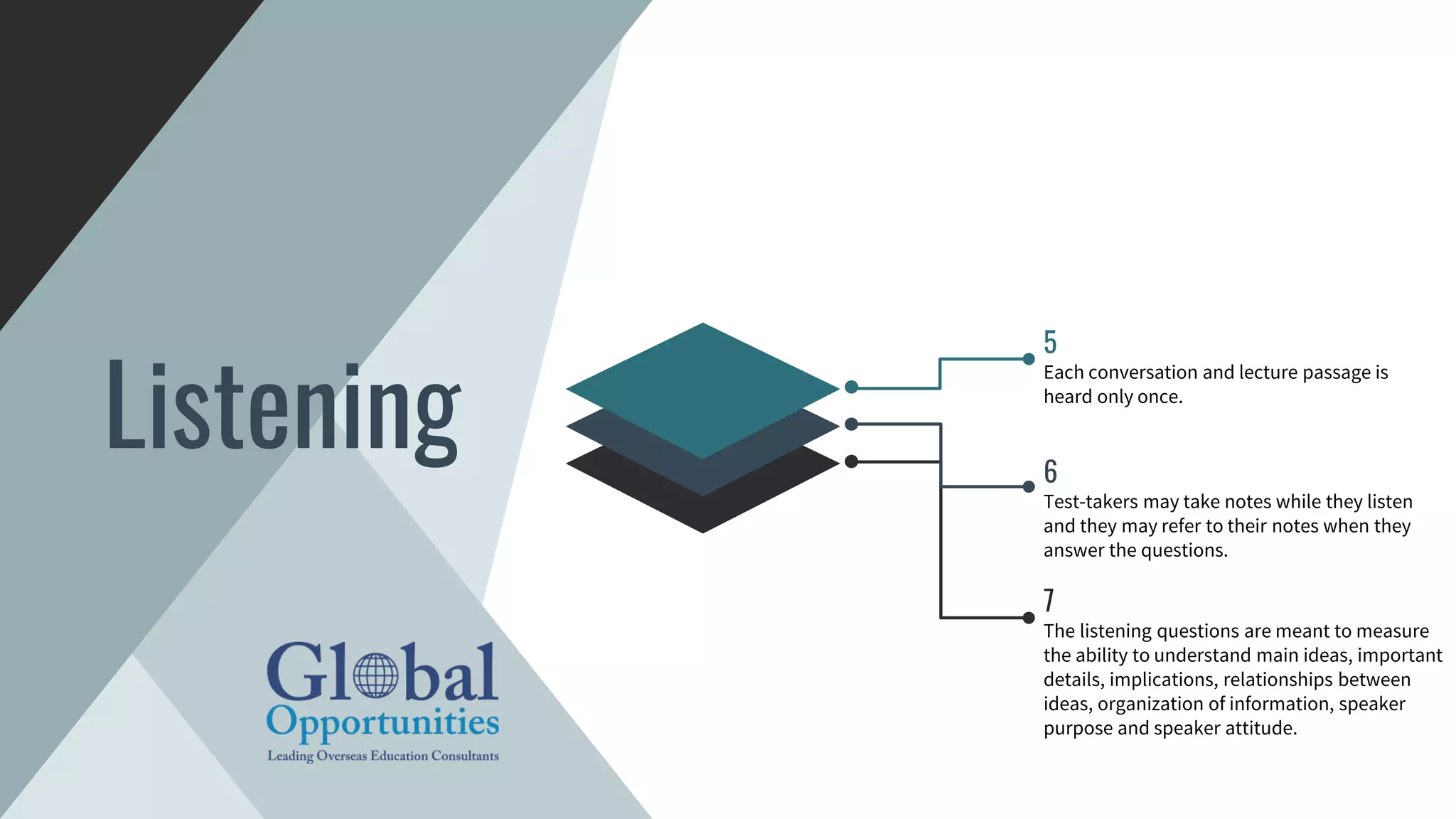
5
Each conversation and lecture passage is
heard only once.
6
Test-takers may take notes while they listen
and they may refer to their notes when they
answer the questions.
7
The listening questions are meant to measure
the ability to understand main ideas, important
details, implications, relationships between
ideas, organization of information, speaker
purpose and speaker attitude.
Listening
Speaking
04
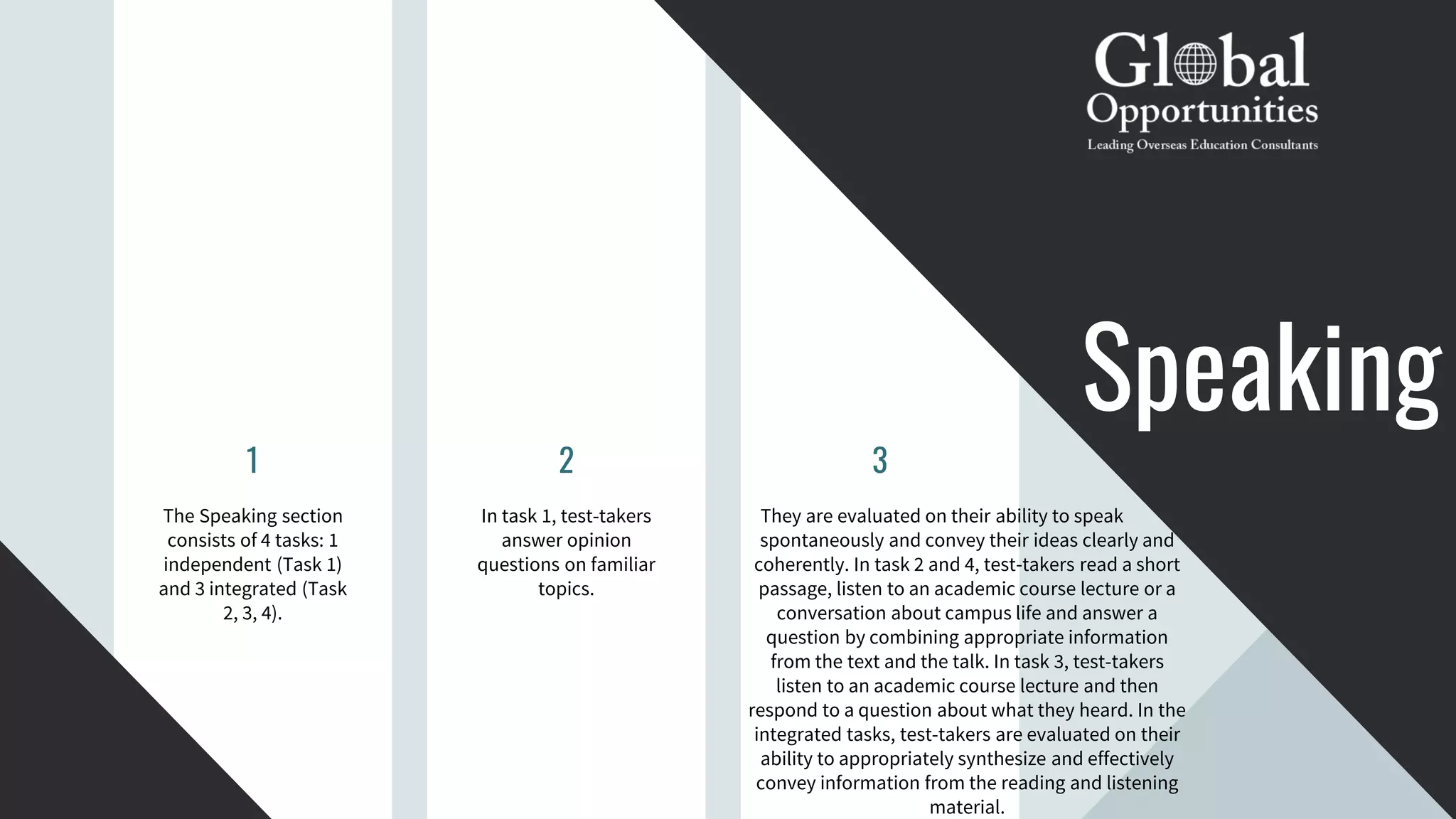
They are evaluated on their ability to speak
spontaneously and convey their ideas clearly and
coherently. In task 2 and 4, test-takers read a short
passage, listen to an academic course lecture or a
conversation about campus life and answer a
question by combining appropriate information
from the text and the talk. In task 3, test-takers
listen to an academic course lecture and then
respond to a question about what they heard. In the
integrated tasks, test-takers are evaluated on their
ability to appropriately synthesize and effectively
convey information from the reading and listening
material.
The Speaking section
consists of 4 tasks: 1
independent (Task 1)
and 3 integrated (Task
2, 3, 4).
In task 1, test-takers
answer opinion
questions on familiar
topics.
Speaking
1 2 3
The responses are
digitally recorded, sent
to ETS's Online Scoring
Network (OSN), and
evaluated by three to
six raters.
Test-takers may take
notes as they read and
listen and may use their
notes to help prepare
their responses.
Test-takers are given a
short preparation time
before they have to
begin speaking.
4 5 6
Speaking
Writing
05
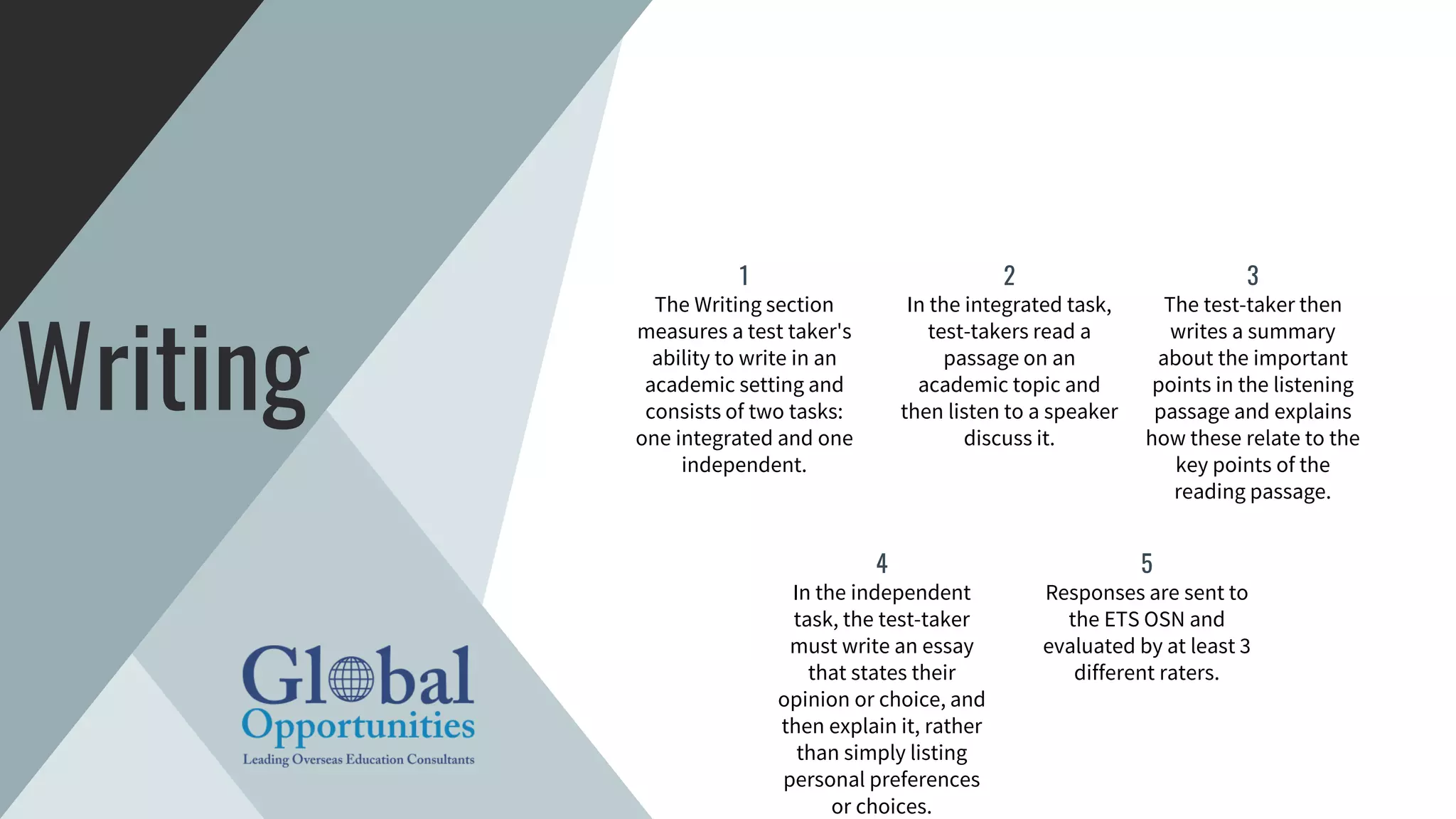
1
The Writing section
measures a test taker's
ability to write in an
academic setting and
consists of two tasks:
one integrated and one
independent.
2
In the integrated task,
test-takers read a
passage on an
academic topic and
then listen to a speaker
discuss it.
3
The test-taker then
writes a summary
about the important
points in the listening
passage and explains
how these relate to the
key points of the
reading passage.
4
In the independent
task, the test-taker
must write an essay
that states their
opinion or choice, and
then explain it, rather
than simply listing
personal preferences
or choices.
5
Responses are sent to
the ETS OSN and
evaluated by at least 3
different raters.
Writing
Thanks!

TOEFL TRAINING :- TOFEL EXAM PATTERN AND SYLLABUS

  • 1.
    TOEFL TRAINING TOFEL EXAMPATTERN AND SYLLABUS
  • 2.
    Table of contents 01 What isTOEFL 02 TOEFL Pattern 03 Listening 04 Speaking 05 Writing
  • 3.
  • 4.
    What is TOEFL? ● Full form of TOEFL is Test of English as a Foreign Language ● To assess the English language proficiency of non-native English speakers. ● The test comes in two formats: computer-based test (iBT) and paper-based test (PBT) ● The Internet-based test is available in most countries. ● The TOEFL iBT test is scored on a scale of 0 to 120 points. ● Each of the four sections (Reading, Listening, Speaking, and Writing) receives a scaled score from 0 to 30. The scaled scores from the four sections are added together to determine the total score. ● The reading and listening sections are tested first, followed by a ten-minute break. The speaking and writing sections are then completed following the break. A maximum amount of 203 minutes is allowed to complete the whole exam process.
  • 5.
    What is TOEFL? ● Each speaking question is initially given a raw score of 0 to 4, with 1-point increment, and each writing question is initially given a raw score of 0.0 to 5.0, with 0.5-point increment. These scores are converted to scaled scores of 0 to 30. ● TOEFL Score is valid for 2 years ● The registration fee for TOEFL in India is US$180
  • 6.
  • 7.
    Task Description Approximatetime Reading 3-4 passages, each containing 10 questions 54-72 minutes Listening 5-7 passages, each containing 5–6 questions 41-59 minutes Break Mandatory break 10 minutes Speaking 4 tasks 17 minutes Writing 2 tasks 55 minutes … TOEFL Pattern
  • 8.
  • 9.
    2 Each conversation is2.5-3 minutes and lectures are 4.5-5.5 minutes in length. 3 The conversations involve a student and either a professor or a campus service provider. 1 The Listening section consists of questions on 2-3 conversations with 5 questions each, and 5-7 lectures with 6 questions each. Listening 4 The lectures are a self-contained portion of an academic lecture, which may involve student participation and does not assume specialized background knowledge in the subject area.
  • 10.
    5 Each conversation andlecture passage is heard only once. 6 Test-takers may take notes while they listen and they may refer to their notes when they answer the questions. 7 The listening questions are meant to measure the ability to understand main ideas, important details, implications, relationships between ideas, organization of information, speaker purpose and speaker attitude. Listening
  • 11.
  • 12.
    They are evaluatedon their ability to speak spontaneously and convey their ideas clearly and coherently. In task 2 and 4, test-takers read a short passage, listen to an academic course lecture or a conversation about campus life and answer a question by combining appropriate information from the text and the talk. In task 3, test-takers listen to an academic course lecture and then respond to a question about what they heard. In the integrated tasks, test-takers are evaluated on their ability to appropriately synthesize and effectively convey information from the reading and listening material. The Speaking section consists of 4 tasks: 1 independent (Task 1) and 3 integrated (Task 2, 3, 4). In task 1, test-takers answer opinion questions on familiar topics. Speaking 1 2 3
  • 13.
    The responses are digitallyrecorded, sent to ETS's Online Scoring Network (OSN), and evaluated by three to six raters. Test-takers may take notes as they read and listen and may use their notes to help prepare their responses. Test-takers are given a short preparation time before they have to begin speaking. 4 5 6 Speaking
  • 14.
  • 15.
    1 The Writing section measuresa test taker's ability to write in an academic setting and consists of two tasks: one integrated and one independent. 2 In the integrated task, test-takers read a passage on an academic topic and then listen to a speaker discuss it. 3 The test-taker then writes a summary about the important points in the listening passage and explains how these relate to the key points of the reading passage. 4 In the independent task, the test-taker must write an essay that states their opinion or choice, and then explain it, rather than simply listing personal preferences or choices. 5 Responses are sent to the ETS OSN and evaluated by at least 3 different raters. Writing
  • 16.